
The US citizenship application fee in 2026 is $710 for online filing or $760 for paper filing. This Form N-400 naturalization fee includes biometrics processing — there is no separate biometrics fee since April 2024. Low-income applicants may qualify for a reduced fee of $380, a complete fee waiver, or fee-free military naturalization. This guide covers the N-400 cost, certificate of citizenship fees, fee waivers, and the new October 2025 payment rules from the U.S. Citizenship and Immigration Services (USCIS).
Source: USCIS Fee Schedule (Form G-1055), effective from April 2024
Understanding the US Citizenship Application Fee in 2026
The US citizenship application fee is the government filing fee required to submit Form N-400, the Application for Naturalization. This fee covers application review, background checks, biometrics, the naturalization interview, civics and English testing, and the Certificate of Naturalization issued at your oath ceremony. For green card holders ready to become US citizens, understanding the N-400 cost is essential for proper financial planning.
USCIS fees are set through federal rulemaking and are subject to periodic adjustments. The current fee structure has been in effect since 1 April 2024, when USCIS implemented significant changes including bundling biometrics costs into the main N-400 filing fee. Unlike US visa cost breakdown paid to the Department of State for entry visas, citizenship fees are paid directly to USCIS for immigration benefits processed within the United States.
What is the N-400 Citizenship Application Fee in 2026?
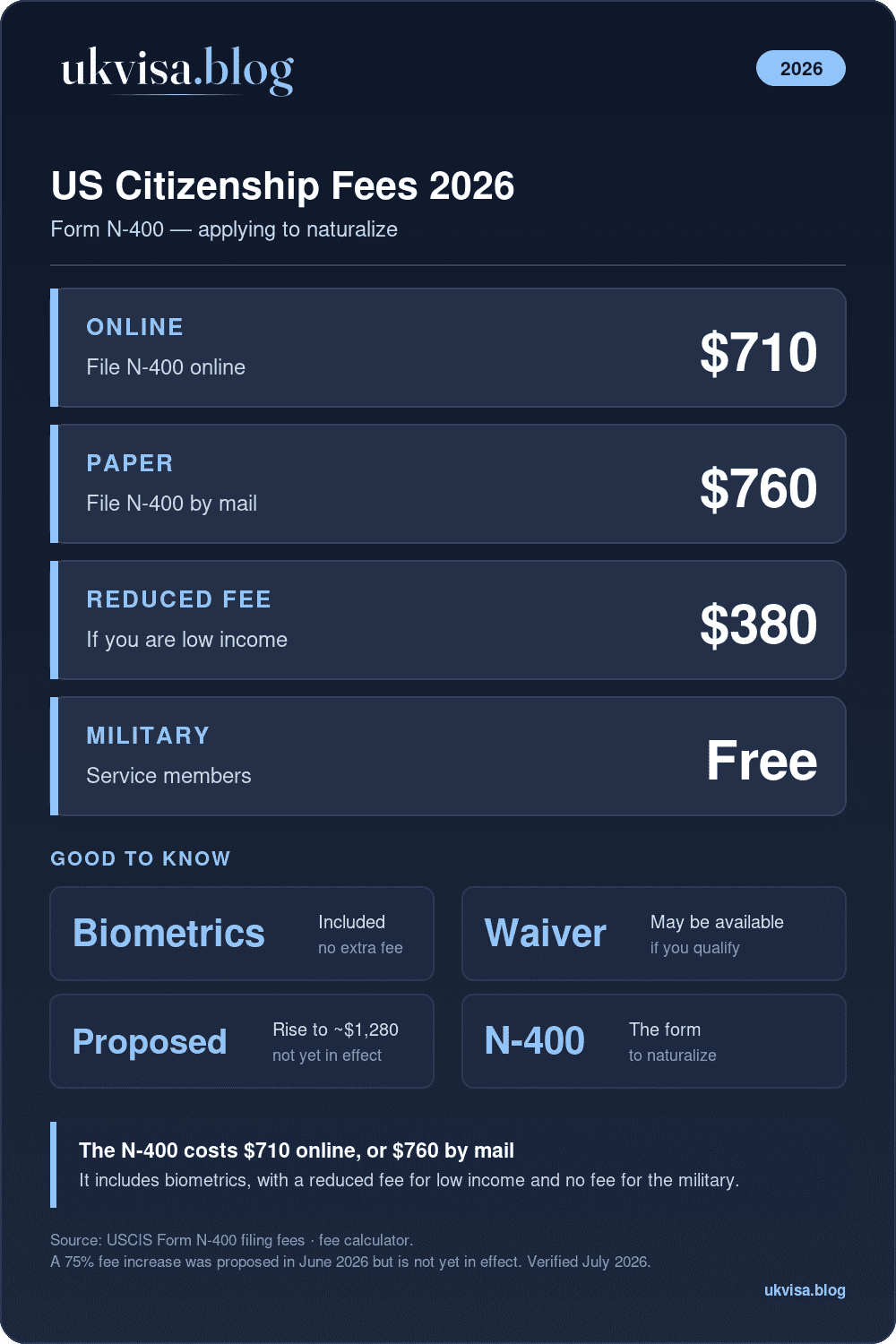
The N-400 citizenship application fee is $710 for online filing or $760 for paper filing in 2026. The naturalization fee includes biometrics processing — there is no separate biometrics fee. Low-income applicants may qualify for a reduced fee of $380 or a full fee waiver. Active-duty military applicants and qualifying veterans can naturalize at no cost.
The Form N-400 filing fee depends on how you submit your application. USCIS offers a $50 discount for online filing, making it the more affordable option for most applicants. The N-400 cost has remained unchanged since April 2024 — there is no announced increase for 2026.
N-400 Fee Structure 2026
| Filing Type | Fee (USD) | Notes |
|---|---|---|
| Online Filing | $710 | Recommended — $50 savings vs paper |
| Paper Filing | $760 | Required for fee waiver / reduced fee requests |
| Reduced Fee | $380 | Income up to 400% of Federal Poverty Guidelines |
| Full Fee Waiver | $0 | Income at or below 150% FPG, or means-tested benefits |
| Military Applicants | $0 | Active duty and qualifying veterans (INA §328 / §329) |
Since April 2024, the N-400 fee includes biometrics processing as a single bundled payment. USCIS may still require you to attend an Application Support Center appointment for fingerprinting, photograph, and signature, but there is no separate fee for this appointment. This change simplifies the citizenship cost calculation compared to previous years when biometrics was an $85 add-on charge.
N-400 Fee History: Recent Changes
| Period | N-400 Fee Structure | Total Cost |
|---|---|---|
| Before April 2024 | $640 application + $85 biometrics | $725 |
| April 2024 – present (online) | $710 (biometrics included) | $710 |
| April 2024 – present (paper) | $760 (biometrics included) | $760 |
If your N-400 application is denied, the citizenship fee is non-refundable. To minimise this risk, applicants should review common US immigration application refusal reasons and ensure complete documentation before filing. Once denied, you can either reapply with corrected documentation or file Form N-336 to request a hearing on the decision (covered in the Other Fees section below).
How to Get a Citizenship Fee Waiver or Reduced Fee
You qualify for a full N-400 fee waiver if your household income is at or below 150% of the Federal Poverty Guidelines, or if you receive means-tested benefits (Medicaid, SNAP, SSI, TANF). A reduced fee of $380 is available if your income is up to 400% of the poverty guidelines. Request waivers using Form I-912; reduced fees are requested directly in Part 10 of Form N-400. Both options require paper filing only.
USCIS recognises that not all green card holders can afford the full N-400 cost. Several options exist for applicants facing financial hardship.
Full Fee Waiver Eligibility
To qualify for a complete fee waiver, you must demonstrate financial hardship by meeting one of the following criteria: household income at or below 150% of the Federal Poverty Guidelines, current receipt of means-tested benefits (Medicaid, SNAP, SSI, or TANF), or extraordinary expenses preventing payment such as medical emergencies or unemployment.
To request a fee waiver, complete Form I-912 (Request for Fee Waiver) and submit it with your paper N-400 application. You cannot file Form N-400 online if requesting a fee waiver — paper filing is mandatory.
Reduced Fee Option ($380)
If your household income is up to 400% of the Federal Poverty Guidelines, you may qualify for the reduced naturalization fee of $380. Request this directly in Part 10 of Form N-400 — you do not need a separate form. However, you must file on paper; the reduced fee option is not available for online filing.
Military Fee Exemption
Active-duty service members and veterans who meet the requirements of INA sections 328 or 329 regarding military service can naturalize with no application fee. Include proof of military service (such as Form N-426, Request for Certification of Military or Naval Service) with your N-400 application. This exemption applies regardless of income level and is one of the most generous benefits in US immigration law.
Citizenship Fee for Seniors and Special Cases
There is no special citizenship fee for seniors based on age alone in 2026. Applicants over 75 pay the same N-400 fee as other adults ($710 online / $760 paper). Previously, seniors over 75 were exempt from the separate biometrics fee, but since biometrics is now bundled into the main N-400 fee, this distinction no longer applies. However, seniors may still qualify for fee waivers based on income or means-tested benefits.
Many older applicants searching for "citizenship fee for seniors" are surprised to learn that age alone does not reduce the N-400 cost in 2026. The age-based exemption that previously applied to biometrics no longer exists as a separate benefit because biometrics has been merged into the main filing fee. However, seniors with limited income often qualify for either the reduced fee ($380) or full waiver ($0) through standard income-based criteria.
Test Exemptions for Older Applicants
While the N-400 fee is the same for all adults, USCIS does provide testing accommodations for older applicants:
- 50/20 rule: Applicants aged 50+ who have been lawful permanent residents for 20+ years may take the civics test in their native language
- 55/15 rule: Applicants aged 55+ who have been LPRs for 15+ years may take the civics test in their native language
- 65/20 rule: Applicants aged 65+ who have been LPRs for 20+ years receive a simplified civics test (20 questions instead of 100)
These exemptions reduce the difficulty of the citizenship process for older applicants but do not affect the application fee itself.
Other Citizenship-Related USCIS Fees
Beyond the N-400 naturalization fee, other citizenship-related costs include Form N-600 (Certificate of Citizenship) at $1,335 online / $1,385 paper, Form N-565 (replacement documents) at $505 online / $555 paper, and Form N-336 (hearing request) at $780 online / $830 paper. Each form has different fee waiver eligibility rules.
While the N-400 is the most common citizenship form, USCIS processes several other citizenship-related applications with their own fee structures.
N-600: Certificate of Citizenship ($1,335 / $1,385)
Form N-600 is used to obtain documentary evidence of US citizenship for individuals who acquired or derived citizenship through a parent — typically children of US citizens born abroad, or children who became citizens automatically when their parents naturalized. The fee is $1,335 for online filing or $1,385 for paper filing in 2026. Current or former military members filing on their own behalf pay no fee, as do certain adopted children meeting specific criteria.
N-565: Replacement Documents ($505 / $555)
If your naturalization certificate or citizenship document is lost, stolen, damaged, or contains errors, use Form N-565 to request a replacement. The fee is $505 for online filing or $555 for paper filing. There is no fee if the replacement is needed due to a USCIS error on the original document.
N-336: Hearing on Naturalization Decision ($780 / $830)
If your N-400 application is denied, you can request a hearing to have the decision reviewed by filing Form N-336. The fee is $780 for online filing or $830 for paper filing. A reduced fee of $320 applies if you originally filed under military provisions (INA sections 328 or 329) and your application was denied.
- N-400 (Naturalization): $710 online / $760 paper
- N-600 (Certificate of Citizenship): $1,335 online / $1,385 paper
- N-565 (Replacement Document): $505 online / $555 paper
- N-336 (Hearing Request): $780 online / $830 paper
- N-426 (Military Certification): No fee
How to Pay USCIS Citizenship Fees
For online filing, pay through your USCIS account at Pay.gov using credit card, debit card, prepaid card, or bank account transfer. For paper filing, use Form G-1450 to authorise a credit/debit card payment, or Form G-1650 for direct ACH bank transfer. As of 28 October 2025, USCIS no longer accepts checks, money orders, or cashier's checks for paper filings.
Online Filing Payment
When filing through your USCIS online account, the system guides you through payment using credit card (Visa, MasterCard, American Express, Discover), debit card, prepaid card, or bank account withdrawal (ACH transfer). Payment is processed via Pay.gov, the secure US Department of the Treasury portal. Online payment is processed immediately, and you receive confirmation upon successful submission.
Paper Filing Payment Options
For paper applications, USCIS now accepts only electronic payment methods:
- Credit/debit/prepaid card: Include Form G-1450 (Authorization for Credit Card Transactions) with your application
- Direct bank transfer (ACH): Include Form G-1650 (Authorization for ACH Transactions) with your application
- Paper payment exemption: If you cannot use electronic payment due to remote location, mental impairment, undue hardship, or national security reasons, file Form G-1651 (Exemption for Paper Fee Payment)
Ensure all information matches your card or bank account exactly, as discrepancies will result in rejection of the entire application package. USCIS destroys payment information immediately after processing for security.
Refund Policy
Most USCIS fees are non-refundable once accepted. If USCIS accepts your fee and begins processing, you cannot get a refund even if your application is denied or withdrawn. Always verify the current fee amount on the official USCIS Fee Schedule (Form G-1055) before submitting your application. Fee discrepancies remain one of the top causes of N-400 application rejection.
Total Cost of US Citizenship in 2026
The total cost to become a US citizen in 2026 typically ranges from $710 to $4,000+ depending on your circumstances. The minimum is the $710 online N-400 fee. Additional costs include US passport application ($165), immigration attorney fees ($500-$2,500), document translations ($50-$300), travel to USCIS appointments, and test preparation materials.
While the N-400 fee is the largest single cost, the complete citizenship journey involves several additional expenses that applicants should budget for:
| Cost Category | Typical Range | Notes |
|---|---|---|
| N-400 filing fee | $710 – $760 | Mandatory; reduced/waived options available |
| US passport (Form DS-11) | $165 | $130 application + $35 execution fee |
| Immigration attorney | $500 – $2,500 | Optional but recommended for complex cases |
| Document translations | $50 – $300 | For non-English supporting documents |
| Photos / passport photos | $15 – $30 | Often included with online filing |
| Test preparation | $0 – $200 | Free USCIS materials available; paid courses optional |
| Travel to appointments | Variable | Biometrics, interview, oath ceremony |
For comparative context, UK applicants pursuing British citizenship pay £1,709 for the UK naturalisation application — making US citizenship significantly cheaper than its UK counterpart. UK applicants going through the standard route also need to satisfy English language requirements for UK visas, similar to the USCIS English test for naturalization.
Once you become a US citizen, your immediate family members abroad can visit you using the USA B1/B2 visitor visa, or you can sponsor them for permanent residency through family-based immigration petitions. New citizens often help relatives prepare for their visa interviews — see our US visa interview preparation guide for what to expect.
If your N-400 application has issues, understanding US visa rejection rates by country can help contextualize approval likelihood, though it's worth noting naturalization approval rates are significantly higher than non-immigrant visa approval rates because applicants have already passed multiple immigration checks to reach permanent resident status.
- N-400 naturalization fee: $710 online / $760 paper (includes biometrics)
- Reduced fee: $380 for income up to 400% of Federal Poverty Guidelines
- Full fee waiver: Income at or below 150% FPG or means-tested benefits
- Military exemption: Active duty and qualifying veterans pay $0
- Senior fee: No age-based reduction; over-75s pay standard fee but qualify for test exemptions
- Payment methods: Card, ACH, or Pay.gov only — no checks since 28 October 2025
- Total citizenship cost: $710 – $4,000+ depending on attorney use and incidentals
- Non-refundable: Fees cannot be returned even if application is denied
Frequently Asked Questions about US Citizenship Application Fee
How much does the US citizenship application cost in 2026?
The US citizenship application fee (Form N-400) costs $710 for online filing or $760 for paper filing in 2026. This fee includes biometrics processing, with no separate biometrics fee since April 2024. Low-income applicants may qualify for a reduced fee of $380 or a complete fee waiver. Military applicants meeting INA sections 328 or 329 requirements can naturalize at no cost.
What is the N-400 fee for 2026?
The N-400 fee is $710 for online filing or $760 for paper filing in 2026. This naturalization fee has been in effect since 1 April 2024 and includes biometrics processing. There is no separate biometrics fee. USCIS offers a $50 discount for online filing to encourage digital submissions, and there is no announced fee increase scheduled for 2026.
What is the citizenship fee for seniors over 75?
There is no special citizenship fee for seniors based on age alone in 2026. Applicants over 75 pay the same N-400 fee as other adults: $710 online or $760 paper. Previously, seniors were exempt from the separate $85 biometrics fee, but since biometrics is now bundled into the main N-400 fee, this age-based distinction no longer applies. However, seniors with limited income often qualify for the reduced fee ($380) or full waiver ($0) through income-based criteria.
Is there a separate biometrics fee for citizenship applications?
No, there is no separate biometrics fee for Form N-400 as of 1 April 2024. The biometrics cost is bundled into the main N-400 filing fee. USCIS may still require you to attend an Application Support Center appointment for fingerprinting, photograph, and signature, but you will not pay an additional fee for this appointment. This change simplified the citizenship cost calculation by eliminating the previous $85 biometrics charge.
How can I get a citizenship fee waiver?
To request a fee waiver, file Form I-912 (Request for Fee Waiver) with your paper N-400 application. You may qualify if your household income is at or below 150% of the Federal Poverty Guidelines, you receive means-tested benefits (Medicaid, SNAP, SSI, TANF), or you can demonstrate financial hardship from extraordinary circumstances. You must file on paper to request a waiver — online filing is not available for waiver requests. A reduced fee of $380 is also available for income up to 400% FPG.
How much is the N-600 certificate of citizenship fee?
The N-600 fee is $1,335 for online filing or $1,385 for paper filing in 2026. This form is used to obtain a Certificate of Citizenship for those who acquired or derived citizenship through a parent — typically children of US citizens born abroad, or children who became citizens when their parents naturalized. Current or former military members filing on their own behalf, and certain adopted children meeting specific criteria, may be exempt from this fee.
Can I pay USCIS citizenship fees with a check or money order?
No, USCIS no longer accepts personal or business checks, money orders, or cashier's checks for paper filings as of 28 October 2025. You must pay using credit card, debit card, prepaid card, or ACH bank transfer for all applications. For paper filings, include Form G-1450 (credit/debit card authorization) or Form G-1650 (ACH bank transfer authorization). Online filers pay through Pay.gov.
Is the citizenship application fee refundable if my application is denied?
No, the citizenship application fee is non-refundable in most cases. Once USCIS accepts your fee and begins processing, the fee cannot be returned regardless of the outcome — even if your application is denied or withdrawn. This is standard USCIS policy for most immigration benefit requests. If denied, you can either reapply with corrected documentation (paying the fee again) or file Form N-336 to request a hearing on the decision.
What is the total cost of becoming a US citizen in 2026?
The total cost to become a US citizen in 2026 typically ranges from $710 to $4,000+ depending on your circumstances. At minimum, you pay the $710 online N-400 fee. Additional expenses include the US passport application ($165), optional immigration attorney fees ($500-$2,500), document translations ($50-$300), photos, travel to appointments, and test preparation materials. Self-filing applicants who qualify for fee waivers may pay as little as $200-$300 in incidentals only.