
The Turkish ECAA routes are closed to new applicants and now exist only for people already on them. What remains is an extension and settlement framework — one that still leads to indefinite leave to remain after five years, and one where the Turkish Worker rules turn on how long you have already worked in the UK rather than on salary or sponsorship.
UK Work Visas
Turkish ECAA Visas 2026: Extensions, Settlement and What Replaced Them
What the ECAA Routes Are
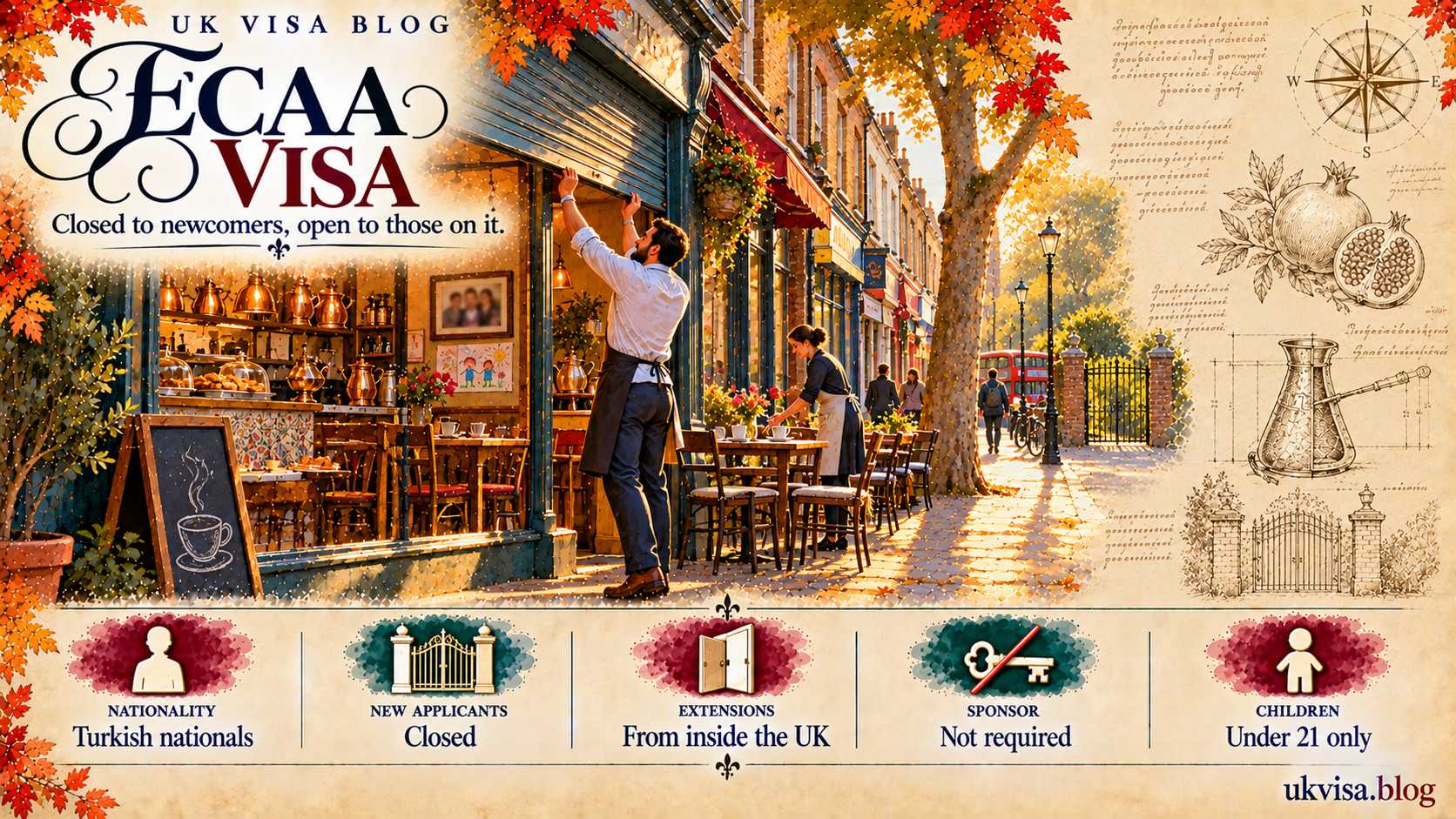
Two legacy categories for Turkish nationals: the Turkish Worker route for employees and the Turkish Businessperson route for people running or helping to run a UK business. Both are closed to new applicants. Existing holders can extend from inside the UK as many times as they continue to qualify, and after five years may apply for indefinite leave to remain. Only child dependants under 21 can still join a Turkish Businessperson.
The routes derive from the European Community Association Agreement between the EU and Turkey, which is why they never looked like the rest of the points-based system: no sponsor, no certificate of sponsorship, no salary threshold and no occupation codes.
Closed to New Applicants
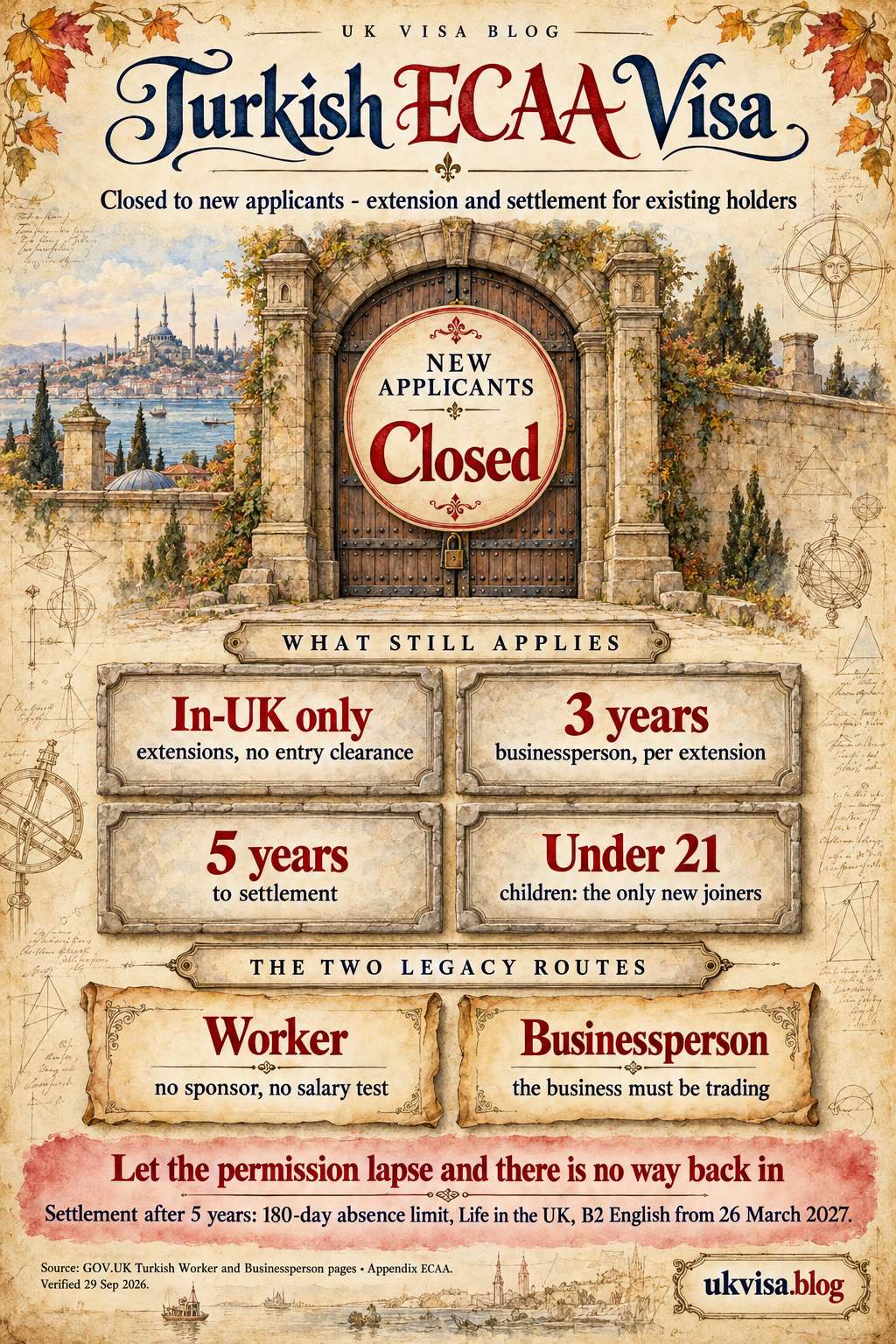
GOV.UK states that new applications for the Turkish Businessperson visa have closed, and that only children under 21 — child dependants — can apply to join a holder in the UK on that visa. Extensions on both routes can only be made from inside the UK, and only by people who already hold that permission. There is no route in from abroad and no switching in from another category, so anyone outside the UK, or inside it on a different visa, is looking at the mainstream work routes instead however strong the Turkish connection.
Turkish Worker Extensions
The Turkish Worker route is unusual in that both the length of permission and what you are allowed to do depend on how long you have already worked legally in the UK. There is no salary test and no employer sponsorship at any point.
What Your Work History Buys
| Time worked legally in the UK | Extension length | What you can do |
|---|---|---|
| 3 to 4 years | Up to 1 year | Change employer, but stay in the same occupation |
| 4 years or more | Up to 3 years | Work in any occupation for any employer |
Source: GOV.UK, Turkish Worker visa — extend your visa. Verified 22 August 2026.
The four-year point is therefore the one to plan around: it is where the permission lengthens from one year to three and where the occupational restriction falls away entirely. Applications must be made from within the UK before the current permission expires.
Turkish Businessperson Extensions
Extensions run for up to three years at a time and can be repeated as often as you continue to meet the requirements. You can carry on running your UK business and start another one, or continue helping to run an established UK business — the route contemplates both the founder and the participant.
As with the Worker route, extensions are only possible from inside the UK, and only for people who already hold the permission. The business itself is what is examined: whether it is real, whether it is trading, and whether your role in it is what you say it is.
Why the Routes Look Nothing Like the Rest of the System
Both categories were preserved from an association agreement rather than designed as part of the points-based system, which is why they carry no sponsor, no points table and no occupation list. That also explains their limits: because they rest on a standstill arrangement for people already exercising rights, they could be closed to newcomers without disturbing anyone already inside them.
How to Apply
Applications are made online from within the UK, before the current permission expires. You prove your identity and provide documents in the usual way, and may need an appointment — what follows is covered in our processing guide. A refusal is normally challenged through administrative review (AR).
Documents
Evidence on the Worker route is essentially employment history: contracts, payslips and employer letters establishing how long you have worked legally in the UK, since that is what sets both the length of the extension and the occupational freedom. On the Businessperson route it is business evidence — accounts, contracts, invoices and material showing the business is trading and that you are running or helping to run it.
Documents not in English or Welsh need certified translations. Because these routes have no sponsor to corroborate anything, the applicant’s own records carry the entire evidential weight, which makes gaps harder to repair than on sponsored routes.
Do Not Let Permission Lapse
Everything on these routes depends on already holding the permission. An application made after the current leave expires is not an extension of a continuing status but an out-of-time application on a closed route, and there is no way back in from abroad. Diary the expiry date a clear three months ahead and gather the evidence before, not after.
Settlement
After five years you may be able to apply for permanent settlement, on both routes, through the dedicated Turkish Worker and Businessperson settlement provisions. The ordinary settlement conditions apply: absences within the 180-day limit, a pass in the Life in the UK test, and English at the settlement standard — which rises to B2 for applications made on or after 26 March 2027 under HC 1691, as explained in our English requirements guide.
Naturalisation follows on the ordinary timetable set out in our citizenship guide. For families who have been here since before the routes closed, that sequence — extend, settle, naturalise — is the whole remaining life of the category.
If the Business Changes
The Businessperson route contemplates starting another business alongside the first, and moving between running a business and helping to run an established one. What it does not tolerate is a business that has stopped trading, because the evidence at extension is the trading itself. A wind-down needs a plan for the immigration position before it needs one for the accounts.
Partners and Children
Partners and children who already hold dependant permission can apply separately to extend it. New joiners are heavily restricted: on the Businessperson route, only children under 21 can apply to join a holder in the UK. Children applying from outside the UK do so as dependants of the main holder rather than in their own right.
Counting the Five Years
The qualifying period is built from continuous permission on the route, so the extensions are what carry you to settlement. Long absences and gaps between grants are the two things that break it, and neither is recoverable once the pattern is set — which is why the absence log matters as much here as the business or employment evidence.
What Turkish Nationals Use Instead
Anyone who cannot use the legacy routes is in the mainstream system. Skilled Worker covers sponsored employment. Innovator Founder is the closest successor for business builders, requiring an endorsed innovative business rather than simply a trading one. Global Talent visa runs on endorsement, the Scale-up route on six months of sponsorship, and High Potential Individual route on a recent degree from a listed university.
None of them reproduces what the ECAA routes offered, which was permission to work or trade without a sponsor, an endorsement or a salary floor. That is the practical loss for people who narrowly missed the closure, and the reason the legacy population is worth protecting carefully through extensions rather than experimenting with alternatives.
Sources: GOV.UK Turkish Worker route page on GOV.UK and Turkish Businessperson route page on GOV.UK; the ECAA settlement page on GOV.UK; and the Home Office Turkish ECAA indefinite leave to remain caseworker guidance. Figures verified 22 August 2026.
Frequently Asked
Questions about the Turkish ECAA Routes
No. GOV.UK states that new applications have closed. The route now exists only for people who already hold that permission and are extending it from inside the UK. The single exception for joiners is children under 21, who can apply to join a holder in the UK as child dependants.
It depends on how long you have already worked legally in the UK. Between three and four years, you can extend for up to a year and can change employer but must stay in the same occupation. At four years or more, you can extend for up to three years and work in any occupation for any employer.
Yes. After five years, holders of either route may apply for indefinite leave to remain under the dedicated Turkish Worker and Businessperson settlement provisions. The usual conditions apply — absences within the limits, the Life in the UK test, and English at the settlement standard, which rises to B2 from 26 March 2027.
No. Both routes can only be extended from inside the UK, and only by someone who already holds that permission. There is no entry clearance application and no switching in from another category. Leaving the UK without extending first therefore risks ending access to the route altogether.
As many times as you continue to meet the eligibility requirements. On the Businessperson route each extension can run up to three years; on the Worker route the length depends on your work history. There is no cap on the number of extensions, which is what makes reaching the five-year settlement point realistic.
Partners and children who already hold dependant permission can apply separately to extend it. New joiners are restricted: on the Businessperson route only children under 21 can apply to join a holder in the UK. Adult partners who do not already hold dependant permission are not able to join on this route.
On the Worker route, employment history — contracts, payslips and employer letters showing how long you have worked legally in the UK, since that determines both the extension length and the occupational freedom. On the Businessperson route, evidence the business is trading and that you run or help run it. Documents not in English or Welsh need certified translations.
There is no direct replacement. Skilled Worker covers sponsored employment, Innovator Founder covers business building but requires an endorsed innovative business rather than an ordinary trading one, and Global Talent, Scale-up and High Potential Individual each have their own gateways. None allows unsponsored work or trade on the ECAA terms.