
Bringing an adopted child to the UK — whether you plan to adopt a child from abroad, adopt a baby from abroad, or adopt a relative such as a nephew or niece — means satisfying UK intercountry adoption law and the law of the child's home country. The standard route is the visa for adopted child to UK, a Child Settlement Visa that can lead to automatic British citizenship by adoption for Hague Convention adoptions where a parent is British. Hague countries (India, Philippines, China) use standardised procedures; non-Hague countries such as Ghana require UK re-adoption; Pakistan and Bangladesh permit guardianship only.
Source: Adoption and Children Act 2002; Hague Convention on Intercountry Adoption 1993; UKVI caseworker guidance on intercountry adoption; GOV.UK child adoption guidance.
The framework operates under the Adoption and Children Act 2002, with the DfE's Intercountry Adoption Centre coordinating UK assessments — the Certificate of Eligibility fee is £2,500. Hague Convention adoptions (India, Philippines, China, South Africa) are automatically recognised and confer citizenship where a parent is British and habitually resident in the UK; non-Hague designated-list adoptions need Form MN1 registration. Pakistan and Bangladesh remain guardianship-only. Restricted countries — Cambodia, Guatemala, Nepal, Haiti, Ethiopia and Nigeria — carry UK adoption suspensions.
- What is the Visa for Adopted Child to UK?
- Can I Adopt My Nephew or Niece from Another Country to the UK?
- Country-Specific Adoption Requirements
- British Citizenship by Adoption — Automatic and Registration Routes
- De Facto Adoption UK Explained
- Adoption Visa UK Application Process
- Fees and Costs for Bringing an Adopted Child to the UK
- Countries with Restricted or Suspended Adoption
- Frequently Asked Questions
Visa for Adopted Child to UK 2026 — Intercountry Adoption Visa and British Citizenship by Adoption
Adopting a child from abroad involves three interlocking processes: a UK suitability assessment through a registered adoption agency, a Certificate of Eligibility from the Department for Education, and legal adoption in the child's country of origin. The child then applies for the visa for adopted child to UK — a Child Settlement Visa under Appendix Adoption. Whether citizenship follows automatically depends on whether it is a Hague Convention adoption. For relatives such as a nephew or niece, the same framework applies — adopting a family member does not simplify the requirements.
What is the Visa for Adopted Child to UK?
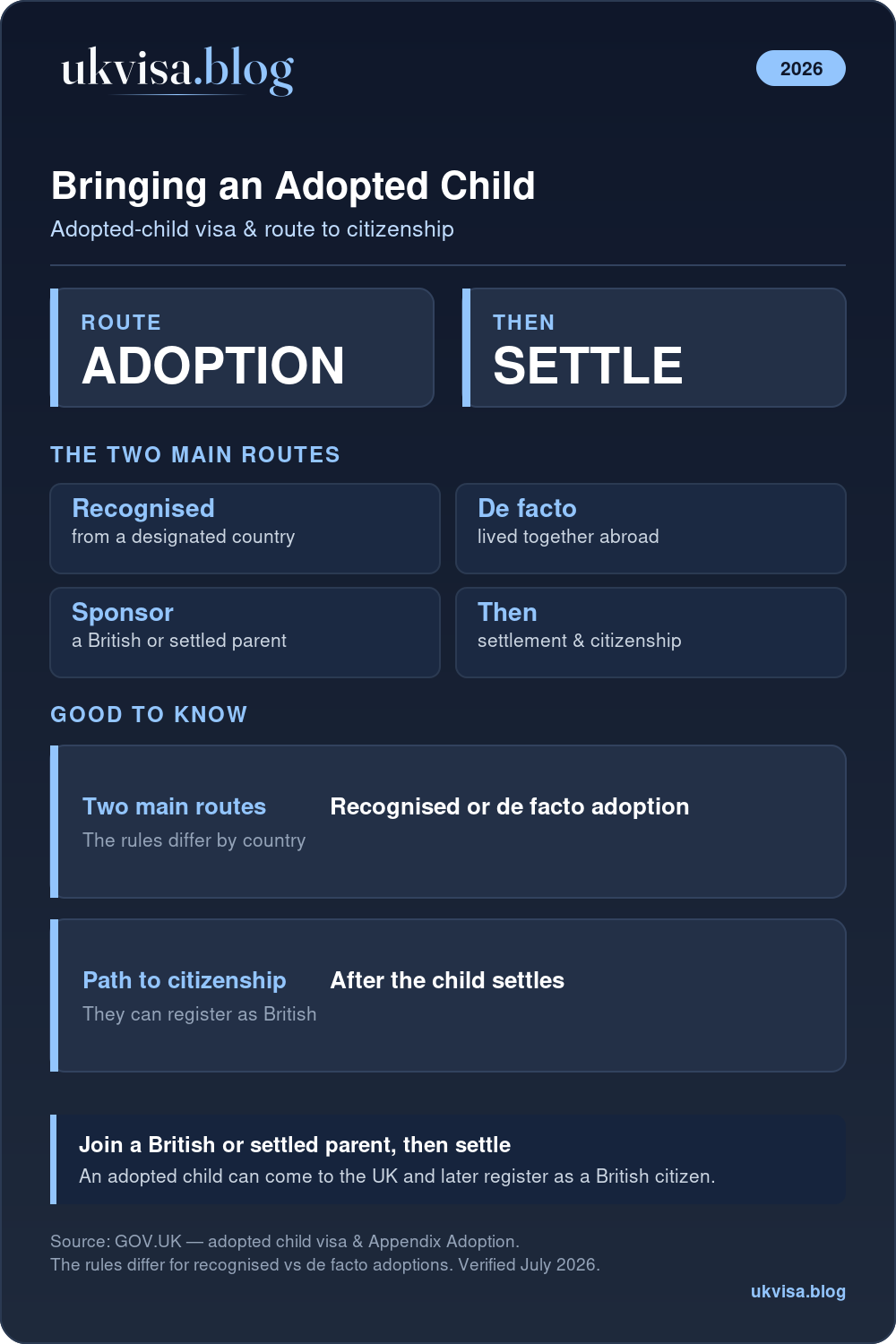
The visa for adopted child to UK is a Child Settlement Visa under Appendix Adoption, granting indefinite leave to enter for a child legally adopted by parents settled in the UK. For Hague Convention adoptions (India, Philippines, China, South Africa) where at least one adoptive parent is British and habitually resident in the UK, the child becomes British automatically from the adoption order date. Non-Hague adoptees enter on the settlement visa and register as British via Form MN1.
This is one of the few entry clearance routes granting indefinite leave from arrival — most settlement-route applicants must first hold a 5-year visa. It applies only to legally completed adoptions; guardianship and de facto adoption follow different routes. At least one adoptive parent must be settled — British, ILR, or EU Settled Status — as our ILR settlement framework guide explains.
Can I Adopt My Nephew or Niece from Another Country to the UK?
Yes — you can adopt your nephew or niece from another country and bring them to the UK, but the process must satisfy both UK intercountry adoption regulations and the child's home country law. Adopting a relative simplifies nothing: the full suitability assessment, DfE Certificate of Eligibility, and legal adoption abroad all still apply. Where formal adoption is not permitted (Pakistan, Bangladesh), guardianship is the only route.
Relative adoption is one of the most common intercountry scenarios — often initiated when the child's biological parents are deceased, incapacitated, or unable to provide care. The UK has no fast-track for family adoptions: the Hague Convention contemplates relative adoptions, but its procedural protections — home study, central authority involvement, best-interests assessment — apply in full. Cases involving biological family members need professional immigration advice from the outset.
Requirements for Adopting a Relative from Overseas
- UK Suitability Assessment: home study and approval by a UK adoption agency — typically 6-9 months
- DfE Certificate of Eligibility: Department for Education approval (£2,500 fee)
- Child's Best Interests: evidence the child cannot be safely cared for at home
- Legal Adoption Abroad: completed under the child's home country law
- Settlement Status: at least one adoptive parent British, ILR, or EU Settled Status
- No Recourse to Public Funds: demonstrated financial capacity to support the child
- Adequate Accommodation: suitable housing for the child in the UK
Country-Specific Adoption Requirements
Requirements vary sharply by country. Hague Convention countries (India, Philippines, China, South Africa, Brazil) follow standardised procedures with automatic UK recognition. Designated-list countries (USA, Canada, Australia) are recognised under domestic law. Non-Hague, non-designated countries such as Ghana require UK re-adoption. Pakistan and Bangladesh permit guardianship only. Restricted countries (Cambodia, Guatemala, Nepal, Haiti, Ethiopia, Nigeria) carry UK suspensions.
Adoption from India to UK
India is a Hague Convention country — adoptions run through the Central Adoption Resource Authority (CARA). The procedure: registration on the CARINGS portal, matching with an eligible child, a court order from the Indian competent authority, and a No Objection Certificate before departure. UK adopters work through a UK registered agency that liaises with CARA — direct approach is not permitted. Once the Indian order is granted, the child applies for the visa and acquires British citizenship automatically where a parent is British and habitually resident in the UK.
Adopting from Pakistan to UK
Pakistan does not permit formal intercountry adoption — Pakistani family law recognises guardianship (kafala). Adopters apply through Pakistani family courts for guardianship, but once granted, the child cannot use the visa for adopted child to UK because no legal adoption exists. Alternatives: a dependent visa where the guardian is UK-settled, an Article 8 ECHR family-life claim, or exceptional discretionary leave. Adopting from Pakistan to UK almost always needs specialist solicitor input.
Adoption from Bangladesh to UK
Bangladesh mirrors Pakistan — formal adoption is not recognised for Muslim families, though limited provisions exist for some Hindu and Christian communities under personal law. The default is guardianship under the Guardians and Wards Act 1890, which does not trigger the adoption visa, so alternative immigration routes apply. Cases typically involve nieces, nephews, or grandchildren, and usually need Bangladeshi family-law advice alongside UK immigration advice.
Adopting a Child from Philippines to UK
The Philippines is a Hague Convention country — adoptions run through the Inter-Country Adoption Board (ICAB) under Republic Act 8043. The procedure includes Philippine approval, matching, a Family Court order, and the Certificate of Adoption, with UK adopters working through a UK agency authorised for Philippine cases. Once the Philippine order is granted, the visa for adopted child to UK is straightforward, and citizenship follows automatically where a parent is British and habitually resident in the UK.
Country Recognition Framework — Comparison Table
| Country | Adoption Type | Central Authority | UK Recognition |
|---|---|---|---|
| India | Full Adoption (Hague) | CARA | Automatic — Hague Convention |
| Philippines | Full Adoption (Hague) | ICAB | Automatic — Hague Convention |
| China | Full Adoption (Hague) | CCCWA | Automatic — Hague Convention |
| USA | Full Adoption (designated list) | State courts | Recognised — domestic law |
| South Africa | Full Adoption (Hague) | DSD | Automatic — Hague Convention |
| Ghana | Full Adoption (Non-Hague) | DSW | Requires UK re-adoption |
| Nigeria | Full Adoption (Non-Hague) | State Welfare | Restricted since 2021 — DfE Certificate not issued |
| Pakistan | Guardianship Only | Family Courts | Alternative visa routes |
| Bangladesh | Guardianship Only | Family Courts | Alternative visa routes |
| Morocco | Kafala (Guardianship) | Family Courts | Alternative visa routes |
British Citizenship by Adoption — Automatic and Registration Routes
British citizenship by adoption runs through three routes: automatic citizenship for Hague Convention adoptions where at least one adoptive parent is British and habitually resident in the UK at the adoption date; registration via Form MN1 for children under 18 whose adoption is recognised but not automatic; and naturalisation for everyone else. Automatic Hague citizenship is the usual route for British parents adopting from India, the Philippines, or China.
Automatic citizenship applies only to Hague Convention adoptions with a qualifying British parent habitually resident in the UK — the strongest route: no application, no fee, British from the order date. Non-Hague adoptees enter on the settlement visa and register via Form MN1. The full framework is set out at the official gov.uk become a British citizen if your child has been adopted page.
Three Routes to British Citizenship by Adoption
- Route 1 — Automatic (Hague Convention): British from the adoption order date where a parent is British otherwise than by descent and habitually resident in the UK — no application needed
- Route 2 — Registration via Form MN1: for under-18s whose non-Hague adoption is recognised under UK law — fee applies, usually straightforward for British parents
- Route 3 — Naturalisation: for those over 18 or outside the first two routes — standard UK naturalisation requirements apply
- Citizenship by descent: adopted children acquire citizenship otherwise than by descent, so can pass it to their own children
- Residence-based registration: applicants relying on UK residence must meet continuous residence requirements
Documentation Required for British Citizenship by Adoption
- Child's birth certificate (original, with certified English translation)
- Adoption certificate or court order plus any UK re-adoption order
- Hague Article 23 Certificate confirming Convention compliance (Hague cases)
- Adoptive parents' British passports or proof of citizenship status
- Child's current passport from the country of origin
- Proof of UK residence for registration or naturalisation applications
- DfE Certificate of Eligibility where applicable to the route used
De Facto Adoption UK Explained
De facto adoption is the Immigration Rules' recognition (paragraph 309A) of a parent-child relationship without a formal adoption order: the adoptive parents must have lived abroad with the child for at least 18 continuous months, holding full parental responsibility from the start. It can support a UK application where formal adoption is unavailable — but the evidential bar is high.
The concept addresses families from Pakistan, Bangladesh, and other non-adoption jurisdictions. Where the strict 18-month cohabitation requirement is met, the child may qualify for entry clearance as an adopted child. UKVI looks for continuous shared accommodation, school registration naming the de facto parents, financial dependency, and the absence of biological-parent involvement — and the arrangement must not appear created for immigration purposes.
Evidence Requirements for De Facto Adoption
- 18-month continuous cohabitation: tenancy agreements, utility bills, joint addresses, photographs
- Full parental responsibility from day one: not assumed gradually
- Financial dependency: the child supported by the de facto parents throughout
- Educational and medical records: school enrolment and medical consent naming the de facto parents
- Genuine relationship evidence: photographs, letters, family events across the period
- Absence of biological parents: parental responsibility ceded — voluntarily or through death or incapacity
- Child's best interests: the arrangement demonstrably serves the child's welfare
Adoption Visa UK Application Process
The application begins after the overseas adoption is finalised. The child applies for entry clearance under Appendix Adoption through the visa application centre in their country, submitting the adoption certificate, Hague Article 23 Certificate where applicable, DfE Certificate of Eligibility, proof of the parents' settled status, and financial and accommodation evidence. Standard processing takes 8-12 weeks.
Step-by-Step Adoption Visa UK Application
- Step 1 — UK Suitability Assessment: home study and agency approval (6-9 months)
- Step 2 — DfE Certificate of Eligibility: apply with the £2,500 fee
- Step 3 — Country of Origin Process: complete the adoption under home country law
- Step 4 — Adoption Order: receive the order plus Hague Article 23 Certificate where applicable
- Step 5 — UK Visa Application: complete the online UK visa application form for entry clearance
- Step 6 — Biometric Enrolment: the child attends the visa application centre
- Step 7 — Document Submission: adoption documents, DfE Certificate, financial and accommodation proof
- Step 8 — Decision: standard processing time after biometrics is 12 weeks for entry clearance
- Step 9 — Entry and Citizenship: the child enters with indefinite leave; Hague adoptees of British parents can apply straight for a passport
Fees and Costs for Bringing an Adopted Child to the UK
Total costs typically run £10,000 to £30,000+ depending on country and complexity. The major components: UK agency fees (£3,000-£7,000), the £2,500 DfE Certificate, country-of-origin fees and court costs, the UK entry clearance visa fee, document translation (£500-£2,000), legal advice (£2,000-£10,000 for complex cases), and travel — often several trips.
Cost Breakdown for Intercountry Adoption
- UK adoption agency fees: £3,000-£7,000 — home study, matching, post-placement support
- DfE Certificate of Eligibility: £2,500 (2026 fee, non-refundable, exempt from VAT)
- Country-of-origin fees: highly variable — CARA moderate, ICAB higher, court costs extra
- UK entry clearance visa: see current UK visa fees for the adoption settlement rate
- Citizenship registration (Form MN1) if needed: see current Home Office citizenship fees
- Translation and apostille: £500-£2,000 — birth certificates, orders, court documents
- Legal advice: £2,000-£10,000 — vital for non-Hague and guardianship cases
- Travel to country of origin: multiple trips often required
Countries with Restricted or Suspended Adoption
The UK has restricted or suspended adoption from countries with safeguarding concerns: Cambodia, Guatemala, Nepal, Haiti, Ethiopia, and Nigeria currently carry restrictions, reflecting trafficking risks, fraudulent practices, or weak safeguarding frameworks. The DfE maintains the list and reviews it periodically. Adoption from these countries is not impossible, but needs an exception request with rigorous safeguarding evidence.
Restrictions follow safeguarding failures — Cambodia's suspension dates from 2001 trafficking concerns, Guatemala's from its 2008 reforms, Nepal's from post-conflict child-protection issues, and Nigeria's from the Special Restrictions on Adoptions from Abroad (Nigeria) Order 2021 (in force 12 March 2021), after which the DfE will not issue a Certificate of Eligibility for Nigerian cases. A restricted-country adoption requires an exception request to the Education Secretary, granted only where the specific case demonstrates safeguarding compliance — adopting a close family member is the most common basis. Existing Nigerian orders made before the restriction may still be recognised at common law through the UK courts, but new DfE-route adoptions are suspended. Most adopters are advised to consider alternative countries of origin.
- The visa (Child Settlement Visa) grants indefinite leave from arrival — unlike time-limited settlement routes
- Framework: Adoption and Children Act 2002 plus Hague Convention 1993
- UK suitability assessment + DfE Certificate of Eligibility (£2,500) come before the overseas adoption
- Hague adoptions (India, Philippines, China, South Africa) confer automatic citizenship where a parent is British and UK-resident
- Designated-list countries (USA, Canada, Australia): adoption recognised; citizenship via Form MN1
- Non-Hague, non-designated countries such as Ghana: UK re-adoption typically required
- Pakistan, Bangladesh, Morocco: guardianship only — dependent visa or Article 8 routes instead
- De facto adoption needs 18 months' continuous cohabitation abroad with full parental responsibility from the start
- Adopting a nephew or niece follows the same process — no fast-track for relatives
- Restricted countries (Cambodia, Guatemala, Nepal, Haiti, Ethiopia, Nigeria) carry UK adoption suspensions
- Total costs typically £10,000-£30,000+ depending on country and complexity
Frequently Asked Questions about Bringing an Adopted Child to the UK
Four stages: complete a UK suitability assessment through a registered adoption agency (6-9 months); obtain the DfE Certificate of Eligibility (£2,500); finalise the adoption under the child's home country law; then apply for the visa for adopted child to UK. Hague countries (India, Philippines, China, South Africa) follow standardised procedures with automatic citizenship for British parents resident in the UK; non-Hague countries such as Ghana typically need UK re-adoption. Adopting a baby from abroad follows the same framework as older children.
Yes — but adopting a relative does not simplify the requirements. You still complete the UK suitability assessment, obtain the DfE Certificate of Eligibility (£2,500), finalise the adoption legally in the child's home country, and apply for the visa. In countries without formal adoption (Pakistan, Bangladesh), legal guardianship is the only option, and alternative immigration routes apply.
Yes — under the same framework as any other intercountry adoption. The Hague Convention explicitly contemplates relative adoptions, and the UK has no separate procedure for nieces, nephews, or other family members. You complete the suitability assessment, obtain the DfE Certificate, finalise the adoption under her home country law, and apply for the adoption visa. For nieces from Pakistan or Bangladesh, guardianship is the only available option.
A Child Settlement Visa under Appendix Adoption — formal entry clearance for a child legally adopted overseas to join their adoptive parents. Unlike most settlement routes, it grants indefinite leave to enter from arrival. Where the adoption is a Hague Convention adoption and at least one adoptive parent is British otherwise than by descent and habitually resident in the UK, the child also acquires citizenship automatically from the order date.
Automatically only for Hague Convention adoptions (India, Philippines, China, South Africa) where at least one adoptive parent is British otherwise than by descent and habitually resident in the UK at the order date. Designated-list adoptions (USA, Canada, Australia) are recognised but require Form MN1 registration. Non-Hague, non-designated countries such as Ghana usually require UK re-adoption before registration.
An immigration concept under paragraph 309A of the Immigration Rules: a parent-child relationship is recognised without a formal adoption order where the adoptive parents have lived abroad with the child for at least 18 continuous months, holding full parental responsibility from the start. It is particularly relevant for Pakistan and Bangladesh cases. Evidence must show continuous cohabitation, financial dependency, school enrolment, and no commercial arrangement.
Pakistan permits guardianship (kafala) only — not adoption equivalent under UK law. You apply through Pakistani family courts for guardianship, but the child then cannot use the visa for adopted child to UK. Alternatives: a dependent visa where you hold settled status, an Article 8 ECHR family-life claim where genuine family life is established, or exceptional discretionary leave. Specialist solicitor input is essential.
Through CARA, India's Hague Convention central authority — working via a UK registered adoption agency, since direct approach is not permitted. The Indian process covers CARINGS registration, child matching, a court order from the competent authority, and a No Objection Certificate before departure. Once the order is granted, the child applies for the visa and acquires citizenship automatically where a parent is British and habitually resident in the UK.
Typically 12-36 months end to end. The UK home study and DfE Certificate take 6-9 months; matching and the country-of-origin process vary (Hague countries usually 6-18 months, non-Hague longer); UK entry clearance takes 8-12 weeks. Guardianship cases from Pakistan or Bangladesh tend to be the most complex and time-consuming.
Yes — Cambodia (suspended since 2001 over trafficking concerns), Guatemala, Nepal, Haiti, Ethiopia, and Nigeria (restricted since 12 March 2021). Adoption from these countries is not absolutely prohibited but needs an exception request to the Education Secretary, granted only in exceptional circumstances with demonstrated safeguarding compliance — adopting a close family member is the usual basis. The DfE's Intercountry Adoption Centre maintains and reviews the list; most adopters are advised toward alternative jurisdictions.
For canonical guidance, see gov.uk child adoption and the DfE's intercountry adoption publications. The statutory foundation for the entire framework is the Adoption and Children Act 2002.