
Judicial review asks whether a decision was lawful, not whether it was generous. It is the remedy of last resort when no appeal or administrative review exists, it begins with a pre-action letter rather than a claim, and it is bound by a short time limit that runs from the decision.
Judicial Review
Judicial Review of a UK Visa Decision
What Judicial Review Does
It supervises the decision-making process. A court will not substitute its own view of whether you should have been granted a visa; it decides whether the decision maker acted within their powers, applied the right test, considered what they were obliged to consider, and acted fairly.
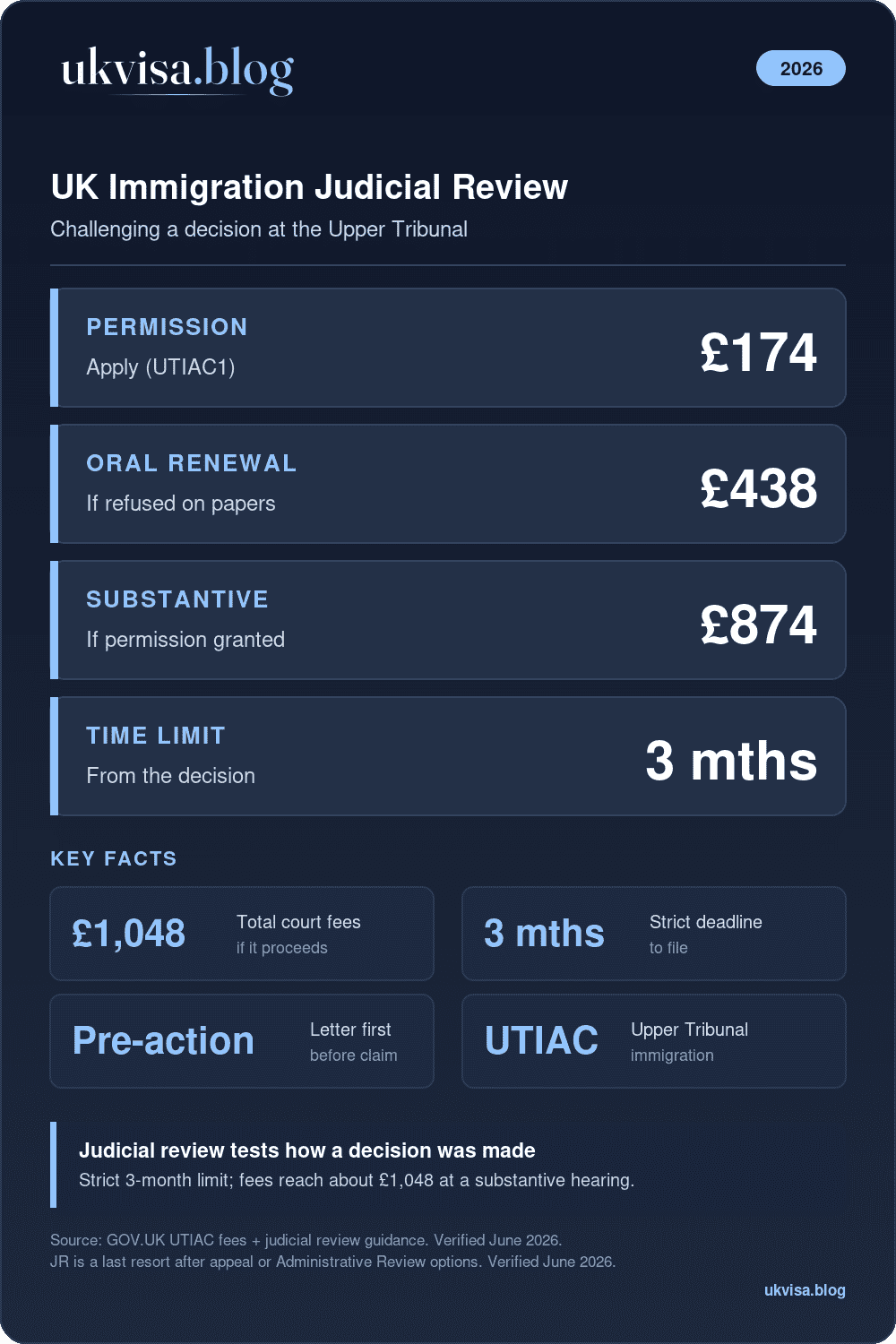
Judicial review is available where no appeal or administrative review exists. It starts with a pre-action protocol letter giving the Home Office a chance to withdraw the decision, and a claim must be filed promptly and in any event within three months of the grounds arising. Immigration claims are usually heard in the Upper Tribunal, and the tribunal fees run £174, £438 and £874 through the stages.
What It Cannot Do
It cannot re-decide your application. A successful claim usually results in the decision being quashed and remade by the Home Office, which may reach the same conclusion lawfully. That is why the remedy suits legal errors rather than evidential gaps — for those, a fresh application is faster and more likely to change the answer.
The Grounds
Illegality
The decision maker applied the wrong rule, misinterpreted the one they applied, exceeded their powers, or fettered a discretion the rules require them to exercise. A refusal citing a paragraph that does not exist, or applying a mandatory test to a discretionary ground, falls here.
Irrationality
The decision is one no reasonable decision maker could have reached on the material before them. The threshold is high by design. Disagreeing with the weight given to your evidence is not irrationality; a conclusion that flatly contradicts the documents can be.
Procedural Unfairness
You were not given a fair opportunity to answer something used against you. An allegation of deception decided without putting the point to you, evidence relied on that you were never shown, or a decision made after a promise that further submissions would be considered.
Human Rights
Where a decision interferes with rights protected under the Human Rights Act, principally family and private life, the question becomes whether the interference is proportionate. Where a right of appeal exists on human rights grounds, that is the route rather than judicial review — see our page on human rights in visa applications.
The Pre-Action Protocol Letter
The protocol requires you to write before you sue. The letter identifies the decision, sets out the error, states what you want done, and gives the Home Office a period to respond — usually fourteen days. It is not optional, and issuing a claim without it invites criticism on costs.
It is also the cheapest step in the process. A letter costs a fraction of a claim, and a proportion of decisions are withdrawn or reconsidered at this stage without anything further being needed.
What the Letter Actually Achieves
- Withdrawal of the decision: the outcome you are seeking, without a claim.
- An agreement to reconsider: the decision is remade, not necessarily in your favour.
- A defence of the decision: with reasons, which sharpens the eventual claim.
- A concession on one point only: narrowing what remains in dispute.
- No response at all: which is itself material to the court's view of conduct.
A well-drafted letter that identifies a specific legal error, with the document that proves it, is far more likely to produce a withdrawal than a general complaint about unfairness. The letter is where the case is won or lost most cheaply.
What to Include
- The parties and the reference: your details and the application reference.
- The decision challenged: its date, and the date of deemed service.
- The legal error: identified by ground, with the paragraph misapplied.
- The evidence: the specific documents that establish the error.
- The remedy sought: withdrawal, reconsideration, or a decision within a time.
- The deadline for response: and the address for reply.
Attach the refusal notice and the documents you rely on. Our pages on reading the refusal letter and refusal grounds cover how to identify the paragraph and the finding it rests on.
Judicial Review of a Visit Refusal
Visit refusals carry no right of appeal and no administrative review, so judicial review is technically the only formal challenge. In practice it is almost never proportionate: the visa fee is £135 and a fresh application can be made immediately, while a claim costs many multiples of that and takes months.
Where a visit refusal turns on evidence — funds, ties, a purpose that was not credible — a better-evidenced application answers it directly. Judicial review cannot supply the evidence that was missing, and a court asked to review a lawful assessment of thin evidence will not intervene. See our page on the standard visitor route.
The exception is a refusal containing a finding of deception, because that carries a ten-year period and follows you into every later application. There, the stakes justify the cost — see our pages on the deception ban and re-entry bans.
The Procedure
- Pre-action letter: the error set out, with a response period.
- Claim filed: in the Upper Tribunal for most immigration decisions, with grounds and evidence.
- Acknowledgement of service: the Home Office responds and may summarise its defence.
- Permission decided on the papers: a judge decides whether the claim is arguable.
- Oral renewal if refused: a short hearing to argue for permission.
- Substantive hearing: only if permission is granted.
Most claims end at the permission stage. A judge who considers the claim unarguable refuses permission on the papers, and the only step left is renewal at a hearing. Getting past permission is the real hurdle, not winning the substantive argument.
Fees
Tribunal Fees Through the Stages
| Stage | Fee |
|---|---|
| Application for permission | £174 |
| Renewing permission at an oral hearing | £438 |
| Continuing after permission is granted | £874 |
| First-tier Tribunal appeal, on the papers | £82 |
| First-tier Tribunal appeal, oral hearing | £144 |
| Administrative review | £80 |
Source: tribunal fee orders and GOV.UK guidance. Checked 22 August 2026.
These are court fees only. Legal costs are the larger figure by a wide margin, and an unsuccessful claimant can be ordered to pay the Home Office's costs as well. Fee remission is available on means-tested grounds through the standard application.
Costs, and Who Pays Them
Judicial review carries a costs risk that no other immigration remedy does. A claimant who loses can be ordered to pay the Home Office's legal costs as well as their own, and those figures dwarf the tribunal fees. That risk is the single most important factor in deciding whether to proceed, and it is why the pre-action letter matters so much: a decision withdrawn at that stage costs almost nothing.
Where the Home Office withdraws after a claim is filed, costs are usually recoverable by the claimant, so a well-founded claim that succeeds early is not merely cheaper — it can be close to cost neutral. Where a claim is refused permission on the papers and abandoned, the exposure is limited but real.
Outcomes
Published tribunal statistics for early 2026 show that where an immigration judicial review reached a substantive determination, the outcome favoured the appellant in around 41% of cases. That figure describes cases that got past permission, which is a small proportion of those started.
Read alongside appeal statistics — around 39% of immigration appeals allowed overall in the same period, with human rights appeals at 44% — the picture is consistent. Where an appeal exists, it is usually the better route. Our page on success rates sets out the wider data, and our page on immigration appeals when a right exists.
Time Limits
A claim must be filed promptly and in any event no later than three months after the grounds first arose. Promptness is a separate requirement: a claim filed at eleven weeks can still be too late if nothing explains the delay.
The period runs from the decision, and the decision is treated as given on its deemed service date under Appendix SN — the second day after recorded post within the UK, the 28th day after posting abroad, or the day of sending for email. Establish that date first, because the pre-action letter has to fit inside the same window.
Where a delay rather than a decision is the complaint — an application sitting unanswered far beyond the published time — the grounds arise continuously, but the same discipline applies. See our pages on delays and exceptionally complex issues.
Where Judicial Review Is Heard
Most immigration judicial reviews are transferred to or started in the Upper Tribunal, Immigration and Asylum Chamber, rather than the Administrative Court. Some categories remain with the Administrative Court, and the choice of forum affects the procedure and the fees. That is one of several reasons this remedy is not sensibly attempted without representation.
Your Status During a Claim
This catches people out. Section 3C leave continues your permission while an in-time application, administrative review or appeal is pending. Judicial review is not on that list in the same way, so a claim does not automatically preserve status that has already ended.
Take advice on the position before relying on it. Working, renting and driving all depend on holding leave, and the consequences of getting it wrong extend beyond the claim. See our pages on section 3C leave and settlement.
Sources: the Upper Tribunal Immigration and Asylum Chamber, the Administrative Court judicial review guide, Civil Procedure Rules Part 54 and published tribunal statistics. Figures verified 22 August 2026.
Frequently Asked
Judicial Review Questions
What can judicial review actually achieve?
The decision being quashed and remade lawfully. It does not grant you the visa, and the Home Office may reach the same conclusion again by a proper route.
Do I have to send a pre-action letter first?
Yes, under the pre-action protocol. Issuing without one invites criticism on costs, and the letter is the cheapest chance of resolving the matter.
How long do I have?
Promptly, and in any event within three months of the grounds arising. Promptness is a separate requirement, so filing at the eleventh week can still be too late.
Is judicial review worth it for a visit refusal?
Rarely. A fresh application costs £135 and can be made immediately. The exception is a refusal containing a deception finding, which carries a ten-year period.
What are the court fees?
£174 to apply for permission, £438 to renew at an oral hearing and £874 to continue once permission is granted. Legal costs are far larger, and you may be ordered to pay the Home Office's costs.
Can I get help with the fees?
Fee remission is available on means-tested grounds through the standard application. It covers court fees, not legal representation.
What proportion of claims succeed?
Of immigration judicial reviews reaching a substantive determination in early 2026, around 41% favoured the appellant. Most claims never get past permission.
Does a claim protect my status while it runs?
Not automatically. Section 3C continues leave during an in-time application, review or appeal, but judicial review does not preserve status that has already ended. Take advice.
Can I challenge a delay rather than a decision?
Yes, where the delay is unreasonable. Start with a pre-action letter setting out the timeline against the published waiting time.
Should I use a lawyer?
For judicial review, yes. The permission stage turns on how the grounds are pleaded, and an unsuccessful claim carries a costs risk that a fresh application does not.