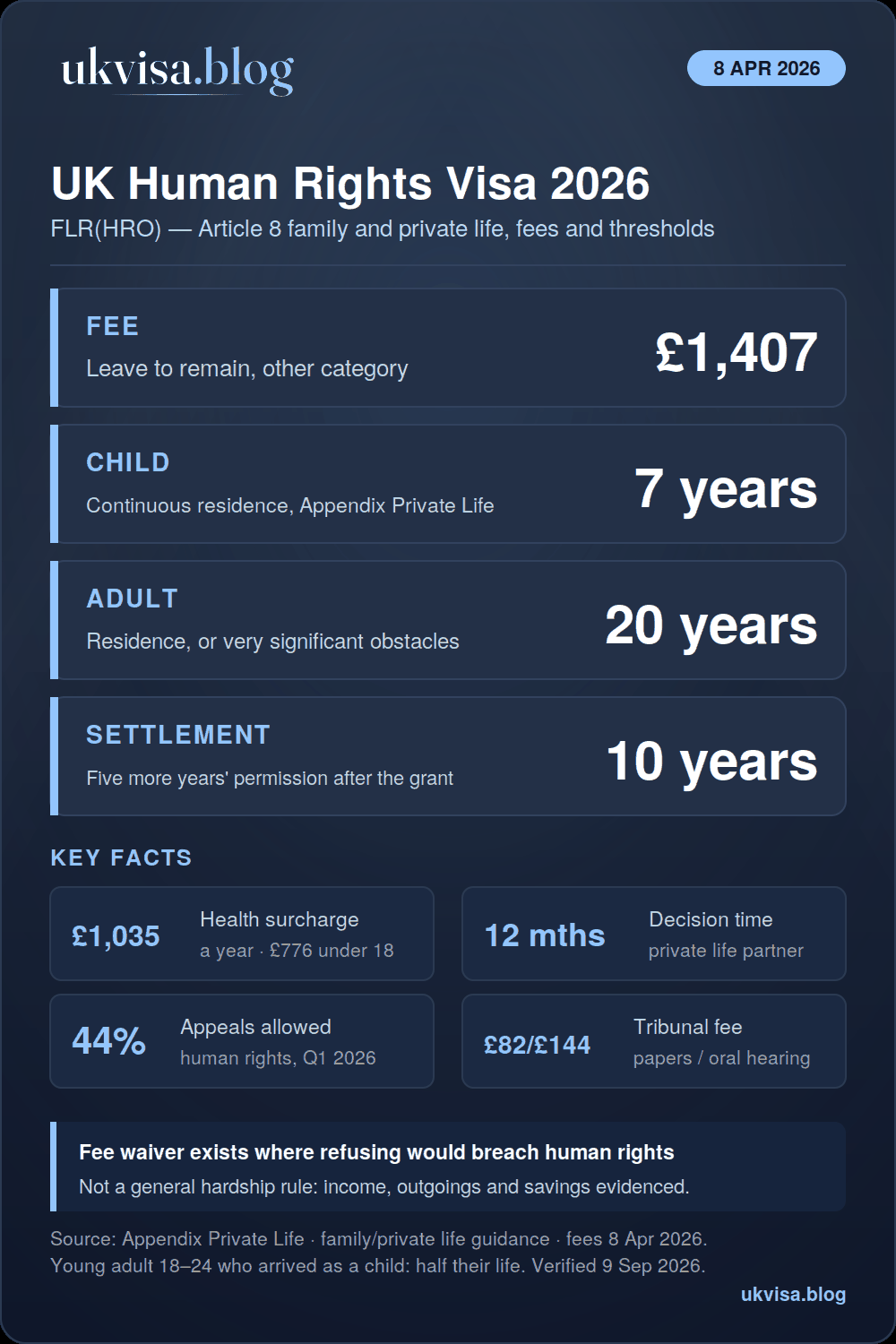
A UK human rights visa is leave to remain granted under the European Convention on Human Rights (ECHR) framework — most commonly Article 8 (family / private life) or Article 3 (protection from inhuman treatment). The application is made on the FLR(HRO) form (Further Leave to Remain Other / Human Rights) for in-country applicants. From 8 April 2026, the FLR(HRO) fee is £1,407 per applicant (raised from £1,321 in April 2025). The Immigration Health Surcharge adds £1,035 per year of leave granted (typically 2.5 years = £2,587.50). Priority Service £500 / 5 working days; Super Priority £1,000 / next working day. Standard processing is up to 6 months. Article 8 family life claims succeed more often than Article 3 medical claims — the medical threshold tightened in AM (Zimbabwe) [2020] UKSC 17. This guide covers FLR(HRO) requirements, the 2026 fee, processing time, success factors, fee waivers, and appeal rights.
Source: Home Office in-country fees order (effective 8 April 2026); Immigration Rules Appendix FM and Appendix Private Life; AM (Zimbabwe) v Secretary of State for the Home Department [2020] UKSC 17 (Article 3 medical threshold); Statement of Changes HC 1691 (laid 5 March 2026); UKVI in-country visa decision waiting times service standards
The UK human rights visa framework via FLR(HRO) covers in-country applications for further leave to remain under ECHR provisions. From 8 April 2026: FLR(HRO) fee £1,407 per applicant (raised from £1,321 / £1,258 in earlier years); IHS £1,035 per year of leave granted for adults (£776 for under-18s and students). Processing: standard up to 6 months; Priority Service £500 / 5 working days; Super Priority Service £1,000 / next working day. Article 3 medical claims: post-AM (Zimbabwe) [2020] UKSC 17 threshold requires evidence that removal would expose the applicant to a real risk of being subjected to serious, rapid, and irreversible decline in health or significantly reduced life expectancy. HC 1691 (laid 5 March 2026) introduces a B2 English settlement standard from 26 March 2027 — affecting ILR routes after a human rights visa grant. Earned Settlement consultation closed 12 February 2026 — outcome pending.
- What is FLR(HRO)? — Further Leave to Remain (Other / Human Rights)
- Four Types of Human Rights Application (Article 8 / Article 3 / DLR)
- Article 8 Family Life Requirements
- Article 8 Private Life Requirements (Appendix Private Life)
- Article 3 Medical Grounds — AM (Zimbabwe) Threshold
- FLR(HRO) Application Fees 2026 — £1,407 from 8 April
- Fee Waiver for FLR(HRO) Applications
- FLR HRO Processing Time — Up to 6 Months
- FLR(HRO) Success Rate and Factors
- Appealing a Refused FLR(HRO) Application
- Frequently Asked Questions
UK Human Rights Visa 2026 — FLR(HRO) £1,407, Article 8 and Article 3 Pathways
A UK human rights visa is leave to remain under the European Convention on Human Rights framework. The in-country application is made on form FLR(HRO) — Further Leave to Remain (Other / Human Rights). The route covers family life claims under Article 8 ECHR; private life claims under Article 8 (Appendix Private Life); medical claims under Article 3 (where removal would expose the applicant to inhuman treatment); and discretionary leave outside the Immigration Rules. Article 8 claims engaging UK-settled partners, parents, or children typically have the highest success rates. Article 3 medical claims face a very high threshold post-AM (Zimbabwe) [2020] UKSC 17. The 8 April 2026 fees order set the FLR(HRO) fee at £1,407 — aligned with FLR(M) and FLR(FP) across all in-country leave-to-remain routes.
What is FLR(HRO)? — Further Leave to Remain (Other / Human Rights)
FLR(HRO) stands for Further Leave to Remain (Other / Human Rights). It is the in-country application form used to request leave to remain in the UK based on European Convention on Human Rights provisions — most commonly Article 8 (right to private and family life) or Article 3 (protection from torture and inhuman treatment). FLR(HRO) is used when the applicant's circumstances fall outside the standard family or private life routes in the Immigration Rules but engage ECHR rights. For standard family / partner / private life routes, FLR(M) or FLR(FP) applies — see our FLR forms guide (FLR(M) / FLR(FP) / FLR(IR) / FLR(HRO)). Using the correct form is critical — applications on the wrong form may be rejected or delayed.
Four Types of Human Rights Application
FLR(HRO) covers four distinct types of human rights claim. (1) Article 8 family life — genuine subsisting relationship with UK-settled partner / parent / child where separation causes unjustifiably harsh consequences; engages the Appendix FM spouse visa framework as fallback context. (2) Article 8 private life — long residence, integration, social ties; engages Appendix Private Life route to settlement. (3) Article 3 medical grounds — serious illness with no available treatment in home country causing real risk of inhuman treatment. (4) Discretionary leave — exceptional circumstances outside the Immigration Rules. Each has distinct evidential requirements.
Four FLR(HRO) Application Types — Comparison
| Application Type | ECHR Article | Key Evidence Required | Typical Success |
|---|---|---|---|
| Family Life | Article 8 | Relationship evidence, cohabitation, sponsor documents, children's best interests | Moderate to high |
| Private Life | Article 8 | Residence history, social ties, integration, very significant obstacles | Moderate (route-specific) |
| Medical Grounds | Article 3 | Specialist medical reports, country condition evidence, prognosis | Low (post-AM Zimbabwe) |
| Discretionary Leave | Various ECHR rights | Compelling and exceptional circumstances; usually combined with Article 8 / Article 3 | Low to moderate |
Article 8 Family Life Requirements
An Article 8 family life FLR(HRO) claim requires evidence of (1) a genuine subsisting relationship with a UK-settled partner, parent, or dependent child; (2) insurmountable obstacles to the relationship continuing outside the UK; (3) unjustifiably harsh consequences if the relationship is forced overseas; (4) children's best interests where children are involved. The Appendix FM rules set the standard framework; FLR(HRO) is appropriate where the applicant does not meet Appendix FM requirements (e.g. financial requirement, English language) but Article 8 still engages. The test is whether refusal would be disproportionate in all the circumstances — balancing the applicant's family life against the public interest in immigration control.
Article 8 Family Life — Evidence Required
- Genuine relationship evidence: Marriage / civil partnership certificate, cohabitation evidence (joint tenancy, bills, bank statements), photographs, communication records — see our UK Spouse visa relationship evidence framework
- Insurmountable obstacles: Sponsor's settled status, employment ties, children at school, family in the UK, no realistic option to relocate together
- Children's best interests: Section 55 Borders, Citizenship and Immigration Act 2009 — UKVI must consider the welfare and best interests of children affected by the decision
- Unjustifiably harsh consequences: Specific evidence of psychological, financial, educational, cultural, or social harm that would result from family separation
- Sponsor documents: Passport / BRP showing settled status; financial evidence if Appendix FM partial compliance; relationship narrative statement
- Exceptional circumstances: Compelling factors beyond standard Appendix FM cases — see our exceptional circumstances UK family visa framework
Article 8 Private Life Requirements (Appendix Private Life)
Article 8 private life claims are made under Appendix Private Life of the Immigration Rules (formerly paragraph 276ADE). Qualifying residence thresholds: under 18: lived continuously in the UK for at least 7 years AND unreasonable to expect them to leave; aged 18-24: lived continuously in the UK for at least half their life; over 25: lived continuously in the UK for at least 20 years; any age: very significant obstacles to integration in the country of return. The Private Life route leads to a 10-year qualifying period for settlement, not the standard 5 years.
Private Life Route Residence Thresholds
| Applicant Age | Residence Requirement | Additional Requirement |
|---|---|---|
| Under 18 | 7+ years continuous UK residence | Unreasonable to expect them to leave |
| Aged 18-24 | At least half their life in the UK | Continuous residence required |
| Aged 25+ | 20+ years continuous UK residence | Standard test |
| Any age | Less than threshold | Very significant obstacles to integration in country of return |
Article 3 Medical Grounds — AM (Zimbabwe) Threshold
Article 3 medical grounds FLR(HRO) claims face a very high threshold post-AM (Zimbabwe) v Secretary of State for the Home Department [2020] UKSC 17. The Supreme Court clarified that Article 3 medical claims succeed where removal would expose the applicant to a real risk of being subjected to a serious, rapid, and irreversible decline in health resulting in intense suffering or a significant reduction in life expectancy — and there is no available appropriate medical treatment in the country of return. Even where medical conditions are serious, applications often fail because treatment is available abroad (even at lower quality / higher cost). Successful Article 3 medical claims require detailed expert medical reports, comprehensive country condition evidence, and independent expert opinion on the consequences of removal.
AM (Zimbabwe) Article 3 Medical Threshold Test
Article 3 Medical Evidence Required
- Specialist consultant reports: Detailed medical reports from treating NHS specialists covering diagnosis, current treatment, and prognosis
- Treatment availability evidence: Specific evidence on whether the required treatment is available in the country of return (drug availability, specialist capacity, cost barriers)
- Independent expert opinion: Country-specific medical expert reports on the consequences of removal — typically commissioned through immigration law specialists
- Prognosis evidence: Evidence on likely outcomes with continued UK treatment vs treatment available (or unavailable) in country of return
- Country condition reports: Reports from organisations like World Health Organization, Médecins Sans Frontières, or UK government Country Policy Information Notes
FLR(HRO) Application Fees 2026 — £1,407 from 8 April
From 8 April 2026, the FLR(HRO) application fee is £1,407 per applicant — raised from £1,321 (April 2025) and £1,258 (April 2024). The same £1,407 fee applies across all in-country leave-to-remain extensions including FLR(M), FLR(FP), FLR(IR), and FLR(HRO). Each dependant attracts a separate £1,407 fee. The Immigration Health Surcharge (IHS) framework adds £1,035 per year of leave granted (adults); £776 for under-18s and students. Typical total for an adult applicant on 2.5-year leave: £1,407 + £2,587.50 IHS = £3,994.50. Priority Service +£500 / 5 working days; Super Priority Service +£1,000 / next working day. Fee waivers available for low-income applicants under Appendix FM, FLR(FP), and FLR(HRO) routes.
FLR(HRO) Fee Schedule 2026
| Fee Type | Amount (from 8 April 2026) | Notes |
|---|---|---|
| FLR(HRO) application fee | £1,407 | Per applicant (including each dependant) |
| Immigration Health Surcharge (adult) | £1,035 / year | Typically 2.5 years = £2,587.50 paid upfront |
| IHS (under 18 / student / YMS) | £776 / year | Reduced rate for under-18s, students, Youth Mobility Scheme |
| Biometric enrolment | Included | UKVCAS appointment fees may apply separately for upgrades |
| Priority Service | +£500 | Optional — 5 working day decision |
| Super Priority Service | +£1,000 | Optional — next working day decision |
| Typical total (adult 2.5 years) | £3,994.50 | Without expedited service; £4,494.50 with Priority; £4,994.50 with Super Priority |
FLR(HRO) Fee History
| Effective Date | FLR(HRO) Fee | Change |
|---|---|---|
| Before 9 April 2025 | £1,258 | Pre-April 2025 rate |
| 9 April 2025 | £1,321 | +£63 (+5.0%) under 2025 Home Office fees order |
| 8 April 2026 | £1,407 | +£86 (+6.5%) under 2026 Home Office fees order — aligned with FLR(M) / FLR(FP) / FLR(IR) |
Fee Waiver for FLR(HRO) Applications
Applicants who cannot afford the FLR(HRO) £1,407 fee plus IHS may apply for a fee waiver. The Home Office considers waiving the fee (and IHS) if payment would leave the applicant unable to meet essential living needs — accommodation, food, heating. Fee waivers are particularly common for FLR(FP) and FLR(HRO) routes where applicants often face financial hardship. The fee waiver application is submitted before the FLR(HRO) application; processing can take 4-8 weeks. If granted, the applicant pays no fee and no IHS for the relevant period of leave. The fee waiver application requires comprehensive financial evidence — bank statements, benefit letters, income evidence, accommodation costs, expenses. If refused, the applicant has 28 days to pay the fee and proceed with FLR(HRO), or apply for administrative review of the waiver decision.
Fee Waiver Eligibility and Evidence
- Eligible routes: Partner / parent / dependent child under family visa or private life routes; discretionary leave / leave outside the Immigration Rules on human rights grounds; victims of modern slavery or human trafficking
- Essential living needs test: Payment of the fee would leave the applicant unable to afford accommodation, food, fuel, clothing, transport — basic necessities
- Financial evidence required: 6 months of bank statements; benefit award letters (Universal Credit, Housing Benefit); payslips if employed; accommodation costs (rent, mortgage); regular expenses
- Dependants: If applying for multiple people, the financial circumstances of each must be addressed
- Process: Submit fee waiver application via gov.uk before the FLR(HRO) application; if granted, then submit the FLR(HRO) within the deadline specified by the waiver decision
- Timing: Fee waiver processing typically 4-8 weeks; the substantive FLR(HRO) decision follows separately
FLR HRO Processing Time — Up to 6 Months
The standard FLR(HRO) processing time is up to 6 months from biometric appointment under the UKVI in-country service standard. Complex cases involving Article 3 medical evidence, country condition reports, or expert witness evidence may take 6-12 months. Priority Service (£500) provides a decision within 5 working days. Super Priority Service (£1,000) provides a decision by the next working day — though availability is limited and not offered for complex Article 3 medical cases. Standard FLR(HRO) decisions cluster around the 8-12 week range for straightforward Article 8 family life claims. The Section 3C leave protection automatically extends the applicant's existing leave if the FLR(HRO) application was made before previous leave expired — preventing overstaying status during the decision period.
FLR(HRO) Processing Time by Service Level
| Service | Processing Time | Additional Fee | Best For |
|---|---|---|---|
| Standard | Up to 6 months from biometrics | None | Applicants with flexible timelines and Section 3C protection |
| Priority | 5 working days | +£500 | Straightforward Article 8 family life claims with complete documentation |
| Super Priority | Next working day | +£1,000 | Time-critical decisions; not available for complex Article 3 medical cases |
| Complex / Article 3 cases | 6-12 months+ | (Standard fee) | Medical / country condition expert evidence cases |
FLR(HRO) Success Rate and Factors
The FLR(HRO) success rate varies significantly by application type. Article 8 family life claims typically have moderate-to-high success rates (often 50%+) when supported by strong evidence and engaging UK-settled partners, parents, or children. Article 8 private life claims succeed where qualifying residence thresholds are met or very significant obstacles to integration are clearly demonstrated. Article 3 medical claims have low success rates post-AM (Zimbabwe) [2020] — the threshold is exceptionally high. Discretionary leave requires truly exceptional circumstances. The Home Office does not publish FLR(HRO) success rates by route, but legal representation, comprehensive evidence packages, and clear engagement with case law substantially improve outcomes. Refused applications typically retain First-tier Tribunal appeal rights where ECHR rights engage.
Factors Affecting FLR(HRO) Success Rate
- Quality of evidence: Comprehensive, well-organised documentation substantially improves success — strong cases typically include 100+ pages of supporting documents
- Children's best interests: Cases involving British or settled children typically receive more favourable consideration under Section 55 BCIA 2009
- Length of UK residence: Longer continuous UK residence strengthens both private life and family life arguments
- Legal representation: Solicitor-prepared applications typically achieve higher success rates than litigants in person — particularly for Article 3 medical claims requiring expert evidence
- Immigration history: Previous compliance with immigration rules strengthens the application; previous breaches or deception findings (paragraph 9.8.1) weaken it
- Suitability under Part 9: Applicants must not fall foul of Part 9 general refusal grounds (deception, criminality, conduct conducive to public good)
- Engagement with case law: Citing relevant case law (Razgar, Beoku-Betts, AM (Zimbabwe), Agyarko) and Section 55 strengthens the application
Appealing a Refused FLR(HRO) Application
If your FLR(HRO) application is refused, you typically have the right to appeal to the First-tier Tribunal (Immigration and Asylum Chamber) because the refusal engages ECHR rights. The deadline is 14 days from the decision if you are in the UK, or 28 days if you are outside. The appeal is heard by an immigration judge who will assess whether the Home Office decision was correct in law and fact. Appeals can succeed even where the original application failed — particularly when new evidence is presented, the Home Office made factual errors, or case law was misapplied. For procedural defects in the decision-making process without an appeal right, judicial review may be available. See our First-tier Tribunal appeal framework guide for the full procedure.
Grounds for Appealing a Refused FLR(HRO) Decision
- Error in applying the Immigration Rules: Misapplication of Appendix FM, Appendix Private Life, or paragraph 276ADE framework
- Breach of ECHR rights: Refusal would breach Article 8 (disproportionate interference with family / private life) or Article 3 (real risk of inhuman treatment)
- Failure to consider relevant evidence: Relevant documents or submissions overlooked or misinterpreted
- Factual errors: Decision based on incorrect facts or wrong inferences from the evidence
- Failure to apply Section 55: Children's best interests not properly considered as a primary consideration
- Misapplication of case law: Failure to engage with relevant authorities (Razgar, Beoku-Betts, AM (Zimbabwe), Agyarko)
- Procedural unfairness: Decision-making process flawed — relevant for judicial review where no appeal right applies
- Confirm FLR(HRO) is the correct form — for human rights claims outside Appendix FM / Private Life standard routes
- Apply BEFORE existing leave expires — Section 3C protection requires in-time application
- Pay £1,407 application fee + IHS at £1,035/year (typically 2.5 years = £2,587.50 IHS = £3,994.50 total)
- Consider fee waiver if essential living needs would be unaffordable — supply 6 months bank statements + benefit letters
- Choose service level — Standard (up to 6 months) / Priority (£500 / 5 days) / Super Priority (£1,000 / next day)
- Article 8 family life evidence: relationship proof, cohabitation, sponsor settled status, children's best interests
- Article 8 private life evidence: residence history, social ties, integration, very significant obstacles to return
- Article 3 medical evidence: specialist consultant reports, country condition evidence, treatment availability assessment, independent expert opinion
- Engage with case law: Razgar, Beoku-Betts, AM (Zimbabwe), Agyarko, Section 55 BCIA 2009
- Book biometric appointment at UKVCAS / Sopra Steria centre after submitting the online application
- FLR(HRO) = Further Leave to Remain (Other / Human Rights) — the in-country form for human rights claims outside standard family / private life routes
- Application fee from 8 April 2026: £1,407 per applicant (raised from £1,321 in April 2025)
- Immigration Health Surcharge: £1,035/year adult; £776/year under-18 / student; typical 2.5-year total £2,587.50
- Typical total adult cost: £3,994.50 (fee + 2.5yr IHS); +£500 Priority or +£1,000 Super Priority optional
- Fee waiver available for low-income applicants who cannot meet essential living needs
- Four claim types: Article 8 family life, Article 8 private life, Article 3 medical, discretionary leave
- Article 3 medical threshold post-AM (Zimbabwe) [2020] UKSC 17 is exceptionally high — real risk of serious, rapid, irreversible decline / intense suffering / significant life expectancy reduction
- Standard processing: up to 6 months; Priority 5 working days; Super Priority next working day
- Section 3C leave protects in-country applicants if application made before previous leave expired
- Most FLR(HRO) refusals retain First-tier Tribunal appeal rights — 14 days deadline in-country
- HC 1691 (5 March 2026) introduces B2 settlement English standard from 26 March 2027 — affecting subsequent ILR after human rights visa
- Private Life route to settlement requires 10 years on the route, not the standard 5 years
Frequently Asked Questions About FLR(HRO) Human Rights Visa
FLR(HRO) stands for Further Leave to Remain (Other / Human Rights). It is the in-country application form used to request leave to remain in the UK based on European Convention on Human Rights provisions — primarily Article 8 (private and family life) or Article 3 (protection from torture and inhuman treatment). FLR(HRO) covers human rights claims that fall outside the standard family and private life routes in the Immigration Rules. For standard partner / parent applications under Appendix FM, FLR(M) or FLR(FP) is used instead. Using the correct form is critical — applications on the wrong form may be rejected or delayed.
The FLR(HRO) application fee is £1,407 per applicant from 8 April 2026 — raised from £1,321 (April 2025) and £1,258 (April 2024). The same £1,407 fee applies across all in-country leave-to-remain extensions including FLR(M), FLR(FP), FLR(IR), and FLR(HRO). Each dependant attracts a separate £1,407 fee. Adults must also pay the Immigration Health Surcharge at £1,035 per year of leave granted (£776 per year for under-18s and students). Typical total for an adult on 2.5-year leave: £1,407 + £2,587.50 IHS = £3,994.50. Priority Service +£500; Super Priority Service +£1,000 (where available).
The standard FLR(HRO) processing time is up to 6 months from the biometric appointment date under the UKVI in-country service standard. Most straightforward Article 8 family life claims are decided within 8-12 weeks. Complex cases involving Article 3 medical evidence, country condition reports, or expert witness evidence may take 6-12 months. Priority Service (£500) provides a decision within 5 working days; Super Priority Service (£1,000) provides a decision by the next working day — though Super Priority is typically not available for complex Article 3 medical cases. Section 3C leave protects in-country applicants throughout the decision period.
The FLR(HRO) success rate varies significantly by application type. Article 8 family life claims with strong evidence and UK-settled partners / parents / children typically have moderate-to-high success rates (often 50%+). Article 8 private life claims succeed where qualifying residence thresholds are met or very significant obstacles to integration are clearly demonstrated. Article 3 medical claims have low success rates post-AM (Zimbabwe) [2020] UKSC 17 — the threshold is exceptionally high. Discretionary leave requires truly exceptional circumstances. The Home Office does not publish FLR(HRO) success rates by route. Legal representation, comprehensive evidence, and engagement with case law substantially improve outcomes.
Requirements vary by claim type. Article 8 family life: genuine subsisting relationship with UK-settled partner / parent / child; insurmountable obstacles to family life continuing outside the UK; children's best interests considered. Article 8 private life: residence thresholds (7+ years under 18; half of life aged 18-24; 20+ years aged 25+) OR very significant obstacles to integration in country of return. Article 3 medical: serious illness with no available appropriate treatment in country of return; real risk of serious, rapid, irreversible decline / intense suffering. Discretionary leave: compelling and exceptional circumstances outside the standard rules. Suitability under Part 9 grounds must also be met.
Yes — applicants who cannot afford the £1,407 FLR(HRO) fee plus IHS may apply for a fee waiver. The Home Office considers waiving the fee if payment would leave the applicant unable to meet essential living needs (accommodation, food, heating). Fee waivers are particularly common for FLR(FP) and FLR(HRO) routes. The fee waiver application is submitted before the FLR(HRO) application; processing takes 4-8 weeks. Required evidence includes 6 months of bank statements, benefit award letters, payslips (if any), accommodation costs, and regular expenses. If granted, no application fee or IHS is paid. If refused, the applicant has 28 days to pay the fee and proceed.
Yes — most human rights visa holders are permitted to work in the UK without restrictions. The eVisa or BRP will confirm work entitlement. Some grants of discretionary leave outside the Immigration Rules may have conditions attached, so always check the specific visa documentation. There are generally no restrictions on the type of employment or self-employment. Recourse to public funds is typically restricted — most FLR(HRO) grants come with a "no recourse to public funds" condition unless specifically removed. Public funds restrictions can be challenged separately if causing destitution.
Yes — FLR(HRO) on medical grounds is made under Article 3 ECHR. The threshold is very high following the Supreme Court decision in AM (Zimbabwe) v SSHD [2020] UKSC 17. You must demonstrate that removal would expose you to a real risk of being subjected to a serious, rapid, and irreversible decline in health resulting in intense suffering or a significant reduction in life expectancy — AND that appropriate medical treatment is not available in the country of return. Required evidence: specialist consultant reports, treatment records, country condition evidence on healthcare availability, prognosis with and without continued UK treatment, and independent country-specific medical expert opinion. Most Article 3 medical claims fail because some treatment is available abroad.
Yes — you can apply for Indefinite Leave to Remain after the qualifying period on a human rights visa. The qualifying period depends on your specific route: 5 years for Appendix FM 5-year route partners / parents who continued under FLR(M) or FLR(FP); 10 years for the Private Life route under Appendix Private Life; 10 years for the ten-year human rights family life route (where Appendix FM 5-year route requirements were not initially met). Standard ILR requirements apply: continuous residence, Life in the UK test, English language at B1 (B2 from 26 March 2027 under HC 1691), no serious criminal history. The standard ILR fee from 8 April 2026 is £3,226. IHS is not payable on ILR applications.
For the underlying ECHR framework, see Home Office family policy: family life and exceptional circumstances guidance. For the in-country fees schedule, see Home Office fees: visa regulations revised table. For human rights caseworker guidance, see Home Office general grounds for refusal modernised guidance. For the substantive Immigration Rules, see consolidated Immigration Rules — Appendix FM and Appendix Private Life.