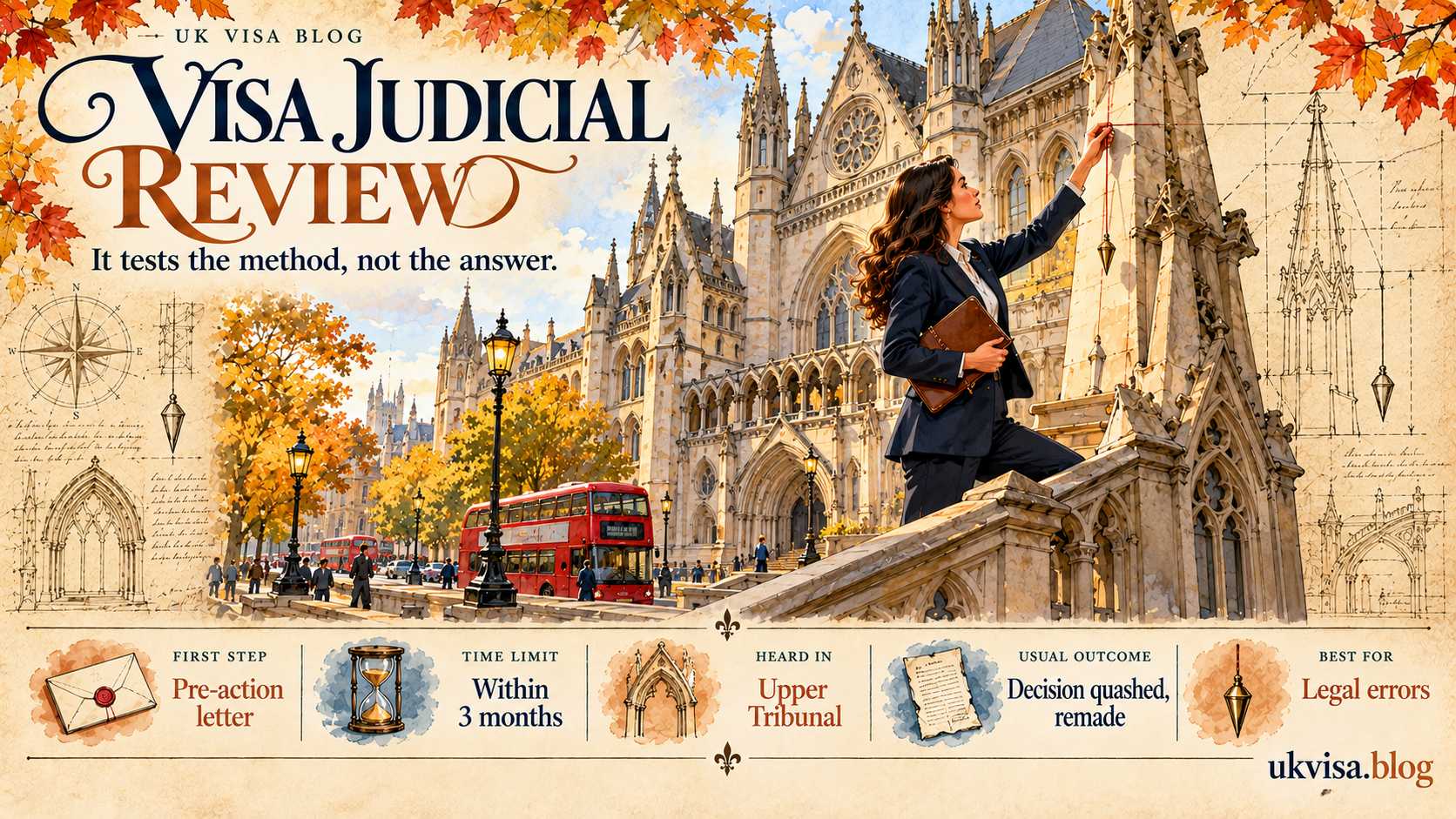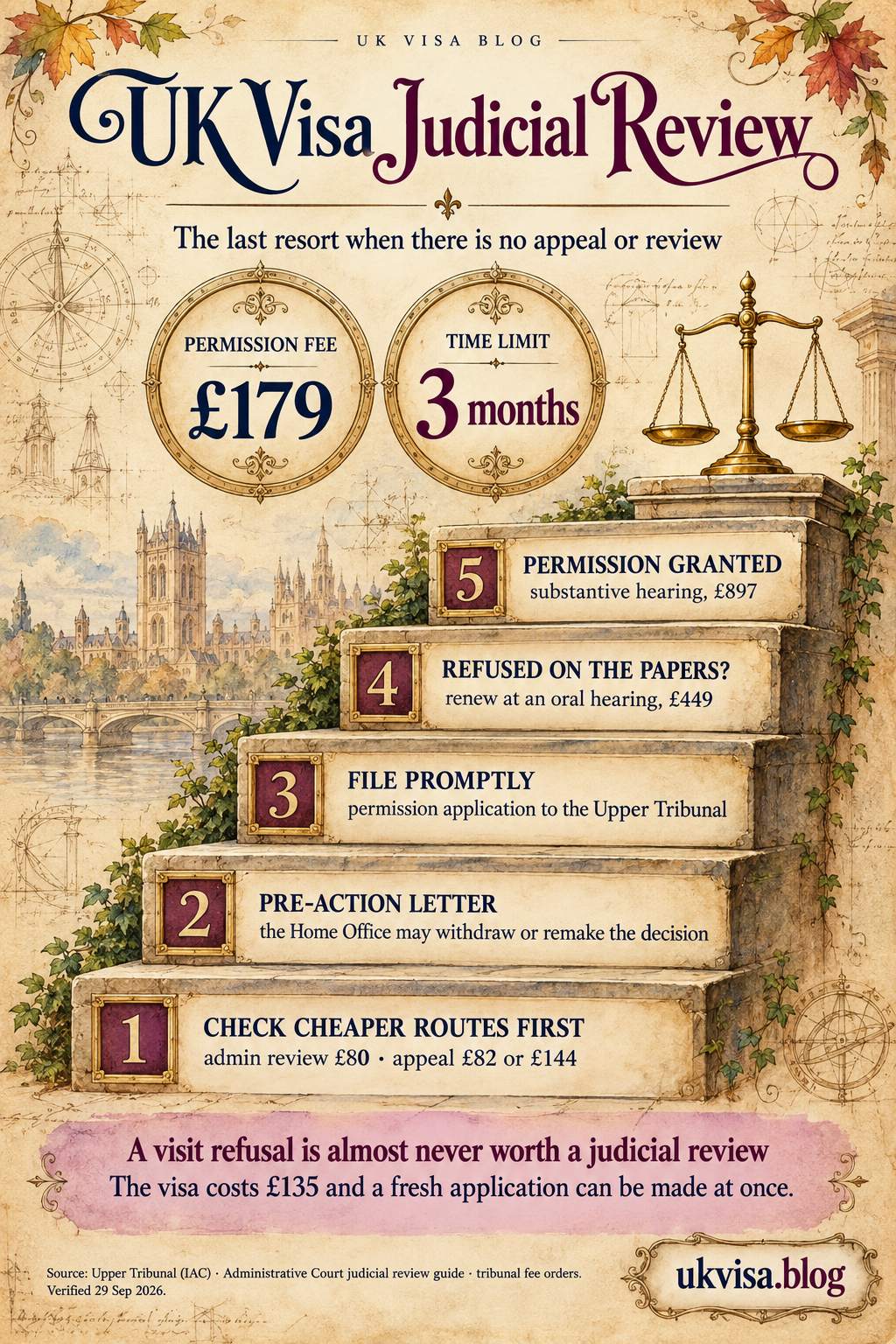
UK visa judicial review is the legal process for challenging unlawful Home Office immigration decisions. It tests the lawfulness of the decision — not whether it was correct. JR is the only remedy where no statutory appeal right exists, including for UK visitor visa refusals, 10-year deception bans, and most post-administrative-review refusals. The mandatory first step is the Pre-Action Protocol (PAP) letter, sent free to [email protected]; about 30% of UK visa PAP cases settle here without court. If PAP fails, the claim is filed under Civil Procedure Rules Part 54. This guide covers PAP, the four grounds, fees, success rates, time limits, and visit-visa JR.
Source: Civil Procedure Rules Part 54; Home Office judicial review caseworker guidance; Upper Tribunal (Immigration and Asylum Chamber) Procedure Rules 2008; HMCTS UTIAC fee forms (UTIAC1 dated 11.25, UTIAC11 dated 04.25); Senior President of Tribunals statistics 2024-2025
Judicial review is the primary remedy for unlawful Home Office decisions in 2026. PAP: mandatory; sent free to [email protected]; 14-day response; ~30% of cases settle here.Court fees: £174 initial (UTIAC1, uprated Nov 2025 from £169); £438 oral renewal; £874 substantive — £1,048 minimum total. Stage success rates: PAP 30%; permission paper 26%; oral renewal 92%; substantive 46%. Forum: most immigration JRs in the Upper Tribunal; complex cases may transfer to the Administrative Court. EX160 fee remission for low-income applicants; Section 3C leave protects in-country applicants. Immigration was ~36% of JR cases in Q1 2025.

- What is UK Visa Judicial Review?
- Four Grounds for UK Visa Judicial Review
- Pre-Action Protocol (PAP) Letter — Mandatory First Step
- PAP Success Rate ~30% and Response Time 14 Days
- What to Include in a PAP Letter
- Judicial Review for Visit Visa Refusal
- UK Visa Judicial Review Procedure — 5 Stages
- Judicial Review Court Fees 2026
- Immigration Judicial Review Success Rates
- Time Limits — 3 Months and Promptness
- Section 3C Leave During Judicial Review
- Frequently Asked Questions
UK Visa Judicial Review 2026 — PAP, Court Fees, Procedure, and Success Rates
UK visa judicial review (JR) is the legal procedure for challenging the lawfulness of UKVI and Home Office immigration decisions in court. Unlike administrative review or statutory appeal — which examine whether a decision was correct — JR examines whether it was made lawfully, applying public law principles. It is the only remedy where no appeal or administrative review right exists, including for most visitor visa refusals, 10-year deception bans, certain ETA refusals, and post-AR Points-Based System decisions. Immigration JRs are heard primarily in the Upper Tribunal. The mandatory first step is the Pre-Action Protocol (PAP) letter — about 30% of UK visa PAP cases settle here, avoiding full proceedings.

What is UK Visa Judicial Review?
UK visa judicial review is a court procedure allowing individuals to challenge the lawfulness of Home Office and UKVI immigration decisions. It focuses on the process — not the merits. JR is the primary remedy where no statutory appeal right exists — for most Standard Visitor visa refusals, refusals subject to a 10-year deception ban, certain ETA refusals, and Points-Based System refusals after administrative review. Most immigration JRs are heard in the Upper Tribunal, which handles around 36% of JR applications.
Four Grounds for UK Visa Judicial Review
The four grounds for UK visa judicial review are: (1) Illegality — the decision-maker acted outside their legal powers or misapplied the Immigration Rules. (2) Irrationality (Wednesbury unreasonableness) — so unreasonable no reasonable authority could have made it. (3) Procedural unfairness — failure to give reasons, bias, ignoring evidence, or denial of a fair hearing. (4) Human rights violations — breaching ECHR rights, particularly Article 8 or Article 3, under the Human Rights Act 1998. You must demonstrate one or more to succeed.
Ground 1 — Illegality
Illegality occurs when the decision-maker acts outside their legal powers or misinterprets the law they must apply. In immigration cases, illegality commonly includes: misapplication of the Immigration Rules (applying the wrong paragraph or misinterpreting requirements); acting beyond statutory powers under the Immigration Act 1971; fettering of discretion (rigidly applying policy without considering individual circumstances); and failing to apply published Home Office policy or caseworker guidance that should have been considered. Illegality is one of the most commonly invoked judicial review grounds in immigration cases, because UKVI caseworkers frequently misapply complex Immigration Rules.
Ground 2 — Irrationality (Wednesbury Unreasonableness)
Ground 3 — Procedural Unfairness
- Failure to give adequate reasons: Refusal letters that fail to explain why specific evidence was rejected or how the decision was reached
- Bias or appearance of bias: Decision-maker had a personal interest, predetermined outcome, or appearance of bias
- Failure to consider relevant evidence: Ignoring documents, submissions, or evidence provided in support of the application
- Breach of legitimate expectation: Not following a published policy, promise, or established practice the applicant relied upon
- Denial of fair hearing: Not giving the applicant an opportunity to respond to adverse information (particularly relevant for deception findings — see Balajigari case law)
- Failure to make further enquiries: Not seeking clarification on points the decision-maker found unclear
Ground 4 — Human Rights Violations (Human Rights Act 1998)
The Human Rights Act 1998 provides additional grounds where a decision violates European Convention on Human Rights provisions. Most commonly: Article 8 (private and family life) — raised in family separation, deportation, and removal cases involving an active re-entry ban; Article 3 (inhuman treatment); and Article 6 (fair trial). For the family / private life framework, see our Article 8 ECHR rights guide. Many such claims go via First-tier Tribunal appeal — such as a spouse visa human rights appeal — with JR reserved for where no statutory appeal exists.
Pre-Action Protocol (PAP) Letter — Mandatory First Step
The Pre-Action Protocol (PAP) letter is a mandatory first step before filing UK visa judicial review proceedings. It is sent free to [email protected] and gives the Home Office 14 days to respond. PAP for UK visa cases has an approximate 30% success rate — nearly one-third settle at this stage without court. The letter must set out the decision challenged, the legal grounds, and the remedy sought. Failure to follow PAP can result in cost penalties even if the JR succeeds.
PAP Success Rate ~30% and Response Time 14 Days
The Pre-Action Protocol success rate for UK visa cases is approximately 30% — roughly one-third of immigration JR cases settle at the PAP stage, where the Home Office reconsiders or withdraws the decision. The standard UK PAP response time is 14 days. The Home Office team at [email protected] responds within this window. If none arrives, or it is unsatisfactory, you can file the JR claim. PAP is the most cost-effective way to resolve disputes without court fees.
Understanding the Pre-Action Protocol success rate is essential when deciding whether to pursue judicial review. Approximately 30% of immigration PAP letters result in a favourable outcome — the Home Office withdraws the decision, agrees to reconsider, or offers a settlement. This makes the PAP stage a crucial opportunity to resolve disputes without the expense and delay of court proceedings. For broader context on Home Office decision-making patterns, see our UK visa approval rates and refusal patterns guide.
Why the PAP Success Rate Is ~30%
- Fresh senior caseworker review: PAP letters trigger a fresh assessment by a senior caseworker — often catching errors the original caseworker made
- Home Office cost avoidance: Defending JR is expensive — settling at PAP saves substantial Home Office legal costs and adverse cost awards
- Error identification: Well-drafted PAP letters highlight genuine errors the Home Office will concede — failure to consider evidence, misapplication of rules, procedural unfairness
- New evidence with PAP: Sometimes additional evidence submitted with the PAP letter changes the assessment
- Avoiding precedent risk: Some cases would set unfavourable precedents if defended — the Home Office may settle to avoid the legal exposure
Possible Home Office PAP Responses
| Response Type | What It Means | Next Step |
|---|---|---|
| Agree to reconsider | Home Office withdraws decision and agrees to make fresh determination | Wait for fresh decision; JR proceedings paused or withdrawn |
| Defend the decision | Home Office maintains its position; explains why the decision was lawful | Consider filing JR claim if grounds remain |
| Request extension | Complex case; Home Office requests more time to respond | Agree only if reasonable; preserve JR time limits |
| No response | 14-day deadline passes without substantive response | Proceed to file JR claim |
| Settlement offer | Home Office offers compromise (e.g. priority reconsideration) | Negotiate or accept; document agreement formally |
What to Include in a PAP Letter
A well-drafted PAP letter must contain: claimant details (name, date of birth, nationality, Home Office reference); decision challenged (date and specifics); legal grounds (illegality, irrationality, procedural unfairness, or human rights); remedy sought (typically withdrawal and reconsideration); supporting documents; and response deadline (standard 14 days). It is sent free to [email protected]. A poorly drafted PAP weakens settlement prospects and may attract cost penalties in subsequent JR proceedings.
- PAP Fee: FREE — no cost to submit the letter
- Send To: [email protected]
- Response Time: 14 days from Home Office (standard); shorter for urgent cases
- Success Rate: Approximately 30% of UK visa PAP cases settle at this stage
- Mandatory: Must send PAP before filing JR (except genuine urgency)
- Claimant details: Full name, date of birth, nationality, Home Office reference
- Decision challenged: Date and specifics of the decision under challenge
- Legal grounds: Illegality, irrationality, procedural unfairness, or human rights
- Remedy sought: Withdrawal of decision and reconsideration; or other specific remedy
- Supporting documents: Decision letter, key evidence, expert reports if relevant
Judicial Review for Visit Visa Refusal
Judicial review is the primary remedy for UK visit visa refusals because Standard Visitor visa applicants have no statutory appeal right. However, it is challenging, because courts give significant deference to Entry Clearance Officers. You must show the decision was unlawful — not simply that you disagree. Common grounds: evidence ignored by the ECO; misapplication of Appendix V; irrational reasons; procedural unfairness. For many refusals, a fresh application is more practical than JR — see refusal recovery and reapplication strategy.
UK Visa Judicial Review Procedure — 5 Stages
The UK visa judicial review procedure runs in 5 stages under Civil Procedure Rules Part 54. Stage 1: PAP letter — FREE; 14-day response. Stage 2: file claim (Form N461 + N462) — £174. Stage 3: permission on paper — a judge decides if the claim is arguable (2-3 months). Stage 4: oral renewal if refused on paper — £438 (4-6 weeks). Stage 5: substantive hearing if permission granted — £874 (3-6 months). Total contested duration: 9-12 months.
JR Procedure Stage-by-Stage
| Stage | Action | Court Fee | Typical Duration |
|---|---|---|---|
| 1 — PAP | Send PAP letter to [email protected] | FREE | 14 days response window |
| 2 — File claim | Form N461 + Form N462 + supporting bundle | £174 | 3 months from decision (strict) |
| 3 — Permission (paper) | Judge reviews paper application | (included) | 2-3 months |
| 4 — Oral renewal | If refused on paper, request oral hearing | £438 | 4-6 weeks after request |
| 5 — Substantive hearing | Full court hearing if permission granted | £874 (reduced if oral renewal paid) | 3-6 months after permission |
Judicial Review Court Fees 2026
The Pre-Action Protocol (PAP) is free. Court fees in 2026: £174 initial application (uprated from £169 in November 2025); £438 oral renewal; £874 substantive hearing (reduced if the oral renewal fee was paid). Total minimum: £1,048 to full hearing. Legal representation: typically £10,000-£30,000 — separate from the original visa application fees. EX160 fee remission is available for low-income applicants. Adverse costs risk: if unsuccessful, you may be liable for the Home Office's costs — typically £5,000-£20,000+.
Court Fees Table — Judicial Review (2026)
| Stage | Fee | Form | Notes |
|---|---|---|---|
| Pre-Action Protocol (PAP) | FREE | Letter (no form) | Sent to [email protected] |
| Initial application | £174 | Form N461 + N462 | Required to file claim (uprated from £169, Nov 2025) |
| Oral renewal | £438 | Reconsideration form | If permission refused on paper (not available where TWM certified) |
| Substantive hearing | £874 | (automatic if permission granted) | Reduced if oral renewal fee already paid |
| Total minimum (full hearing) | £1,048 | — | Paper → permission granted → substantive hearing |
EX160 Fee Remission for Low-Income Applicants
Low-income applicants may qualify for court fee remission using Form EX160. Eligibility rests on either qualifying benefits (Income Support, income-based JSA, Pension Credit Guarantee Credit, low-income Universal Credit, income-based ESA) OR disposable capital below set thresholds (typically £4,250 single / £8,500 with partner, with higher allowances for older applicants). If successful, the applicant may pay no fee, a reduced fee, or have fees waived. EX160 can be filed before or alongside the JR claim. Remission covers HMCTS court fees only — not legal representation.
Cost Recovery if Successful
Successful claimants can typically recover their reasonable legal costs from the Home Office. The court assesses costs at the end — those incurred unreasonably or beyond what was needed may be reduced. Following the PAP and maintaining a properly pleaded case improves both success and full cost recovery. Failing to follow PAP may attract cost penalties even on a win. Adverse costs, if the claimant loses, typically range £5,000-£20,000+ depending on complexity and stage.
Immigration Judicial Review Success Rates
Immigration judicial review success rates vary by stage. PAP settlement: ~30% of UK visa PAP cases settle without court. Permission on paper: only 26% are granted. Oral renewal: a striking 92% succeed after paper refusal (up from 82% in 2022/23). Substantive hearing: ~46% allowed once permission is granted. The high oral renewal rate shows the value of oral hearings — cases that look weak on paper often persuade when argued before a judge. Overall, 15-20% of immigration JR cases ultimately succeed.
Immigration JR Success Rates by Stage (2024-2025)
| Stage | Success Rate | Outcome |
|---|---|---|
| PAP Settlement (Stage 1) | ~30% | Cases resolved without court proceedings |
| Permission on Paper (Stage 3) | 26% granted | 74% refused on paper |
| Oral Renewal (Stage 4) | 92% allowed | 8% dismissed (up from 82% in 2022/23) |
| Substantive Hearing (Stage 5) | 46% allowed | 54% dismissed |
| Overall JR Success | 15-20% | From filing to final outcome |
Time Limits — 3 Months and Promptness
Judicial review claims must be filed promptly and within 3 months of the decision. Courts interpret "promptly" strictly — within days or weeks, not months. Late claims may be refused even within the 3-month window if the delay was not justified. Time runs from the decision date. The PAP letter does NOT extend the limit — send it early enough to file in time. Urgent cases involving imminent removal can be filed the same day. See also our UK visa delay and processing time guides.
Section 3C Leave During Judicial Review
Section 3C leave automatically extends your leave while immigration applications, administrative reviews, appeals, and judicial reviews are pending — if your original application predated your previous leave expiring. You can lawfully remain throughout JR proceedings on the same conditions as before. It protects continuous residence toward indefinite leave to remain and applies to in-country routes such as the spouse visa. Section 3C does NOT apply if your leave had already expired when you applied — then you are an overstayer.
- UK visa judicial review challenges the lawfulness of Home Office decisions — not their merits
- Four grounds: illegality, irrationality (Wednesbury), procedural unfairness, human rights
- Pre-Action Protocol (PAP) is mandatory before filing JR — sent FREE to [email protected]
- Standard PAP response time: 14 days
- UK visa PAP success rate: approximately 30% of cases settle at this stage
- Court fees (2026): £174 initial, £438 oral renewal, £874 substantive hearing — £1,048 minimum total
- EX160 fee remission available for low-income applicants meeting benefit / capital thresholds
- Stage success rates: PAP 30%, permission paper 26%, oral renewal 92%, substantive hearing 46%
- JR is the primary remedy for visit visa refusals — but courts give deference to Entry Clearance Officers
- Most immigration JRs heard in Upper Tribunal (Immigration and Asylum Chamber); some transfer to Administrative Court
- Section 3C leave protects in-country applicants during JR if the original application was made in time
- Time limit: promptly and within 3 months — but courts interpret "promptly" strictly
- If successful: court quashes the decision and orders reconsideration; cannot grant a visa directly
- Immigration cases account for around 36% of all UK judicial review applications
Frequently Asked Questions about UK Visa Judicial Review
PAP stands for Pre-Action Protocol — a mandatory letter sent to the Home Office before filing UK visa judicial review proceedings. The PAP letter is sent free to [email protected] and sets out the decision being challenged, the legal grounds for unlawfulness, and the remedy sought. There is no fee for PAP submission. The Home Office has 14 days to respond. Approximately 30% of UK visa PAP cases settle at this stage without proceeding to court — making PAP the most cost-effective opportunity to resolve immigration disputes.
The Pre-Action Protocol (PAP) success rate for UK visa cases is approximately 30%. This means roughly one-third of immigration judicial review cases settle at the PAP stage — the Home Office withdraws or agrees to reconsider the decision without court proceedings. The remaining 70% of cases proceed to file a judicial review claim. The PAP success rate reflects how often the Home Office concedes when senior caseworkers review the case afresh in response to a well-drafted PAP letter — typically where genuine errors are identified, where defending JR would be expensive, or where settlement avoids precedent risk.
The standard UK PAP response time is 14 days from receipt of your Pre-Action Protocol letter. The Home Office PAP team at [email protected] should provide a substantive response within this timeframe. The response will typically agree to reconsider the decision, defend it, request more time, or fail to respond. If no response is received within 14 days, or the response is unsatisfactory, you may proceed to file the judicial review claim. For genuinely urgent cases — such as imminent removal from the UK — you can request a shorter response window, but document the urgency clearly.
There are no fees for the Pre-Action Protocol — PAP is completely free to submit. The PAP letter is sent by email to [email protected] at no cost. Court fees only begin when you file the actual judicial review claim: £174 for the initial application (Form N461), £438 for oral renewal (if permission is refused on paper), and £874 for the substantive hearing (reduced if the oral renewal fee was already paid). Total minimum court fees if proceeding to full hearing: £1,048. EX160 fee remission is available for low-income applicants.
Yes — judicial review is the primary remedy for UK visit visa refusals because visitor visa applicants have no statutory appeal right. However, it faces particular challenges, as courts give significant deference to Entry Clearance Officers. You must demonstrate the decision was unlawful — not simply that you disagree. Common grounds include the ECO ignoring evidence you submitted, misapplication of Appendix V, irrational reasons, or procedural unfairness. In many cases, a fresh application with stronger evidence is more practical than JR.
Immigration judicial review success rates vary significantly by stage. PAP settlement: approximately 30% of cases settle at this stage. Permission on paper: only 26% of applications are granted permission by a judge reviewing the papers. Oral renewal: a striking 92% succeed when applicants request oral renewal after paper refusal (up from 82% in 2022/23). Substantive hearing: approximately 46% are allowed once permission has been granted. Overall, 15-20% of immigration JR cases ultimately succeed. The high oral renewal success rate shows the value of requesting oral hearings if permission is refused on paper.
The Pre-Action Protocol is free. Court fees in 2026 are: £174 for the initial application (Form N461; uprated from £169 in November 2025), £438 for oral renewal (if permission is refused on paper), and £874 for the substantive hearing (reduced if the oral renewal fee was already paid). Total minimum court fees if proceeding to full hearing: £1,048. Legal representation typically costs £10,000-£30,000 additionally depending on complexity. EX160 fee remission is available for low-income applicants receiving qualifying benefits or with disposable capital below specified thresholds. Adverse costs risk if unsuccessful: £5,000-£20,000+.
If successful, the court typically quashes the unlawful decision and orders the Home Office to reconsider lawfully. It cannot grant you a visa directly — only require a new decision applying the law correctly. You may also recover your reasonable legal costs through a costs order. In some cases the court issues a declaration that the Home Office acted unlawfully, or a mandatory order requiring specific action. The Home Office must then reconsider — but the new decision is not automatically in your favour.
A contested UK visa judicial review typically takes 9-12 months from filing the PAP letter to substantive hearing outcome. Timeline by stage: PAP response 14 days; permission decision on paper 2-3 months after filing; oral renewal hearing 4-6 weeks after request; substantive hearing 3-6 months after permission granted. Cases that settle at the PAP stage conclude within weeks. Cases that settle at the permission stage (where the Home Office concedes after seeing the formal claim) conclude within 3-4 months. Cases that require oral renewal and substantive hearing run the full 9-12 month course.
Yes — Section 3C of the Immigration Act 1971 automatically extends your leave while immigration applications, administrative reviews, appeals, and judicial reviews are pending — provided your original application was made before your previous leave expired. It continues on the same conditions as your previous leave until proceedings conclude, so you can lawfully remain throughout the 9-12 months a contested JR takes. Section 3C does NOT apply if your previous leave had already expired when you applied — in that case you are an overstayer.
For the formal procedure rules, see Civil Procedure Rules Part 54 (judicial review). For Upper Tribunal Immigration and Asylum Chamber procedure, see the Upper Tribunal (Immigration and Asylum Chamber). For the Pre-Action Protocol framework, see the Home Office judicial review guidance Chapter 27. For fee remission via Form EX160, see get help with court fees.