
A visit refusal notice cites paragraph numbers, and those numbers tell you what actually went wrong. V 4.2 is the genuine visitor test with five limbs. V 4.3 governs third-party money. V 4.4 to V 4.6 set the prohibited activities and payment rules. Identify the limb, and the fix becomes obvious.
Refusals
UK Visit Visa Refusal Reasons and the Paragraphs Behind Them
What a Refusal Notice Is Telling You
Refusals fall into two families. Eligibility refusals mean you did not meet a requirement of the route — the paragraph will be from Appendix V. Suitability refusals mean something about your history or conduct, and those carry SUI paragraph numbers and, sometimes, a re-entry ban.
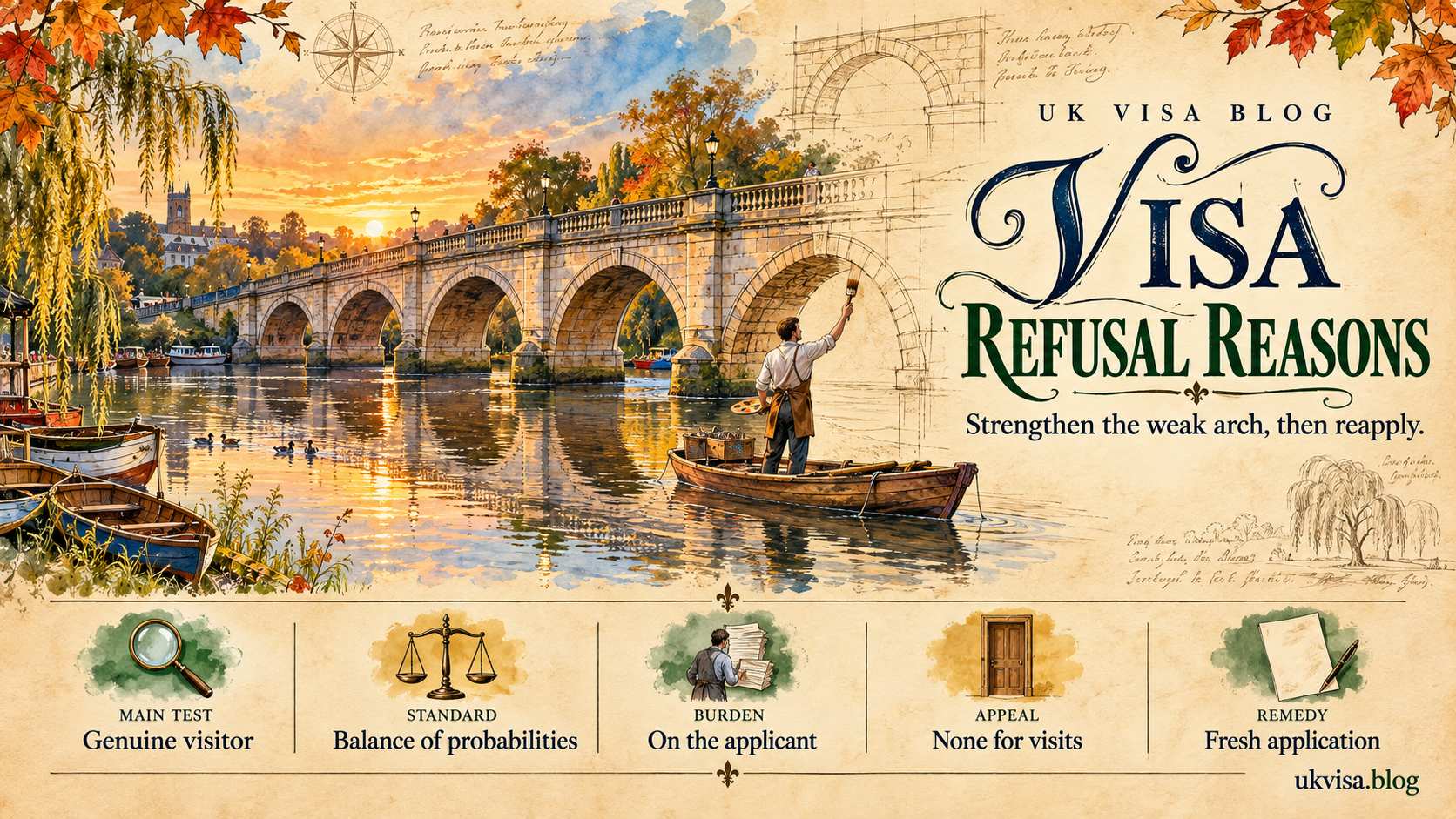
Most visit refusals cite V 4.2, the genuine visitor test: you will leave at the end of the visit, you will not live here through repeated visits, your purpose is permitted, you will do nothing prohibited, and you have sufficient funds. There is no right of appeal and no administrative review for visit refusals — the route is a fresh, better-evidenced application.
The burden sits on you to show you meet the validity and eligibility requirements, and the standard is the balance of probabilities. On suitability, where the Home Office alleges something, the burden may shift to them. That difference matters when you decide what a fresh application needs to prove.
V 4.2: The Genuine Visitor Test
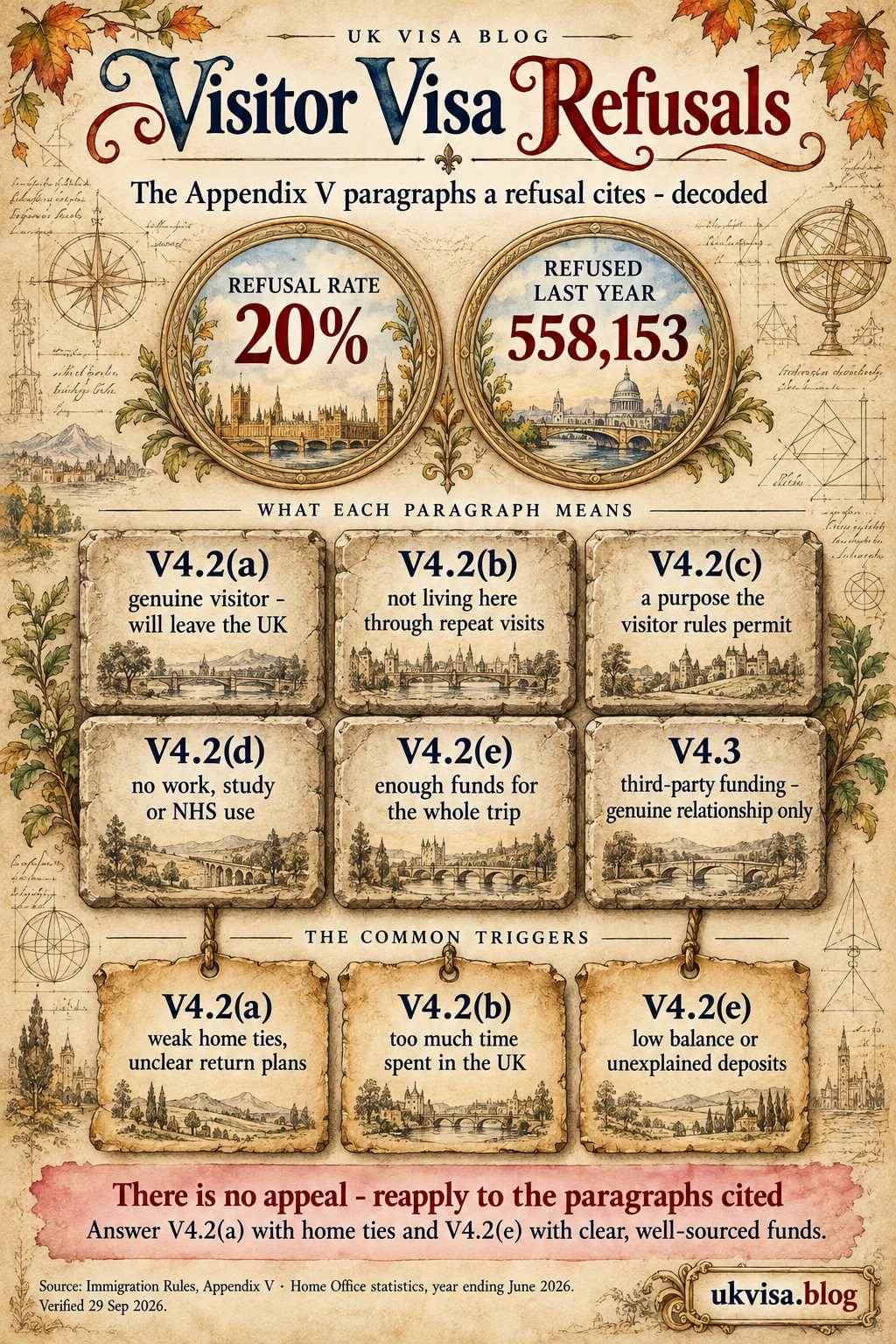
V 4.2 requires you to satisfy the decision maker that you are a genuine visitor. It has five limbs, and a refusal usually cites one or two of them. Each limb is a separate question with its own evidence.
V 4.2(a): You Will Leave at the End of Your Visit
The most cited limb and the hardest to evidence, because it is about intention. What answers it is ties: employment with a return date, a business, property, dependants remaining behind, fixed commitments. Assurances answer nothing. A checkable fact — leave approved to the fourteenth, term starting the fifteenth — answers a great deal.
V 4.2(b): You Will Not Live Here Through Repeated Visits
This limb catches long-term visa holders rather than first-time applicants. There is no annual day cap — guidance says no maximum period in any given window is specified. What is assessed is the pattern: more time here than at home, trips out used only to re-enter, a GP registration, children in UK schools, where you are registered for tax.
V 4.2(c): Your Purpose Is Permitted
You must genuinely be seeking entry for a purpose permitted under the route, as set out in the permitted activities appendix. A stated purpose that is not on the list fails here, and so does a purpose that is on the list but is not credible for the length of stay requested. Our page on what visitors may do lists them.
V 4.2(d): You Will Not Undertake Prohibited Activities
The prohibitions themselves live in V 4.4 to V 4.6. This limb is about intention to breach them. It is what a border officer relies on when baggage or an interview answer suggests work, and what a caseworker relies on when an application describes activities dressed up as something else.
V 4.2(e): You Have Sufficient Funds
You must have enough to cover all reasonable costs of the visit without working or accessing public funds, including the return or onward journey, any costs relating to dependants, and planned activities such as private medical treatment. Funds relied on must be held in a financial institution permitted under Appendix Finance.
The Five Limbs of V 4.2
| Limb | What it requires | What answers it |
|---|---|---|
| V 4.2(a) | You will leave at the end of the visit | Employment, property, dependants, fixed commitments abroad |
| V 4.2(b) | You will not live here through repeated visits | A travel pattern of short, spaced visits |
| V 4.2(c) | Your purpose is permitted and genuine | A specific, listed purpose matching the stay requested |
| V 4.2(d) | You will not do prohibited activities | An account consistent at application, border and extension |
| V 4.2(e) | You have sufficient funds | Six months of statements in a permitted institution |
Source: Appendix V of the Immigration Rules, checked 22 August 2026.
V 4.3 to V 4.6: Money, Work and Payment
V 4.3: When Third-Party Support Counts
Someone else may provide your travel, maintenance and accommodation only if they have a genuine professional or personal relationship with you, are not and will not be in breach of immigration laws at the date of decision or your entry, and can and will support you for the whole intended stay. Fail any of the three and the support does not count. See our page on sponsoring a visitor.
V 4.4: The Prohibited Activities
- Work: taking employment, working for a UK business, running a business as self-employed, a work placement or internship, direct selling to the public, or providing goods and services — unless expressly permitted.
- Study: except as the permitted activities allow, and meeting the additional study requirements.
- Medical treatment: other than private treatment or organ donation, each with its own extra requirements.
- Marriage or civil partnership: including giving notice, unless holding a Marriage or Civil Partnership visit visa or being a relevant national.
V 4.5: Filling a Role Is Not a Permitted Activity
Even a listed activity fails where it amounts to employment, or to filling a role or providing short-term cover within a UK organisation. Where the visitor is already paid and employed outside the UK, they must remain so. This is the paragraph that catches secondments dressed as business visits.
V 4.6: Payment From a UK Source
A visitor must not be paid from a UK source, with defined exceptions: reasonable travel and subsistence expenses including fees for directors at board meetings; certain drivers and seafarers; prize money; billing a UK client where your overseas employer is contracted to a UK company and most of the work is done overseas, at less than your salary; multinationals paying salaries from the UK for administrative reasons; paid performances at permit-free festivals; and permitted paid engagements.
Why Parent and Family Visits Fail More Often
Guidance names, as a reason to doubt a genuine visitor, having few or no family and economic ties in the country of residence while having several family members in the UK. A retired parent whose children have all settled here fits that description before a single document is read.
Where an applicant has previously been refused under the family rules and then applies as a visitor, the caseworker must assess whether the visitor route is being used to avoid the rules for family migrants joining British or settled people. Disclose the history and give the visit a defined purpose and a firm return date.
The counterweight is evidence of what remains abroad: a property, a pension, a spouse or another child, caring responsibilities, medical treatment continuing at home. Where the honest position is that a parent needs to live with you, the visit route is wrong and repeat applications damage the record.
Reading the Refusal Letter
- Find the paragraph numbers: V paragraphs are eligibility, SUI paragraphs are suitability.
- Identify the limb: a V 4.2(e) funds point needs different evidence from a V 4.2(a) intention point.
- Separate findings from observations: only the findings drive the decision.
- Look for a ban: a SUI 12.1 reference means a fixed period applies.
- Note anything factually wrong: a misread document is the strongest basis for a fresh application.
Our page on reading a refusal letter line by line works through a worked example, and our general grounds page covers refusals outside the visit route.
The Reasons That Recur
- Funds that appeared recently: a lump sum with no declared source invites checks on its origin.
- Undeclared third-party money: excluded from the assessment entirely where you cannot show it is yours.
- Discrepancies with the sponsor: particularly on facts the sponsor should know.
- A purpose that is not credible: or a stay length that does not match it.
- Unverifiable information: an employer or host who could not be reached.
- Previous deception: by you, your sponsor or an immediate family member.
When a Refusal Becomes a Ban
Most visit refusals carry no ban. Bans arise under the suitability rules — principally SUI 12.1, which runs twelve months for voluntary departure at your own expense, two or five years where the taxpayer paid depending on timing, five years where departure was a condition of a caution, and ten years for removal at public expense or for deception in an application.
Our pages on re-entry bans and the deception ban set out how each is calculated and when it starts running.
Eligibility and Suitability Are Not the Same Thing
Visit caseworker guidance states that where an applicant is assessed as not meeting the genuine visitor requirements under V 4.2 to V 4.3, that is distinct and separate from suitability under Part Suitability. A genuine visitor refusal is a failure to meet the rules, not a finding against your character, and carries no SUI ban.
That is worth holding on to when reapplying. The task is to supply the evidence that was missing, not to defend yourself. Where the refusal does cite a suitability paragraph — deception, criminality, a sham marriage finding — the task is different and professional advice is warranted.
Avoiding a Refusal in the First Place
Match every figure across the form, the statements and any host letter. Declare all third-party support. Explain any unusual deposit before you are asked. Request a stay length that fits the stated purpose. And leave out the documents GOV.UK lists as less useful — hotel and flight bookings, photographs, travel insurance, the sponsor’s utility bills.
Our supporting documents guide and application form walkthrough cover the detail, and our standard visitor page the route as a whole.
After a Refusal
Visit refusals carry no right of appeal except on human rights or discrimination grounds, and administrative review is not available for them. A fresh application answering the refusal notice point by point is the practical route, and there is no waiting period before making one.
Where a decision was unlawful rather than merely unwelcome, judicial review tests lawfulness rather than merits and is time-limited. Our pages on reapplying after refusal, administrative review and immigration appeals explain which applies where.
Sources: Appendix V of the Immigration Rules on GOV UK, Part Suitability of the Immigration Rules, and the Home Office visit caseworker guidance version 17.0 published 25 February 2026. Figures verified 22 August 2026.
Frequently Asked
Refusal Questions
What does a V 4.2(a) refusal mean?
The caseworker was not satisfied you would leave at the end of your visit. Answer it with evidence of what pulls you home — employment with a return date, property, dependants, fixed commitments.
Can I appeal a visit visa refusal?
Only on human rights or discrimination grounds. There is no general right of appeal and no administrative review for visit refusals. A fresh application is the usual route.
How soon can I reapply?
Immediately, unless a ban applies. But reapplying without new evidence answering the stated ground produces the same result and another refusal on your record.
Does a refusal ban me from the UK?
Not by itself. Bans arise under the suitability rules, principally SUI 12.1, and run from one to ten years depending on how you left the UK or whether deception was used.
Why was my parent refused when I can clearly support them?
Your ability to pay answers V 4.2(e). It does not answer V 4.2(a), which asks whether they will leave. Those need different evidence, and strong sponsorship can even sharpen the intention question.
My brother paid into my account. Why did that count against me?
Third-party support only counts where the relationship is genuine, the supporter is not in breach of immigration laws, and they can support you throughout. Undeclared money you cannot show is yours is excluded altogether.
Can I be refused for planning to work remotely?
Yes, where remote work is the real purpose. Working for an overseas employer is permitted as a secondary activity, but where a long stay is only affordable because you keep earning, that is treated as the primary purpose.
Do I have to declare a refusal from another country?
Yes. The question covers applications to any country. A declared refusal you can explain is far less damaging than an omission that surfaces on a records check.
Is a genuine visitor refusal the same as a suitability refusal?
No. Guidance states the two are distinct and separate. A genuine visitor refusal is an eligibility failure and carries no re-entry ban, though it must still be declared.
Should I use a lawyer to reapply?
For a straightforward funds or documents point, usually not. Where the refusal cites deception, criminality or a sham marriage finding, or where a ban is in play, take advice before applying again.