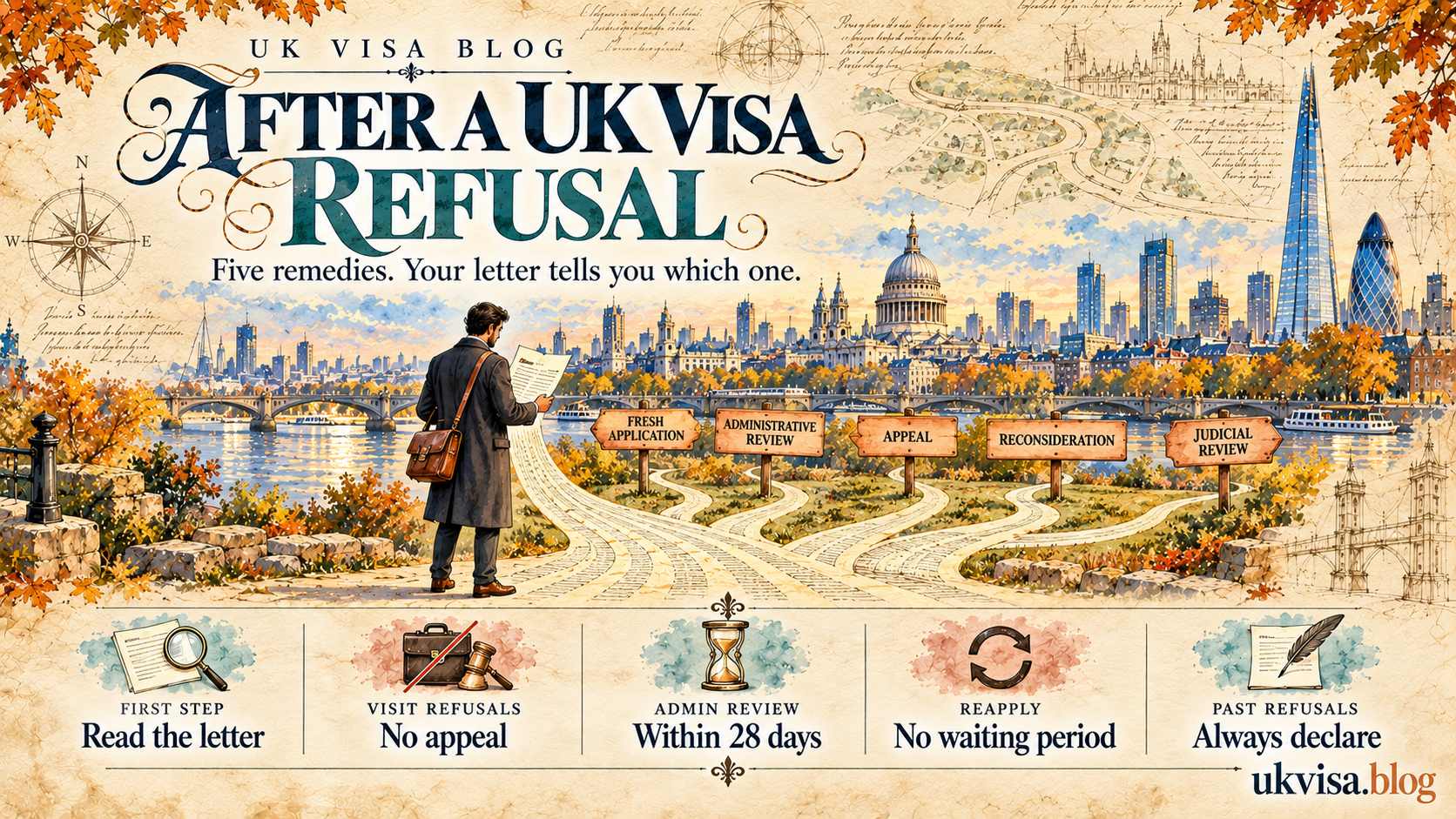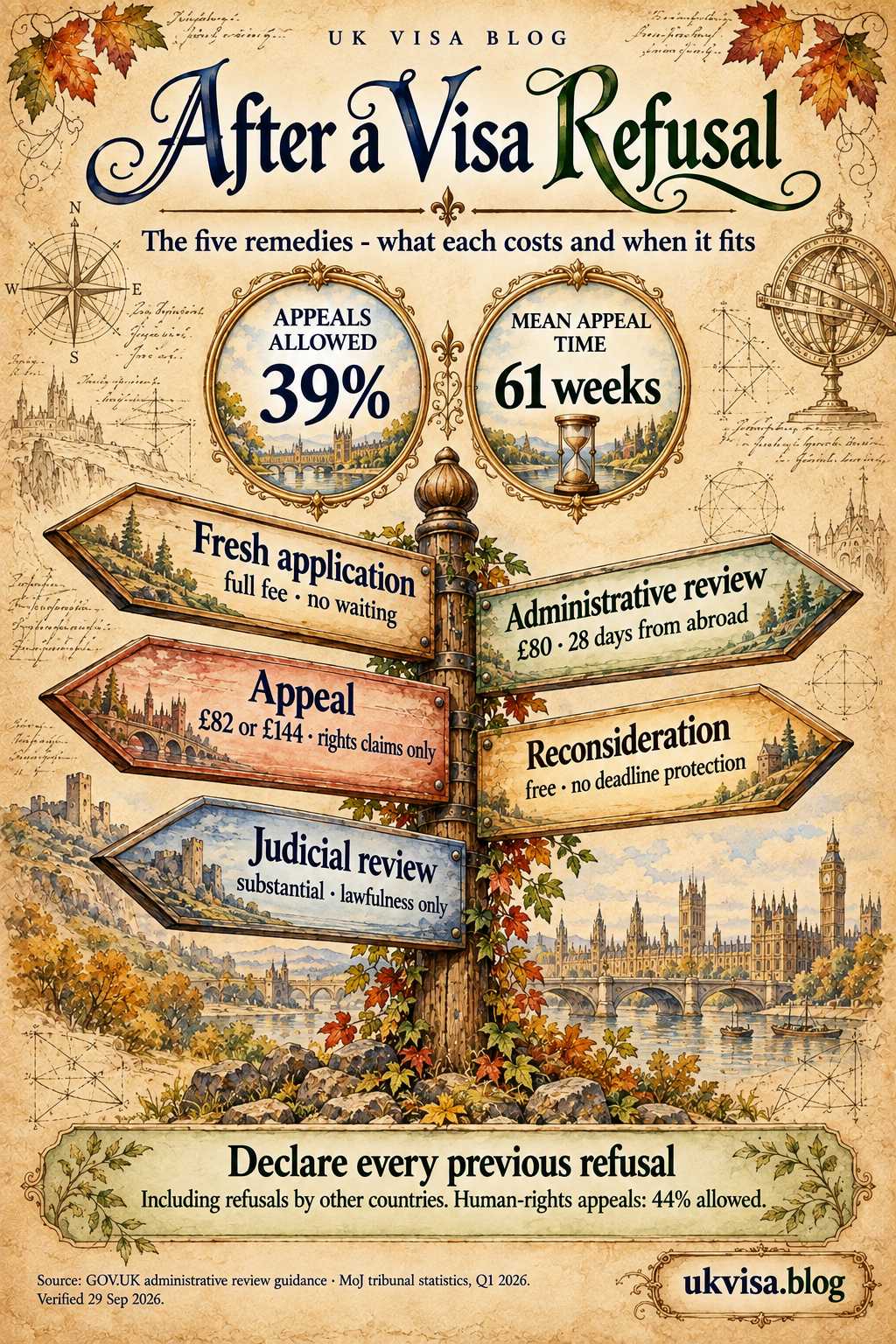
A UK visa refusal does not permanently bar you from future applications. Your chances of getting a UK visa after refusal depend on the specific refusal reasons, the visa category, and how effectively you address the concerns raised by UKVI. Five recovery options are available depending on circumstances: reapplication (immediate in most cases, high success when refusal reasons are addressed), administrative review (£80 fee, 8–25% success rate, Points-Based System decisions only), immigration appeal at the First-tier Tribunal (over 50% success for eligible human rights and protection cases), reconsideration request (informal, when new evidence emerges), and judicial review (last-resort legal challenge). This guide covers all five remedies, when each applies, and the strategic reapplication framework that maximises your chances of a successful UK visa application after refusal.
Source: Home Office Immigration Statistics, year ending September 2025; Ministry of Justice Tribunal Statistics; gov.uk caseworker guidance
Administrative review processing times have lengthened significantly — overseas applications now take 6 to 12 months, in-country applications 8 to 12 weeks. Some applicants whose original visa decisions are delayed beyond service standards receive UKVI's templated "exceptionally complex issues" email — these cases often end in refusal after the extended consideration. The £80 administrative review fee remains unchanged. EU Settlement Scheme administrative review rights were removed from 4 April 2024 — affected applicants must use judicial review instead. The First-tier Tribunal appeal fees remain £140 (paper) and £170 (oral hearing). 2026 application fees rose on 8 April: any reapplication will incur the new fee schedule (e.g. Standard Visitor £135, Skilled Worker £819 out-of-country, Spouse Visa £2,064 + IHS). The Pre-Action Protocol for Judicial Review must be issued before any judicial review claim is filed at the Upper Tribunal or Administrative Court.
- The Five Remedies Available After UK Visa Refusal
- UK Visa Success Rates by Remedy Type
- When to Reapply Immediately vs When to Wait
- Strategic Reapplication — Step-by-Step
- Administrative Review — Internal Caseworker Review
- Immigration Appeals at the First-tier Tribunal
- Reconsideration Requests
- Judicial Review and Pre-Action Protocol
- Multiple UK Visa Refusals — Strategy After 2 or 3 Refusals
- Refusal Recovery Decision Tree by Visa Category
- Frequently Asked Questions
Understanding Your Options After a UK Visa Refusal
A UK visa refusal triggers a formal decision notice and reasoning issued by UKVI, identifying which Immigration Rules requirement was not met. The refusal letter is the foundation of any recovery strategy — it tells you which remedy is available, the deadline for challenging the decision, and what evidence will be needed to address the concerns in any future application. Most importantly, the refusal letter dictates whether you have a right of administrative review, a right of appeal, or only the option to reapply. Understanding the common UK visa refusal reasons — insufficient financial evidence, doubts about genuine intentions, document authenticity, English language failures, and relationship credibility — is the foundation of any successful recovery strategy.
The Five Remedies Available After UK Visa Refusal
UK visa refusals can be challenged through five mechanisms: reapplication (a fresh application addressing refusal reasons), administrative review (internal Home Office review for caseworker error, Points-Based System only), immigration appeal at the First-tier Tribunal (limited to human rights and protection routes), reconsideration request (informal Home Office reconsideration when new evidence emerges), and judicial review (legal challenge on lawfulness, typically last resort). The correct remedy depends on your visa category, the refusal grounds, and whether the refusal letter grants an appeal or administrative review right.
| Remedy | Best For | Deadline | Fee |
|---|---|---|---|
| Reapplication | Documentation errors, changed circumstances, no AR/appeal right | Immediate (no waiting period unless banned) | Full application fee |
| Administrative Review | PBS caseworker error (Skilled Worker, Student, ILR refusals) | 14 days UK / 28 days overseas | £80 (refunded if successful) |
| Immigration Appeal | Human rights (Art 8 family) and protection refusals | 14 days UK / 28 days overseas | £140 paper / £170 oral hearing |
| Reconsideration Request | New evidence emerges, information overlooked | No formal deadline (act promptly) | No additional fee |
| Judicial Review | Legal error, no other remedy available | 3 months from decision date | £170 court fee + legal costs |
UK Visa Success Rates by Remedy Type
Reapplication success rates are high when refusal reasons are properly addressed with new evidence. Administrative review succeeds in approximately 8–25% of cases depending on visa category and decision type — recent independent analyses suggest in-country reviews succeed at 8–22% while out-of-country reviews vary 12–18%. Immigration appeals at the First-tier Tribunal succeed in over 50% of eligible human rights and protection cases. Judicial review permission-stage success is low on paper but rises significantly at oral hearings (where granted). Reconsideration requests have no formal success data — outcomes depend entirely on the strength of any new evidence.
Understanding realistic success rates by remedy type helps you choose the most effective path forward. For initial application approval and refusal statistics by visa category, see our analysis of UK visa refusal statistics by country.
| Remedy | Approximate Success Rate | Key Driver of Success |
|---|---|---|
| Reapplication | High when refusal reasons fully addressed | Quality and specificity of new evidence |
| Administrative Review (in-country) | 8–22% | Clear identification of caseworker error |
| Administrative Review (overseas) | 8–18% | Mathematical or documentary errors are strongest cases |
| First-tier Tribunal Appeal | 50%+ for eligible cases | Quality of legal representation and evidence |
| Reconsideration Request | Variable — no formal data | Strength of new evidence not previously available |
| Judicial Review — paper permission stage | Low (typically 10–20%) | Demonstrable legal error or procedural unfairness |
| Judicial Review — oral hearing stage | Higher (post-permission) | Arguable case on point of law |
Factors That Influence Your Chances of Success
- Nature of the refusal reason: Simple documentation gaps are easier to fix than credibility, deception, or genuine-intention concerns
- Quality of new evidence: Specific, targeted, well-organised supporting documents addressing each refusal ground
- Time since refusal: Genuine changes in circumstances (new employment, travel history, financial position) strengthen subsequent applications
- Visa category: Work and study routes have higher initial success rates; visitor routes face greater scrutiny on credibility
- Immigration history: Past compliance with visa conditions in the UK or other countries improves credibility
- Disclosure quality: Honest, complete disclosure of all prior refusals (failure to disclose triggers a 10-year 10-year deception ban consequences)
When to Reapply Immediately vs When to Wait
If your UK visa is rejected, you can reapply immediately in most cases — there is no mandatory waiting period unless you have been issued a re-entry ban (typically for overstaying, deception, or breach of conditions). However, immediate reapplication without addressing the refusal reasons will almost certainly result in another refusal. The key question is not "when can I apply again?" but "what new evidence can I gather to address the refusal reasons?"
Immediate Reapplication Scenarios — No Waiting Required
You can reapply as soon as you have addressed the refusal reasons if your refusal was due to:
- Missing or insufficient documentation: Submit a fresh application with the required evidence
- Unclear or inadequate financial evidence: Provide clearer bank statements, employer letters, and explanatory cover letter for any unusual transactions
- Insufficient ties to home country: Stronger evidence of employment continuity, property, family ties, or business commitments
- Technical application form errors: Correct the mistakes and resubmit
- English language test issues: Take an approved SELT test, ensure validity
- No right of administrative review or appeal: Reapplication is the only formal remedy
When Waiting Strengthens Your Reapplication
Strategic waiting is appropriate where:
- Your circumstances need to change: Building work experience, savings, travel history, or relationship duration takes time
- Credibility concerns were raised: Time to build a track record of compliance with visa conditions elsewhere helps rebuild trust
- Re-entry ban applies: Mandatory re-entry exclusion periods typically range from 1 to 10 years — you must wait until the ban expires
- Multiple refusals on similar grounds: Pattern recognition becomes a barrier; demonstrable change is essential
- You cannot yet address the refusal reasons: Reapplying without changes invites identical refusal and worsens the credibility record
Strategic Reapplication — Step-by-Step Approach
To maximise your chances of a successful UK visa application after refusal: analyse the refusal letter line-by-line, gather targeted evidence directly addressing each Immigration Rules failure, strengthen other areas of your application beyond just the cited problems, include a cover letter explaining how previous concerns have been resolved, and consider professional review before submission. Generic resubmission of the same evidence will almost always result in another refusal.
- Step 1 — Read the refusal letter carefully: Identify each Immigration Rules paragraph cited and the specific evidential gap or credibility concern
- Step 2 — Map evidence to each refusal ground: For each cited reason, prepare specific new evidence that directly addresses it
- Step 3 — Strengthen the application beyond cited issues: A reapplication is reviewed afresh — improve all areas, not just the failed ones
- Step 4 — Disclose the prior refusal: Mandatory disclosure in the application form, with a brief explanatory cover letter
- Step 5 — Include a reapplication cover letter: Explain how each previous concern has now been resolved with reference to the new evidence
- Step 6 — Consider professional review: Complex refusals (credibility, deception, repeated applications) benefit significantly from solicitor pre-submission review
- Step 7 — Pay the new 8 April 2026 application fees: Reapplication incurs full fees — see UK out-of-country visa fees for entry clearance or UK in-country Home Office fees for FLR / ILR / citizenship
Addressing Common Refusal Reasons in a Reapplication
| Refusal Reason | Specific Evidence to Address It in Reapplication |
|---|---|
| Insufficient funds | 6-month bank statements showing consistent income; explanatory letters for large or unusual deposits; payslips matched to bank credits |
| Doubts about return / genuine visit intention | Employment continuity evidence, property ownership documents, family responsibilities at home, detailed travel itinerary, return tickets |
| Spouse visa relationship credibility | Photographs across multiple time periods, communication logs (WhatsApp, video calls), joint financial commitments, visit history, witness statements |
| Document authenticity concerns | Certified translations, apostilled documents, verification letters from issuing authorities, original document submission |
| English language failure | Fresh SELT test from approved provider (IELTS UKVI, LanguageCert, Trinity, PSI Services) within validity period |
| Suitability concerns under Part 9 | Police certificates, court documents, sentencing details, evidence of rehabilitation — see discretionary refusal grounds under Part 9 |
Administrative Review — Internal Caseworker Review
Administrative review is an internal Home Office reconsideration available for Points-Based System decisions where you believe a caseworker error occurred. You must apply within 14 days if in the UK (7 days if detained) or 28 days if outside the UK. The fee is £80, refunded if the review succeeds. Critically, no new evidence can be submitted — the review assesses whether the original decision was made correctly based on the documents originally provided. Recent processing times have lengthened: overseas applications now take 6 to 12 months, in-country applications 8 to 12 weeks. Full procedure detail at our PBS administrative review procedure guide.
When Administrative Review Is the Right Remedy
- Skilled Worker, Student, or other PBS refusals: Where the refusal letter grants an AR right
- In-country ILR refusals: Where caseworker error in calculating residence, salary, or points
- Mathematical or documentary mistakes: Salary miscalculations, missed documents, points wrongly assessed
- No new evidence needed: The review is on the original application file only
- EU Settlement Scheme excluded: AR rights removed for EUSS decisions from 4 April 2024 — judicial review is the only remaining remedy
The official application route and current rules are set out at the GOV.UK guide on how to ask for a visa administrative review. The four possible AR outcomes under the Immigration Rules are: original decision withdrawn (visa granted, fee refunded); refusal upheld but reasons reduced; refusal upheld with different reasons; refusal upheld in full. Critically, even a successful AR can lead to a new refusal on different grounds if the reviewer identifies a separate Immigration Rules failure.
Immigration Appeals at the First-tier Tribunal
Immigration appeals at the First-tier Tribunal (Immigration and Asylum Chamber) are available for refusals engaging human rights (particularly Article 8 family and private life claims) or protection rights (asylum/humanitarian protection). Appeals allow new evidence and live witness testimony, with success rates exceeding 50% for eligible cases. Tribunal fees are £140 (paper consideration) or £170 (oral hearing). The 14-day (UK) or 28-day (overseas) deadline runs from the date you receive the refusal letter.
When You Have a Right of Appeal
- Human rights claim refused: Article 8 family life, including spouse visa, parent route, child route, and certain private life refusals
- Protection claim refused: Asylum, humanitarian protection, or revocation of refugee status
- EUSS decisions: Refusal or revocation of EU Settlement Scheme status carries a tribunal appeal right
- Deprivation of British citizenship: Tribunal appeal under section 40A British Nationality Act 1981
- Refusal letter must specify the appeal right: Most other visa refusals (visitor, work, student) do not carry a tribunal appeal — only admin review or reapplication
Tribunal appeals are heard at the First-tier Tribunal (Immigration and Asylum Chamber) — official information at the GOV.UK First-tier Tribunal Immigration and Asylum Chamber guidance. Tribunal judges are independent of the Home Office; they hear evidence afresh and can substitute their own decision. The appeal process from filing to hearing typically takes 6 to 12 months. Onward appeals to the Upper Tribunal require permission and are limited to errors of law.
Reconsideration Requests — Home Office Informal Review
A reconsideration request asks the Home Office to revisit a decision informally — typically when new evidence becomes available that was not provided with the original application. It is not a formal remedy under the Immigration Rules and there is no statutory timeframe for response. Reconsideration is most effective where you have compelling new evidence that would have changed the original decision had it been considered. Full procedure detail at our informal reconsideration request guide.
- When to use: Significant new evidence that materially affects the refusal reasoning
- No formal deadline: But act promptly — UKVI is more receptive shortly after the original decision
- No additional fee: Reconsideration requests are free
- Not a substitute for AR or appeal: Where AR or appeal is available, those formal remedies take priority — reconsideration does not pause AR/appeal deadlines
- No guaranteed response: UKVI is not legally obliged to respond — a fresh application or judicial review may ultimately be needed
Judicial Review and Pre-Action Protocol
Judicial review challenges the lawfulness of a Home Office decision rather than its merits — typically pursued when no other remedy is available and there are clear legal errors, procedural unfairness, or irrationality in the decision. You must issue a Pre-Action Protocol (PAP) letter before filing, and the 3-month time limit runs from the date of the decision. Judicial review is heard at the Upper Tribunal (Immigration and Asylum Chamber) for most immigration matters, with onward appeals to the Court of Appeal. Detailed procedure at our Pre-Action Protocol and judicial review guide.
- Legal challenge, not merits review: The court does not retake the decision — it reviews whether the decision was lawful
- Grounds: Illegality, irrationality (Wednesbury unreasonableness), procedural unfairness, or breach of legitimate expectation
- Pre-Action Protocol: Mandatory PAP letter before filing — Home Office has 14 days to respond
- 3-month time limit: From the date of the decision being challenged — strictly enforced
- Permission stage: Court grants permission to proceed if the case is arguable — paper permission success is low (10–20%); oral renewal can improve prospects
- Cost exposure: Loser typically pays winner's costs — judicial review carries significant financial risk
- Section 3C protection does not apply: Unlike admin review or appeal, judicial review does not extend leave to remain — you may not be able to work or study during proceedings
Detailed procedural rules for immigration judicial review are set out in the official Administrative Court Judicial Review Guide published by the Ministry of Justice. Most immigration judicial reviews are heard at the Upper Tribunal (Immigration and Asylum Chamber) rather than the Administrative Court, with onward appeals to the Court of Appeal on points of law only.
Multiple UK Visa Refusals — Strategy After 2 or 3 Refusals
Having your UK visa refused 2 or 3 times does not automatically disqualify you from future applications. However, each refusal increases scrutiny on subsequent applications and creates pattern-recognition concerns for caseworkers. Success after multiple refusals requires demonstrating genuine, significant changes in circumstances and comprehensively addressing every refusal reason from every prior application. Professional legal review becomes essential at this stage.
Impact of Multiple Refusals on Future Applications
- Increased caseworker scrutiny: Application is reviewed with greater attention to credibility and pattern of refusals
- Cumulative pattern concerns: Repeated similar applications may be viewed as evidence the applicant cannot meet the Immigration Rules
- Credibility damage: Multiple refusals can themselves become a refusal ground if caseworkers conclude genuine intentions are doubtful
- Visible immigration history: Caseworkers see all prior decisions, including refusal reasoning
- Cumulative cost: Each new application requires full fees at the current 8 April 2026 schedule — three full visitor visa attempts cost £405, three full skilled worker entry clearance attempts cost £2,457
Strategies After Multiple Refusals
- Seek specialist legal review: Complex immigration history with multiple refusals benefits significantly from solicitor assessment
- Allow material time to pass: Demonstrate genuine changes in employment, financial stability, family circumstances, or travel history
- Build positive immigration record elsewhere: Visa applications to Schengen, US, Canada, Australia and compliance with their conditions strengthens credibility
- Strengthen home-country ties: Document significant employment, property, business, or family commitments at home
- Consider alternative visa categories: A different route (e.g. Skilled Worker rather than visitor) may have requirements that better fit your circumstances
- Address every prior refusal reason explicitly: Each application is assessed against the cumulative refusal history — selective addressing fails
Refusal Recovery Decision Tree by Visa Category
- Standard Visitor / Short-Stay refusal: Reapply (no AR or appeal right) — focus on stronger ties evidence and clarity of visit purpose
- Skilled Worker / Health and Care Worker: Administrative review if caseworker error in CoS or salary calculation; otherwise reapply
- Student visa: Administrative review for caseworker error in CAS or financial evidence assessment; otherwise reapply
- Spouse / Family route: Appeal at First-tier Tribunal (Article 8 family life engaged); occasionally AR for PBS-specific elements
- Indefinite Leave to Remain (ILR): Administrative review for caseworker error; appeal if human rights engaged; UK immigration appeal procedure for tribunal cases
- British citizenship refusal: No appeal right — reconsideration request or judicial review for legal errors
- Asylum / Protection claim refusal: Appeal at First-tier Tribunal (Immigration and Asylum Chamber)
- EU Settlement Scheme: Judicial review only (AR rights removed 4 April 2024)
- Any decision with no AR or appeal right: Reapplication or judicial review (where legal error)
- Re-entry ban imposed: Wait until ban expires; consider Pre-Action Protocol for unlawful imposition
- A UK visa refusal is not permanent — five recovery remedies exist depending on visa category and refusal reasons
- You can reapply immediately in most cases; there is no mandatory waiting period unless a re-entry ban applies
- Administrative review costs £80 (refunded if successful), with 14-day UK / 28-day overseas deadlines
- Immigration appeals at the First-tier Tribunal succeed in over 50% of eligible human rights cases
- EU Settlement Scheme refusals lost AR rights on 4 April 2024 — judicial review is now the only remedy
- Mandatory disclosure of all prior refusals — failure to disclose triggers a 10-year deception ban
- Reapplication after refusal requires targeted new evidence addressing each cited Immigration Rules failure
- Multiple refusals demand specialist legal review and demonstrable change in circumstances
- Judicial review carries cost risk and a 3-month time limit — used as last resort or where no other remedy exists
- 2026 application fees apply to all reapplications under the 8 April 2026 fee schedule
Frequently Asked Questions About UK Visa Refusal Recovery
You can reapply immediately after a UK visa refusal in most cases — there is no mandatory waiting period unless you have been issued a re-entry ban for deception, overstaying, breach of conditions, or other serious immigration breaches. However, immediate reapplication without addressing the refusal reasons will almost certainly result in another refusal. The question is not really "when can I reapply?" but "what new evidence can I gather to address the refusal reasons?" Most successful reapplications occur within 1 to 6 months of the original refusal, with the time spent building the new evidence base.
Your chances of getting a UK visa after refusal depend on which remedy you use and how thoroughly you address the original refusal reasons. Reapplications with properly targeted new evidence have high success rates. Administrative reviews succeed in approximately 8–25% of cases depending on visa category and decision type. First-tier Tribunal appeals succeed in over 50% of eligible human rights cases. Judicial reviews succeed in around 10–20% at the paper permission stage but rise significantly where oral renewal is granted. The single biggest predictor of success is the quality and specificity of evidence addressing each original refusal ground.
Yes — you can reapply for a UK Standard Visitor visa after refusal, and reapplication is typically your only option as visitor visa refusals do not carry administrative review or tribunal appeal rights (only judicial review where there is a legal error). Focus on the specific concerns in your refusal letter: provide clearer financial evidence (6-month bank statements with explanations for unusual transactions), stronger evidence of ties to your home country (employment, property, family responsibilities), and a clearer trip purpose and itinerary. The 2026 Standard Visitor visa fee is £135 — the full fee applies to each reapplication.
Yes — a UK visa refusal creates a permanent record on your immigration history that caseworkers will see in future applications. However, it does not automatically disqualify you. The key is demonstrating that you have addressed the previous concerns with new evidence and that any underlying circumstances have changed. Critically, you must disclose every previous UK refusal — and any refusals from Schengen, US, Canada, Australia, New Zealand, or Ireland — in future applications. Failure to disclose constitutes deception under paragraph 9.7 of the Immigration Rules and triggers a mandatory 10-year ban from UK entry.
UK visa administrative review success rates vary significantly by category. Recent independent analyses suggest in-country administrative reviews succeed in approximately 8–22% of cases, while overseas reviews succeed in 8–18%. Administrative review only succeeds where you can demonstrate a specific caseworker error — mathematical mistakes, missed documents, incorrect points calculation, or procedural failures. Simply disagreeing with the decision is not sufficient. New evidence cannot be submitted at administrative review. The £80 fee is refunded automatically if the review succeeds.
UK visa appeal success rates at the First-tier Tribunal (Immigration and Asylum Chamber) exceed 50% for eligible cases. Appeals are limited to refusals engaging human rights (particularly Article 8 family and private life) or protection claims (asylum, humanitarian protection). Appeals allow new evidence and live witness testimony, with judges who are independent of the Home Office. Most spouse visa refusals where the relationship is real but caseworker doubts arose at decision stage can be successfully challenged on appeal. The appeal fee is £140 (paper) or £170 (oral hearing), with the case typically heard within 6 to 12 months of filing.
Yes — three UK visa refusals do not permanently bar you from future applications, but each refusal increases caseworker scrutiny on subsequent attempts. Success after three refusals requires demonstrating genuine, material changes in your circumstances and comprehensively addressing every refusal reason from every prior application. Professional legal review becomes essential at this stage — repeated similar applications without addressing pattern-recognition concerns will fail. Many applicants with multiple refusals succeed through alternative visa categories better suited to their circumstances, or after building substantial positive immigration history with other countries.
To increase your chances of a successful UK visa application after refusal, follow a structured approach: (1) Analyse the refusal letter line-by-line to identify each specific Immigration Rules failure cited; (2) Gather targeted new evidence directly addressing each refusal ground; (3) Strengthen all areas of your application, not just the cited problems; (4) Disclose the prior refusal honestly with an explanatory cover letter; (5) Allow genuine change in circumstances where credibility was questioned; (6) Consider professional solicitor review for complex cases. Generic resubmission of similar evidence will almost certainly result in another refusal.
You do not legally need a lawyer for any UK immigration recovery remedy. However, professional legal representation significantly improves outcomes in: appeals at the First-tier Tribunal (where legal arguments and procedure matter); judicial review (mandatory PAP letter, complex grounds, cost exposure); multiple refusals (pattern-recognition strategy); deception or suitability refusals; and EUSS judicial reviews. Simple administrative reviews (mathematical caseworker errors) and straightforward visitor reapplications often succeed without legal representation if the refusal reasons are clearly documentary or evidential rather than credibility-based.
For the formal Part 9 Immigration Rules grounds that govern refusal decisions, see the official Immigration Rules Part 9 — grounds for refusal. For UKVI processing times across all visa categories including refusal recovery routes, see standard processing timelines after biometrics submission.