
Most spouse visa refusals are evidential, not substantive. The couple is real and the sponsor earns enough — the papers simply fail to prove it in the form Appendix FM-SE demands. Knowing which kind of failure you have decides whether to appeal or to reapply.
UK Family Visas
Understanding UK Spouse Visa Refusal Reasons
Why Spouse Visa Applications Are Refused
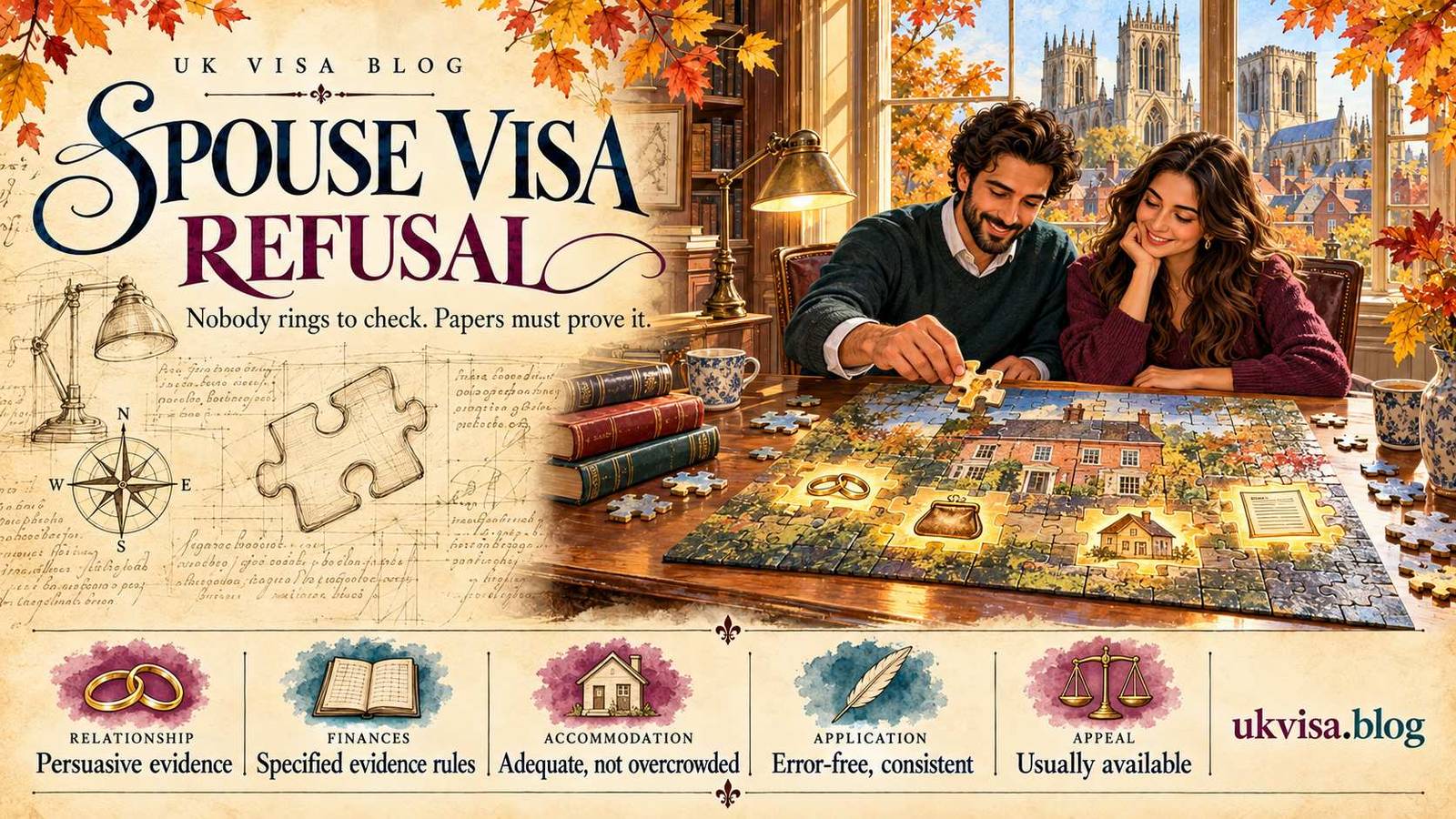
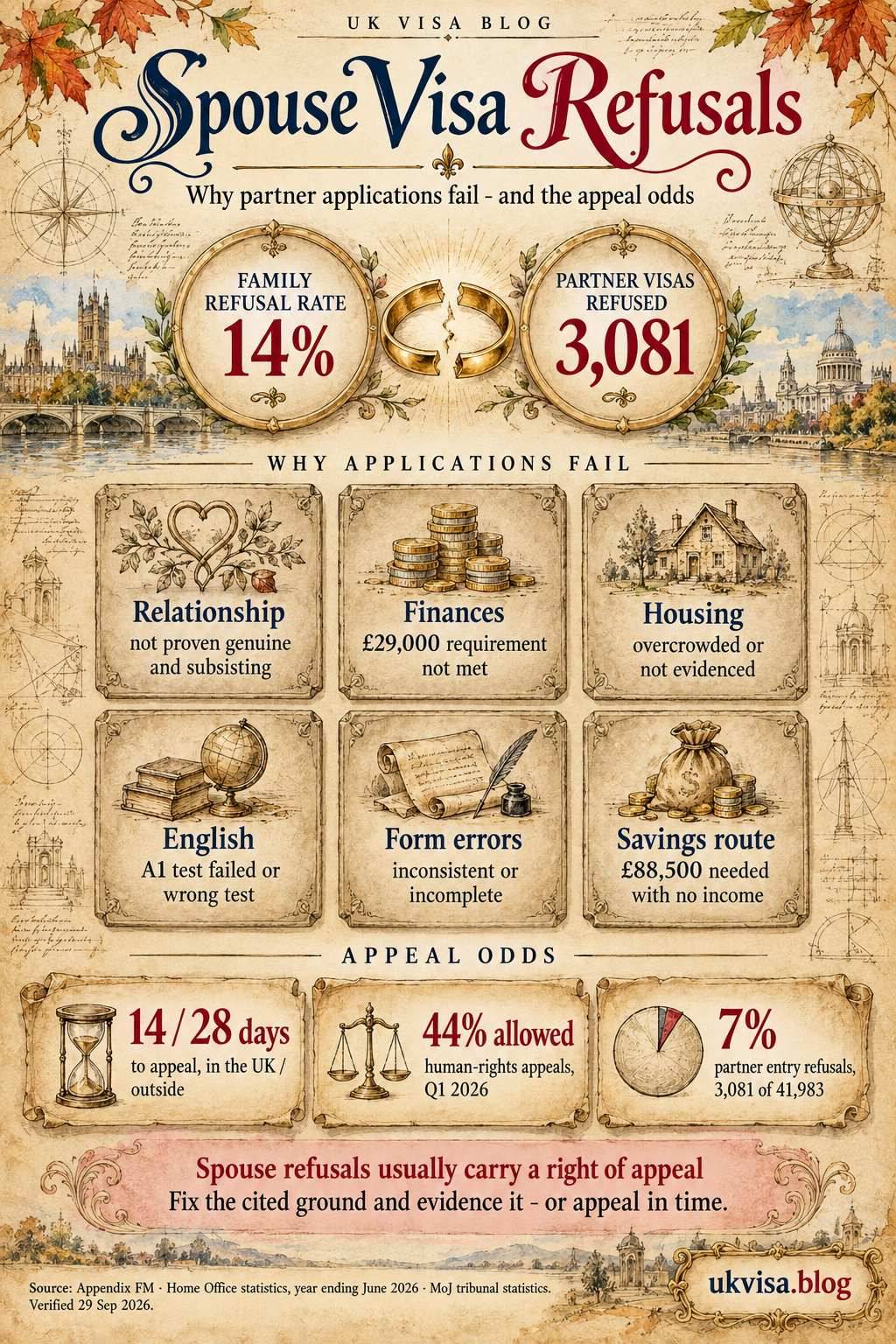
Refusals cluster in four places: relationship evidence that does not persuade, financial evidence that does not match the specified rules, accommodation that cannot be shown to be adequate, and errors inside the application itself. Family visa applications were granted at 86 per cent in the year to June 2026, so roughly one in seven fails — most of them avoidably.
A caseworker decides a UK family settlement visa application from the papers alone. Nobody rings your employer or your landlord. That single fact explains almost every refusal: an application that cannot be verified internally is refused, regardless of how true it is.
Refusals Carry an Appeal, Unlike Most Routes
A partner application under Appendix FM is a human rights claim, so refusing it is one of the three decisions that still attract a statutory appeal to the First-tier Tribunal. Your Home Office refusal notice sets out the right and the deadline — read it before doing anything else.
Accommodation Refusals
Accommodation must be adequate for the family, not statutorily overcrowded, and available at the date of application rather than in prospect. At least part of it must be for the family’s exclusive use — a bedroom is enough, and shared kitchens and bathrooms are fine. Our housing standards guide for partners covers the arithmetic.
- Overcrowding: the property breaches the room or space standard once the applicant moves in.
- No right to occupy: no tenancy agreement, deeds or owner’s consent letter in the bundle.
- Shared housing unexplained: living with extended family with nothing showing dedicated space.
- Prospective housing: a property still being looked for at the date of application.
- Inconsistent addresses: the form, the council tax bill and the tenancy disagree.
A property inspection report is often described as required. It is not — the Home Office guidance does not list it among the standard evidence. It earns its cost where the household is complicated, and it is wasted money where a tenancy agreement and a council tax bill would have answered the question.
Relationship Evidence Failures
This is the single most common ground. The caseworker guidance grades evidence in tiers, and applications built entirely from the weakest tier fail however thick the bundle. Our guide to proving a genuine and subsisting relationship works through the grading.
What Counts as Strong and Weak Evidence
| Category | Strong | Weak |
|---|---|---|
| Home | Joint tenancy or mortgage, council tax records | A statement saying you live together |
| Money | Joint account, regular transfers, policies naming both | No financial connection at all |
| Contact | Sustained records across the whole relationship | Sporadic messages from recent weeks |
| Time together | Several trips with tickets, stamps and photographs | One visit, or none |
| Third parties | Official documents naming both partners | Letters from friends and family alone |
Source: relationship with a partner caseworker guidance version 7.0, 8 October 2024.
Two further traps. Evidence clustered in the months before the application says nothing about the years before that. And contradictions between the partners’ accounts — how you met, when you decided to marry, what the plan is — do more damage than any gap, because they go to credibility rather than sufficiency.
Financial Requirement Failures
The threshold is £29,000 gross, unchanged since 11 April 2024, or £88,500 in savings held for six unbroken months. Announced rises to £34,500 and £38,700 were paused after the Migration Advisory Committee reported in June 2025. Our spouse visa income evidence guide covers each category.
- Wrong documents: the right income proved with papers the rules do not accept.
- Payslip and statement mismatch: a reimbursement or cash element that makes the figures disagree.
- Savings history: funds held under six months, or a balance that dipped once.
- Self-employment: net profit used instead of gross taxable profit, or the wrong financial year.
- Impermissible combination: savings added to Category F or G self-employment income.
- Third-party support: money from parents or relatives, which does not count.
Children Do Not Raise the Threshold
A persistent error, repeated on many advice sites: that £3,800 and £2,400 must be added for children. Those amounts belong only to the transitional £18,600 threshold, and even there the total is capped at £29,000. On the current threshold the figure is a flat £29,000 whatever the size of the family.
Transitional Protection
Where the first spouse, partner or fiancé(e) application predates 11 April 2024 and permission has been continuous with the same partner, £18,600 applies throughout the route to settlement. Any break in leave ends the protection and moves the case to £29,000.
Application Errors That Cause Refusals
These are the cheapest refusals to prevent and the most frustrating to receive, because none of them concerns whether you qualify. The bundle described in our UK Spouse visa supporting documents guide has to agree with itself at every point.
- Incomplete form: sections left blank or answered vaguely.
- Date conflicts: the form, the statements and the documents give different dates.
- Missing translations: non-English documents without a certified translation.
- Unsigned documents: employer letters or declarations without a signature.
- Expired evidence: an out-of-date English certificate or TB result.
- Undisclosed history: an earlier refusal or overstay left off the form — a credibility problem, not a paperwork one.
English Language Errors
A1 speaking and listening is required for the first application, from a UKVI-approved provider. Refusals come from taking a test that is not a SELT, sitting the wrong level, or relying on a certificate more than two years old. A certificate used in an earlier successful application can still be reused — see our A1 SELT requirement for partners guide.
Medical and Mental Health Grounds
Health is rarely a refusal ground and mental health is not one at all. The Immigration Rules do not permit refusal on the basis of a mental health condition, a disability or a chronic illness. The assessment is against the requirements of Appendix FM, not against the applicant’s health.
Where Health Does Matter
Two situations. Applicants from listed countries must produce a tuberculosis certificate from an approved clinic, and a failed or missing test invalidates the application. Separately, an active untreated notifiable infectious disease can engage the suitability rules on public health grounds.
Disability Helps Rather Than Hinders the Financial Test
Sponsors receiving Personal Independence Payment, Disability Living Allowance, Attendance Allowance, Carer’s Allowance and several related awards are exempt from the £29,000 threshold entirely. Adequate maintenance applies instead — a materially lower bar. A disability in the household is a route into the exemption, not a risk factor.
Extension and Settlement Refusals
Later stages fail for different reasons. The FLR(M) extension stage turns on whether the relationship and the finances have held; the SET(M) settlement stage adds knowledge requirements and a five-year evidential span.
- Relationship ended: evidence the couple has separated.
- English not met: A2 required, one level above the first application.
- Income fallen: the sponsor no longer reaches the threshold, and the applicant’s earnings do not close the gap.
- Applied late: submitted after the previous permission expired.
- Condition breached: unauthorised work or recourse to public funds during the earlier grant.
Settlement Refusals and the Absence Myth
Settlement adds B1 English and the Life in the UK test, unspent convictions, and a relationship that must still be subsisting after five years. What it does not add is a 180-day absence cap. Appendix Continuous Residence, which sets that limit, lists the routes it governs and Appendix FM is not among them.
On the five-year partner route absences are weighed rather than counted: the question is whether the relationship stayed genuine and the UK stayed your home. The 180-day rule does bite on the ten-year route, which falls under Appendix Settlement Family Life. Our UK long-term settlement guide sets out both.
What to Do After a Refusal
The choice is between appealing, reapplying and — where the route allows it — administrative review. Classify the error first, because each door answers a different kind of mistake and only one of them is open at a time.
Remedies and When Each Fits
| Remedy | Deadline | When it fits |
|---|---|---|
| First-tier Tribunal appeal | 14 days in the UK, 28 days outside | The caseworker misapplied the rules to evidence you actually sent |
| Fresh application | None | The bundle was incomplete — a tribunal cannot cure missing evidence |
| Administrative review | Stated in the refusal letter | Only where the decision is listed as eligible for review |
Source: GOV.UK immigration and asylum tribunal appeal pages, August 2026.
Appeal fees are £82 for a decision on the papers and £144 with a hearing, with exemptions for those on asylum support or legal aid. Our spouse visa appeal timeline and costs guide covers the procedure, and our general immigration appeal guide covers other categories.
Sources: Appendix FM of the Immigration Rules and Appendix FM-SE; Appendix Continuous Residence; the tribunal appeal pages on GOV.UK; Home Office guidance on relationship with a partner version 7.0 and the minimum income requirement version 13.0; and Home Office immigration statistics to June 2026. Figures verified 5 September 2026.
Frequently Asked
Questions about Spouse Visa Refusal Reasons
Relationship evidence that does not persuade, financial evidence that does not satisfy the specified rules, accommodation that cannot be shown to be adequate, and errors inside the application itself. Insufficient relationship evidence remains the single most common ground. Family visa applications were granted at 86 per cent in the year to June 2026, so roughly one in seven fails.
Yes. The property must be adequate, not statutorily overcrowded once the applicant arrives, and available at the date of application. You need evidence of a right to occupy — a tenancy, deeds or the owner’s consent — and a room that is exclusively yours. A property inspection report is not required, though it helps in complicated households.
Not on applications made on or after 11 April 2024. The requirement is a flat £29,000 however many children are included. The figures of £3,800 for a first child and £2,400 for each further child apply only within the transitional £18,600 threshold, and even there the total is capped at £29,000. Many advice sites still get this wrong.
No. Mental health history, disability and chronic illness are not grounds for refusing a partner application. Health matters in only two situations: a missing or failed tuberculosis certificate where the applicant applies from a listed country, and an active untreated notifiable infectious disease engaging the suitability rules on public health grounds.
The relationship no longer being genuine and subsisting, failure to reach A2 English, household income falling below the threshold, submitting after the previous permission expired, or breaching a condition of the earlier grant through unauthorised work or recourse to public funds. Both partners’ incomes count at this stage, which resolves many financial shortfalls.
Not on the five-year partner route. Appendix Continuous Residence sets that limit for the routes it lists, and Appendix FM is not one of them. Absences there are weighed against whether the relationship stayed genuine and the UK stayed your home. The 180-day rule does apply on the ten-year route, governed by Appendix Settlement Family Life.
Usually yes. A partner application under Appendix FM is a human rights claim, and refusing one carries a right of appeal to the First-tier Tribunal under section 82 of the Nationality, Immigration and Asylum Act 2002. The deadline is 14 days from receipt of the decision inside the UK and 28 days outside it. The refusal letter confirms the right.
£82 for a decision made on the papers and £144 for a decision with a hearing. Exemptions apply for people receiving asylum support or legal aid. Those are tribunal fees only — representation is separate, and an appeal takes months, so weigh it against a fresh application that could be decided in weeks on better evidence.
Appeal where the caseworker misapplied the rules to documents you actually submitted — a tribunal can correct that. Reapply where the bundle was incomplete, because an appeal defends the application you made rather than the one you wish you had made. Administrative review is available only where the refusal letter says the decision is eligible for it.