
A UK visitor visa sponsor is a third party providing maintenance or accommodation. One condition disqualifies them outright, several documents commonly sent are ones GOV.UK says not to use, and the formal undertaking most guides recommend is not accepted as evidence of support at all.

UK Short Stay Visas
Understanding UK Visitor Visa Sponsor Support 2026
What a Visitor Visa Sponsor Actually Is
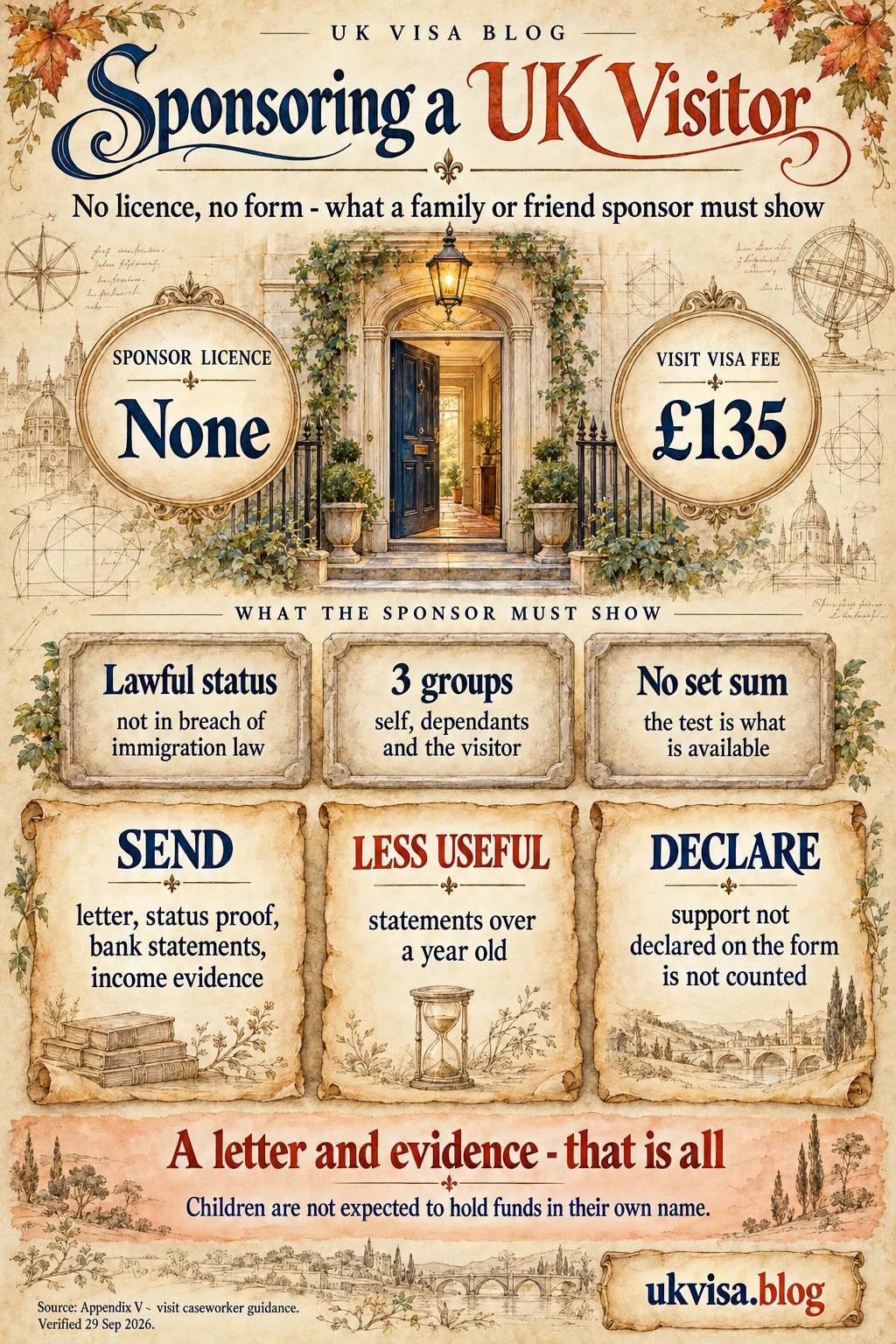
A third party — family, a friend or a professional contact — providing maintenance, accommodation or both for someone applying for a Standard Visitor visa. There is no sponsor licence and no Home Office form. The relationship must be genuine, and if the sponsor is in the UK they must not be in breach of immigration law at the date of decision, or their support is disregarded entirely.
Appendix V permits maintenance and accommodation to be provided by a third party. What the caseworker assesses is whether the relationship is real and whether the sponsor can actually afford it — not whether a particular form has been filed, because there isn’t one.
The Sponsor Must Fund Three People, Not One
The guidance requires a sponsor to satisfy the caseworker they have enough funds to support themselves, anyone normally dependent on them, and the visitor. A sponsor whose income comfortably covers their own household but leaves nothing spare does not meet it, however willing they are.
Their own history matters too. Previous failures to support visitors they sponsored are expressly listed as a reason to doubt both intention and ability this time.
Evidence the Sponsor Is Not in Breach of Immigration Law
This is the most-searched question about visitor sponsorship, and the answer is simpler than the search volume suggests. The rule is at V 4.3: where the third party is in the UK, they must not be in breach of immigration law at the time of the decision or of the visitor’s entry. Where they are, the support must be disregarded.
The Exact Form Wording, Decoded
The upload slot on the online form is labelled “evidence that your sponsor is not, or will not be, in breach of UK immigration laws at the time of your visit”. In plain terms it wants one document proving your sponsor’s own status in the UK — nothing about their money, which belongs under the maintenance heading. Pick the single item from the list below that matches your sponsor and upload it in that slot.
- British or Irish citizen: the passport bio-data page — sufficient on its own.
- Indefinite leave to remain: an eVisa share code, or a biometric residence permit where one was issued.
- EU Settlement Scheme: a digital status share code, or the Home Office decision letter.
- Limited leave: an eVisa share code showing permission valid across the visit dates.
- Resolved past breach: the above, plus documents showing how and when it was resolved.
Note what is not asked for. The requirement is proof of current lawful status, not proof of innocence, and most sponsors satisfy it with a single page. A solicitor’s letter is needed only where there is a history that requires explanation.
The Sponsor Letter
There is no prescribed form, so the letter is judged on content. Its job is to explain who the sponsor is, how they know the applicant, what support is being provided and how it will be paid for — and to be consistent with everything else in the application.
- Identity and address: the sponsor’s full name, UK address and contact details, signed and dated.
- Status: British or Irish citizen, settled, or the permission held and its expiry.
- Income: job title, employer, length of service and income — with the evidence attached.
- Relationship: how you know each other, for how long, and how you keep in contact.
- Purpose and dates: the specific reason for the visit and the intended period.
- Support: exactly what is covered — accommodation, living costs, travel, the fee.
- Accommodation: where the visitor will stay and the sponsor’s right to offer it.
Sample Sponsor Letter
Use this as a structure, not a script. Replace every bracketed field with your own facts and attach the documents the letter refers to. A letter that claims income the payslips do not show does more damage than no letter at all.
[Sponsor full name]
[UK address]
[Telephone] · [Email]
[Date]
To the Entry Clearance Officer
Re: Visit visa application by [Applicant full name], date of birth [DOB], passport number [number]
I am writing in support of the above application. I am a [British citizen / settled person / holder of leave to remain valid until DD Month YYYY] and I live at the address shown above. I have enclosed [passport biodata page / BRP / share code] as evidence of my status.
[Applicant] is my [relationship]. We have known each other since [year] and keep in contact by [telephone, video calls, visits]. I last saw [him/her] in [month, year] in [country].
I am inviting [Applicant] to visit me from [arrival date] to [departure date], a stay of [number] days, for the purpose of [specific reason]. [He/She] will stay with me at my home address, where [he/she] will occupy [describe the room]. I own / rent this property and have enclosed [mortgage statement / tenancy agreement] confirming this.
I am employed as [job title] at [employer] and have been since [month, year]. My gross annual income is [amount]. I have enclosed [number] months of payslips and corresponding bank statements. I will meet the cost of [accommodation / living costs / return airfare / all costs] during the visit, and I confirm I can do so without recourse to public funds.
I confirm the information above is true and that I understand [Applicant] must leave the UK at the end of the visit.
Yours faithfully,
[Signature]
[Sponsor full name]
Two things to leave out. Do not offer a formal maintenance undertaking unless one has been requested — caseworkers are not expected to accept an unsolicited offer of one, and it adds nothing. Do not pad the bundle with photographs together, utility bills or council tax bills; they are not treated as useful evidence of the relationship or the finances.
Friend Sponsors Face the Questions the Guidance Names
Where the sponsor is a friend rather than a relative, the guidance tells caseworkers what to test: where and how the two of you met, and how often and by what method you communicate. Answer both in the letter rather than waiting to be asked, because a friendship that cannot be described concretely is the weakest link in these applications.
The Paragraph 35 Undertaking
An undertaking under paragraph 35 of Part 1 of the Immigration Rules is a formal promise to maintain and accommodate someone without recourse to public funds. It is real, it can be required by a caseworker, and the cost of any public funds claimed may be recovered from the person who gave it.
The visit guidance is explicit: an undertaking offered in support cannot be treated as a guarantee that the visitor will comply, caseworkers “should not actively seek out such an undertaking or accept an offer to provide one”, and where one is supplied it “should not be accepted as evidence of maintenance and accommodation”. It may go to credibility, nothing more. Evidence of the sponsor’s actual funds is what carries the application.
The practical upshot: write the letter, attach the financial evidence, and do not treat a signed undertaking as a substitute for either. Where a caseworker does require one, that is a different matter and it must be given.
“Why Are They Helping to Pay for Your Visit?”
The form asks this whenever third-party support is declared, and it is a credibility question rather than a financial one. Caseworkers are looking for a reason that fits the relationship — and for an answer that matches the sponsor’s own letter.
Keep it to a few sentences and make it specific: what the occasion is, why this person is paying, and what the relationship is. A parent hosting a graduating child, an adult child bringing parents to meet grandchildren, a friend covering costs for a wedding — each is ordinary and each is checkable against the rest of the file.
Undeclared Support Is Worse Than Declared Support
The guidance is direct about this. Where third-party support has not been declared on the form and the applicant cannot show the funds are genuinely theirs, those funds are not counted at all in the assessment. Money in an account that arrived from someone else, unexplained, is money the caseworker disregards.
Describing the Support Being Provided
Be concrete about each element rather than offering a general assurance. Accommodation at a named address; living costs and local travel; the flight, if bought; the £135 fee, if paid — with our visitor visa fees guide covering the current rates.
Then attach evidence for each item claimed. The application form answers, the sponsor letter and the documents must describe the same arrangement, because inconsistency between them is a refusal ground in its own right.
Sponsor Documents — Including What Not to Send
This is where most sponsor bundles go wrong. GOV.UK’s guide to supporting documents, updated 25 February 2026, lists documents that are less useful as evidence — and two of them are standard items in almost every sponsor checklist published online.
What to Send, and What to Leave Out
| Send | Leave out |
|---|---|
| Sponsor letter setting out relationship, support and status | The sponsor’s utility bills |
| Passport bio-data page, eVisa share code or settled status code | The sponsor’s council tax bills |
| Bank statements showing the origin of the funds | Credit card statements and photocopies of bank cards |
| Employment letter, self-employment evidence or pension statements | Bank statements or letters over a year old |
| Evidence of the right to offer the accommodation | Personal photographs |
| Documents evidencing the relationship, such as certificates | Notarial certificates and business cards |
Source: Visiting the UK — guide to supporting documents, updated 25 February 2026.
The photographs point surprises people most. Pictures of the sponsor and visitor together are on the less-useful list, so relationship evidence should rest on documents and on a clear account in the letter — our guide to supporting documents works through the full inventory.
How Much the Sponsor Needs
There is no answer in pounds, and any site quoting one is inventing it. The guidance says plainly that there is no set level of funds required. What caseworkers do instead is arithmetic.
- Estimate the trip: the likely cost of the stay, given its length and what is planned.
- Subtract commitments: rent or mortgage, and anyone financially dependent on the sponsor.
- Test reasonableness: the spend must be reasonable in light of the sponsor’s financial situation.
- Check the origin: funds that have not been held long attract further enquiry into where they came from.
- Check the institution: funds must be held with a financial institution permitted under Appendix Finance.
Children Are Not Expected to Have Their Own Funds
Where a child applies as a visitor, the guidance states they are not expected to hold funds in their own name and may meet the requirement through access to a parent’s or third party’s money. At the border, an unaccompanied child may be asked how the visit is funded.
Should the Applicant Still Show Their Own Money?
Yes, where they have it. The sponsor answers the maintenance question; the applicant’s own finances and employment answer a different one — whether they will leave. Ties at home carry that part of the case, and a fully sponsored applicant with nothing of their own still has to satisfy it. Our guide to refusal reasons covers what happens when they do not.
Sources: Appendix V of the Immigration Rules, paragraphs V 4.2 and V 4.3; paragraph 35 of Part 1 of the Immigration Rules; Home Office visit caseworker guidance, version 17.0 of 25 February 2026; and Visiting the UK: guide to supporting documents, updated 25 February 2026. Figures verified 22 August 2026.
Related guides: permitted activities, long-term visit visas, processing times, refusal letters, reapplying after refusal, administrative review and cancellation. For routes that lead to settlement rather than a visit, see our UK spouse visa and English requirements guides.
Frequently Asked
Questions about Sponsoring a UK Visitor
Proof of the sponsor’s current lawful status, nothing more. A British or Irish passport bio-data page settles it; so does an eVisa share code for someone with settled status or limited leave, or an EU Settlement Scheme share code. Only a sponsor with a past breach needs anything further. If they are in breach at the date of decision, their support is disregarded entirely.
There is no set level — the guidance says so expressly. Caseworkers estimate the likely cost of the visit, subtract the sponsor’s own commitments including rent or mortgage and anyone dependent on them, and ask whether what remains covers the trip and is reasonable given their circumstances. Any specific figure quoted elsewhere is invented.
It adds little. The guidance tells caseworkers not to seek out an undertaking or accept an offer of one, and says an undertaking supplied with an application should not be accepted as evidence of maintenance and accommodation — it goes only to credibility. Where a caseworker requires one it must be given, and public funds claimed can be recovered from the person who gave it.
No. Both appear on GOV.UK’s list of documents that are less useful as evidence in a visit application, alongside personal photographs, credit card statements, driving licences, business cards and bank statements more than a year old. Send the sponsor’s letter, status document, bank statements showing the origin of the funds, and income evidence instead.
Yes, where the relationship is genuine. Expect it to be tested harder than a family relationship: the guidance directs caseworkers to consider where and how you met and how often and by what method you communicate. Address both in the sponsor letter. The sponsor must also meet the same status and financial requirements as any other.
Those funds are ignored. Where third-party support has not been declared and the applicant cannot show the money is genuinely theirs, the guidance directs that it is not counted in the assessment at all. Declare any support openly — an undeclared transfer into an account does more damage than a modest balance honestly explained.
Where they have them, yes. The sponsor answers whether the visit can be paid for; the applicant’s own finances, employment and commitments answer whether they will leave at the end of it. Those are separate questions, and a fully funded applicant with no ties at home still has to satisfy the second one.
No. The guidance states that a child applying as a visitor is not expected to have funds in their own name and may meet the requirement through access to funds from a parent or a third party. Where a child travels unaccompanied, Border Force may ask at the port how the visit is being funded.
Public funds are barred as a condition of every visit visa, and where a paragraph 35 undertaking was given the cost of funds claimed may be recovered from the person who gave it. Emergency NHS treatment is treated differently from benefits such as Universal Credit, Housing Benefit or Council Tax Reduction, which are the funds the restriction bites on.