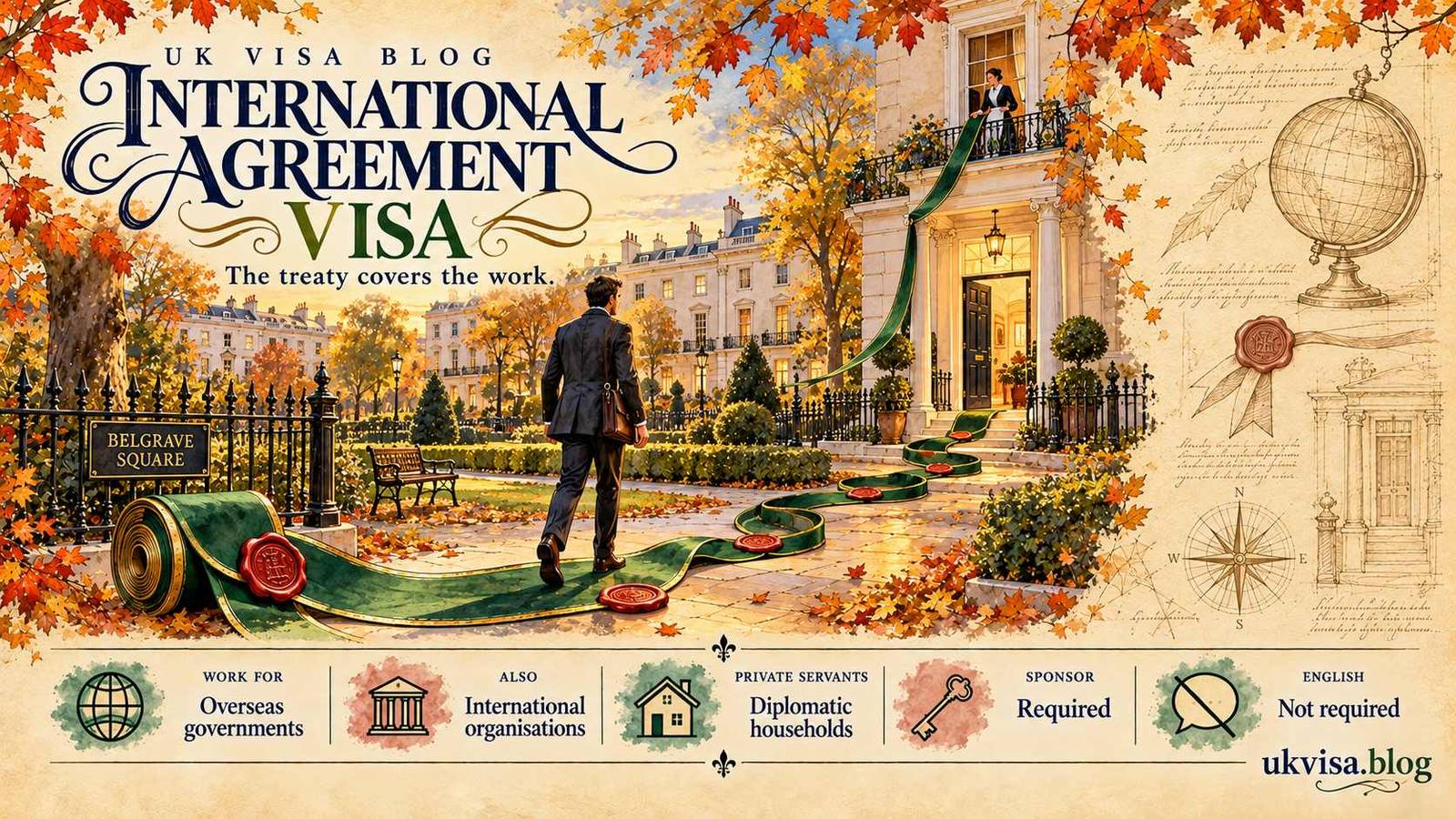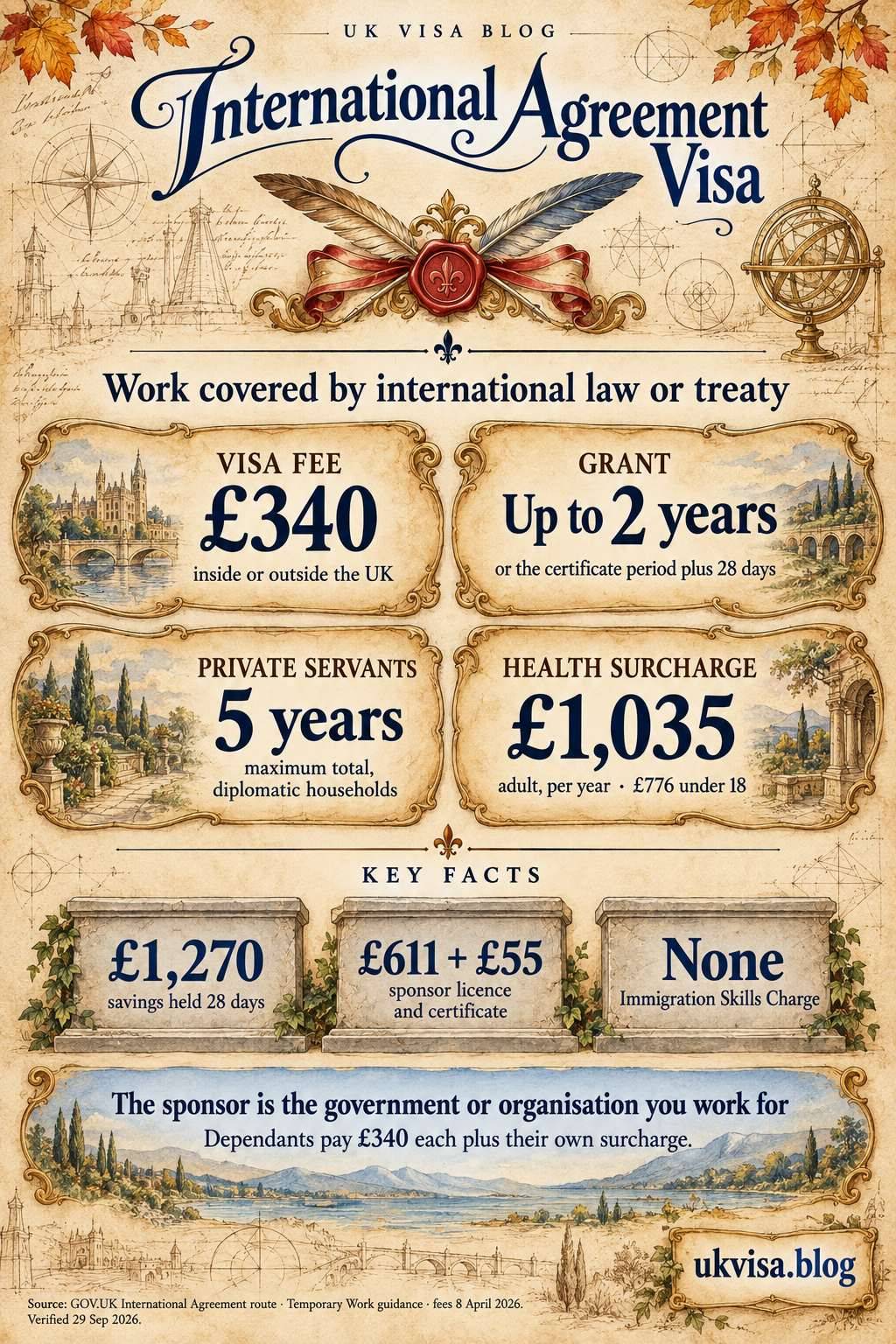
The International Agreement visa — formally known as the Temporary Work — International Agreement route, and still widely called the T5 Tier 5 International Agreement Worker visa after the legacy nomenclature — is the UK's dedicated immigration route for foreign nationals coming to provide a service to the UK under international law or treaty. The route covers three distinct sub-categories: employees of overseas governments coming to perform government work in the UK; employees of recognised international organisations based in or visiting the UK (such as the International Maritime Organization, the Commonwealth Secretariat, NATO, and the European Bank for Reconstruction and Development); and private servants in diplomatic households (the route equivalent to the US G-5 visa for personal employees of diplomats and senior international organisation staff). It is one of six sub-routes within the wider UK Temporary Worker (T5) framework. From 8 April 2026, the application fee rose from £319 to £340; the sponsor licence fee rose from £574 to £611 (Temporary Worker category, flat across all sponsor sizes).
The International Agreement route is the right immigration framework for three specific scenarios: foreign government employees coming to perform government work in the UK (e.g. embassy staff in non-diplomatic roles, government department secondments); employees of recognised international organisations operating in the UK; and private servants in diplomatic households (personal employees of diplomats or international organisation staff). Maximum 2 years for overseas government and international organisation workers; up to 5 years total for private servants (in 2-year extensions). A-rated sponsor required. Private servants applying from overseas must demonstrate CEFR A1 English. NOT for commercial service contractors providing services to UK companies — those workers use the Service Supplier route under Global Business Mobility instead. Replaced the older Tier 5 (T5) International Agreement Worker visa on 11 October 2021.
- What is the International Agreement Visa?
- The Three Sub-Categories
- Private Servants in Diplomatic Households
- Not for Service Suppliers to UK Companies
- Eligibility Requirements
- Duration: 2 vs 5 Years
- Fees and Costs from 8 April 2026
- How to Apply
- What You Can and Cannot Do
- Bringing Your Partner and Children
- Frequently Asked Questions
International Agreement Visa UK 2026: T5/Tier 5 Treaty-Based Work Route
The International Agreement visa sits within the UK Temporary Worker (T5) framework as one of six sub-routes alongside Religious Worker, Charity Worker, Government Authorised Exchange, Creative Worker, and Seasonal Worker. It is the most narrowly scoped sub-route in the family — restricted by treaty, international law, or diplomatic convention, rather than open to any willing employer or sponsor. The route's legal foundations include the Vienna Convention on Diplomatic Relations (1961), the Vienna Convention on Consular Relations (1963), individual UK headquarters agreements with each recognised international organisation, and various General Agreement on Trade in Services (GATS) and free-trade-agreement commitments.
What is the International Agreement Visa?
The International Agreement visa is the UK Temporary Work route for foreign nationals coming to provide a service covered by international law, treaty, or diplomatic convention. Three specific sub-categories: (1) employees of overseas governments coming to perform government work in the UK; (2) employees of "recognised international organisations" — bodies with which the UK has a formal headquarters agreement (IMO, Commonwealth Secretariat, NATO civilian staff, EBRD, OSCE, and others); (3) private servants in diplomatic households — personal employees of diplomats or recognised international organisation staff. NOT a general work visa, NOT a commercial contractor route. Replaced the older Tier 5 (T5) International Agreement Worker visa on 11 October 2021.
Three-Layered Legacy: Tier 5 → T5 Appendix → Current Route
The International Agreement route has gone through three nomenclature phases since 2008. The original Tier 5 (Temporary Worker) International Agreement Worker visa sat under Part 6A of the Immigration Rules from 2008 until 1 December 2020. The first reform (1 December 2020 to 10 October 2021) moved the route into Appendix T5 (Temporary Worker) International Agreement Worker as part of the post-Brexit Points Based Immigration System. The current Appendix Temporary Work — International Agreement applies from 11 October 2021 onwards. Substantively the route's scope and operating rules have remained closely aligned through all three phases — the changes were primarily structural rather than policy-driven. Many sponsors, applicants, and host institutions still use "T5 International Agreement", "Tier 5 International Agreement", or "International Agreement Worker visa" interchangeably with the current name.
The Three Sub-Categories
The International Agreement route operates as three distinct sub-categories with different qualifying scenarios, different durations, and (importantly) different English language requirements. Understanding which sub-category applies is the first step in any application.
| Sub-Category | Who Qualifies | Maximum Stay | English Test (Outside UK) |
|---|---|---|---|
| Overseas Government Worker | Employees of overseas governments coming to perform government work in the UK — embassy administrative/technical/service staff in non-diplomatic roles, foreign government department secondees, foreign trade mission staff | 2 years total | Not required |
| International Organisation Worker | Employees of "recognised international organisations" — bodies with formal UK headquarters agreements (IMO, Commonwealth Secretariat, NATO civilian staff, EBRD, OSCE, ICCROM, and others) | 2 years total | Not required |
| Private Servant in Diplomatic Household | Personal employees of diplomats or recognised international organisation senior staff — domestic staff, drivers, child-minders, cooks, personal assistants | Up to 5 years total, in 2-year extensions | CEFR A1 required for outside-UK applicants |
Source: Appendix Temporary Work — International Agreement; Sponsor an International Agreement worker guidance version 03/26.
Overseas Government Workers
This sub-category covers employees of overseas governments coming to the UK in non-diplomatic roles. Diplomatic staff themselves (diplomatic agents, administrative and technical staff, and service staff with diplomatic privileges) are exempt from UK immigration control under the Vienna Convention on Diplomatic Relations and do NOT need this visa. The International Agreement route applies to overseas government employees who fall outside the Vienna Convention's exempt categories — most commonly secondees to UK government departments under bilateral agreements, foreign trade mission staff in non-diplomatic capacities, and similar arrangements. The 2-year maximum is firm and cannot be extended beyond this cap for this sub-category.
International Organisation Workers
This sub-category covers employees of "recognised international organisations" — bodies with which the UK government has signed a formal headquarters agreement establishing their UK presence and immigration status. Notable examples based in or operating from the UK include the International Maritime Organization (IMO, headquartered in London), the Commonwealth Secretariat (London), the European Bank for Reconstruction and Development (EBRD, London), NATO civilian staff (where they fall outside the NATO Status of Forces Agreement), the Organization for Security and Co-operation in Europe (OSCE, for UK-based posts), and various United Nations specialised agencies with UK offices. The 2-year maximum stay applies; some senior international organisation staff may be exempt from immigration control entirely under their organisation's headquarters agreement rather than needing this visa.
Private Servants in Diplomatic Households
The private servants sub-category — equivalent to the US G-5 visa — covers personal employees of diplomats and recognised international organisation staff: domestic workers, drivers, child-minders, cooks, personal assistants employed in the household of a diplomatic mission member or international organisation senior staff. Maximum 5 years total stay in 2-year extensions. Unique within this route: applicants applying from outside the UK MUST demonstrate CEFR A1 English (basic level). Mandatory National Minimum Wage and Working Time Regulations compliance — the Home Office introduced strict employment protections following historical concerns about domestic worker exploitation in diplomatic households.
The CEFR A1 English requirement (the lowest CEFR level — basic communication) was introduced specifically for private servants in diplomatic households following multiple cases where domestic workers, recruited from non-English-speaking countries by foreign diplomats, became isolated and vulnerable to exploitation within the household. The A1 requirement gives private servants a baseline ability to communicate with UK authorities, healthcare providers, and support organisations independently of their employer. The requirement applies only to outside-UK applicants; in-country extensions do not require demonstrating English knowledge. Overseas government workers and international organisation workers are NOT subject to this English requirement.
The Home Office imposes strict National Minimum Wage and Working Time Regulations compliance on all International Agreement visa employers, with particular vigilance for private servants in diplomatic households. The sponsor must guarantee on the Certificate of Sponsorship that the job pays at least National Minimum Wage (from 1 April 2026: £12.71/hour for workers aged 21+) and complies with the maximum working hours framework. Applications where the decision-maker has reasonable grounds to suspect non-compliance will be refused. Private servants who experience NMW breaches or excessive hours can seek help from organisations such as the Anti-Trafficking and Labour Exploitation Unit and the Modern Slavery Helpline — without prejudicing their UK status.
Not for Service Suppliers to UK Companies
A common misconception: workers being contracted to provide services to UK companies under bilateral trade agreements (such as the UK-India Comprehensive Economic Trade Agreement Service Supplier provisions) do NOT use the International Agreement visa. They use the Service Supplier visa under the Global Business Mobility framework. The International Agreement route is reserved for service provision to the UK as a state (overseas government work, international organisation work, or personal employment within a diplomat's household) — not service provision to private UK companies. Workers misdirected to the wrong route face refusal.
The route a worker uses is determined by who receives the service: the UK state (overseas government activity, international organisation operation, or diplomatic household personal employment) → International Agreement; a UK company contracted under a bilateral trade agreement (the UK's free trade agreements with India, Australia, New Zealand, Canada, Japan, the EFTA states, and others; or GATS Mode 4 commitments) → UK-India CETA and bilateral trade Service Supplier route. The two routes have entirely different sponsor licence categories, different fee structures, and different operating rules. Workers applying to the wrong sub-route face refusal.
Eligibility Requirements
Have a Certificate of Sponsorship from an A-rated sponsor licensed under Appendix Temporary Work — International Agreement; meet one of the three sub-category qualifying scenarios; demonstrate £1,270 in personal savings held for 28 consecutive days (waivable if A-rated sponsor certifies maintenance OR 12+ months prior UK visa); private servants applying from outside UK must demonstrate CEFR A1 English; meet TB test and criminal record certificate requirements where applicable; sponsor must guarantee NMW and Working Time Regulations compliance on the CoS.
- Certificate of Sponsorship: Valid CoS from a UK sponsor holding an A-rated Temporary Worker — International Agreement sub-licence. CoS valid for 3 months from assignment date.
- A-rated sponsor: Sponsor must be A-rated. B-rated sponsors cannot sponsor International Agreement visas — this stricter framework matches the Charity Worker route's approach. Sole exception: extensions to continue working for the same sponsor where the worker was last granted on this route may proceed even if the sponsor's rating has temporarily slipped.
- Sub-category fit: The applicant's role must clearly fit into one of the three qualifying scenarios — overseas government worker, international organisation worker, or private servant in diplomatic household.
- Genuine intention: Applicant must genuinely intend to, and be able to, undertake the sponsored role — and not intend to take other employment beyond the limited supplementary work permissions.
- NMW & Working Time Regulations compliance: Sponsor must guarantee on the CoS that the job pays at least National Minimum Wage (£12.71/hour for workers aged 21+ from 1 April 2026) and complies with the Working Time Regulations. Particular scrutiny applies to private servants in diplomatic households.
- Personal savings: £1,270 in personal savings, held for 28 consecutive days, ending within 31 days of the application date. Exemptions: (a) 12+ months prior valid UK visa, OR (b) A-rated sponsor certifies maintenance on CoS.
- English language (private servants outside UK only): CEFR A1 (basic) English demonstration required. Approved Secure English Language Tests include IELTS Life Skills A1, Trinity GESE Grade 2, and others. NOT required for in-country extensions or for overseas government / international organisation workers.
- TB test certificate: Required if applying from a listed country for stays of more than 6 months.
- Criminal record certificate: Required for any country lived in for 12+ months in the last 10 years where applicable.
- ATAS certificate: Required for certain nationalities in sensitive research roles (rarely applicable to this route).
- Suitability: Must not fall for refusal under general grounds of the Immigration Rules.
Duration: 2 vs 5 Years
| Sub-Category | Initial Grant | Extensions | Absolute Maximum |
|---|---|---|---|
| Overseas Government Worker | Up to 24 months (CoS period + 14 days, whichever is shorter) | Up to total 2-year cap | 2 years total |
| International Organisation Worker | Up to 24 months (CoS period + 14 days, whichever is shorter) | Up to total 2-year cap | 2 years total |
| Private Servant in Diplomatic Household | Up to 24 months (CoS period + 14 days) | Further 24-month extensions permitted | 5 years total |
| Pre-entry window | Up to 14 days before CoS start date — permitted for early arrival | ||
| Curtailment risk | If sponsored job ends early, worker may be asked to leave within 60 days (unless visa has <60 days remaining) | ||
Fees and Costs from 8 April 2026
Application fee £340 from 8 April 2026 (up from £319). Immigration Health Surcharge £1,035/year adults (£776/year under-18s), paid up front for the full grant period. For a 24-month visa: total Home Office cost £2,410 (£340 + £2,070 IHS). Private servants pursuing full 5-year stays pay the visa fee plus IHS at each 2-year extension. Sponsor pays £611 flat Temporary Worker sponsor licence and £55 per Certificate of Sponsorship. Immigration Skills Charge does NOT apply.
| Fee Component | Amount from 8 April 2026 | Notes |
|---|---|---|
| Visa application fee (initial and extension) | £340 per person | Up from £319; same fee inside or outside UK |
| Immigration Health Surcharge — adult | £1,035 per year | Pro-rated for visa duration; paid up front |
| Immigration Health Surcharge — under 18 | £776 per year | Discounted rate for dependent children |
| Personal maintenance | £1,270 | 28 consecutive days; waived if A-rated sponsor certifies OR 12+ months prior valid UK visa |
| Total Home Office charges (24-month visa, single adult) | £2,410 | £340 + £2,070 IHS (£1,035 × 2 years) |
| Total private servant 5-year pathway (cumulative across 3 grants) | ~£6,165 | £340 × 3 grants + £1,035 × 5 years IHS — approximate; assumes uplifts hold flat |
| Priority service | +£500 | 5 working days target (where available) |
| Super-priority service | +£1,000 | Next working day target (where available) |
| Sponsor — Temporary Worker sponsor licence | £611 flat | Up from £574; applies regardless of sponsor size |
| Sponsor — CoS assignment | £55 per worker | Temporary Worker CoS rate |
| Sponsor — Immigration Skills Charge | £0 (exempt) | All T5 sub-routes are ISC-exempt |
Source: gov.uk International Agreement visa fee schedule; Immigration and Nationality (Fees) Order amendments effective 8 April 2026.
For the wider sponsored route fee comparison across Skilled Worker, GBM and Temporary Worker families, see the UK work visa fees and ISC comparison guide.
How to Apply
International Agreement visa applications are submitted online via the gov.uk International Agreement worker portal. Applications can be submitted up to 3 months before the CoS start date, and successful applicants can enter the UK up to 14 days before the CoS start date. The application can be made from outside or inside the UK (in-country switching is permitted in limited circumstances; extensions are standard from in-country).
- Step 1: Secure sponsorship from an A-rated International Agreement sponsor — typically a foreign embassy / high commission (for overseas government workers and private servants), a recognised international organisation's UK office, or directly by the diplomatic household head (for private servants).
- Step 2: Sponsor assigns the Certificate of Sponsorship via the Sponsorship Management System (£55 fee). CoS valid for 3 months.
- Step 3: Applicant completes the online UKVI visa application form on gov.uk — typically 30–60 minutes.
- Step 4: Pay £340 visa fee and IHS (£1,035/year, pro-rated to grant period).
- Step 5: Private servants applying from outside UK: book and pass a Secure English Language Test demonstrating CEFR A1 English. Other sub-categories: skip this step.
- Step 6: Verify identity — via the UK Immigration: ID Check app (eligible passports) or biometric appointment at a Visa Application Centre.
- Step 7: Upload supporting documents — passport, CoS reference, financial evidence, English test pass (private servants), TB and criminal record certificates where applicable.
- Step 8: Decision turnaround — 3 weeks standard (outside UK); 8 weeks standard (in-country switching / extensions). Faster decisions via priority and super-priority decision services where available.
- Step 9: Travel to the UK up to 14 days before CoS start date; begin the sponsored role.
What You Can and Cannot Do
| Activity | Permitted? | Notes |
|---|---|---|
| Work for sponsor in the CoS-defined role | Yes | Primary activity; the entire purpose of the visa |
| Second job — same sector and skill level | Yes — up to 20 hours/week (NOT for private servants) | Outside main hours; private servants are EXCLUDED from this permission |
| Second job — Immigration Salary List role | Yes — up to 20 hours/week (NOT for private servants) | From the Skilled Worker Immigration Salary List; private servants excluded |
| Study (most courses) | Yes | Provided it does not interfere with sponsored work; ATAS certificate required for some courses |
| Bring partner and dependent children | Yes | Subject to dependant eligibility and additional fees |
| Take a permanent job | No | Cannot accept permanent employment with the sponsor or any other UK employer outside the supplementary work permissions |
| Run a UK business | No | Self-employed business activity not permitted |
| Access public funds | No | No recourse to public funds — applies throughout grant period |
| Switch to a settlement-leading route in-country | Limited | Generally restricted; most workers must apply from overseas for other routes |
A unique restriction applies to private servants in diplomatic households: the standard 20-hour-per-week supplementary work permission does NOT apply. This reflects the route's structure — private servants are sponsored to work within a specific diplomatic household, not in a general employment role, and the Home Office wishes to prevent any structure where the worker effectively becomes a general UK worker with the diplomatic household as cover. Overseas government workers and international organisation workers retain the standard 20-hour supplementary work permission, in the same sector at the same skill level or on the Skilled Worker Immigration Salary List.
Bringing Your Partner and Children
International Agreement visa holders can bring eligible dependants to the UK — spouse, civil partner, unmarried partner (2+ years' cohabitation), and dependent children under 18. Each dependant submits a separate UK family dependant visa application.
| Dependant Type | Application Fee | IHS | Maintenance Requirement |
|---|---|---|---|
| Partner / spouse / civil partner / unmarried partner | £340 | £1,035/year | £285 in addition to main applicant's £1,270 |
| First dependent child | £340 | £776/year | £315 in addition |
| Each additional dependent child | £340 | £776/year | £200 in addition |
Dependants of overseas government workers and international organisation workers can typically work in any sector without restriction. Dependants of private servants are subject to standard dependant work permissions but face practical constraints because the host household structure rarely supports an extensive UK employment search. Dependant permission aligns with the main applicant's grant end-date.
- Temporary Work — International Agreement route (formerly T5 / Tier 5 International Agreement Worker, replaced 11 October 2021) — for service provision to the UK under international law, treaty, or diplomatic convention.
- Application fee £340 from 8 April 2026 (up from £319); £1,035/year IHS — total £2,410 for a 24-month visa.
- Three sub-categories: overseas government workers (2 years max), international organisation workers (2 years max), and private servants in diplomatic households (5 years max in 2-year extensions).
- Private servants applying from outside UK MUST demonstrate CEFR A1 English — the only T5 sub-route with an English language requirement.
- A-rated sponsor required — like Charity Worker, this is stricter than other T5 routes.
- NMW (£12.71/hour from 1 April 2026 for aged 21+) and Working Time Regulations compliance mandatory.
- Private servants are EXCLUDED from the 20-hour supplementary work permission.
- NOT for commercial service contractors — those use the Service Supplier (Global Business Mobility) route.
- NO Immigration Skills Charge applies; sponsor licence £611 flat Temporary Worker rate.
- Does NOT count toward 5-year ILR clock; settlement requires switching to another settlement-leading route from overseas.
For official guidance and to start the application, the authoritative entry point is the gov.uk International Agreement worker visa overview. The legal framework sits in Appendix Temporary Work — International Agreement. The fee uplifts (£319→£340 visa fee; £574→£611 sponsor licence) took effect on 8 April 2026 alongside Statement of Changes HC 1691 (5 March 2026). UK sponsors should consult the Home Office's Sponsor an International Agreement worker guidance (version 03/26) — the operational framework for sponsor compliance. The remaining T5 sub-routes — Religious Worker route for paid religious work, Charity Worker route for unpaid voluntary work, Government Authorised Exchange route for approved schemes, and Creative Worker route for creative industries — provide alternative Temporary Worker pathways for different scenarios.
The International Agreement visa (formally Temporary Work — International Agreement, formerly T5 / Tier 5 International Agreement Worker) is the UK Temporary Work route for foreign nationals providing a service to the UK under international law, treaty, or diplomatic convention. Three sub-categories: (1) employees of overseas governments coming to perform government work in the UK; (2) employees of recognised international organisations operating in the UK (IMO, Commonwealth Secretariat, NATO, EBRD); (3) private servants in diplomatic households — personal employees of diplomats or international organisation senior staff. Replaced the older Tier 5 framework on 11 October 2021.
From 8 April 2026 the application fee is £340 per person (up from £319). Immigration Health Surcharge is £1,035 per year for adults (£776 per year for under-18s), paid up front for the full grant period. For a 24-month visa: total worker-side cost £2,410 (£340 + £2,070 IHS). Private servants pursuing the full 5-year pathway pay the fees at each 2-year extension. Sponsor pays £611 flat for the Temporary Worker sponsor licence and £55 per Certificate of Sponsorship; Immigration Skills Charge does not apply.
No. Diplomatic agents, administrative and technical staff, and service staff of foreign diplomatic missions are exempt from UK immigration control under the Vienna Convention on Diplomatic Relations (1961) and do not use the International Agreement visa. The International Agreement route applies to overseas government employees who fall OUTSIDE the Vienna Convention's exempt categories, international organisation employees not covered by their organisation's own headquarters agreement, and private servants employed in diplomatic households. The visa is the immigration framework for workers connected with diplomacy but not themselves diplomatic agents.
The UK equivalent of the US G-5 visa (for personal employees and domestic workers of officials at international organisations and foreign diplomatic missions) is the International Agreement visa under the "Private Servants in Diplomatic Households" sub-category. The UK version permits stays of up to 5 years total in 2-year extensions, requires CEFR A1 English from outside-UK applicants, and mandates National Minimum Wage and Working Time Regulations compliance. Private servants are excluded from the 20-hour supplementary work permission that applies to other International Agreement workers.
Only private servants in diplomatic households applying from outside the UK need to demonstrate English language ability — at CEFR A1 (basic) via an approved Secure English Language Test (IELTS Life Skills A1, Trinity GESE Grade 2, or equivalent). Overseas government workers and international organisation workers are NOT subject to any English language test. In-country extensions for any sub-category do NOT require demonstrating English knowledge.
The maximum stay depends on the sub-category: 2 years total for overseas government workers and international organisation workers (with extensions permitted within this cap); up to 5 years total for private servants in diplomatic households (in 2-year extensions). Pre-entry: applicants can enter the UK up to 14 days before the Certificate of Sponsorship start date. Curtailment: if the sponsored job ends early, the worker may be asked to leave within 60 days unless the visa has less than 60 days remaining.
Yes. Spouses, civil partners, unmarried partners (2+ years' cohabitation), and dependent children under 18 can apply as dependants. Each dependant pays £340 visa fee plus £1,035/year IHS (£776 for under-18s). Maintenance: £285 partner, £315 first child, £200 each additional child — waived if the A-rated sponsor certifies. Dependants of overseas government and international organisation workers can typically work in any sector without restriction; dependant permission aligns with the main applicant's grant end-date.
No. Unlike overseas government workers and international organisation workers, private servants in diplomatic households are EXCLUDED from the standard 20-hour per week supplementary work permission. This restriction reflects the route's structure — private servants are sponsored to work within a specific diplomatic household, and the Home Office prevents any arrangement where the diplomatic household effectively serves as cover for general UK employment. Overseas government workers and international organisation workers retain the standard 20-hour supplementary work permission.
No. Time on the International Agreement visa does NOT count toward the 5-year continuous-residence period required for Indefinite Leave to Remain. The route is fundamentally a temporary route. Even private servants who reach the 5-year maximum stay do not qualify for ILR through this route. Settlement requires switching to a settlement-leading route — typically Skilled Worker from overseas (subject to £41,700 salary threshold, RQF Level 3+ occupation, CEFR B2 English, and a Worker sponsor licence) or Family routes where applicable. In-country switching to settlement routes is generally restricted.
No. Workers being contracted to provide services to UK private companies — even under bilateral free trade agreements like the UK-India Comprehensive Economic Trade Agreement — use the Service Supplier visa under the Global Business Mobility framework instead. The International Agreement route is reserved for service provision to the UK as a state: overseas government work, international organisation operation, or personal employment within a diplomatic household. Workers misdirected to the wrong route face refusal — the sub-route choice is determined by who receives the service, not by which international agreement underpins it.