
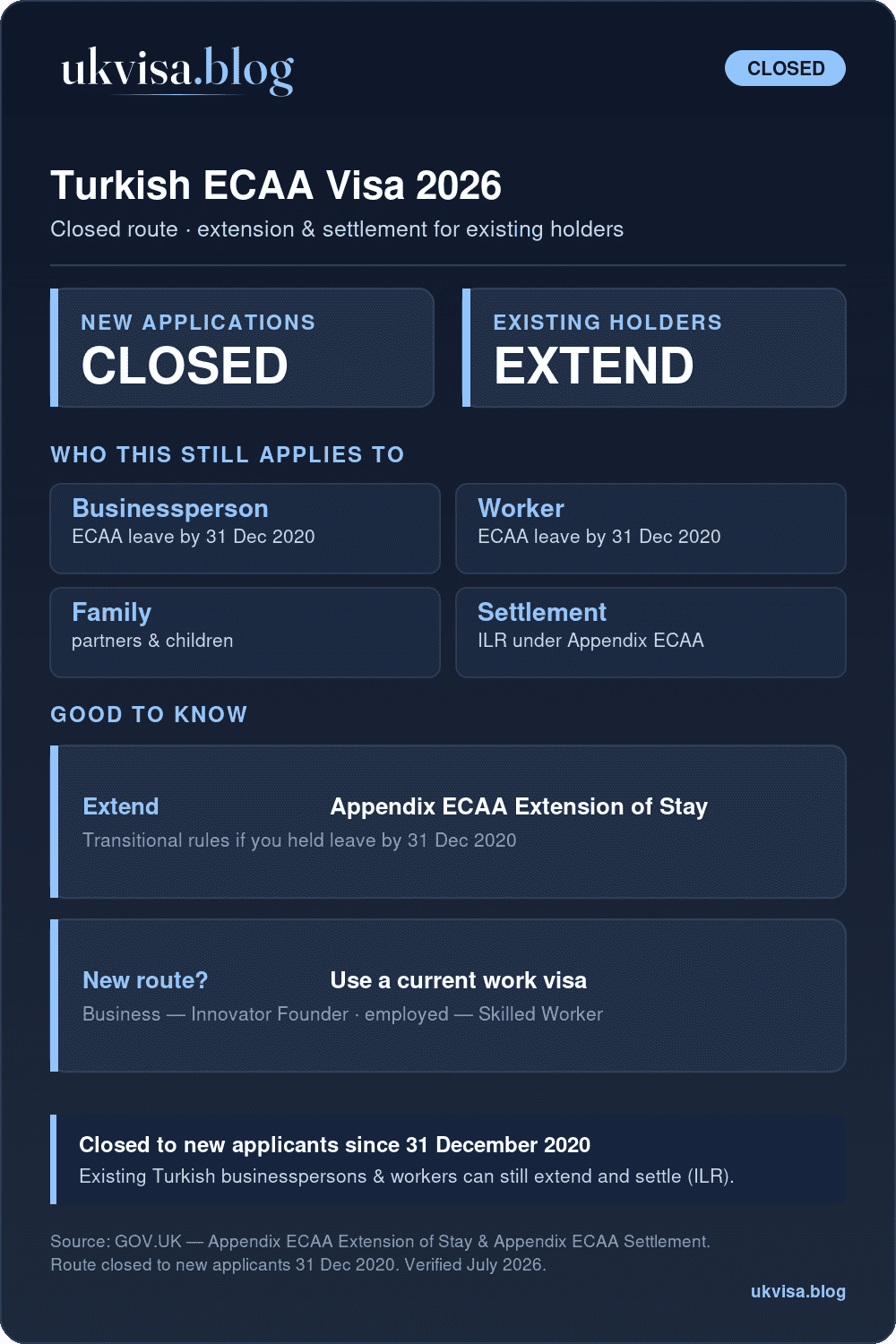
The ECAA visa UK framework — covering the Turkish Worker and Turkish Businessperson routes established under the 1963 Ankara Agreement — closed to new applicants on 31 December 2020 at the end of the Brexit transition period. The legal framework was preserved through transitional protections under Appendix ECAA Extension of Stay and Appendix ECAA Settlement, which continue to govern extensions and settlement applications for existing leave holders and their dependants. Extension applications remain free of charge; ILR applications cost £3,226 from 8 April 2026.
For existing Turkish Worker and Businessperson visa holders, the route remains fully usable: extensions of up to 36 months continue under Appendix ECAA Extension of Stay, ILR under Appendix ECAA Settlement is available after 5 years' continuous residence, and dependants follow the same framework. New Turkish applicants must use the modern points-based system instead. Extension applications are free; ILR is £3,226 from 8 April 2026.
- What is the ECAA Visa UK?
- Route Closure on 31 December 2020
- Turkish Worker Visa Extension
- Turkish Businessperson Visa Extension
- How to Apply for an ECAA Extension
- Supporting Documents
- ECAA ILR Under Appendix ECAA Settlement
- Dependants and Child of a Turkish Worker
- Alternative Routes for New Turkish Applicants
- Frequently Asked Questions
ECAA Visa UK 2026: Turkish Worker and Businessperson Guidance
The ECAA visa (European Community Association Agreement visa) was created under the 1963 Ankara Agreement between Turkey and the European Economic Community. The UK joined the agreement on accession to the EEC in 1973, and Turkish nationals gained the right to establish themselves in the UK as workers or self-employed businesspersons under conditions broadly aligned with those of other EEC member states. Two distinct routes emerged: the Turkish Worker visa for employed staff and the Turkish Businessperson visa for self-employed entrepreneurs.
What is the ECAA Visa UK?
The ECAA visa UK is two transitional immigration routes for Turkish nationals under the Ankara Agreement: the Turkish Worker visa (employed workers) and the Turkish Businessperson visa (self-employed business owners). Both closed to new applicants on 31 December 2020 but remain extendable for existing holders under Appendix ECAA Extension of Stay. ILR is available after 5 years' continuous residence under Appendix ECAA Settlement.
Since 1 January 2021, the routes are described in the Immigration Rules as "ECAA Worker" and "ECAA Businessperson" rather than "Turkish Worker" and "Turkish Businessperson" — the underlying eligibility is the same and the colloquial names remain in widespread use, but caseworkers apply Appendix ECAA Extension of Stay (for extensions) and Appendix ECAA Settlement (for ILR) under domestic UK law rather than the original EU-derived treaty rights.
Two Routes Compared
| Feature | Turkish Worker Visa | Turkish Businessperson Visa |
|---|---|---|
| Original purpose | Employed workers | Self-employed business owners and directors |
| Closed to new applicants | 31 December 2020 | 31 December 2020 |
| Extensions available | Yes — existing holders only | Yes — existing holders only |
| Extension fee | Free | Free |
| Maximum grant per extension | Up to 12 months (3-4 yrs employment) or 36 months (4+ yrs) | Up to 36 months |
| ILR qualifying period | 5 years' continuous residence | 5 years' continuous residence |
| Standard processing | Up to 6 months | Up to 6 months |
| Governing Immigration Rules | Appendix ECAA Extension of Stay | Appendix ECAA Extension of Stay |
Route Closure on 31 December 2020 — What Changed
The closure stems from the UK's withdrawal from the European Union. The Immigration and Social Security Co-ordination (EU Withdrawal) Act 2020 ended free movement and the EU-derived entry rights that supported the ECAA routes. From 1 January 2021, no new initial applications can be made under the ECAA framework, whether from inside or outside the UK. Switching into ECAA from another visa category is also no longer permitted. The Home Office did, however, preserve the transitional position of those who had already been granted ECAA leave — that is the basis for the modern extension and settlement framework.
If an ECAA extension application is made before the current leave expires, the applicant's existing leave is extended automatically by section 3C of the Immigration Act 1971 until the application is decided. This means existing rights to work or operate the business continue unchanged during the processing period. Late applications break section 3C and create overstaying — which is why timing in-time applications matters more than for many other visa categories. Each extension is treated as a fresh substantive assessment, not a light-touch renewal.
Turkish Worker Visa Extension Requirements
To extend a Turkish Worker visa under Appendix ECAA Extension of Stay, the applicant must currently hold valid ECAA worker leave, have been lawfully employed in the UK for the required minimum period (3 years with the same employer for a 1-year extension, or 4+ years lawful employment for a 3-year extension with full occupation freedom), and apply from inside the UK before the current leave expires. No fee is payable.
Worker Extension Lengths and Employment Rights
| Time Lawfully Worked in UK | Extension Length | Employment Rights Unlocked |
|---|---|---|
| 3-4 years (same employer) | Up to 1 year | Can change employer but must remain in the same occupation |
| 4+ years lawful employment | Up to 3 years | Any occupation with any UK employer; full UK labour market access |
Worker Extension Eligibility Criteria
- Current ECAA worker leave: Must hold valid permission as a Turkish Worker / ECAA Worker.
- Lawful employment history: 3+ years' continuous employment with the same UK employer, or 4+ years total UK employment with at least 3 of those years with the same employer.
- In-UK applicant: Must be physically in the UK at the time of application.
- In-time application: Must be submitted before the current leave expires to preserve section 3C protection.
- No immigration breaches: No breach of UK immigration conditions during the previous grant period.
- Suitability: Must not fall for refusal under the general grounds of the Immigration Rules.
Turkish Businessperson Visa Extension Requirements
To extend a Turkish Businessperson visa, the applicant must hold valid ECAA businessperson leave, have established, taken over or become director of one or more genuine UK businesses, be able to support themselves and any dependants from business profits without recourse to public funds, and apply from inside the UK before current leave expires. Extensions are granted for up to 36 months at a time with no cap on the number of extensions. The fee is zero.
Officially set out at Appendix ECAA Extension of Stay, the businessperson extension is not a light-touch renewal — each application is a fresh substantive assessment of whether the business remains genuine, viable, and producing enough profit to maintain the applicant and dependants. The Home Office examines turnover, net profit, balance-sheet position, fixed-asset value, and the ratio of debt to overall business value when assessing viability.
Businessperson Extension Eligibility Criteria
- Current ECAA businessperson leave: Must hold valid permission as a Turkish Businessperson / ECAA Businessperson.
- Genuine business activity: Established, taken over, or become director of one or more UK businesses operated genuinely during the previous grant period.
- Viable business: Financial statements show the business can continue to make money — no fixed minimum turnover but Home Office assesses balance-sheet health and trading activity.
- Self-supporting profits: Share of profits sufficient to support the applicant and dependants without public funds.
- Share of business liabilities: Able to meet the applicant's share of any business debts.
- Genuine self-employment: Role must be genuine self-employment or directorship, not disguised employment.
- In-UK, in-time: Application made from inside the UK before the current leave expires.
- Suitability: No refusal under general grounds.
Where a businessperson holds existing ECAA leave but the business is experiencing temporary financial difficulties — making losses or lacking complete accounts — the Home Office may exercise discretion to grant a shorter 12-month extension rather than the standard 36 months. This allows the business time to return to profitability and accounts to be brought up to date. A subsequent extension can then run at the standard 36-month length once viability is re-established. Submit business plan evidence explaining the recovery strategy where this pattern applies.
How to Apply for an ECAA Visa Extension
Both worker and businessperson extensions are submitted online on gov.uk from inside the UK. The application form differs slightly between routes but the workflow is the same. Identity is verified through the UK Immigration: ID Check app for eligible passports or through an in-person biometric appointment at a UKVCAS centre. Standard Home Office decision wait period is up to 6 months from completion of biometrics.
- Step 1: Confirm current ECAA leave is valid and gather evidence of lawful continuous employment (worker) or genuine viable business activity (businessperson).
- Step 2: Apply online via the relevant form on gov.uk — Turkish Worker or Turkish Businessperson extension — free of charge.
- Step 3: Verify identity through the UK Immigration: ID Check app where the passport is eligible, or book a biometric appointment at a UKVCAS centre.
- Step 4: Upload supporting documents — passport, current BRP or eVisa, employment or business evidence, and proof of continuous UK residence.
- Step 5: Section 3C extends current leave automatically while the application is pending, provided the application was in-time.
- Step 6: Receive decision — standard processing up to 6 months; priority services are not generally available for ECAA extensions.
Supporting Documents
The exact document set required differs between worker and businessperson routes, but both share a passport, current BRP or eVisa, and evidence of continuous UK residence. The Home Office expects original or certified-copy documentation; uncertified photocopies are commonly rejected.
For Turkish Worker Extensions
- Valid passport (current and any previous passports covering the qualifying period).
- Current BRP or digital eVisa confirmation showing ECAA worker leave.
- Employment evidence: Payslips, P60s, employment contracts, and an employer letter confirming dates and continuity of employment.
- Continuous-residence evidence: Utility bills, council tax records, bank statements, tenancy agreements covering the qualifying period.
- HMRC documentation: P60s and tax records confirming PAYE earnings.
For Turkish Businessperson Extensions
- Valid passport and current BRP / eVisa showing ECAA businessperson leave.
- Business accounts: Audited or chartered-accountant-prepared accounts covering the previous grant period.
- HMRC documents: Self-assessment tax returns, corporation tax returns, evidence of tax paid.
- Companies House registration (where the business is a limited company or LLP).
- Business bank statements: Showing trading activity, sales, and recurring transactions.
- Contracts and invoices: Sample contracts with clients or suppliers; invoices issued and received.
- Business plan where relevant (especially after a loss-making period).
ECAA ILR Under Appendix ECAA Settlement
After 5 years' continuous residence in the UK on an ECAA visa (worker, businessperson or combination), the applicant can apply for Indefinite Leave to Remain (ILR) under Appendix ECAA Settlement. The most recent leave must be ECAA worker or businessperson. The ILR fee is £3,226 per applicant from 8 April 2026. The application requires meeting the Knowledge of Language and Life in the UK (KoLL) requirement and falling within Appendix Continuous Residence absence rules. Decision time is up to 6 months.
The settlement framework sits at Appendix ECAA Settlement within the Immigration Rules. Workers and businesspersons follow the same settlement test, and dependants (including child of a Turkish worker) can apply alongside the main applicant or independently once they themselves have completed the 5-year qualifying period. ILR grants permanent permission to live and work in the UK without immigration conditions and unlocks the 12-month wait period for British citizenship.
ECAA ILR Eligibility Requirements
- 5 years' continuous UK residence: Under ECAA worker or businessperson leave, or a combination of the two. See continuous residence absence rules for the 180-day-per-rolling-12-months absence test in Appendix Continuous Residence.
- Most recent leave is ECAA: The latest grant must have been as Turkish Worker or Turkish Businessperson.
- Knowledge of Language and Life (KoLL): Pass the Life in the UK citizenship test and meet the Appendix KoLL English standards.
- Continuing business / employment: The worker must still be in qualifying employment; the businessperson must still operate a genuine viable business.
- No public funds: The applicant must be able to support themselves and dependants without recourse to public funds.
- Suitability: Must not fall for refusal under general grounds of the Immigration Rules — character, criminality, and immigration history.
ECAA-Route Fees in 2026
| Application Type | Fee (from 8 April 2026) | Standard Decision Time |
|---|---|---|
| ECAA extension (worker or businessperson) | £0 — no fee | Up to 6 months |
| ECAA ILR (settlement) under Appendix ECAA Settlement | £3,226 per applicant | Up to 6 months |
| Naturalisation as a British citizen (12 months after ILR) | £1,709 per applicant | Up to 6 months |
| Biometric enrolment (per appointment) | £19.20 | At booking |
Source: Home Office immigration and nationality fees, 8 April 2026.
Dependants and "Child of a Turkish Worker"
Family members already granted leave as dependants of a Turkish Worker or Businessperson before 31 December 2020 retain transitional rights to extend their leave and apply for ILR. The phrase "child of a Turkish worker" has a specific meaning in immigration law: it refers to a child granted dependent leave under the ECAA framework, who under the original Decision 1/80 of the EU-Turkey Association Council had rights to access UK employment after a period of residence.
Dependant Eligibility
- Partners (spouses, civil partners and unmarried partners in a 2-year durable relationship) granted dependent leave before route closure can extend and apply for ILR alongside the main applicant.
- Children under 21 at the time of application can apply as dependants.
- Children over 21 may qualify in defined circumstances — typically where they were last granted leave as a dependent child of the ECAA route holder and are not leading an independent life.
- Adequate accommodation for all dependants must be evidenced.
- Business profits or salary must be sufficient to maintain dependants without public funds.
- 5-year qualifying period applies separately to each dependant for their own ILR application.
Alternative Routes for New Turkish Applicants
Turkish nationals who do not hold pre-31 December 2020 ECAA leave cannot enter the ECAA route afresh. They must use the modern points-based system. Four routes are the practical replacements depending on circumstances — Skilled Worker is the most common, with Innovator Founder filling the businessperson gap.
- Skilled Worker route for sponsored employment: Requires a job offer from a licensed UK sponsor at RQF Level 6 and £41,700 salary (or applicable lower threshold). Leads to ILR after 5 years.
- Innovator Founder route for entrepreneurs: The closest modern equivalent to the Turkish Businessperson visa — requires endorsement of an innovative, viable, scalable UK business idea.
- Global Talent endorsement route: For leaders in science, engineering, humanities, medicine, digital technology, or arts and culture, with endorsement by an approved body.
- Scale-up visa for fast-growing companies: Initial 6-month sponsorship by an approved Scale-up business followed by unsponsored permission.
- HPI route for top-100 university graduates: For Turkish graduates of qualifying global universities — no sponsor required.
- Both Turkish Worker and Turkish Businessperson routes closed to new applicants on 31 December 2020 — switching into ECAA from another category is also prohibited.
- Existing ECAA leave holders can extend under Appendix ECAA Extension of Stay — free of charge, up to 36 months per businessperson extension.
- Worker extensions run 1 year (3-4 yrs lawful employment, same occupation) or 3 years (4+ yrs, any occupation any employer).
- Section 3C automatically extends current leave during a pending in-time application.
- ILR is available under Appendix ECAA Settlement after 5 years' continuous residence — £3,226 from 8 April 2026.
- Naturalisation as a British citizen is available 12 months after ILR — £1,709 from 8 April 2026.
- Child of a Turkish worker has defined rights under transitional protections; partners and children granted dependent leave before route closure remain eligible to extend and settle.
- New Turkish applicants must use Skilled Worker, Innovator Founder, Global Talent, Scale-up or HPI under the points-based system.
- Standard processing for both extension and ILR is up to 6 months; ECAA-route priority service is not generally available.
Where an ECAA extension or ILR application is refused, the remedy is administrative review under Appendix AR — there is no full appeal right for these route refusals. The 14-day deadline and procedure sit inside the wider administrative review challenge process. Once ILR is granted, the standard 12-month wait period applies before British citizenship application — and the qualifying clock for naturalisation runs from the ILR grant date. Official entry points for these applications are the gov.uk Turkish Worker visa and gov.uk Turkish Businessperson visa pages, and the overarching Indefinite Leave to Remain settlement framework guide compares ECAA settlement with other ILR routes.
Frequently Asked Questions about ECAA Visa UK
No. The Turkish Worker visa route closed to new applicants on 31 December 2020 at the end of the Brexit transition period. Existing ECAA worker leave holders can still extend under Appendix ECAA Extension of Stay and apply for ILR under Appendix ECAA Settlement after 5 years' continuous residence. New Turkish applicants seeking sponsored UK employment must use the Skilled Worker route or another modern points-based work visa instead.
No new entry applications under the Turkish Businessperson route have been accepted since 1 January 2021. Existing leave holders can extend their leave under Appendix ECAA Extension of Stay — for up to 36 months per extension, free of charge — and apply for ILR after 5 years. Turkish nationals wishing to start a new UK business now use the Innovator Founder visa, which is the modern equivalent of the original businessperson route.
Apply online via the relevant gov.uk form — Turkish Worker or Turkish Businessperson extension — before the current leave expires to preserve section 3C protection. Verify identity through the UK Immigration: ID Check app or at a UKVCAS centre. Upload evidence of qualifying employment or genuine viable business activity, alongside passport and BRP / eVisa. No application fee is payable. Standard processing is up to 6 months, and the existing leave continues automatically under section 3C while the application is pending.
No. ECAA extension applications under Appendix ECAA Extension of Stay are free of charge — there is no Home Office application fee and no Immigration Health Surcharge tied to the extension itself. The only related cost is the £19.20 biometric enrolment fee if biometrics are required (typically waived where the UK Immigration: ID Check app can verify identity). The £3,226 ILR fee applies only at the settlement stage from 8 April 2026.
Standard processing is up to 6 months from completion of biometric enrolment. ECAA extensions are not eligible for priority or super-priority processing in the way most other UK visa categories are. Processing may take longer where the Home Office requests additional evidence — particularly for businessperson cases where viability or balance-sheet position requires further explanation. Travel outside the Common Travel Area while the application is pending should be avoided as it can be treated as application withdrawal.
Yes. After 5 years' continuous UK residence on the ECAA route — worker, businessperson, or a combination — the applicant can apply for Indefinite Leave to Remain under Appendix ECAA Settlement. The most recent leave must have been ECAA worker or businessperson. ILR requires passing the Life in the UK test, meeting the English language standard under Appendix KoLL, maintaining no recourse to public funds, and not falling for refusal under general grounds. The fee is £3,226 from 8 April 2026.
Yes, where they hold dependent leave already linked to your ECAA status. Partners (spouses, civil partners, unmarried partners of 2+ years) and children under 21 can extend alongside you. Children over 21 may qualify in defined circumstances — typically where they were last granted leave as a dependent child of the ECAA route holder and are not leading an independent life. Each dependant can apply for ILR after 5 years' continuous residence and naturalisation 12 months after ILR.
"Child of a Turkish worker" is the term used in immigration law and Home Office guidance for children who were granted dependent leave under the ECAA Turkish Worker framework. Under the original EU-Turkey Decision 1/80, such children acquired specific rights — including access to UK education and, after a qualifying period of residence, access to the UK labour market without further immigration permission. The transitional rules preserve those rights for children already granted ECAA dependent leave before 31 December 2020. New child dependants of new Turkish entrants now use the points-based system.
The Home Office issues a decision letter explaining the refusal reasons. An administrative review may be available under Appendix AR of the Immigration Rules to challenge caseworking errors in the decision — there is no full right of appeal for ECAA extension refusals. The administrative review deadline is typically 14 days from receipt of the decision (or 28 days for refusals outside the UK). Where section 3C protection has lapsed, the applicant may become an overstayer — making prompt advice from a regulated immigration adviser important after any refusal.
New Turkish applicants who do not hold pre-31 December 2020 ECAA leave must use the modern points-based system. The Skilled Worker visa is the most common — requires a job offer from a licensed UK sponsor at £41,700 (or applicable lower threshold) and RQF Level 6. The Innovator Founder route is the modern equivalent of the Turkish Businessperson visa for entrepreneurs with an innovative business idea endorsed by an approved body. The Global Talent route suits leaders in science, technology, humanities or the arts. Turkish graduates of qualifying top-100 global universities can use the High Potential Individual route. The Scale-up visa is suited to roles at high-growth UK businesses.