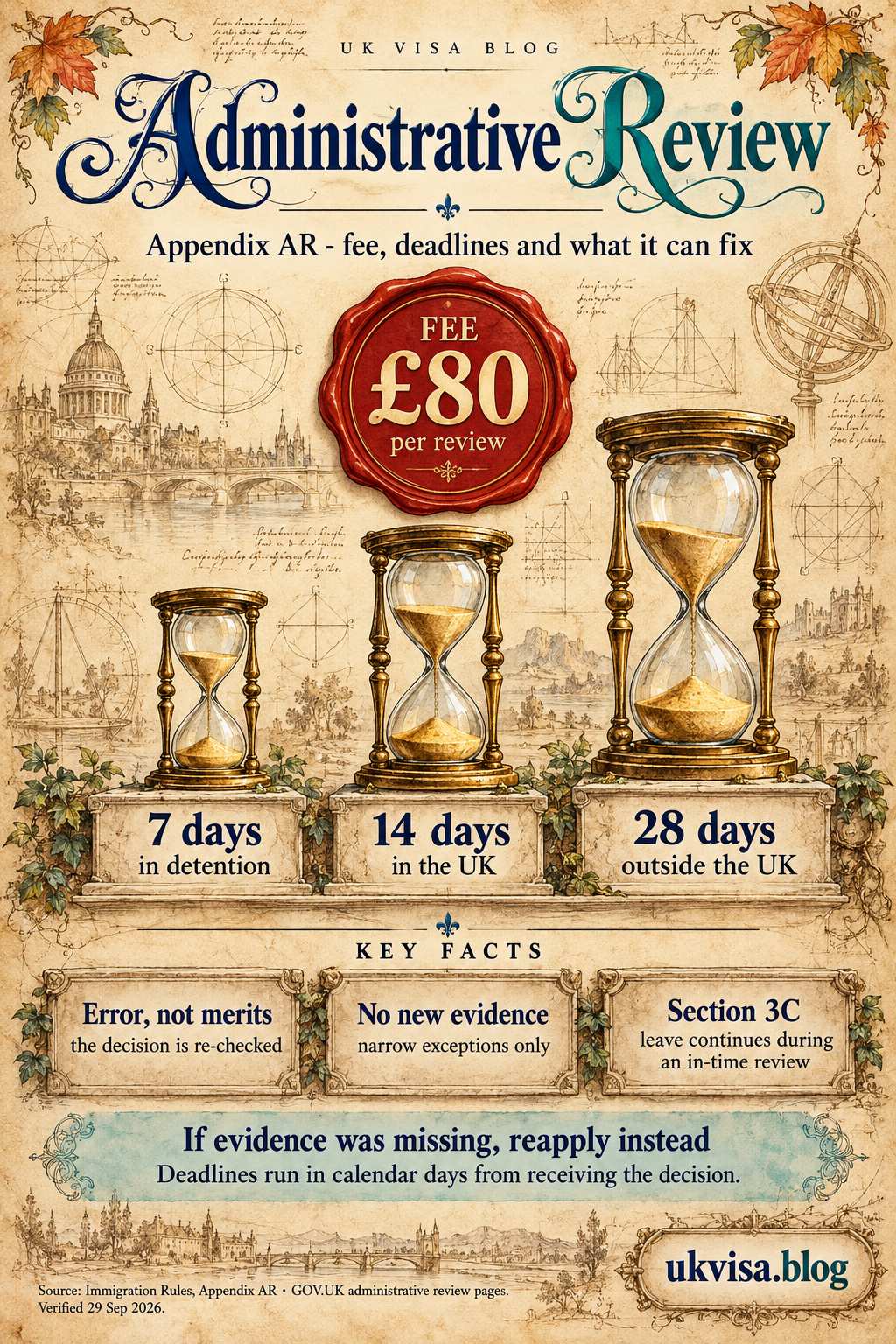
UK visa administrative review is a paid Home Office process for challenging an eligible refusal where a caseworker made a decision-making error. It costs £80 (refunded if successful), must be filed within 14 days inside the UK or 28 days from overseas, and is decided on the original evidence only — no new documents. AR covers Points-Based System routes, Student, dependants, and ILR; family route refusals (spouse, partner, parent) carry First-tier Tribunal appeal rights instead. Success rates run roughly 8% to 25% by category. This guide covers eligibility, success rates, procedure, 2026 timelines, and alternatives.
Source: Home Office Immigration System Statistics, year ending March 2026; Appendix AR of the Immigration Rules; Home Office caseworker guidance, May 2026
Administrative review remains the primary in-system remedy for eligible UK visa refusals, but the landscape has shifted. EU Settlement Scheme AR rights were removed on 4 April 2024 — EUSS applicants now have only judicial review as a paid challenge. Processing has lengthened: 6 to 12 months overseas, 8 to 12 weeks in-country. The £80 fee survived the 8 April 2026 fee revision unchanged, and success rates run from roughly 8% (Student) to 25% (Skilled Worker). AR permits no new evidence — where the refusal reflects an evidential gap, not caseworker error, reapplication is usually the better remedy.

- What is UK Visa Administrative Review?
- Administrative Review Eligibility — Which Visa Categories Have AR Rights?
- UK Visa Administrative Review Success Rate by Category
- How to Apply for Administrative Review — Step-by-Step Process
- Administrative Review Deadlines — 14 Days UK / 28 Days Overseas
- UK Administrative Review Processing Time 2026
- What Counts as a Caseworker Error for Administrative Review?
- What Happens If Your Administrative Review Is Successful?
- What Happens If Your Administrative Review Is Unsuccessful?
- Administrative Review Letter Template — Structure and Content
- Alternatives to Administrative Review
- Frequently Asked Questions
UK Visa Administrative Review — Process, Success Rate, and Recovery Framework 2026
Administrative review is the Home Office's paid internal mechanism for challenging an eligible visa refusal. Introduced in 2014 to replace Points-Based System appeal rights, AR lets a different caseworker re-examine the decision against the same evidence — checking for errors in fact-finding, rule application, or evidential assessment. It is cheaper and faster than a tribunal appeal, but cannot consider new evidence and overturns fewer decisions. Many applicants reach AR after a UK visa delay or NSF notification ends in refusal, or after exceptionally complex case routing signalled extended scrutiny. AR sits within the wider reapplication and refusal recovery options framework.
What is UK Visa Administrative Review?
UK visa administrative review is a paid Home Office process where a different caseworker checks an eligible refusal for caseworker error. The fee is £80, refunded if the decision is overturned. AR covers most Points-Based System refusals (Skilled Worker, Student, Global Talent, Innovator Founder), dependants, and some ILR refusals. Family route refusals (spouse, partner, parent) have First-tier Tribunal appeal rights instead. AR is decided on the original evidence only — no new documents can be submitted.
Why Administrative Review Exists
Administrative review was introduced under the Immigration Act 2014, alongside reforms that removed in-country appeal rights for most Points-Based System refusals. The rationale: where the Rules set quantitative thresholds — salary, English level, maintenance — caseworker errors are better corrected through a fast internal review than a tribunal hearing. The trade-off is no oral hearing, no new evidence, and a lower overturn rate than First-tier Tribunal appeals. Refusals engaging human rights, such as spouse and partner cases, fall outside AR entirely. See our common UK visa refusal reasons and visa approval rates by route guides.
Administrative Review Eligibility — Which Visa Categories Have AR Rights?
Administrative review is available for Skilled Worker, Health and Care Worker, UK Student route refusals, Global Talent, Innovator Founder and other Points-Based System refusals, PBS ILR refusals, dependants where the main applicant had AR rights, and certain Returning Resident refusals. It is not available for family route refusals (spouse, partner, parent, child, ADR), visitor visas, ETA, EU Settlement Scheme (removed 4 April 2024), asylum, or deportation decisions.
Visa Categories With Administrative Review Rights
| Visa Category | AR Available? | Alternative Recourse If Refused |
|---|---|---|
| Skilled Worker sponsored employment | Yes | Reapply or Judicial Review if AR fails |
| Health and Care Worker | Yes | Reapply or Judicial Review if AR fails |
| UK Student route | Yes | Reapply or Judicial Review if AR fails |
| Graduate route | Yes | Reapply or Judicial Review if AR fails |
| Global Talent | Yes | Reapply or Judicial Review if AR fails |
| Innovator Founder | Yes | Reapply or Judicial Review if AR fails |
| Indefinite Leave to Remain (PBS routes) | Yes | Reapply or Judicial Review if AR fails |
| Dependant visas (PBS routes) | Yes | As above |
| UK Spouse visa, Partner, Parent, Child (family route) | No | First-tier Tribunal appeal (Article 8 grounds) |
| Adult Dependent Relative | No | First-tier Tribunal appeal |
| UK Standard Visitor visa | No | Reapply only (no appeal rights for non-settlement visitor) |
| Electronic Travel Authorisation (ETA) | No | Reapply only |
| EU Settlement Scheme | No (removed 4 April 2024) | Judicial Review only |
| Asylum / Protection | No | First-tier Tribunal (Asylum and Immigration Chamber) appeal |
UK Visa Administrative Review Success Rate by Category 2026
Across all categories, roughly 8% to 25% of administrative reviews overturn the original refusal. Skilled Worker reviews succeed most often at around 18–25%, reflecting technical salary, sponsorship, and CoS errors. Student reviews run 8–12%, ILR 10–15%, Health and Care Worker 15–20%. These rates sit well below First-tier Tribunal appeal success rates (typically 40–55% for family route Article 8 appeals) because AR reviews caseworker error only, on the original evidence.
| Visa Category | Approx. AR Success Rate 2026 | Common Successful AR Grounds |
|---|---|---|
| Skilled Worker | 18–25% | Salary calculation errors, CoS verification issues, sponsor licence misreading |
| Health and Care Worker | 15–20% | Salary, professional registration evidence, CoS errors |
| UK Student route | 8–12% | Financial maintenance calculation, ATAS clearance, CAS error |
| Graduate route | 10–15% | Award verification, sponsorship completion date errors |
| Global Talent | 12–18% | Endorsement verification, evidential assessment errors |
| Innovator Founder | 10–15% | Endorsing body verification, business plan assessment errors |
| ILR (PBS routes) | 10–15% | Continuous residence calculation, absence calculation, English / KOLL errors |
| Dependants (PBS) | 10–15% | Relationship documentation, age calculation, financial requirement errors |
Why AR Success Rates Are Lower Than Tribunal Appeal Rates
Administrative review success rates are meaningfully lower than First-tier Tribunal appeal success rates for several structural reasons:
- No new evidence permitted: AR can only re-examine the evidence the original caseworker had — applicants cannot cure evidential gaps that caused the refusal
- No oral hearing: AR is decided entirely on documents — applicants cannot explain in person why the decision was wrong
- Narrower scope of review: AR reviews for caseworker error only — not for merits or proportionality
- Same Home Office reviewing same Home Office: AR is internal review, lacking the independence of a tribunal
- Higher bar of error: Caseworker disagreement is not enough — the decision must contain a demonstrable error in law, fact, or guidance application
How to Apply for Administrative Review — Step-by-Step Process
- Receive your refusal notice and grounds explanation from UKVI confirming refusal and AR eligibility
- Confirm you are within the deadline — 14 calendar days in the UK, 28 calendar days overseas
- Confirm your visa category has AR rights — family route refusals do not
- Identify the specific caseworker errors, point-by-point against each refusal ground
- Complete the online AR application at gov.uk — separate in-country and out-of-country forms
- Pay the £80 fee — refunded only if the review succeeds
- Submit written submissions explaining the alleged errors in the original decision
- Wait for the decision — 8 to 12 weeks in-country, 6 to 12 months overseas in 2026
- Receive the outcome: decision maintained, overturned, or remitted for re-decision
- If successful, the fee is refunded to the original payment method within 4–6 weeks
What You Can and Cannot Submit With Administrative Review
The strict evidential limit on administrative review is critical to understanding when AR is the right remedy:
- Permitted: Written submissions identifying specific caseworker errors in the original decision
- Permitted: Reference to evidence already submitted with the original application
- Permitted: Legal arguments on the application of Immigration Rules or published Home Office guidance
- Permitted (limited circumstances): Evidence to address procedural fairness or natural justice errors
- Not permitted: New evidence not submitted with the original application
- Not permitted: Updated financial evidence, new bank statements, or new English test certificates
- Not permitted: Oral submissions or in-person hearing — AR is a paper-only process
- Not permitted: Challenge to the Immigration Rules themselves — only their application to your case
Administrative Review Deadlines — 14 Days UK / 28 Days Overseas
Administrative review must be filed within 14 calendar days of the refusal decision if you are inside the UK, or 28 calendar days if overseas. The clock runs from the date the decision is given — not the date you received it. Late applications are accepted only in exceptional circumstances. Miss the deadline and your options narrow to reapplication, a discretionary reconsideration request, or — for human rights refusals — a late tribunal appeal at the Tribunal's discretion.
Section 3C Protection During In-Country Administrative Review
If you are inside the UK with valid leave when you apply for administrative review, Section 3C of the Immigration Act 1971 extends your existing immigration status while the AR is being considered. This means:
- Your leave continues automatically from the expiry of your original visa until the AR is decided
- Conditions attached to your previous leave continue — including any restrictions on work or recourse to public funds
- You are not an overstayer while the AR is pending — even if your original visa has technically expired
- If the AR is unsuccessful, Section 3C ends — you must leave the UK or face overstaying consequences unless a further remedy is filed
- No new application during 3C leave: You cannot apply for a different visa while AR is pending — only after it is decided
UK Administrative Review Processing Time 2026
In-country administrative reviews typically take 8 to 12 weeks in 2026. Overseas reviews take 6 to 12 months — far beyond the old 28-day service standard. Where the underlying purpose is time-sensitive (course start, job offer, family event), the AR delay alone may rule it out as the primary remedy — reapplication with corrected evidence is often faster despite the higher fee.
A common follow-up is whether processing extends further after a successful review. It does — where AR overturns a refusal and remits the case, visa issuance takes a further 4 to 8 weeks in-country and 4 to 12 weeks overseas. The full journey from refusal to grant via overseas AR can therefore exceed 12 months. Where that timeline is incompatible with a course, job, or family event, a fresh application curing the original evidential gap is usually the faster route.
AR Processing Times Compared to Other UK Visa Remedies
| Recovery Route | Typical Processing Time 2026 | Cost |
|---|---|---|
| Administrative Review (in-country) | 8–12 weeks | £80 (refunded if successful) |
| Administrative Review (overseas) | 6–12 months | £80 (refunded if successful) |
| Reapplication (most categories) | Original service target (e.g. 3 weeks visitor / 12 weeks settlement) | Full application fee (e.g. £558 Student, £819 Skilled Worker, see UK out-of-country entry clearance fees 2026) |
| Reconsideration Request | 4–12 weeks (discretionary) | Free, but no guarantee of consideration |
| First-tier Tribunal Appeal (family route) | 12 to 18 months to first hearing | £80 paper / £140 oral hearing |
| Judicial Review (Upper Tribunal) | 6 months to 2 years | £154 permission fee + barrister + solicitor costs (typically £5,000+) |
What Counts as a Caseworker Error for Administrative Review?
AR succeeds only where the decision contains a demonstrable caseworker error — not mere disagreement or a wish to add evidence. Recognised grounds include factual errors in the decision letter; misapplied Immigration Rules; failure to consider submitted evidence; departures from published caseworker guidance; procedural unfairness; misread documents; and arithmetic errors in salary, maintenance, or absence calculations. If the refusal was correct on the evidence submitted, reapplication with corrective evidence is the right remedy.
Strong Grounds for Administrative Review Success
- Factual error in decision letter: Wrong dates, wrong names, wrong financial amounts, or wrong references to evidence
- Failure to consider submitted evidence: Caseworker did not review documents submitted with the application — the full document requirements framework explains what should have been considered
- Misapplication of the Immigration Rules: Wrong rule cited, wrong threshold applied, or wrong qualifying period calculated
- Misreading of supporting documents: Caseworker concluded a bank statement did not show required funds when in fact it did
- Failure to follow published guidance: Caseworker acted contrary to current Home Office published guidance for the route
- Arithmetic errors: Wrong continuous residence calculation, wrong absence days total, wrong salary calculation
- Wrong English or KoLL assessment: Valid SELT certificate rejected as invalid; valid Life in the UK pass treated as a fail
- Wrong Part 9 application: Part 9 general grounds refusals applied where the specific ground does not in fact apply to the applicant
- Procedural unfairness: Caseworker did not seek clarification before refusing on grounds that could have been clarified
Weak Grounds Where AR Is Unlikely to Succeed
- Mere disagreement with the outcome where the evidence genuinely did not meet the Rules
- New evidence not submitted with the original application — AR cannot consider this material
- Changes in circumstances since the refusal — new employment, new English test, new financial position
- Challenging the Immigration Rules themselves — AR can only review their application
- Article 8 / human rights arguments — these belong in a tribunal appeal, not AR
What Happens If Your Administrative Review Is Successful?
If the review succeeds, the refusal is overturned and the Home Office either grants the visa directly or remits the case to a different caseworker for re-decision. The £80 fee is refunded automatically within 4 to 6 weeks. Remitted cases are typically decided within 4 to 12 weeks depending on location. Section 3C leave, where held, continues until the new decision. No fresh application or fee is needed — the original application is processed afresh.
The Two Outcomes of a Successful Administrative Review
- Decision overturned and visa granted directly: The reviewer concludes the original decision was wrong and grants the visa without remittal — most common for clear factual or arithmetic errors
- Decision overturned and remitted for re-decision: The reviewer concludes the decision was wrong but the case needs fresh assessment by a different caseworker — most common for procedural errors
In either case, the £80 AR fee is refunded automatically and no further fee is payable — the grant or re-decision proceeds on the original application. Where the requested validity period has partly passed, the Home Office will typically issue the visa with the validity period as originally requested.
What Happens If Your Administrative Review Is Unsuccessful?
If the review fails, the refusal stands and the £80 fee is not refunded. The written notification explains why the reviewing caseworker upheld the decision. Remaining options: reapply addressing the refusal grounds (most common); judicial review at the Upper Tribunal within 3 months, preceded by a Pre-Action Protocol letter; or a free, discretionary reconsideration request. Section 3C leave held during an in-country AR ends with the unsuccessful outcome — leave the UK or secure a further remedy promptly.
Recovery Options After Unsuccessful Administrative Review
- Reapplication: Make a fresh application addressing the original refusal grounds. Most common path. Pay the full application fee. A prior refusal does not disqualify a future application unless deception or a 10-year re-entry ban is involved
- Judicial Review: Challenge the AR decision itself at the Upper Tribunal. The deadline is 3 months from the AR refusal date. Requires the Pre-Action Protocol letter first. Total costs typically £5,000+ with solicitor and barrister fees
- Pre-Action Protocol letter: Final pre-litigation step. Sets out the proposed judicial review grounds. Sometimes resolves the case without formal judicial review proceedings
- Reconsideration request: Discretionary — request the Home Office reconsider outside the formal AR / judicial review framework. No guaranteed response. Free
- Wait for changed circumstances: Where the refusal was tied to a temporary issue (e.g. salary threshold, English test date), wait and reapply when circumstances change
Administrative Review Letter Template — Structure and Content
An effective AR submission works point-by-point through the refusal letter. Address it to the relevant Home Office team, cite the application reference, quote each refusal ground, identify the specific error — factual, evidential, legal, or procedural — and cross-reference the original evidence the caseworker overlooked or misread, citing the relevant Immigration Rules or guidance. Close with the outcome sought: overturn and grant, or remit for re-decision. Two to six pages is typical; the gov.uk form provides a structured submission field.
Administrative Review Submission Structure
- 1. Header: Application reference number, applicant name and date of birth, refusal decision date, AR application date
- 2. Eligibility statement: Confirm this is an eligible AR (within deadline, eligible visa category)
- 3. Refusal ground 1: Quote the specific refusal ground from the original decision letter
- 4. Error explanation: Identify the specific error — factual, evidential, legal, or procedural — and explain why this was an error
- 5. Evidential reference: Cross-reference the original evidence that the caseworker overlooked or misread
- 6. Rules / guidance citation: Cite the relevant Immigration Rule or Home Office published guidance demonstrating the correct approach
- 7. Repeat steps 3–6 for each additional refusal ground
- 8. Conclusion: Request the AR outcome you seek — overturn and grant, or overturn and remit for re-decision
- 9. Signature and date
Alternatives to Administrative Review
Administrative review is one of several recovery routes available after a UK visa refusal. Choosing the right remedy depends on the refusal ground, the visa category, and whether new evidence is available:
| Recovery Route | Best Used When | Cost |
|---|---|---|
| Administrative Review | Eligible visa category AND clear caseworker error AND no new evidence needed | £80 (refunded if successful) |
| Reapplication | New evidence available; refusal was correct on original evidence; or AR rights not available | Full application fee |
| Reconsideration request | Discretionary outside formal remedies; no guaranteed response; usually only where exceptional circumstances | Free |
| First-tier Tribunal Appeal | Refusal engages Article 8 / human rights (family route, settlement); no AR right available | £80 paper / £140 oral hearing |
| Judicial review through the Upper Tribunal or High Court | AR has failed; or no AR / appeal right; or EUSS refusal post-4 April 2024 | £154 permission fee + solicitor/barrister costs (£5,000+) |
When to Choose AR vs Other Remedies
- Choose administrative review when: You have AR rights (PBS / Skilled Worker / Student / ILR), the refusal contains a clear caseworker error, and your original evidence was sufficient. AR is cheapest and quickest where it applies
- Choose reapplication when: The refusal was correct on the original evidence but you can now provide additional or corrected evidence. Faster than AR if AR processing is delayed. More expensive than AR (full fee)
- Choose tribunal appeal when: The refusal is a family route refusal (no AR right) and engages Article 8 family / private life. Slower than AR but with markedly higher overturn rates
- Choose judicial review when: AR has failed; or no AR / appeal right exists; or the refusal is unlawful in a way the AR / appeal system cannot remedy. Most expensive option
- Choose reconsideration request when: Exceptional circumstances apply outside the normal framework. Discretionary — no guaranteed response
- Administrative review is the £80 paid Home Office internal review for eligible UK visa refusals
- Available for PBS / Skilled Worker / Student / Global Talent / Innovator / ILR refusals — NOT family route
- Deadlines: 14 calendar days from refusal if in the UK; 28 calendar days if overseas
- EU Settlement Scheme AR rights removed 4 April 2024 — EUSS applicants have judicial review only
- Success rates 2026: Skilled Worker 18–25%, Student 8–12%, ILR 10–15%, Global Talent 12–18%
- Processing times 2026: 8–12 weeks in-country; 6–12 months overseas — much longer than previous 28-day target
- No new evidence permitted at AR — only review of caseworker error on original evidence
- Successful AR: fee refunded in 4–6 weeks; visa granted or case remitted for re-decision
- Unsuccessful AR: reapply, judicial review, or wait for changed circumstances
- Section 3C leave continues during in-country AR; ends with unsuccessful AR outcome
Success rates vary by category. Skilled Worker reviews show approximately 18 to 25% overturn rates — the highest among AR-eligible routes, reflecting technical salary, sponsorship, and Certificate of Sponsorship errors. Student reviews run 8 to 12%, ILR on PBS routes 10 to 15%, Health and Care Worker 15 to 20%, and Global Talent 12 to 18%. These rates sit well below First-tier Tribunal appeal success rates — typically 40 to 55% for family route Article 8 appeals — because AR considers caseworker error only, with no new material.
Processing times are significantly longer than the previous 28-day service standard. In-country reviews (FLR, ILR, in-country Skilled Worker and Student variations) typically take 8 to 12 weeks. Overseas reviews (out-of-country Skilled Worker, Student, Global Talent, dependants) typically take 6 to 12 months. Where time is critical to the underlying purpose — a course start, an employment offer, a family event — the AR delay alone may make it unsuitable as the primary remedy, and reapplication may be faster despite the higher cost.
It can. Where AR overturns a refusal and remits the case for re-decision, visa issuance takes a further 4 to 8 weeks in-country and 4 to 12 weeks overseas — so the full journey from refusal to grant via overseas AR can exceed 12 months. Where AR overturns the refusal directly without remittal, more common for clear arithmetic or factual errors, the visa typically issues within 2 to 4 weeks. The £80 fee is refunded automatically within 4 to 6 weeks of the successful outcome.
The original refusal is overturned and the Home Office either grants your visa directly or remits the case for re-decision by a different caseworker. The £80 fee is refunded automatically to the original payment method within 4 to 6 weeks, and you receive written confirmation. Remitted cases are typically decided within 4 to 12 weeks. No additional application fee is payable — the original application is processed afresh — and Section 3C leave, for in-country applicants, continues until the new decision is issued.
The refusal stands and the £80 fee is not refunded. The written notification explains why the reviewing caseworker upheld the original decision. Your remaining options are: reapply with a fresh application addressing the refusal grounds (the most common path); judicial review at the Upper Tribunal within 3 months of the AR refusal, preceded by a Pre-Action Protocol letter; or a free, discretionary reconsideration request. If you held Section 3C leave during an in-country AR, that leave ends with the unsuccessful outcome.
No — AR cannot consider evidence that was not submitted with the original application. It reviews whether the original caseworker erred in assessing the material already before them, not a fresh decision on updated information. You can submit written submissions identifying specific errors and cross-referencing the original evidence, but not new bank statements, English test certificates, or employment letters. Where the refusal was correct on the original evidence but curable with additional documents, reapplication is the appropriate remedy.
Administrative review costs £80, paid online at the gov.uk AR portal, and is refunded automatically if the review succeeds — typically within 4 to 6 weeks. If it fails, the fee is not refunded. The £80 fee was unchanged by the 8 April 2026 fee revision, which raised most other application fees. Compared to alternatives — reapplication at full visa fee (£558 Student, £819 Skilled Worker), a First-tier Tribunal appeal at £80–£140, or judicial review at £5,000+ in legal costs — AR remains the cheapest paid recovery route where available.
No — spouse, partner, parent, and child refusals do not have AR rights. Family route refusals carry First-tier Tribunal appeal rights instead under section 82 of the Nationality, Immigration and Asylum Act 2002, because the refusal engages Article 8 ECHR family and private life. The appeal route is slower (12 to 18 months to first hearing, £80 paper or £140 oral hearing fee) but succeeds far more often — typically 40 to 55% for spouse and partner appeals — and the Tribunal can consider new evidence post-dating the refusal.
If you are inside the UK when the refusal is given, you have 14 calendar days to file the AR application; if outside the UK, 28 calendar days. The deadline runs from the date the decision was given — not the date you received the letter. Late applications are accepted only in exceptional circumstances. If you miss the deadline, your remaining options are reapplication or — for human rights-engaging refusals — a late appeal to the First-tier Tribunal, subject to its discretion to extend time.
No — EUSS administrative review rights were removed on 4 April 2024 under amendments to Appendix AR (EU). Applicants who are refused, or whose pre-settled status is not upgraded to settled status, no longer have AR as a paid remedy; the only paid challenge route is judicial review at the Upper Tribunal, which is far costlier and usually requires solicitor representation. Reapplication, which remains free for most EUSS categories, may suit refusals correctable with additional evidence. AR continues unchanged for Skilled Worker, Student, ILR, and other PBS routes.
For the official Home Office administrative review framework, see how to ask for a visa administrative review on GOV.UK. The full Immigration Rules basis for AR is set out at Immigration Rules Appendix AR — Administrative Review. For the published Home Office caseworker guidance on administrative review decision-making, see the Home Office administrative review caseworker guidance. For wider data on visa refusal volumes and outcomes, see the Home Office Immigration System Statistics, year ending March 2026.