
After a refusal there are five things you can do, and only one or two will be open to you. Which depends entirely on the paragraph cited in your notice. Choosing the wrong remedy wastes months and money, so the first task is reading the letter, not deciding what feels fair.
After a Refusal
Your Options After a UK Visa Refusal
The Five Remedies
- A fresh application: available on any route, at any time, unless a ban applies.
- Administrative review: an internal review for case working errors, on routes where it is offered.
- An appeal to the First-tier Tribunal: where a right of appeal exists, usually on human rights grounds.
- A reconsideration request: informal, discretionary, and not a legal remedy.
- Judicial review: a challenge to the lawfulness of the decision, not its merits.
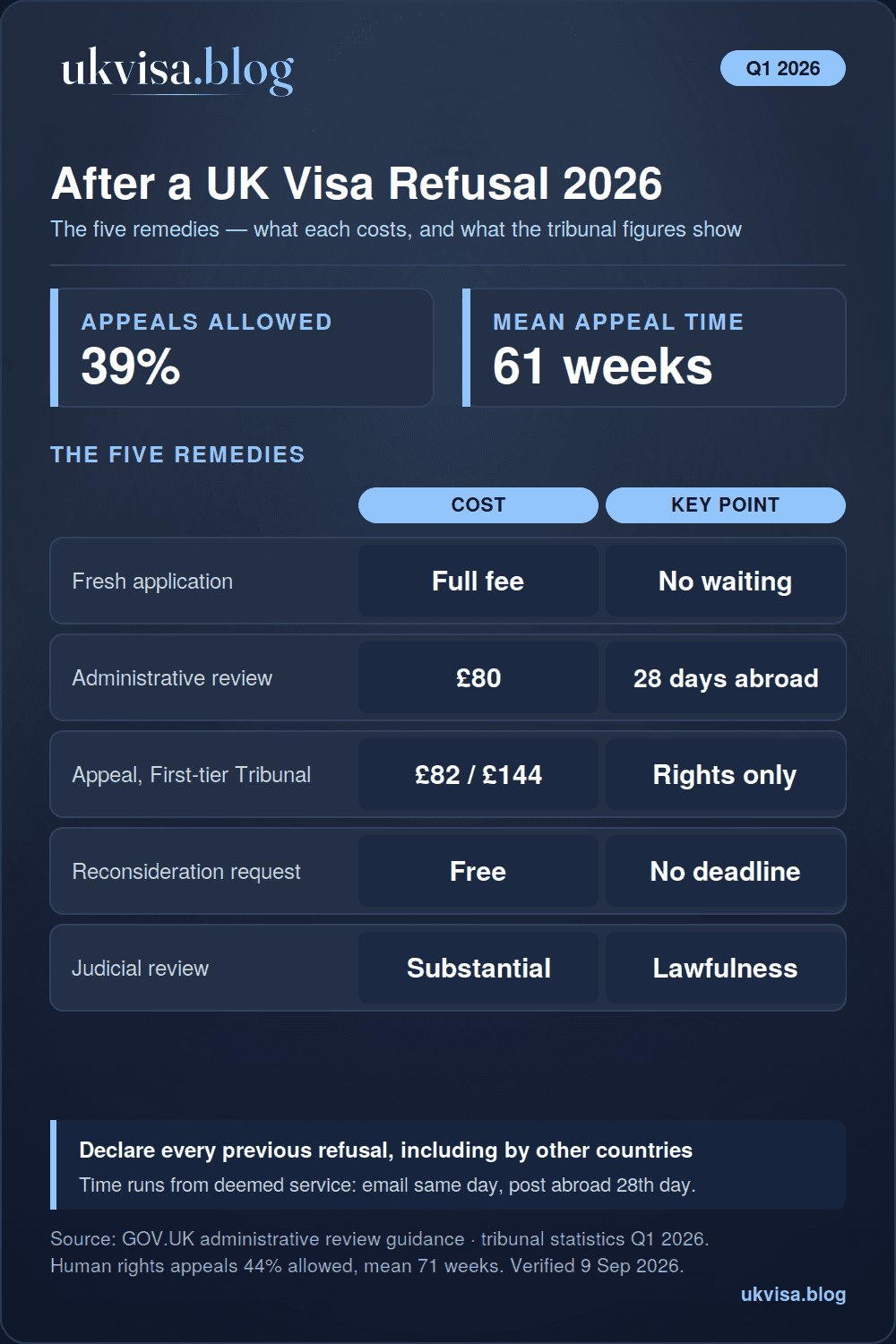
Visit refusals carry no appeal and no administrative review, so a fresh application is the route. Where administrative review is available it costs £80 and must be requested within 28 days from outside the UK. First-tier Tribunal fees are £82 on the papers and £144 for a hearing. Judicial review is expensive, time limited, and tests lawfulness rather than merits.
What Actually Succeeds
Tribunal statistics for the first quarter of 2026 show 39% of immigration appeals allowed overall, with human rights appeals at 44%, asylum at 40% and EEA cases at 30%. The mean time from lodging to determination was 61 weeks, and 71 weeks for human rights cases. In judicial review, substantive Upper Tribunal outcomes favoured the appellant in around 41% of cases.
What Moves the Odds
- Whether the refusal was evidential or a finding about you: gaps are fixable; deception findings are not, easily.
- Whether anything has actually changed: a resubmitted identical bundle produces an identical answer.
- Whether the right remedy was chosen: an appeal where no right exists is struck out.
- Whether the deadline was met: counted from deemed service, not from when you read the letter.
- Whether the history was declared: concealment converts a fixable case into a suitability one.
Reapply Now, or Wait?
Reapply Straight Away
Where the refusal turned on something you can fix today — a document that was missing, a statement that was not in the right format, a figure explained badly — there is no waiting period and nothing is gained by delay. Fix the point, evidence it, and reapply.
Wait First
Where the refusal turned on your circumstances rather than your paperwork, time is the remedy. A refusal for insufficient ties to your home country is not answered by the same job and the same balance a fortnight later. Six months of stable employment, a settled account history and a clear reason to travel change the picture; a resubmission does not.
Where the notice cites a re-entry ban, reapplying inside the period produces a mandatory refusal and another negative decision on the record. Check for a SUI 12.1 reference before doing anything — see our page on UK entry bans and on deception bans.
Reapplying Properly
- List every finding in the notice: separately, in the order given.
- Match each to a document: a finding answered by argument alone is not answered.
- Declare the refusal: on the form, with the date and reference.
- Explain what has changed: in the additional information field, briefly and specifically.
- Check consistency: figures and dates must match across the form, the evidence and any sponsor letter.
- Leave out the low-value documents: photographs, hotel and flight bookings, travel insurance.
Our pages on reading the refusal letter, the paragraphs behind refusals and supporting documents cover the detail. Fees are on our pages on entry clearance fees and in-country fees.
The Deadline Runs From Deemed Service
Every formal remedy has a time limit, and each is counted from the date the notice was treated as given rather than the date you read it. A notice sent by email is served the day it was sent. Posted to an address outside the UK, it is served on the 28th day after posting. Recorded post within the UK is served on the second day after sending.
Establish that date before anything else. Applicants routinely discover a 28-day window has already run because the decision reached a spam folder or an old address. Where the window has closed, whether anything can be done depends on the facts of service, and that argument needs the notice in front of you.
Cost Is Not the Only Price
Each remedy costs time as well as money, and time has consequences of its own — a job offer that lapses, a course that starts without you, a passport that expires while a decision is pending. Weigh the realistic timescale of a review or appeal against the timescale of a fresh application before choosing on principle.
Administrative Review
A different caseworker rechecks the decision for a case working error. It is not a second bite at the evidence: new material is generally not considered, and the review asks whether the original decision was made correctly on what was before the decision maker.
It costs £80 and, from outside the UK, must be requested within 28 days of the decision. GOV.UK currently warns that a result can take 12 months or more, with a Home Office update if nothing is decided within six months. It is not available for visit refusals.
When It Is the Right Choice
Where the caseworker missed a document you did send, misread a figure, or applied the wrong rule. Where the real problem is that your evidence was thin, a fresh application is faster and more likely to work. See our page on the administrative review route and the GOV UK review pages.
Appeals
A right of appeal exists in defined situations, principally where a human rights or protection claim has been refused. Most refusals on work, study and visit routes carry none. Where an appeal does exist, the tribunal fee is £82 for a decision on the papers and £144 for an oral hearing.
Appeals are slow. The mean time to determination in early 2026 was 61 weeks, and longer for human rights cases. That is the trade-off: a properly argued appeal decides the point authoritatively, but a fresh application may resolve the same problem within months. Our pages on immigration appeals and human rights grounds cover when the right exists.
Reconsideration Requests
A reconsideration is a request that the Home Office look again, outside any formal process. It is discretionary, carries no deadline protection, and does not stop time running on a review or an appeal. Its main use is where an obvious factual error can be pointed out quickly.
Never rely on one as your only step. Pursue the formal remedy in time and treat the reconsideration as a parallel effort — see our page on reconsideration requests.
Judicial Review
Judicial review tests whether a decision was lawful — whether the right test was applied, whether relevant matters were considered, whether the process was fair. It does not ask whether the decision was generous. It is the remedy of last resort where no review or appeal exists.
A pre-action protocol letter comes first, setting out the error and giving the Home Office a chance to withdraw the decision. A meaningful proportion of cases resolve at that stage. Claims are time limited and costly; our page on judicial review at the Upper Tribunal and the Administrative Court guide set out the process.
If You Are Inside the UK
The calculation changes entirely. An in-country refusal usually ends the section 3C leave that was continuing your permission while the application was pending, and you are then without status. Working, renting and driving are affected immediately, and overstaying carries a re-entry ban of its own.
Where an in-time review or appeal is available, section 3C can continue during it — which is often the decisive reason to use the formal remedy rather than leave and reapply. Take advice quickly, because the window is short and the consequences of getting it wrong are not limited to this application.
When You Have Been Refused More Than Once
Repeat refusals compound. Each is declared on the next application and each adds to the picture a caseworker forms before reading the evidence. Two refusals on the same ground is the point to stop reapplying and change something structural.
- The route: a visit refusal for someone who wants to live here is answered by the correct route, not a better visit application.
- The timing: wait until the underlying circumstance has genuinely changed.
- The evidence: different documents, not more of the same ones.
- The representation: take advice where a suitability finding is in play.
Choosing Between Them
Which Remedy Fits Which Problem
| What went wrong | Best route | Cost |
|---|---|---|
| A document was missing or unclear | Fresh application | The application fee |
| The caseworker missed evidence you sent | Administrative review, where available | £80 |
| A human rights claim was refused | Appeal, where the right exists | £82 papers, £144 hearing |
| An obvious factual error | Reconsideration, alongside the formal remedy | Free |
| The wrong legal test was applied | Pre-action letter, then judicial review | Substantial |
| Your circumstances were the problem | Wait, then reapply | The application fee |
Sources: GOV.UK administrative review guidance and published tribunal statistics. Checked 22 August 2026.
The pattern is consistent. Evidential problems are solved by evidence, and the fastest route to that is usually a fresh application. Legal problems need a legal remedy, and the deadline runs from deemed service. Anything involving a finding about your honesty warrants advice before you spend another fee.
Sources: the GOV UK administrative review pages, the immigration and asylum tribunal, the Administrative Court judicial review guide and published tribunal statistics for the first quarter of 2026. Figures verified 22 August 2026.
Frequently Asked
After-Refusal Questions
How soon can I reapply after a refusal?
Immediately, unless a re-entry ban applies. There is no waiting period. Whether you should is a different question, and depends on whether anything has changed.
Can I appeal a visit visa refusal?
Only on human rights or discrimination grounds. There is no general right of appeal and no administrative review for visit refusals.
How much is administrative review and how long does it take?
£80, requested within 28 days from outside the UK. GOV.UK warns it can take 12 months or more, with an update if nothing is decided within six months.
What proportion of appeals succeed?
Around 39% were allowed in the first quarter of 2026, with human rights appeals at 44%, asylum at 40% and EEA cases at 30%.
How long does an appeal take?
The mean time to determination was 61 weeks in early 2026, and 71 weeks for human rights appeals. A fresh application is often far faster.
Does a refusal ban me from applying again?
Not by itself. Bans arise under the suitability rules and are stated in the notice. Without one, you may apply again straight away.
Should I send new evidence with an administrative review?
It generally will not be considered. Review looks for a case working error on the material that was before the decision maker. New evidence belongs in a fresh application.
Is a reconsideration request worth making?
Only alongside a formal remedy, and mainly for obvious factual errors. It is discretionary, has no deadline protection, and does not pause time running elsewhere.
Do I have to declare a previous refusal?
Yes, including refusals by other countries. A declared refusal you can explain is far less damaging than one that surfaces on a records check.
When should I get professional help?
Where the notice cites deception, criminality or a sham finding, where a ban is in play, or where you are considering judicial review. Straightforward evidential gaps rarely need it.