
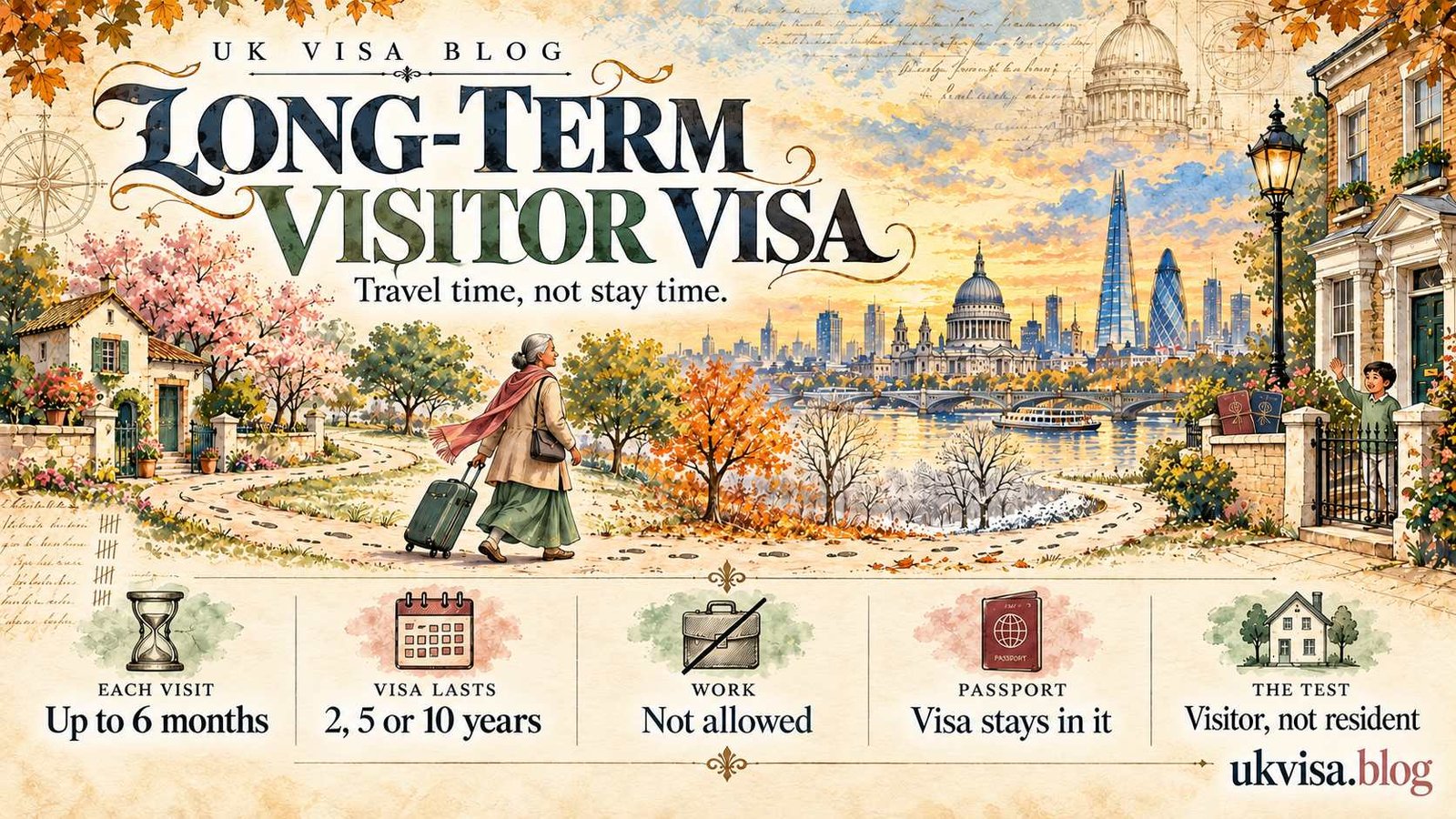
A long-term visit visa buys travel time, not stay time. Two, five and ten-year visas all cap each individual visit at six months; what you are paying for is the freedom to come back without applying again. Whether that is worth £506, £903 or £1,128 depends entirely on how often you actually travel.
Long-Term Visits
Two, Five and Ten-Year UK Visit Visas Compared
What a Long-Term Visa Actually Gives You
It is a Standard Visitor visa with a longer validity window. The Immigration Rules allow applicants to apply for a visa permitting multiple visits of up to six months at a time over two, five or ten years. The rules governing each visit are unchanged — same permitted activities, same prohibition on work, same requirement to leave.
Long-term visit visas cost £506 for two years, £903 for five and £1,128 for ten from 8 April 2026. Each stay is still capped at six months. There is no annual day limit, but a travel pattern showing you living in the UK is refused. The visa is tied to the passport it is issued in.
Who Should Consider One
- You travel at least twice a year: two six-month visas already cost £270.
- Your travel is unpredictable: a family emergency needs no three-week wait.
- You have a strong travel history: previous compliant UK visits carry weight.
- You will keep the old passport: the visa stays valid in it after that passport expires, so travel with both.
- Your circumstances are stable: employment, property and family ties that will still hold in five years.
The Fees, and What They Work Out At
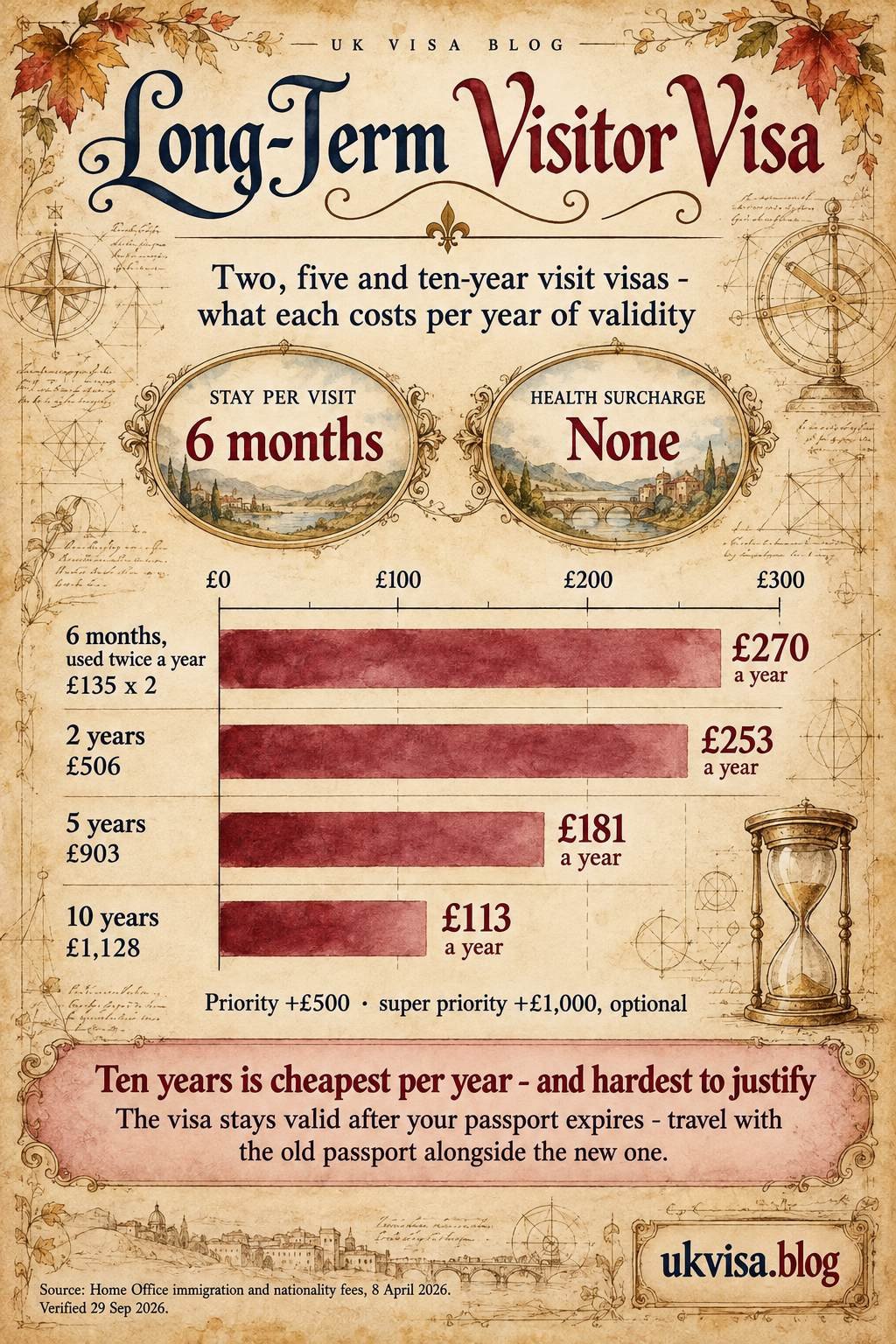
Long-Term Visit Fees from 8 April 2026
| Validity | Previous fee | From 8 April 2026 | Cost per year |
|---|---|---|---|
| Up to 6 months | £127 | £135 | £270 if used twice a year |
| 2 years | £475 | £506 | £253 |
| 5 years | £848 | £903 | £181 |
| 10 years | £1,059 | £1,128 | £113 |
Source: Home Office visa fees table, checked 22 August 2026.
The break-even is straightforward. A two-year visa pays for itself against roughly four six-month applications; a ten-year visa against nine. Add the costs that do not change with validity — the visa application centre appointment, any courier or document scanning charges, and travel to the centre. Our visitor fee page lists them in full.
Where an officer issues a shorter visa than the one applied for, no refund, full or partial, is available. The decision requires an Entry Clearance Manager’s authority, and clear reasons must be given in a covering letter when your passport is returned — so you should be told why, but you will not get the difference back.
The Two-Year Visa
The natural first long-term step. It costs less than four separate applications, and two years is short enough that a caseworker can assess your current circumstances holding good for the whole period — which is exactly the assessment they are making.
What Makes a Two-Year Application Strong
A demonstrable reason to travel repeatedly, evidenced rather than asserted: family in the UK, a continuing commercial relationship, a recurring event. Stable employment and income at home. A clean travel history. And a stated pattern of use that is plausible — three or four visits of a few weeks each reads better than an intention to spend six months here every year.
The Five-Year Visa
At £181 a year this is usually the best value for genuinely frequent travellers. The bar is higher because the caseworker is projecting your circumstances five years forward, and the more your case depends on a current job or a current relationship, the harder that projection is.
Guidance helps here in one respect: it accepts that the reason for visiting is likely to differ over the life of a two, five or ten-year visa, and that this is permissible provided each visit is for a permitted activity. You are not locked into the purpose you stated on the form. What you are locked into is remaining a visitor.
The Ten-Year Visa
The cheapest per year and the hardest to justify: the officer must be satisfied you will keep visiting genuinely for a decade. A passport expiring sooner is not a reason to avoid it, because the visa stays valid in the expired passport and you travel with it alongside the new one.
UK 10-Year Visa Cost in 2026
The UK 10-year visa fee is £1,128 from 8 April 2026, up from £1,059 — about £113 a year against £253 a year on the two-year visa and £181 on the five-year. That is the whole Home Office charge: there is no health surcharge on any visit visa, and the only additions are optional priority (£500) or super priority (£1,000) processing.
How Much Time It Actually Buys
Six months per entry, with no annual cap in the rules. Caseworker guidance states expressly that no maximum period in any given window, such as six months in twelve, is specified. But the same guidance directs officers to refuse where the travel history shows someone seeking to remain for extended periods or making the UK their home.
The indicators named are concrete: more time in the UK than in the home country, return trips abroad used only to seek re-entry, registering with a GP, children enrolled in UK schools, and where the applicant is registered for tax. Our page on the MULT endorsement and the 180-day myth works through this in detail.
First-Time Applicants: Aim Long or Start Short?
With no UK travel history, the caseworker has nothing to project from. Officers are told to issue the visa applied for unless there are grounds not to, but “concerns about issuing a long-term visit visa” is itself a stated ground for issuing something shorter, with a manager’s authority.
The Staged Approach
- First application: a six-month visa at £135 for a specific, well-evidenced trip.
- Comply visibly: enter, stay for the period you described, leave before it expires.
- Second application: two years, with the compliant visit as evidence.
- Later: five or ten years once a pattern of short, compliant visits exists.
This is a judgement, not a rule. A first-time applicant with strong ties, clear funds and an obvious reason to travel repeatedly can be granted five years. But where an application is marginal, the shorter request is the one more likely to succeed outright, and the fee difference is money you keep. Our success rate page gives the wider context.
Applying
Same form, same route, same evidence — you select the validity period and pay the corresponding fee. Our application form walkthrough covers the free-text fields, and our supporting documents guide what to send. Where someone is funding your travel, see our page on sponsoring a visitor.
Two Things That Limit the Grant
A child granted a long-term visa has it limited to six months past their eighteenth birthday, so a fourteen-year-old cannot get ten years of use from a ten-year fee. And where a travel document restricts how long the holder may be outside their country of residence, or carries permission to enter another country that must be used by a set date, the visa can be limited accordingly.
Processing and Priority
Decisions target around three weeks from biometrics regardless of validity requested. Priority costs £500 for a five working day target, super priority £1,000 for the next working day. See our pages on priority services, timelines after biometrics and delays.
Long-Term Visas for Parents and Grandparents
This is the most common use of the route and the one most often refused. A retired parent with adult children settled in the UK has, on paper, the profile guidance flags: few economic ties at home, several family members here. The application has to answer that rather than hope it goes unnoticed.
- Property or tenancy at home: evidence of a residence they are returning to.
- Pension or income evidence: a continuing source of money outside the UK.
- Remaining family or commitments abroad: a spouse, another child, caring responsibilities.
- Your sponsorship evidence: status, income, accommodation and a letter that matches the form.
- A defined visiting pattern: the times of year and lengths of stay intended.
Where the honest answer is that a parent needs to live with you, the visit route is the wrong one and repeated applications damage the record. The adult dependent relative route is the correct application. Our family visit page covers shorter visits.
Renewal, Expiry and What Happens Mid-Visit
There is no renewal. When a long-term visa expires you make a fresh application on the same form, at the current fee, with current evidence. Apply before the old visa expires if you travel regularly, since decisions take around three weeks and there is no continuity provision.
If the Visa Expires While You Are Here
You may apply to extend as a Standard Visitor to complete up to six months from arrival. Guidance gives the example directly: arrive in January on a visa expiring in February, and you may extend until June provided you meet the rules. The application must be made before your current permission expires — see our page on extending a visit.
Arriving for a Different Reason Than You Applied For
Guidance addresses this directly. Where a visitor stated one permitted activity on the application and arrives intending another — the sporting event they named was cancelled, so they have come for a holiday instead — that change is not a sufficient reason to cancel the visa on arrival, provided they meet any eligibility criteria for the new activity and are not proposing anything prohibited.
That protection has a boundary. It covers a change between permitted activities, not a change of character. Arriving with tools, a UK employment contract, or belongings suggesting relocation puts you outside it, and a Border Force officer can refuse entry and cancel the visa on that basis.
A New Passport Does Not Carry the Visa
The vignette stays in the old document and remains valid after that passport expires. Carry both passports when you travel, or apply to transfer the visa into the new passport. Keep the old passport safe: losing it means losing the visa.
Sources: Appendix V of the Immigration Rules on GOV UK, the Home Office fees table, and the visit caseworker guidance version 17.0 published 25 February 2026. Figures verified 22 August 2026.
Frequently Asked
Long-Term Visit Visa Questions
How long can I stay on a ten-year visa?
Six months per entry. The ten years is how long you may keep travelling, not how long you may stay. There is no annual day allowance in the rules.
Can I get a five-year visa on my first application?
Yes, and officers are told to grant the visa applied for unless there are grounds not to. But concerns about issuing a long-term visa are a stated ground for granting a shorter one, and no refund follows.
Why was I given two years when I paid for five?
An officer with concerns can issue a shorter visa with a manager’s authority. The reasons must be set out in a covering letter returned with your passport, and the fee difference is not refunded.
Does my long-term visa transfer to a new passport?
No. The visa stays in the passport it was issued in. Carry both documents when travelling, or apply to have the visa transferred.
Can my teenager get a ten-year visa?
The visa will be limited to six months past their eighteenth birthday, whatever the length applied for. For most teenagers a shorter, cheaper application is the better purchase.
Can I change my reason for visiting during the visa’s life?
Yes. Guidance accepts the purpose of visits will differ over two, five or ten years, provided each visit is for a permitted activity and you are not living here.
Is there a limit on how many days a year I can spend in the UK?
No. Guidance states no maximum period in any given period, such as six months in twelve, is specified. What is assessed is whether your pattern shows you making the UK your home.
Can I work or study on a long-term visit visa?
No work. Study is limited to short courses within the visitor provisions and recreational study capped at thirty days. Anything longer requires the correct route.
Do I need to reapply if I am refused entry at the border?
Refusal of entry usually comes with cancellation of the visa, so yes. Our pages on refusal letters and reapplying after refusal cover the next steps.
Can a long-term visa lead to settlement?
No. Time as a visitor counts towards nothing. Settlement requires a qualifying route such as the spouse route, applied for from abroad.