
The private life route settles people on the strength of the life they have already built here: seven years for a child, half a lifetime for a young adult, twenty years for an adult. It is applied for from inside the UK only, and it leads to settlement in five years or ten depending on which door you come through.

UK Family Visas
Private Life Route Visa UK: Understanding the Immigration Pathway
What Is the Private Life Route?
An immigration route under Appendix Private Life, which replaced paragraph 276ADE on 20 June 2022. It covers children with seven years’ continuous residence, young adults aged 18 to 24 who have spent half their life here, adults with twenty years’ residence, and adults facing very significant obstacles to integration abroad. Applications are made from inside the UK only.
Where work and family routes turn on a job or a relationship, this one turns on roots: schooling, language, community, medical care, the absence of anywhere else that functions as home. It rests on Article 8’s protection of private life, which is a different limb from the family life claims covered by our guide to exceptional circumstances.
Who Qualifies and Where It Leads
| Category | Requirement | Route to settlement |
|---|---|---|
| Child under 18 | Seven years’ continuous residence, and unreasonable to expect them to leave | Five years |
| Young adult 18 to 24 | Continuous residence for at least half their life | Five years |
| Adult 25 or over | Twenty years’ continuous residence | Ten years |
| Adult under twenty years’ residence | Very significant obstacles to integration on return | Ten years |
| UK-born child | Seven years’ residence where a parent holds private life permission | Settlement without the wait |
Source: Appendix Private Life; private life caseworker guidance version 6.0, 30 December 2025.
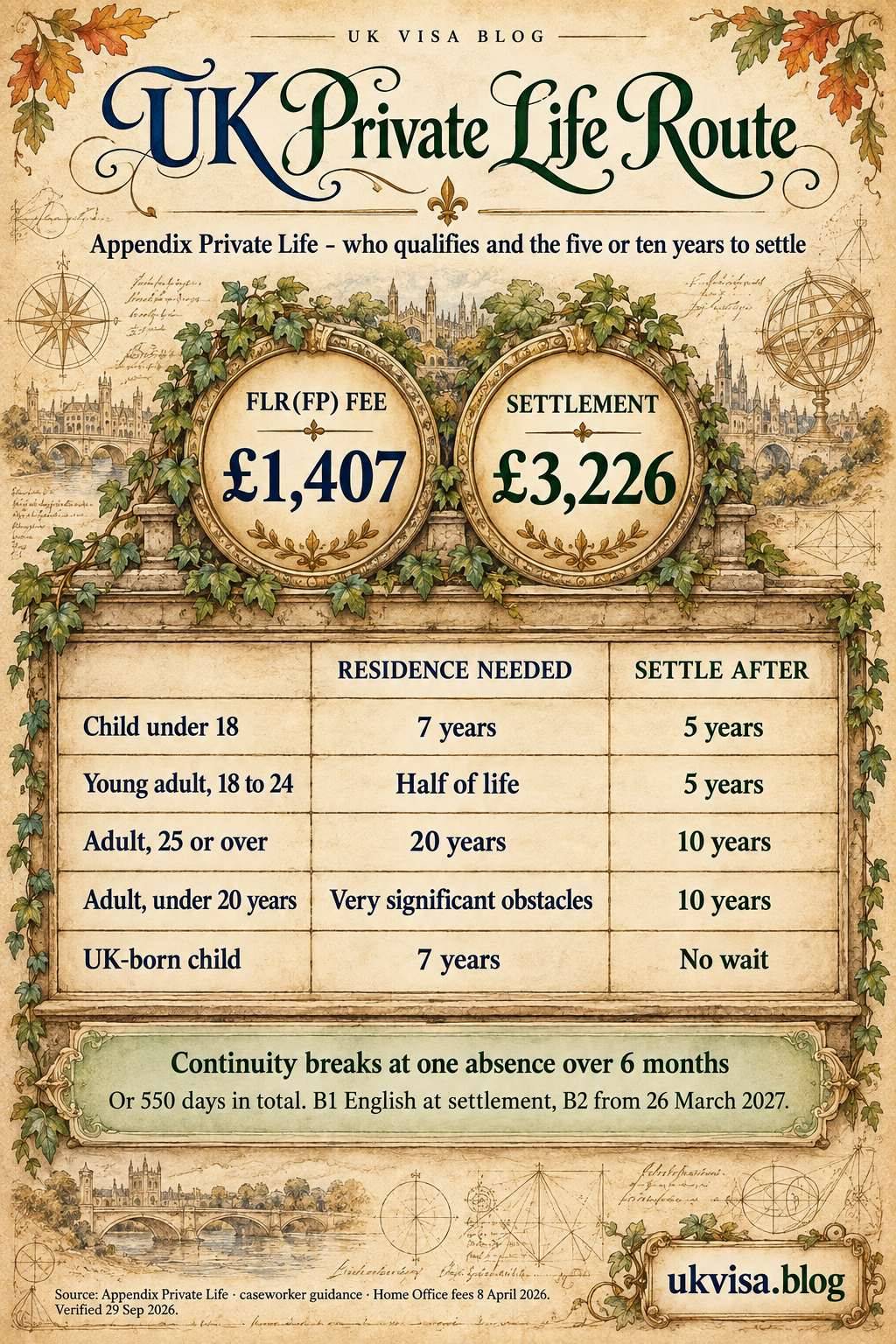
Private Life Route Requirements
Each category has its own test, but every one of them rests on continuous residence, which has to be evidenced across the whole qualifying period rather than asserted. All applications are made from within the UK; there is no overseas equivalent.
Children with Seven Years’ Residence
A child under 18 with seven years here qualifies where it would be unreasonable to expect them to leave. Caseworkers weigh education and language, friendships and community involvement, connection or lack of connection to the country of nationality, the family’s own plans, and the child’s best interests as a primary consideration.
The guidance adds a detail worth knowing: where a child qualifies under both the private life rules and the family rules, caseworkers are directed to grant under private life because the outcome is more favourable. It is worth saying expressly in the application which basis you rely on.
Young Adults Aged 18 to 24
Half of your life, lived continuously in the UK, measured at the date of application rather than the date of decision. A 22-year-old needs eleven years. The category exists because people brought here as children should not carry the consequences of decisions they had no part in.
Adults: Twenty Years, or Very Significant Obstacles
Twenty years’ continuous residence qualifies regardless of whether that time was lawful. Below twenty years, an adult must show very significant obstacles to integration into the country of return — and the guidance directs caseworkers to assume integration is possible unless the evidence shows otherwise.
It means considerably more than inconvenience or economic hardship. What engages it is an inability to speak the language, a complete absence of family or social networks, a medical condition dependent on treatment available only here, or a real risk of persecution or discrimination on grounds of faith, sexuality, gender identity or political opinion. Factors are weighed individually and cumulatively, and independent verifiable evidence is expected.
Continuous Residence and What Breaks It
Residence is continuous unless a single absence exceeded six months, or absences totalled more than 550 days across the qualifying period. Time spent in prison or immigration detention does not break continuity, but it does not count towards the period either — a distinction frequently reported the wrong way round.
Removal, deportation, or leaving while permission stood refused all break the period. Our guide to the continuous residence requirement sets out how the concept differs across routes.
The Route to Settlement
Two pathways run to permanent settlement, and which one you are on is fixed by the category you qualified under rather than by anything you do afterwards.
The Five-Year Route
Children and young adults settle after five years with permission. The guidance records that a first grant in these categories carries a choice between 30 and 60 months — taking 60 avoids an extension application, its fee and its surcharge entirely, which is worth several thousand pounds to a family.
The Ten-Year Route
Adults qualifying on twenty years’ residence or on very significant obstacles are granted 30 months at a time and settle after ten years. That means four grants across the period, each with its own fee and health surcharge, before settlement becomes available.
- Time: five years with permission for children and young adults, ten for adults.
- English: B1 for applicants aged 18 to 64 — B2 for applications made on or after 26 March 2027.
- Knowledge: a pass in the Life in the UK test, subject to the usual age exemptions.
- Continuity: the residence requirement maintained throughout.
- Suitability: Part Suitability has applied to this route since 11 November 2025.
Where the Private Life Route Sits Against Long Residence
Two twenty-year concepts are frequently confused. Appendix Long Residence settles people who have held ten years of continuous lawful residence, counting only time with permission. Appendix Private Life reaches twenty years of continuous residence whether or not any of it was lawful, and settles them ten years after the grant.
The practical consequence is that someone with a long history of lawful permission should look at long residence first, because it settles faster. Private life is the route for people whose time here cannot be shown as lawful throughout, which is precisely why the qualifying period is longer.
Fees and Fee Waivers
Both the application fee and the health surcharge apply, per person, including children — which is what makes the 60-month option so valuable where it is offered.
Private Life Fees from 8 April 2026
| Charge | Amount | Notes |
|---|---|---|
| FLR(FP) application | £1,407 | Initial grant or extension; was £1,321 |
| Settlement | £3,226 | Was £3,029 |
| Health surcharge, adult | £1,035 a year | £2,587.50 for 30 months |
| Health surcharge, child | £776 a year | £1,940 for 30 months |
| Priority service | £500 | Where offered |
| Super priority service | £1,000 | Where offered |
Source: Home Office immigration and nationality fees, 8 April 2026.
The Fee Waiver Is Central to This Route
More than on any other family route, applicants here are people without means. The guidance confirms that both the fee and the health charge can be waived in whole or in part where the applicant cannot pay after essential living costs — housing, food, heating and children’s needs — are met.
Waivers are assessed case by case on documented financial circumstances, and applying for one before the application rather than after a refusal for non-payment is the difference between a route and a dead end. Full costs across settlement sit in our Home Office fees guide.
How to Apply
Applications are made online from inside the UK. The form depends on the stage: FLR(FP) for a first grant or an extension, the child settlement application for a UK-born child qualifying for settlement, and the settlement form for an adult completing the qualifying period. Our guide to the UK visa application form covers the mechanics.
- Residence: utility bills, council tax, tenancy agreements and bank statements covering the entire qualifying period.
- Identity: passport, birth certificate or national identity document.
- Integration: school records, employment letters, GP registration, community involvement.
- Absences: passport stamps and travel records accounting for every trip.
- Obstacles: medical reports and country expert evidence where that limb is relied on.
- Finances: the fee waiver evidence, where one is sought.
Section 3C and Staying in the UK
An application made before existing permission expires is protected by section 3C leave until it is decided, on the same conditions. Leaving the UK ends that protection and the application may be treated as withdrawn. Where a decision is taking longer than the published waiting time, our guide to UK visa delays explains how to escalate.
After Settlement
Settlement on this route carries the ordinary consequences: no time limit, no work restriction, and access to public funds. Naturalisation becomes available twelve months after settlement — the exemption from that wait belongs to spouses of British citizens, not to this route. Our naturalisation requirements guide sets out the rest.
Sources: Appendix Private Life of the Immigration Rules; Home Office private life caseworker guidance, version 6.0 of 30 December 2025; the private life pages on GOV.UK; and the fee table of 8 April 2026. Figures verified 22 August 2026.
Frequently Asked
Questions about the Private Life Route
A route under Appendix Private Life, which replaced paragraph 276ADE on 20 June 2022, allowing people to stay in the UK on the strength of the life they have established here. It covers children with seven years’ residence, young adults who have spent half their life here, adults with twenty years, and adults facing very significant obstacles abroad.
Continuous residence in the UK for at least seven years while under 18, and that it would be unreasonable to expect the child to leave. Caseworkers weigh education, language, friendships, connection to the country of nationality and the family’s circumstances, with the child’s best interests as a primary consideration. The route to settlement is five years.
Where the choice is offered — children and young adults on a first grant — 60 months is almost always better. It reaches the five-year settlement point without an intervening extension, saving a £1,407 fee and £2,587.50 of health surcharge per person. The guidance records the choice; the application should state which you want.
Considerably more than inconvenience or economic hardship. Inability to speak the language, a complete absence of family or social networks, a serious medical condition dependent on UK treatment, or a real risk of persecution or discrimination on grounds of faith, sexuality, gender identity or political opinion. Factors are weighed individually and together, on independent evidence.
No, but it does not count towards the qualifying period either — a distinction often reported the wrong way round. What does break continuity is a single absence of more than six months, absences totalling more than 550 days, removal or deportation, or leaving the UK while permission stood refused.
£1,407 for FLR(FP) and £3,226 for settlement from 8 April 2026, plus the health surcharge at £1,035 a year for adults and £776 for children. Both the fee and the health charge can be waived in whole or in part where you cannot pay after essential living costs. Apply for the waiver first, not after a refusal for non-payment.
No. Every private life application is made from inside the UK, because the route exists for people who have already established a life here. Leaving the UK while an application is pending ends section 3C protection and the application may be treated as withdrawn, so travel should wait until a decision has been made.
The five-year route covers children with seven years’ residence and young adults who have spent half their life here. The ten-year route covers adults qualifying on twenty years or on very significant obstacles, granted 30 months at a time — four grants and four sets of fees before settlement. The category you qualified under fixes which applies.
No time limit, no work restriction and access to public funds. Naturalisation becomes available twelve months after settlement, subject to residence, good character and knowledge requirements. Settlement lapses after more than two continuous years outside the UK, so anyone planning long absences should consider citizenship first.