
The UK Secondment Worker visa is one of five sub-routes under the Global Business Mobility (GBM) framework, designed for overseas employees seconded to a UK organisation to fulfil a high-value contract or investment worth at least £50 million. Unlike Senior or Specialist Worker (intra-corporate transfer within the same group) or Graduate Trainee (structured training programme), the Secondment Worker route specifically targets commercial arrangements between two separate organisations where the overseas employer's staff deliver services on UK soil. Two major 2026 changes reshape the route: from 8 April 2026 the application fee rose from £319 to £340, and the prior overseas employment requirement reduced from 12 months to 6 months — a significant flexibility uplift introduced under Statement of Changes HC 1691 to attract more high-value project work to the UK.
The most specialised of the five GBM sub-routes — built for major commercial deployments rather than corporate group transfers. From 8 April 2026 the overseas employment threshold halved (12 months → 6 months), making the route materially more accessible for shorter-tenured project teams. No salary threshold applies (unlike Senior or Specialist Worker's £52,500 floor), no English language test, and no Immigration Skills Charge — but the £50 million high-value contract must be registered with the Home Office before any Certificate of Sponsorship can be assigned, and the route does not lead to Indefinite Leave to Remain. Ideal for engineering, IT services, infrastructure, and consultancy firms deploying project teams under major UK client contracts.

- What is the Secondment Worker Visa?
- The £50 Million High-Value Contract Requirement
- Eligibility Requirements (Updated 8 April 2026)
- Fees and Costs from 8 April 2026
- How to Apply
- Bringing Your Partner and Children
- Duration, Extension and the 5-in-6 Cap
- Secondment Worker vs Other GBM Routes
- What Happens After the Visa Ends?
- Frequently Asked Questions
UK Secondment Worker Visa 2026: GBM Sub-Route for High-Value Contracts
The Secondment Worker visa sits within the broader Global Business Mobility (GBM) route framework — the five-route umbrella launched on 11 April 2022 to consolidate intra-corporate transfers, business expansion deployments, secondments and trade-agreement service supply into a single coherent system. Where the wider GBM family covers transfers within the same corporate group, the Secondment Worker sub-route is uniquely designed for commercial relationships between two separate, unrelated entities: an overseas employer and a UK client organisation linked only by a high-value contract.
What is the Secondment Worker Visa?
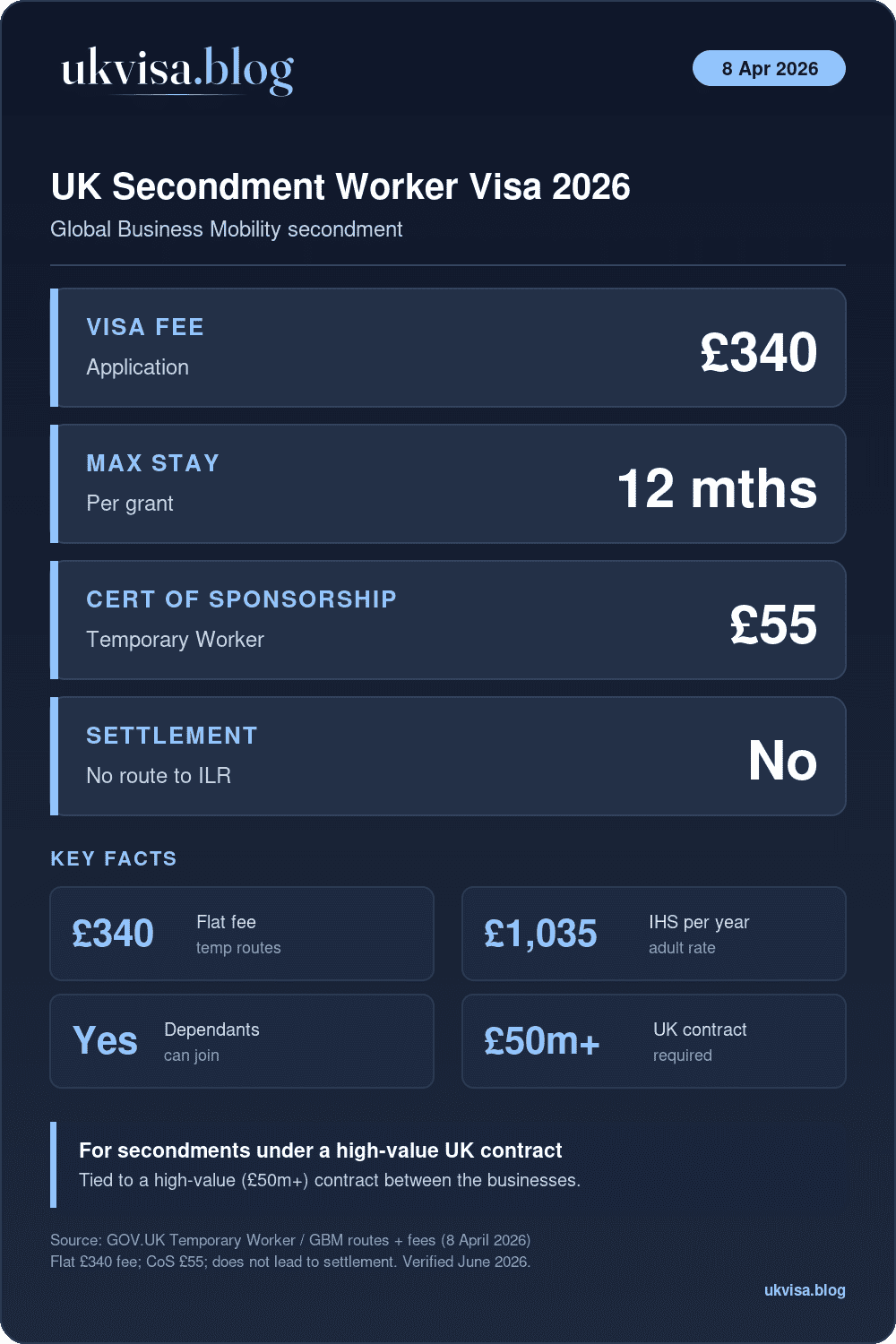
The UK Secondment Worker visa lets overseas employees deliver services in the UK under a high-value contract (£50M+) between their overseas employer and a UK sponsor. Eligibility requires 6 months' prior employment with the overseas business (from 8 April 2026, down from 12 months), a Certificate of Sponsorship from a GBM-licensed UK sponsor with a registered high-value contract, and a job on the eligible occupations list at RQF Level 6. No salary threshold and no English language test required. The visa runs for up to 12 months initially with a 12-month extension option (total 2 years).
Origin and Purpose of the Route
The Secondment Worker visa is unique within the GBM family because it is a genuinely new route created in April 2022 rather than a rebrand of an earlier ICT category. Before its introduction, secondment-style commercial arrangements were generally pushed through the Tier 2 Intra-Company Transfer route — which was a poor structural fit because ICT presumed a corporate group relationship. The Secondment Worker route was designed to facilitate trade-driven labour deployment for major UK contracts in infrastructure, IT services, consultancy, energy and engineering, and to support the UK's post-Brexit ambition to attract high-value foreign investment and project work.
The £50 Million High-Value Contract Requirement
The defining feature of the Secondment Worker route is the high-value contract requirement. The contract between the overseas employer and the UK sponsor must be worth at least £10 million per year AND at least £50 million in total. For contracts under 5 years, the £50 million total applies. For contracts of 5 years or more, the £10 million annual minimum applies. For indefinite contracts, the £50 million total over the first 5 years applies. The contract must be registered with the Home Office via the Sponsorship Management System BEFORE any Certificate of Sponsorship can be assigned.
| Contract Type | Threshold | How It Applies |
|---|---|---|
| Fixed-term contract under 5 years | At least £50 million total | Total contract value across the full term must reach £50M |
| Fixed-term contract of 5+ years | At least £10 million per year | Annual value must meet £10M; total can exceed £50M |
| Indefinite / ongoing contract | At least £50 million over first 5 years | Measured against the initial 5-year window |
| Investment agreement (alternative) | Specific criteria in the Immigration Rules | Alternative to standard contract; sponsor evidences via SMS |
Source: Appendix Global Business Mobility — Secondment Worker, "Eligible Contract Requirement"; Sponsor Guidance for GBM Routes.
Contract Registration with the Home Office
Unlike most UK sponsored work routes — where the sponsor licence itself is sufficient to assign Certificates of Sponsorship — the Secondment Worker route requires a two-step registration process. The UK sponsor must first apply for a Global Business Mobility: Secondment Worker sponsor licence, AND register each high-value contract separately via the Sponsorship Management System. If the sponsor wins a new high-value contract that wasn't part of the original licence application, they must report it via the SMS "Request change of circumstances" function before assigning any related CoS. Each CoS must identify which specific registered contract the worker will be supporting.
A Secondment Worker CoS is tied to a specific registered high-value contract. The worker can only work on the contract identified in their CoS — they cannot be moved to a different client project, even if the sponsor has other registered contracts. If the contract ends early or the worker's involvement is no longer required, the sponsor must report this to the Home Office, and the worker's permission may be curtailed under standard Immigration Rules. This is a stricter framework than Senior or Specialist Worker, where workers move within their sponsoring entity.
Eligibility Requirements (Updated 8 April 2026)
Existing employee of an overseas organisation with a Home Office-approved high-value contract with the UK sponsor; worked for that overseas business for at least 6 months immediately before the application (reduced from 12 months on 8 April 2026); valid Certificate of Sponsorship within 3 months of the application; job on the GBM eligible occupations list at RQF Level 6 or above; £1,270 in personal savings held for 28 consecutive days (waived if sponsor certifies maintenance). No salary threshold, no English language test, no Immigration Skills Charge.
The 8 April 2026 Overseas Employment Reduction
Statement of Changes HC 1691 (5 March 2026, in force 8 April 2026) reduced the prior overseas employment requirement from 12 months to 6 months. This is a material flexibility uplift: the previous 12-month threshold ruled out shorter-tenured project specialists, recent recruits with critical expertise, and acquired-company employees from overseas M&A activity. The reduction reflects the government's explicit aim to attract more high-value project work to the UK by making it easier for sponsors to deploy the right specialist talent for major contracts. The 6-month minimum applies to all new applications from 8 April 2026 onward and to extensions where the worker is changing sponsor.
- Existing overseas employment: Currently employed by an overseas organisation with a high-value contract registered with the Home Office in respect of the UK sponsor.
- 6-month overseas work history: Worked for that overseas business for at least 6 months outside the UK immediately before the application (reduced from 12 months on 8 April 2026). The requirement is waived for extensions where the worker continues with the same sponsor.
- Age: 18 or over on the date of application.
- Certificate of Sponsorship: Valid CoS from a GBM-licensed UK sponsor, issued within 3 months of the visa application, identifying the specific registered high-value contract the worker will support.
- Eligible occupation: Role must be on the GBM eligible occupations list — RQF Level 6 (graduate / degree level) or above under SOC 2020.
- No salary threshold: Unlike Senior or Specialist Worker (£52,500) and Skilled Worker (£41,700), the Secondment Worker route has NO general salary threshold — only the going-rate alignment under the eligible occupations list.
- Financial maintenance: £1,270 in personal savings held for 28 consecutive days, unless the sponsor certifies maintenance on the CoS.
- TB test certificate: Required if applying from a listed country with TB screening obligations.
- NO English language test: Unlike Skilled Worker (CEFR B2 from 8 January 2026), Secondment Worker has no SELT or CEFR demonstration requirement.
- Outside-UK or in-country switching: Can apply from outside the UK OR switch from within the UK provided the worker does not hold last leave as Visitor, Short-term Student, Parent of a Child Student, Seasonal Worker, Domestic Worker in a Private Household, or outside the Immigration Rules.
- Suitability: Must not fall for refusal under general grounds of the Immigration Rules.
Fees and Costs from 8 April 2026
From 8 April 2026 the application fee is £340 (up from £319 — same GBM family uplift in the 8 April 2026 fee schedule). Immigration Health Surcharge is £1,035/year for adults, paid up front for the full grant period (typically £1,035 for a 12-month visa). Total cost for a single adult applicant: £1,375 for a 12-month visa. The Immigration Skills Charge does NOT apply to GBM Secondment Worker — a £1,320/year (large sponsor) or £480/year (small sponsor) employer saving versus Skilled Worker sponsorship.
| Fee Component | Amount from 8 April 2026 | Notes |
|---|---|---|
| Visa application fee | £340 per person | Up from £319; same uplift across all GBM sub-routes |
| Visa extension fee (in-country) | £340 per person | Same as initial application; standard Home Office pricing |
| Immigration Health Surcharge — adult | £1,035 per year | Standard work-visa rate; paid up front for full grant period |
| Immigration Health Surcharge — under 18 | £776 per year | Discounted rate for dependent children |
| Personal maintenance | £1,270 | 28 consecutive days; waived if sponsor certifies maintenance |
| Total Home Office charges (12-month visa, single adult) | £1,375 | £340 + £1,035 IHS |
| Priority service uplift | +£500 | Targets decision within 5 working days (where available) |
| Super-priority service uplift | +£1,000 | Targets next working day decision (where available) |
| Sponsor — CoS assignment | £55 | Paid by employer, not worker |
| Sponsor — Immigration Skills Charge | £0 (exempt) | GBM routes are exempt from ISC under all sponsor categories |
Source: gov.uk Secondment Worker visa fee schedule (updated 29 April 2026); the Immigration and Nationality (Fees) Regulations 2026.
For the broader sponsored work visa fee context across Skilled Worker, the wider GBM family, and Temporary Worker routes, see the dedicated UK work visa fees and ISC comparison guide.
How to Apply
Secondment Worker visa applications can be made from outside the UK or — unusually for the GBM family — from inside the UK as a switch from a different visa category (subject to restrictions on the prior visa type). Applications are submitted online and successful applications are issued as eVisas linked to the worker's UKVI account.
- Step 1: UK sponsor registers the high-value contract with the Home Office via the Sponsorship Management System (if not already registered).
- Step 2: UK sponsor assigns the Certificate of Sponsorship via SMS, identifying the specific registered contract, role description, salary, start date, and worker's overseas employment history.
- Step 3: Applicant completes the online visa application on gov.uk — typically takes 30–60 minutes.
- Step 4: Pay the £340 visa fee and £1,035/year IHS by debit or credit card.
- Step 5: Verify identity — either via the UK Immigration: ID Check app (eligible passports) or by booking a biometric appointment at a Visa Application Centre.
- Step 6: Upload supporting documents — current passport, CoS reference, evidence of 6 months' overseas employment (employment contract, payslips, employer letter), training programme description if applicable, financial maintenance evidence, TB certificate if applicable.
- Step 7: Wait for decision — 3 weeks standard service from outside the UK; 8 weeks for in-country applications.
- Step 8: Create a UKVI account, link the eVisa, and travel to the UK to start the secondment assignment.
Processing Times
| Application Type | Standard Processing | Priority Service (where available) |
|---|---|---|
| Outside-UK application | 3 weeks from biometric enrolment | 5 working days (+£500) |
| In-country extension | 8 weeks from biometric enrolment | Next working day (+£1,000, super-priority) |
| In-country switch from another route | 8 weeks from biometric enrolment | Varies by case complexity |
Applications can be submitted up to 3 months before the role start date listed on the Certificate of Sponsorship. For details on what happens between biometric enrolment and decision, see the dedicated visa processing timeline after biometrics guide.
Bringing Your Partner and Children
Secondment Worker visa holders can bring eligible dependants to the UK — spouse, civil partner, unmarried partner (2-year durable relationship), and dependent children under 18 (or over 18 if already in the UK as a dependant). Each dependant submits a separate dependant partner and children application and pays the same fee structure as the main applicant.
Dependant Financial Requirements
- Partner: Additional £285 in savings held for 28 consecutive days.
- First child: Additional £315 in savings.
- Each additional child: Additional £200 in savings.
- Sponsor certification waiver: Where the sponsor certifies maintenance for the family on the CoS, the savings requirement is waived for the first month.
- Same fees: Each dependant pays £340 visa fee and £1,035/year IHS (£776/year for under-18s).
- Aligned visa end-date: Dependant grants align with the main applicant's grant end-date unless they qualify independently for a longer stay.
Dependants can work in most jobs (excluding professional sportsperson roles), study without restriction, and travel freely. Their permission is tied to the main applicant's status — if the Secondment Worker's permission is curtailed, the dependant's permission is generally curtailed in parallel.
Duration, Extension and the 5-in-6 Cap
The Secondment Worker visa is initially granted for the shorter of the period on the Certificate of Sponsorship plus 14 days or 12 months. A single 12-month extension is permitted in-country, bringing the maximum stay to 2 years. The route also counts toward the cumulative 5-years-in-6 cap across all GBM sub-routes and former ICT routes — so worked time on other GBM routes may reduce the available Secondment Worker window.
Initial Grant and Extension Structure
The 12+12 structure is the practical maximum for any single deployment. After the 2-year cap is reached, the worker must leave the UK and remain outside (subject to the cumulative 5-in-6 cap analysis). Unlike Senior or Specialist Worker — which permits up to 5 years per grant and longer cumulative stays for high earners ≥ £73,900 — Secondment Worker has no high-earner extension carve-out: the 2-year hard ceiling applies to all applicants regardless of salary.
Time on the Secondment Worker visa counts toward a maximum 5 years of permission in any 6-year rolling period across the entire GBM and ICT route family — including the Senior or Specialist Worker visa for intra-corporate transfers, the Graduate Trainee visa for structured training programmes, the UK Expansion Worker visa for new branch setup, the Service Supplier visa for trade agreement contractors, and the older Intra-Company Transfer (Long-Term and Short-Term) and Intra-Company Graduate Trainee routes. A worker who has already spent 4 years on a Senior or Specialist Worker visa can therefore add at most 1 further year as a Secondment Worker within the same rolling 6-year window. Plan long-term UK corporate mobility strategy carefully with this cumulative cap in mind.
Secondment Worker vs Other GBM Routes
The five GBM sub-routes serve fundamentally different corporate scenarios. Selecting the wrong route at the application stage is a leading cause of refusal — the Home Office assesses route eligibility strictly against the specific business arrangement evidenced in the Certificate of Sponsorship and sponsor licence registration. The five routes compared below cover the universe of GBM scenarios.
| GBM Route | Business Scenario | Max Stay | Key Requirement |
|---|---|---|---|
| Secondment Worker | Overseas employer with high-value contract delivering services to a UK organisation | 2 years (12 + 12) | £50M / £10M annual contract; 6 months overseas employment |
| Senior or Specialist Worker | Intra-corporate transfer within the same corporate group | 5 years (9 if salary ≥ £73,900) | £52,500 salary; 12 months overseas employment (waived for high earners) |
| Graduate Trainee | Structured graduate training programme leading to senior/specialist role within the corporate group | 12 months (no extension) | £27,300 salary; 3 months overseas employment |
| UK Expansion Worker | Establishing a new UK branch of an overseas business with no UK presence yet | 2 years across multiple grants | £52,500 salary; 12 months overseas employment; provisional sponsor licence |
| Service Supplier | Contractual service delivery under a UK trade agreement (e.g. UK-India CETA) | 6 or 12 months (varies by agreement) | Trade agreement coverage; employment by overseas supplier |
None of the GBM routes lead directly to Indefinite Leave to Remain. Time spent on any GBM route does not count toward the 5-year continuous-residence period required for ILR. A worker seeking long-term UK settlement must switch to a settlement-leading route — most commonly Skilled Worker — and start the ILR clock from the new visa grant date.
What Happens After the Visa Ends?
At the end of the 2-year Secondment Worker grant, the worker must either leave the UK or switch to a different visa category that permits in-country switching from Secondment Worker.
Onward Visa Options
- Skilled Worker route for longer-term UK employment: Where the worker has a job offer paying the £41,700 Skilled Worker salary threshold (from 22 July 2025) at RQF Level 6 eligible occupation. Skilled Worker permits in-country switching from Secondment Worker and provides a pathway to indefinite leave to remain pathway after 5 years on the route. Note: the worker must meet the Skilled Worker English language requirement (CEFR B2 from 8 January 2026).
- Senior or Specialist Worker visa: Where the role is structurally an intra-corporate transfer within the same group (rather than a commercial secondment) and the £52,500 salary threshold is met. Note: time on Secondment Worker counts toward the cumulative 5-in-6 cap.
- Another GBM sub-route: From outside the UK for a new commercial deployment, subject to the cumulative 5-years-in-6 cap.
- Family visa routes: Where the worker has formed a qualifying relationship with a British citizen or ILR holder during the UK stay.
- Global Talent or Innovator Founder: Where the worker qualifies on talent or business grounds independently of corporate sponsorship.
Time on the Secondment Worker visa does NOT count toward the 5-year continuous-residence period required for Indefinite Leave to Remain. The GBM family is fundamentally designed as a corporate mobility framework, not a settlement pathway. If long-term UK residence is the goal, the worker must switch to a settlement-leading route — and the ILR clock starts from the date the new visa is granted, not from the Secondment Worker entry date. The Home Office sponsor must also bear in mind that early termination of the high-value contract or removal of the worker from the registered contract may trigger curtailment of permission.
If the High-Value Contract Ends Early
If the registered high-value contract ends or the worker's role on the contract terminates, the UK sponsor must report this to the Home Office via the SMS within 10 working days. The worker's permission may then be curtailed (shortened) to a date typically 60 days from the date sponsorship ends — giving them a window to either leave the UK, switch to another visa category, or find a new sponsor. Failure to act within this period may result in becoming an overstayer, which carries significant consequences for future UK visa applications.
- One of five Global Business Mobility sub-routes — uniquely designed for commercial contract delivery rather than intra-corporate transfer.
- Application fee £340 from 8 April 2026 (up from £319) plus £1,035/year IHS — total £1,375 for a 12-month single adult application.
- High-value contract requirement: £50M total OR £10M annual minimum, registered with the Home Office before any CoS is assigned.
- Prior overseas employment reduced from 12 months to 6 months on 8 April 2026 — a significant flexibility uplift under Statement of Changes HC 1691.
- Maximum 2 years total stay (12 months initial + 12 months extension); no high-earner extension carve-out.
- NO salary threshold (unlike Senior or Specialist Worker's £52,500); NO English language test; NO Immigration Skills Charge.
- 5-years-in-6 cumulative cap applies across all GBM and former ICT routes combined.
- In-country switching permitted (unlike Graduate Trainee) — but only from non-Visitor / non-short-term routes.
- Does NOT lead to Indefinite Leave to Remain — must switch to a settlement-leading route (typically Skilled Worker) if long-term UK residence is the goal.
- Dependants permitted; partner £285 / first child £315 / each additional child £200 maintenance.
For official guidance and to start the application, the authoritative entry point is the gov.uk Secondment Worker visa overview. The legal framework sits in Appendix Global Business Mobility: Secondment Worker. Eligible occupation codes and going rates sit in the GBM Eligible Occupations and Codes list. The 2026 changes — including the 6-month overseas employment reduction — were set out in Statement of Changes HC 1691 (5 March 2026). For sponsor-side requirements applicable to all GBM routes including Secondment Worker, see the Home Office sponsor licence framework guide. Sponsors must also ensure ongoing payment of the Immigration Health Surcharge for sponsored workers and dependants at the applicable rates.
Frequently Asked Questions about Secondment Worker Visa UK
The UK Secondment Worker visa is one of five Global Business Mobility (GBM) sub-routes, designed for overseas employees temporarily assigned to work in the UK to deliver services under a high-value contract (£50M+) between their overseas employer and a UK sponsor. Unlike Senior or Specialist Worker (intra-corporate transfer) or Graduate Trainee (structured training programme), the Secondment Worker route specifically covers commercial relationships between two separate organisations. The visa runs for up to 2 years (12 months initial + 12 months extension) and does not lead to settlement.
From 8 April 2026 the application fee is £340 per person (up from £319 — same uplift across all GBM sub-routes). The Immigration Health Surcharge is £1,035 per year for adults (£776 for under-18s), paid up front for the full grant period. A standard 12-month visa costs £1,375 total in Home Office charges. Priority service adds £500 (5 working days) and super-priority adds £1,000 (next working day) where available. The Immigration Skills Charge does NOT apply — a significant employer saving of £1,320/year (large sponsor) or £480/year (small) versus Skilled Worker sponsorship.
The fundamental difference is the corporate relationship. Senior or Specialist Worker is for intra-corporate transfers within the same group (parent company to UK subsidiary). Secondment Worker is for commercial transfers under a £50M+ high-value contract between two separate organisations. Secondment Worker has NO salary threshold; Senior or Specialist Worker requires £52,500 (from 22 July 2025). Secondment Worker maxes out at 2 years; Senior or Specialist Worker allows up to 5 years (9 if salary ≥ £73,900). Both count toward the cumulative 5-in-6 cap and neither leads to ILR.
A high-value contract must be worth at least £10 million per year AND at least £50 million in total. For contracts under 5 years, the £50 million total applies. For contracts of 5+ years, the £10 million annual minimum applies. For indefinite contracts, the £50 million total over the first 5 years applies. The contract must be registered with the Home Office via the Sponsorship Management System before any Certificate of Sponsorship can be assigned. Each CoS must identify which specific registered contract the worker will be supporting.
From 8 April 2026, the prior overseas employment requirement is 6 months — reduced from the previous 12-month requirement under Statement of Changes HC 1691. The change reflects the government's aim to attract more high-value project work to the UK by making the route more accessible for shorter-tenured project specialists. The 6-month minimum applies to all new applications from 8 April 2026. The requirement is waived for extensions where the worker continues with the same UK sponsor.
Yes. Spouses, civil partners, unmarried partners (2-year durable relationship) and dependent children under 18 can apply as dependants. Each dependant submits a separate application and pays the £340 visa fee plus IHS (£1,035/year adult, £776/year under-18). Maintenance requirements: £285 partner, £315 first child, £200 each additional child — waived if the sponsor certifies maintenance on the CoS. Dependants can work in most jobs and study without restriction. Their visa end-date aligns with the main applicant's grant.
Yes. Switching from Secondment Worker to Skilled Worker is permitted in-country, provided the worker meets all Skilled Worker eligibility requirements: a job offer paying at least £41,700 (from 22 July 2025), an RQF Level 6 eligible occupation, a Certificate of Sponsorship from a licensed Skilled Worker sponsor, and the CEFR B2 English language requirement from 8 January 2026. However, time spent on the Secondment Worker visa does NOT count toward the 5-year continuous-residence period required for Indefinite Leave to Remain — the ILR clock starts from the Skilled Worker grant date.
The UK sponsor must report the contract change to the Home Office within 10 working days via the Sponsorship Management System. The worker's permission may then be curtailed to a date typically 60 days from when sponsorship ends, giving them a window to leave the UK, switch to another visa category, or find a new sponsor. Failure to act within the 60-day window may result in becoming an overstayer, with significant consequences for future UK visa applications including potential re-entry bans of 1–10 years depending on the circumstances of departure.
No. Unlike the Skilled Worker route (which requires CEFR B2 from 8 January 2026), the Secondment Worker visa has NO English language requirement. This applies across the entire Global Business Mobility family — the assumption being that commercial deployments operate within the overseas employer's own working language and systems. Applicants do not need to take IELTS, Trinity GESE or any other Secure English Language Test, and there is no waiver framework to navigate.
No. Time on the Secondment Worker visa does NOT count toward the 5-year continuous-residence period required for Indefinite Leave to Remain. None of the five Global Business Mobility sub-routes lead directly to UK settlement — the framework is fundamentally designed for corporate mobility rather than long-term migration. If long-term UK residence is the goal, the worker must switch to a settlement-leading route (most commonly Skilled Worker), and the ILR clock starts from the date the new visa is granted, not from the Secondment Worker entry date.