
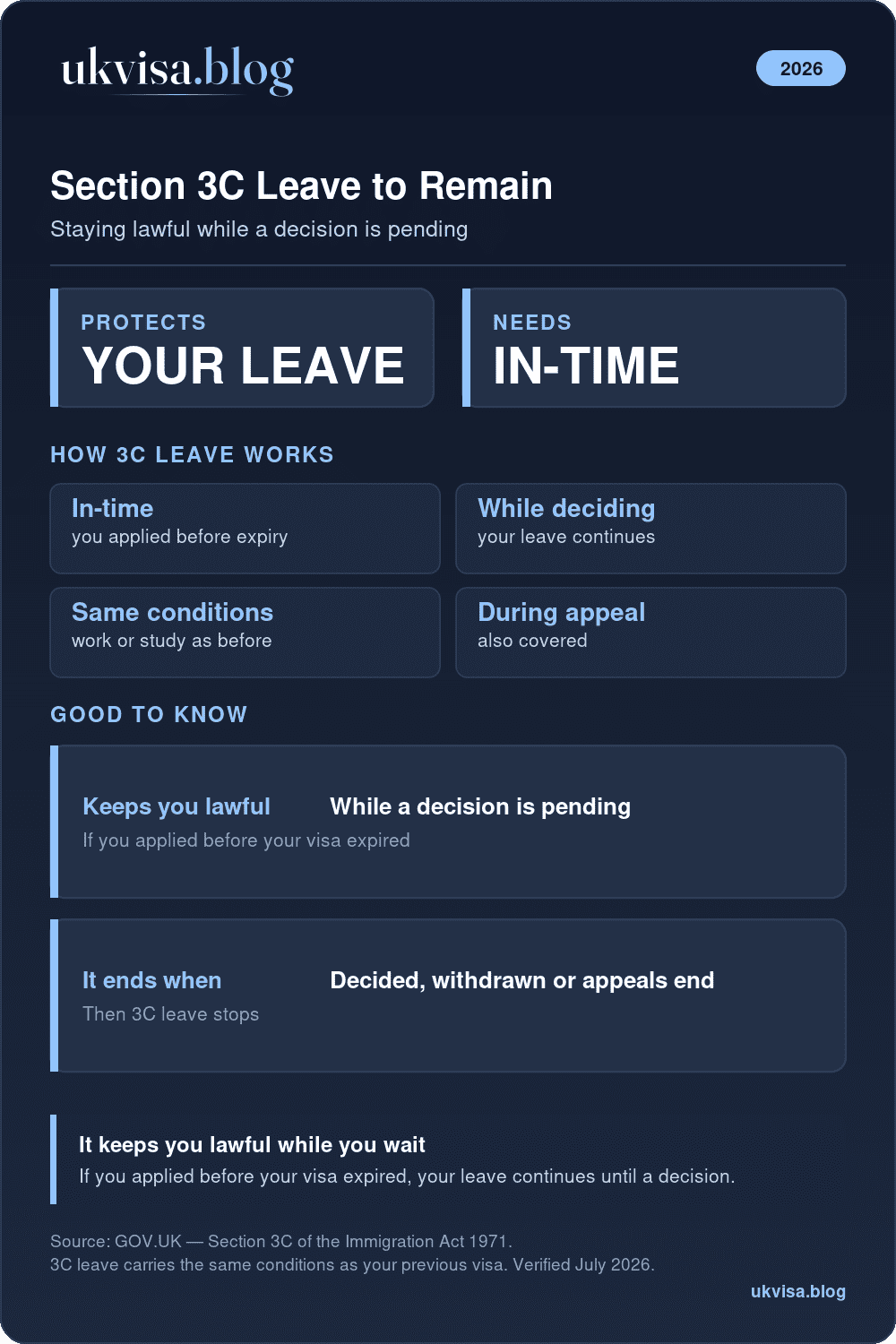
Section 3C leave (often called "3C leave") is the statutory protection under the Immigration Act 1971 that automatically extends your existing UK immigration permission when you submit an in-time visa extension or variation application before your current leave expires. 3C leave maintains your lawful status throughout the Home Office's decision-making period — including any subsequent Administrative Review or appeal — preserving your right to work, right to rent, and access to services on your previous visa's conditions. From end-2024 the UK transitioned from physical BRPs to digital eVisas, with verification now via share codes from the gov.uk View and Prove portal. 3C leave does not grant new rights — only continues existing conditions — and ends if you depart the UK.
Source: Section 3C of the Immigration Act 1971 (as inserted by the Immigration and Asylum Act 1999 and amended by the Immigration Act 2014); UKVI caseworker guidance on 3C and 3D leave; Home Office guidance on right to work checks under digital immigration status
Section 3C leave continues to operate under the Immigration Act 1971 in 2026 — the framework is unchanged, but the verification methods have transformed. The Home Office completed the eVisa transition by end of 2024, replacing the physical BRP with digital immigration status. Employees and tenants now generate share codes from the gov.uk View and Prove portal, with the Employer and Landlord Checking Services as backup. The protection itself remains automatic — it activates on an in-time application, continues your previous conditions until a decision, and covers the appeal and Administrative Review periods. Because Section 3C only continues leave for applicants who remain in the UK, departure extinguishes it. HC 1691 (laid 5 March 2026) does not amend Section 3C.
- What is 3C Leave? Section 3C Leave UK Meaning
- Section 3C of the Immigration Act 1971 — Statutory Framework
- How to Prove Section 3C Leave — eVisa, Share Codes, BRP
- Section 3C Leave Right to Work
- Right to Rent Under Section 3C Leave
- 3C and 3D Leave — Key Differences
- Conditions and Restrictions Under 3C Leave
- Travel Restrictions — Why 3C Leave Ends on Departure
- When Does Section 3C Leave End?
- Section 3C Leave During Appeals and Administrative Reviews
- Frequently Asked Questions
Section 3C Leave UK 2026 — Complete Guide to 3C Leave Under the Immigration Act 1971
Section 3C leave is the statutory mechanism that prevents in-time visa applicants from becoming overstayers while the Home Office processes their application. The provision was inserted into the Immigration Act 1971 by the Immigration and Asylum Act 1999 and significantly amended by the Immigration Act 2014. In 2026 the framework operates within the new eVisa system — physical BRPs were phased out by end of 2024 and digital immigration status is now the standard. Section 3C protection is automatic for any in-time variation application: you do not need to apply for 3C leave separately, and it cannot be refused as a standalone matter. The protection continues your previous visa conditions exactly, granting no new rights, and ends when your application is finally determined or you depart the UK.
What is 3C Leave? Section 3C Leave UK Meaning
3C leave is the automatic continuation of your UK immigration permission that activates when you submit an in-time application to extend or vary your visa. It comes from Section 3C of the Immigration Act 1971. Your previous visa conditions continue exactly — work rights, study restrictions, recourse to public funds prohibitions — until a final decision is made on your application. 3C leave protects you from becoming an overstayer during processing, but grants no new rights. It is also called "3C leave UK", "section 3c leave", or simply "3C visa UK".
3C leave protects in-time variation applicants from becoming overstayers during Home Office processing — a status that would otherwise trigger refusal grounds under Part Suitability of the Immigration Rules and potential re-entry bans under the re-entry-ban provisions (SUI 12.1) (the re-entry ban provisions retained their numbering when the suitability grounds were renamed). The provision recognises that visa processing takes time — see our UK visa extension processing time guide for current FLR and ILR timelines — and applicants should not be penalised for the Home Office's processing duration. 3C leave is purely a continuation mechanism — it cannot be used to gain new conditions, work for a new employer outside your previous visa terms, or take up roles not permitted under your previous category.
When Section 3C Leave Activates
- In-time application required: You must apply before your current leave expires — applying after expiry (even by one day) means 3C leave does NOT activate
- Variation of leave application: Must be an application to vary or extend your existing leave — not a fresh entry clearance application from overseas
- In the UK: You must be physically in the UK at the time of application
- Application submitted (not just paid for): The biometric appointment and document upload must complete the submission
- Genuine application: The application cannot be a sham — UKVI may declare an application invalid if it does not meet basic validity requirements
Section 3C of the Immigration Act 1971 — Statutory Framework
Section 3C of the Immigration Act 1971 is the statutory provision that creates automatic continuation of leave during in-time variation applications. It was inserted into the Immigration Act 1971 by the Immigration and Asylum Act 1999 and substantially amended by the Immigration Act 2014. Section 3C states that where a person with limited leave applies to vary that leave before it expires, the leave continues until the application is decided, withdrawn, or any in-country appeal or Administrative Review is finally determined. The provision applies automatically and cannot be opted out of.
Section 3C of the Immigration Act 1971 was not part of the original 1971 statute — it was inserted by section 3 of the Immigration and Asylum Act 1999 to address a long-standing gap where applicants could become technical overstayers during Home Office processing. The Immigration Act 2014 made significant amendments to clarify when 3C leave continues during appeals and Administrative Reviews, and to align the framework with the abolition of most appeal rights under the same Act. The full statutory text is available at the official legislation.gov.uk Section 3C of the Immigration Act 1971 page.
Key Provisions Under Section 3C
- Section 3C(2)(a): Leave continues while the application is pending and undecided
- Section 3C(2)(b): Leave continues during the period when the applicant could lodge an in-country appeal or Administrative Review
- Section 3C(2)(c): Leave continues while an in-country appeal or Administrative Review is pending
- Section 3C(3): Leave is subject to the same conditions as the previous leave — no new rights or relaxation of restrictions
- Section 3C(4): A second variation application made during 3C leave does not create a fresh 3C protection — original 3C continues from first application
How to Prove Section 3C Leave — eVisa, Share Codes, BRP
To prove Section 3C leave in 2026, generate a share code from the gov.uk View and Prove portal — this gives employers and landlords access to your live digital immigration status. Where digital verification is not possible, alternative proof includes your Certificate of Application (CoA), expired BRP, and application submission confirmation. Employers can also obtain a Positive Verification Notice (PVN) from the Home Office Employer Checking Service. The BRP-to-eVisa transition completed end-2024 — physical BRP cards remain valid as a backup but the primary verification route is now digital.
The 2024-2025 transition to digital immigration status has fundamentally changed how 3C leave is proven. Where applicants previously held physical BRP cards as primary evidence, they now generate share codes through the View and Prove portal — these provide a secure, time-limited window for an employer or landlord to verify the holder's current immigration status, including any 3C extension. The share code system is the official Home Office mechanism for right-to-work and right-to-rent verification in 2026. For applicants whose 3C extension covers an application that may lead to ILR settlement, ensure your eVisa account is fully activated before the new leave is granted to streamline the transition.
Documents and Methods to Prove 3C Leave (2026)
- eVisa share code: Generated at view-and-prove immigration status — the primary 2026 verification route
- Certificate of Application (CoA): Email confirmation from UKVI confirming pending application — particularly useful where eVisa not yet activated
- Application submission receipt: Date-stamped confirmation showing in-time submission before previous leave expired
- Previous BRP or visa: Shows previous leave conditions — still relevant for verification context
- Positive Verification Notice (PVN): Employer obtains from the Employer Checking Service — confirms right to work for 6 months
- Landlord Checking Service confirmation: For tenancy purposes — landlord requests verification directly
Share Code Verification Process
Share codes are nine-character codes generated from the gov.uk View and Prove portal. The holder logs in with their UK Visas and Immigration account, selects the purpose (right to work, right to rent, or other), and shares the resulting code with the third party. The employer or landlord then enters the code at the corresponding gov.uk verification page (right-to-work-checks or right-to-rent-checks) to see the holder's current status — including any active Section 3C protection. Share codes are time-limited (typically 90 days for both right to work and right to rent) but can be regenerated as needed throughout the 3C period.
Section 3C Leave Right to Work
If your previous visa permitted work, your Section 3C leave right to work continues on the same conditions during the 3C period. You can keep working for the same employer in the same role under your previous visa conditions — but you cannot take on new work that falls outside those conditions. Skilled Worker holders must remain with the sponsoring employer; Student visa holders must respect the 20-hour term-time limit; unrestricted work visa holders (Spouse, Global Talent) continue without restriction. Employers verify the right to work via share code or, where digital verification is unavailable, via the Employer Checking Service.
The Section 3C right to work is conditional on what your previous visa permitted — Section 3C does not grant new work rights and does not relax restrictions. A Skilled Worker visa holder on 3C leave can continue working for the sponsoring employer in the role specified on the Certificate of Sponsorship, but cannot switch to a new employer or take a different role. A Student visa holder can continue working within the 20-hour term-time limit. Critically, working outside your previous conditions during 3C leave is illegal working — exposing both you and the employer to penalties under the Immigration, Asylum and Nationality Act 2006.
Section 3C Right to Work by Visa Type
| Previous Visa Type | Work Rights Under 3C Leave |
|---|---|
| Skilled Worker | Continue with same sponsoring employer in same SOC code role — cannot switch employer or role |
| Student | Continue working within previous term-time limit (typically 20 hours/week for degree-level study) |
| Spouse / Partner (Appendix FM) | Continue unrestricted work — can change employer freely |
| Global Talent | Continue unrestricted work — can change employer freely |
| Graduate visa | Continue unrestricted work for any UK employer |
| Innovator Founder | Continue running endorsed business — cannot take secondary employment outside business |
| Health and Care Worker | Continue with same sponsor — sponsor must be CQC-regulated provider |
| Visitor visa (Standard / Marriage) | No work rights — Visitor visa does not permit employment, so no 3C work right exists |
For underlying Skilled Worker conditions and sponsor compliance, see our Skilled Worker sponsored employment guide. For Student visa work conditions, see our UK Student route applications guide. For Appendix FM partner route conditions, see our UK Spouse visa guide.
Right to Rent Under Section 3C Leave
Section 3C leave continues your previous right to rent in England — landlords verify via share code or, where digital verification is unavailable, through the Landlord Checking Service. If your previous visa permitted private rental, you retain that right during 3C leave on identical terms. Right to rent checks under the Immigration Act 2014 (Part 3) apply to England only — Scotland, Wales, and Northern Ireland have different (or no) statutory right-to-rent regimes. Landlords who fail to conduct compliant checks face civil penalties up to £20,000 per illegal occupier; tenants on 3C leave should proactively provide a share code to streamline the check.
Landlord Verification Process
- Share code submission: Tenant generates share code from View and Prove portal; landlord enters at gov.uk right-to-rent-checks
- Digital status check: Landlord sees the tenant's current immigration status including any active 3C extension
- Landlord Checking Service request: Where digital verification fails, landlord requests verification via Home Office LCS — typical response 2 working days
- Statutory excuse documentation: Landlord retains evidence of the check for the duration of the tenancy plus 1 year
- Follow-up checks: Every 12 months while 3C leave continues, or when status changes
3C and 3D Leave — Key Differences
Both Section 3C and Section 3D of the Immigration Act 1971 originally provided continuation of leave protections — but they covered different scenarios. Section 3C applies to in-time variation applications (extension or change of visa category) where the applicant has existing leave. Section 3D applied where leave had been cancelled or curtailed and the applicant had appeal rights against that decision. The Immigration Act 2014 abolished most appeal rights against cancellation and curtailment, making Section 3D largely obsolete for current applicants. In 2026, virtually all continuation-of-leave situations operate under Section 3C alone.
The distinction between 3C and 3D leave matters mainly for legacy cases — applicants whose visa decisions predated April 2015 may still have residual Section 3D protection in narrow circumstances. For practical purposes in 2026, the term "3C and 3D leave" is often used together in caseworker guidance as shorthand for "continuation of leave during in-country challenges to immigration decisions" — but the operative mechanism for new cases is Section 3C only. The Home Office's 3C and 3D leave caseworker guidance covers both provisions in detail.
Conditions and Restrictions Under 3C Leave
Section 3C leave continues your previous visa conditions exactly — including any restrictions on work, study, employer, or access to public funds. You cannot gain new rights through 3C leave. The "no recourse to public funds" (NRPF) condition continues if it applied to your previous visa. Reporting requirements (police registration, address notification) continue. Working outside your previous visa conditions during 3C leave is illegal working under the Immigration, Asylum and Nationality Act 2006 — exposing both you and your employer to civil penalties and criminal sanctions.
Conditions That Continue Under 3C Leave
- Work restrictions: Same employer requirement, same SOC code, same hours limits
- No recourse to public funds (NRPF): If your previous visa had this condition, it continues
- Study restrictions: Course-specific restrictions, sponsor licence requirements continue
- Reporting requirements: Any police registration, address notification, or curfew conditions continue
- Geographical restrictions: Any region-specific restrictions (rare but exist for some routes) continue
- Dependant restrictions: If the underlying visa had dependant restrictions, those continue
Travel Restrictions — Why 3C Leave Ends on Departure
Leaving the UK while on Section 3C leave terminates your 3C leave entirely. This is the most important restriction to understand. The departure also typically renders your variation application withdrawn or void — meaning you would need a fresh entry clearance application from abroad to return. Section 3C only continues leave for applicants who remain in the UK, so departure extinguishes the protection by operation of the statute. Limited exceptions exist for applicants on certain protected routes, but the default rule is to avoid all international travel until your application is decided and you have new leave granted.
Consequences of Leaving the UK on 3C Leave
- 3C leave ends immediately: Your continuation protection terminates the moment you depart UK borders
- Variation application typically void: Most in-country variation applications are treated as withdrawn upon departure
- Re-entry requires valid visa: You will need a new entry clearance to return — your previous visa stamp does not assist as it has expired
- No "stopping the clock": Brief day trips or transit do not preserve 3C — any departure counts
- Common Travel Area subtlety: Travel to the Republic of Ireland, Channel Islands, or Isle of Man may have different effects — seek specific legal advice
- Appeal implications: Pending appeals may be deemed abandoned on departure under section 92(8) of the Nationality, Immigration and Asylum Act 2002
In genuine emergencies — serious family illness or bereavement abroad — applicants should consult an immigration solicitor before travel. Some narrow categories of application (notably certain protection claims) have different rules, but the default for standard work, study, and family route variations is that departure terminates Section 3C and voids the application. For re-entry issues following departure during 3C, see our UK re-entry bans guide.
When Does Section 3C Leave End?
Section 3C leave ends in one of six circumstances: (1) your application is granted and new leave begins; (2) your application is refused and you do not lodge an appeal or Administrative Review within the deadline; (3) your appeal or Administrative Review is finally determined and you do not pursue further challenge; (4) you withdraw your application; (5) you depart the UK; or (6) UKVI declares your application invalid. The exact end date depends on your application's outcome — a granted application transitions you directly into the new leave; a refused application keeps 3C running through the challenge period.
When 3C Leave Ends — Comparison Table
| Scenario | 3C Leave Status | What Happens Next |
|---|---|---|
| Application granted | 3C ends — new leave activates | Begin new visa period with updated conditions |
| Application refused — appeal lodged | 3C continues | Continues until tribunal final decision |
| Application refused — Administrative Review lodged | 3C continues | Continues until Administrative Review outcome |
| Application refused — no challenge lodged | 3C ends at appeal/review deadline expiry | 14 days in-country appeal / 14 days for AR |
| Appeal/Review finally determined | 3C ends | You must leave UK or submit new application |
| Application withdrawn | 3C ends immediately | You revert to overstayer status unless new application made |
| Departure from UK | 3C ends immediately on departure | Application treated as withdrawn |
| UKVI declares application invalid | 3C ends | You revert to overstayer status from date of invalidity declaration |
Section 3C Leave During Appeals and Administrative Reviews
Section 3C leave continues throughout the period when you can lodge an appeal or Administrative Review against a refusal — typically 14 days for in-country appeals and 14 days for Administrative Review (£80 fee). If you lodge a challenge within the deadline, 3C continues until the challenge is finally determined. Your previous visa conditions remain in force throughout — you can continue working, studying, and renting under the same terms. If you do not challenge the refusal within the statutory deadline, your 3C leave ends and you become an overstayer.
The interaction between 3C leave and post-refusal remedies is critical for applicants whose first variation application has been refused. The Immigration Act 2014 restructured appeal rights significantly — most Points-Based System refusals (Skilled Worker, Student, Global Talent) now go to Administrative Review under Appendix AR rather than First-tier Tribunal appeal. Family route and human rights refusals retain First-tier Tribunal appeal rights. In both cases, Section 3C leave continues from the date of refusal through the challenge period and any subsequent challenge, until the matter is finally determined or the deadline passes without challenge.
3C Leave Interaction with Different Remedies
- Administrative Review (Appendix AR): 14-day in-country deadline, £80 fee — 3C continues throughout
- First-tier Tribunal appeal: 14-day deadline in-country, 28-day deadline overseas — 3C continues throughout if appeal lodged in-time
- Judicial Review: 3-month deadline (promptly) — 3C does NOT automatically continue for JR (separate consideration)
- Pre-Action Protocol letter: Does not extend 3C — 3C ends per the refusal pathway
- Reconsideration request: Informal — does not extend 3C
- Multiple challenges: If you lodge both Administrative Review and judicial review, 3C continues for the AR period at minimum
For underlying refusal grounds analysis, see our common UK visa refusal reasons guide. For judicial review framework where 3C does not automatically continue, see our UK visa judicial review process guide. For Administrative Review under Appendix AR — the most common 3C continuation route post-refusal — see our Administrative Review guide.
- Section 3C leave is automatic — no separate application — when you submit an in-time variation application before existing leave expires
- The provision comes from Section 3C of the Immigration Act 1971 (inserted by the Immigration and Asylum Act 1999; amended by the Immigration Act 2014)
- Your previous visa conditions continue exactly — work rights, NRPF condition, study restrictions, reporting requirements all carry over
- Section 3C grants NO new rights — only continues existing conditions until application decided
- BRPs were phased out by end-2024 — verification is now via eVisa share codes from the gov.uk View and Prove portal
- Employer Checking Service (ECS) and Landlord Checking Service (LCS) provide backup verification with Positive Verification Notices
- Section 3C continues during the period to lodge an appeal or Administrative Review, and throughout the pendency of either
- Leaving the UK terminates 3C leave entirely and typically voids the underlying variation application
- Section 3D leave is largely obsolete post-Immigration Act 2014 — most current cases use Section 3C only
- Working outside your previous visa conditions during 3C is illegal working — risks refusal under Part Suitability plus civil penalties
Frequently Asked Questions about Section 3C Leave
3C leave in the UK is the automatic statutory protection under Section 3C of the Immigration Act 1971 that continues your existing immigration permission when you submit an in-time application to extend or vary your visa before your current leave expires. It maintains your lawful status throughout Home Office processing — including any subsequent Administrative Review or appeal — preserving your previous visa conditions exactly. 3C leave does not grant new rights, only continues existing ones. It activates automatically without a separate application.
3C leave means your existing UK immigration permission automatically continues when you submit an in-time visa variation application. The term comes from Section 3C of the Immigration Act 1971. Your previous visa conditions — work rights, study restrictions, "no recourse to public funds" status — continue on identical terms until the Home Office makes a final decision on your application, or until any appeal or Administrative Review is concluded. 3C leave protects you from becoming an overstayer during processing but cannot be used to gain new rights.
Section 3C of the Immigration Act 1971 is the statutory provision that creates automatic continuation of leave for in-time variation applicants. It was inserted into the 1971 Act by section 3 of the Immigration and Asylum Act 1999 and substantially amended by the Immigration Act 2014. The section states that where a person with limited leave applies to vary that leave before it expires, the leave continues until the application is decided, withdrawn, or any in-country appeal or Administrative Review is finally determined. Section 3C applies automatically and cannot be opted out of.
In 2026, the primary way to prove Section 3C leave is via an eVisa share code generated from the gov.uk View and Prove portal. The share code lets employers and landlords verify your current immigration status, including any active 3C extension. Backup evidence includes your Certificate of Application (CoA) from UKVI, your application submission receipt showing in-time submission, your previous BRP or visa, and a Positive Verification Notice from the Employer Checking Service. The BRP-to-eVisa transition completed end-2024 — share codes are now the standard verification route.
Yes — if your previous visa permitted work, your Section 3C leave right to work continues on identical conditions. Skilled Worker holders must remain with the sponsoring employer in the same SOC code role; Student visa holders must respect the term-time 20-hour limit; Spouse/Partner and Global Talent holders continue unrestricted work. You cannot gain new work rights through 3C leave or work outside your previous visa conditions — that is illegal working under the Immigration, Asylum and Nationality Act 2006 and exposes you to civil penalties and refusal of your pending application.
No — leaving the UK while on Section 3C leave terminates your 3C protection entirely and typically renders your variation application withdrawn or void. Section 3C only continues leave for applicants who remain in the UK, so departure extinguishes it. Returning to the UK would require a fresh entry clearance application from abroad — your previous visa stamp will not assist as it has expired. Brief day trips, business travel, and even Common Travel Area visits to Ireland can trigger termination. In genuine emergencies (serious family illness or bereavement abroad), consult an immigration solicitor before travel.
If your visa application is refused, Section 3C leave continues during the period when you can lodge an appeal or Administrative Review against the refusal — typically 14 days for in-country appeals or 14 days for Administrative Review. If you lodge a challenge within the deadline, 3C continues throughout the challenge until it is finally determined. If you do not challenge within the deadline, 3C leave ends and you become an overstayer. Your previous visa conditions remain in force throughout the 3C period — you can continue working, studying, and renting under the same terms.
No — Section 3C leave only applies to in-country variation applications where you have existing leave and apply to extend or vary it before that leave expires. Section 3C does not apply to entry clearance applications made from outside the UK. You must already hold valid UK leave at the time of application, you must be physically in the UK, and the application must be submitted before your previous leave expires. Entry clearance applications operate under a different framework — your status depends on the original visa rules, not Section 3C continuation.
Section 3C and Section 3D of the Immigration Act 1971 both provide continuation of leave protections but cover different scenarios. Section 3C applies to in-time variation applications — extension or change of visa category by an applicant with existing leave. Section 3D applied where leave had been cancelled or curtailed and the applicant had appeal rights against that decision. The Immigration Act 2014 abolished most appeal rights against cancellation and curtailment, making Section 3D largely obsolete for current applicants. In 2026 virtually all continuation-of-leave situations operate under Section 3C alone.
Your access to public funds during Section 3C leave depends entirely on your previous visa conditions. If your previous visa had a "no recourse to public funds" (NRPF) condition — as most work, study, and family route visas do — that condition continues throughout 3C leave. Section 3C does not relax existing restrictions or grant new entitlements. Limited categories of leave permit access to public funds (e.g. some humanitarian protection grants); the 3C continuation will preserve those rights as well. If in doubt, check the conditions attached to your previous BRP or eVisa status.
For the canonical statutory text, see Section 3C of the Immigration Act 1971 at legislation.gov.uk. For UKVI caseworker guidance on how Section 3C is applied in practice, see the official 3C and 3D leave caseworker guidance. To generate a share code for right-to-work or right-to-rent verification during 3C leave, see the View and Prove immigration status portal. Employers verifying right to work where digital verification fails should use the Employer Checking Service.