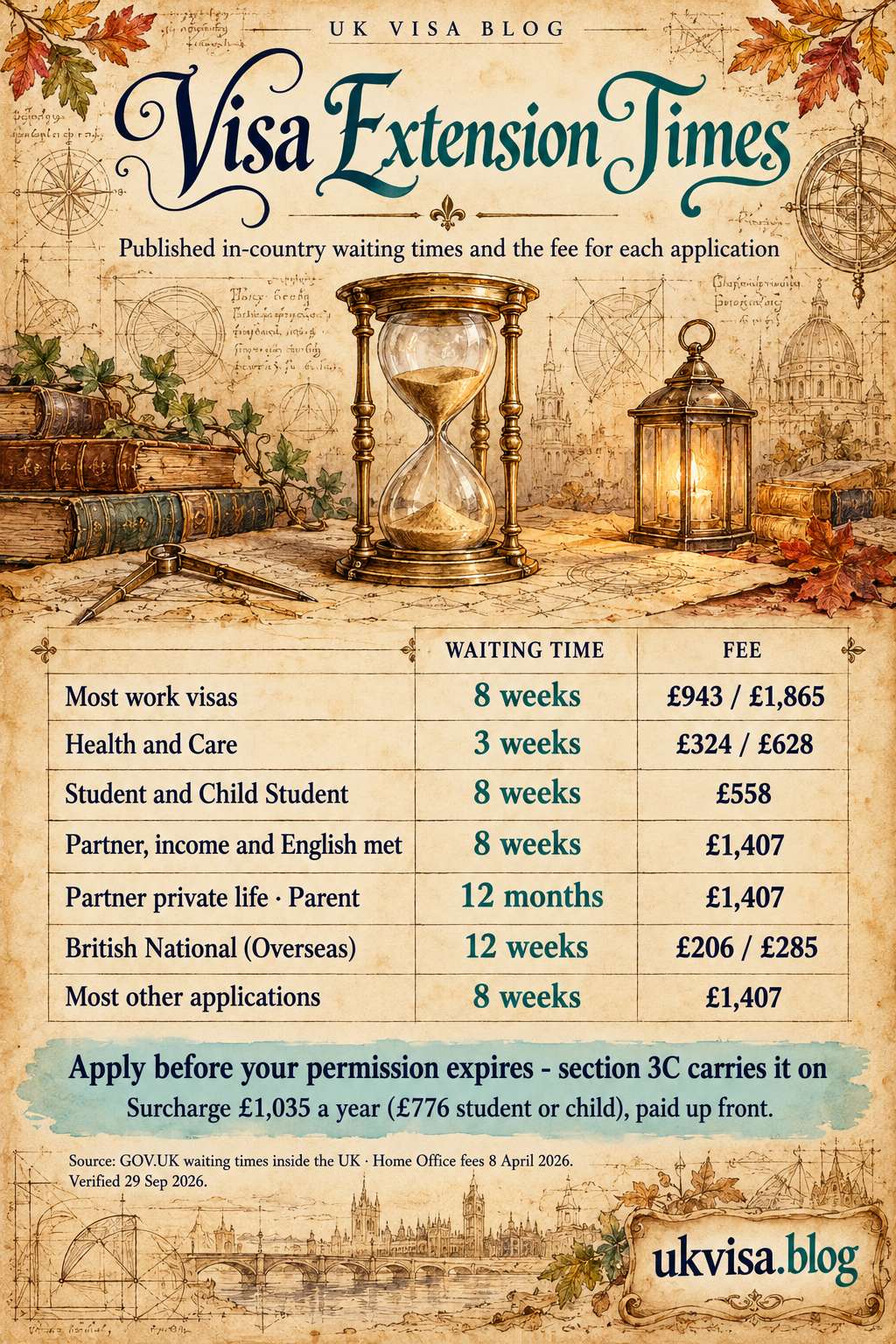
UK visa extension processing time in 2026 follows an 8-week standard service for most in-country applications, with 5 working day priority (£500) and next working day super priority (£1,000) services available across most routes. This guide covers processing timelines for Skilled Worker (formerly Tier 2), FLR (Further Leave to Remain), Spouse, Student, and PBS Dependent visa extensions — plus Certificate of Sponsorship (CoS) processing for Skilled Worker route applications. Your immigration status is protected by Section 3C leave while your in-time variation application is pending, allowing you to continue working, studying, and renting under your previous visa's conditions until a final decision.
Source: gov.uk visa decision waiting times for applications inside the UK; UKVI service standards 2026; Home Office Migration Transparency Data quarterly statistics
The 8-week service standard for in-country variation applications remains in force in 2026. Priority service (5 working days for £500) and super priority service (next working day for £1,000) are available across most extension routes — including Skilled Worker, FLR(M)/FLR(FP)/FLR(HRO), Student, PBS Dependent, and BN(O). Since 2024, applicants using the UK Immigration: ID Check app can access super priority service — earlier restrictions have been removed. The BRP-to-eVisa transition completed end-2024, meaning successful extensions now activate digital immigration status rather than issuing physical cards. Verification is via share code from the gov.uk View and Prove portal. From 8 April 2026, FLR application fees moved to £1,048 (standard) and £1,407 (FLR(HRO)); ILR fees moved to £3,226. HC 1691 (laid 5 March 2026) introduces B2 English settlement standard from 26 March 2027 — this does not affect extension processing times but may affect supporting evidence requirements for FLR(M) and pre-ILR routes.
- Understanding UK Visa Extension Processing Time in 2026
- Standard Processing Times by Visa Category
- Skilled Worker (Tier 2) Visa Extension Processing Time
- UK CoS Processing Time 2026 — Certificate of Sponsorship
- FLR Application Processing Time — FLR(M), FLR(FP), FLR(HRO)
- Spouse Visa Extension Processing Time and Timeline
- PBS Dependent Visa Extension Processing Time
- Student Visa Extension Processing Time
- Priority and Super Priority Services 2026
- Tracking Your Application and Handling Delays
- Frequently Asked Questions
UK Visa Extension Processing Time 2026 — Skilled Worker, FLR, Spouse, Student, PBS Dependent
UK visa extension processing time follows published UKVI service standards in 2026 — typically 8 weeks for standard service, with priority and super priority options available across most routes. Processing duration depends on visa category, application complexity, supporting evidence quality, and the service level chosen. Skilled Worker extensions (still widely searched as "Tier 2 visa extension") track close to the 8-week target with around 92% of standard applications decided within the service standard; spouse and student extensions perform even better at 98-99%. PBS dependent visa extensions are typically processed alongside the main applicant to ensure coordinated decisions. This guide covers each visa category's processing time, the priority service options, CoS processing timelines for Skilled Worker route, and what to do if your application is delayed beyond the published service standard.
Understanding UK Visa Extension Processing Time in 2026
UK visa extension processing time in 2026 is 8 weeks standard for most in-country variation applications, including Skilled Worker (formerly Tier 2), FLR forms, Spouse, Student, and PBS Dependent visas. Priority service decides applications in 5 working days for £500; super priority delivers next working day decisions for £1,000. Processing time is calculated from receipt of complete application and biometrics — not from when you start the online form. UKVI publishes performance data showing 92-99% of applications meet the standard depending on visa category.
When you apply to extend your UK visa from within the country, you must submit your application before your current leave expires — this is the "in-time" requirement that triggers Section 3C statutory continuation of leave. Section 3C protects your immigration status throughout the processing period, allowing you to continue working under your previous visa's conditions, renting, and accessing services without becoming an overstayer. The Home Office publishes official service standards for applications inside the UK, updated quarterly with current performance data.
Standard Processing Times by Visa Category — 2026 Service Standards
Standard UK visa extension processing time is 8 weeks across most categories. Performance against service standards varies: Student extensions achieve approximately 99.8% within 8 weeks; Spouse and FLR(M) extensions hit 98-99%; Skilled Worker extensions achieve 92%; PBS Dependent extensions 97%; BN(O) extensions 95%. Complex or non-straightforward cases may take longer regardless of service level chosen.
Standard Service Processing Times — All Major Extension Routes
| Visa Category | Standard Time | % Met Within Target | Priority Available |
|---|---|---|---|
| Spouse/Partner (FLR(M)) | 8 weeks | ~99% | Yes — Priority & Super Priority |
| Skilled Worker (Tier 2) | 8 weeks | ~92% | Yes — Priority & Super Priority |
| Student | 8 weeks | ~99.8% | Yes — Priority & Super Priority |
| PBS Dependent | 8 weeks | ~97% | Yes (linked to main applicant) |
| BN(O) | 8 weeks | ~95% | Yes — Priority & Super Priority |
| FLR(FP) — 10-Year Family Route | 8 weeks | ~96% | Yes — Priority & Super Priority |
| FLR(HRO) — Human Rights and Other | 6 months | ~85% | Limited availability |
| Innovator Founder | 8 weeks | ~94% | Yes — Priority & Super Priority |
| Health and Care Worker | 8 weeks | ~93% | Yes — Priority & Super Priority |
| Visitor Visa Extension | 8 weeks | ~90% | Limited availability |
The 8-week standard service is published in UKVI's quarterly Migration Transparency Data and reviewed against actual case throughput. Categories with higher success rates (Student, Spouse) typically reflect more standardised documentation requirements. FLR(HRO) has a notably longer 6-month standard reflecting the complexity of human rights case-by-case assessment. Where an application is flagged as "non-straightforward" — typically involving complex relationship evidence, criminality, or unusual immigration history — UKVI will notify you and processing may extend beyond the standard regardless of priority service purchased.
Skilled Worker (Tier 2) Visa Extension Processing Time
Skilled Worker visa extension processing time — still widely searched as "Tier 2 visa extension" or "Tier 2 visa processing time" — is 8 weeks standard service, with approximately 92% of applications decided within target. Priority service (5 working days, £500) achieves around 85% on target; super priority (next working day, £1,000) reaches 97%. Your Certificate of Sponsorship (CoS) must be assigned by your sponsor employer before submission. Dependent extensions are typically processed alongside the main applicant.
The Skilled Worker visa replaced the Tier 2 General visa in December 2020, but "Tier 2" remains a heavily-used term in extension search queries — reflecting how many holders still identify their visa by the legacy label. For extension purposes the two terms are now interchangeable: existing Tier 2 visa holders extend under the Skilled Worker framework using the same application form, fee structure, and processing standards. The UK Skilled Worker visa requirements for extension include continuing employment with a Home Office licensed sponsor, an assigned CoS, meeting the salary threshold (general £38,700 from April 2024), and English language compliance.
Tier 2 Visa Extension — Now Skilled Worker Visa Extension
If you are extending what you call a "Tier 2 visa", you are extending under the Skilled Worker route. The application form is the in-country variation Skilled Worker form, accessed via gov.uk's extend your Skilled Worker visa page. The processing standard is 8 weeks for standard service. Your previous Tier 2 leave continues uninterrupted under Section 3C until decision. The new Skilled Worker leave grant typically extends your permission by up to 5 years (or to the CoS end date, whichever is shorter). Five years' continuous Skilled Worker residence then qualifies you for ILR settlement consideration — see our ILR settlement framework guide for the qualifying period detail.
Skilled Worker Extension Processing Performance 2026
- Standard service (8 weeks): Approximately 92% of straightforward applications meet target
- Priority service (5 working days, £500): Approximately 85% meet target
- Super priority (next working day, £1,000): Approximately 97% meet target
- Dependent extensions: Processed alongside main applicant at the same service level
- Tier 2 dependent processing: Same 8-week standard — submit together with main applicant for coordinated decisions
- Non-straightforward cases: May exceed target — UKVI notifies you separately
UK CoS Processing Time 2026 — Certificate of Sponsorship
UK CoS processing time 2026 — the time for a sponsor to assign a Certificate of Sponsorship for Skilled Worker extension — is typically 1-3 working days once the sponsor licence holder requests it through the Sponsorship Management System (SMS). For undefined CoS allocations (Skilled Worker route), no Home Office approval is needed, so CoS issuance is essentially immediate. Defined CoS (used for new overseas hires) requires UKVI allocation review, taking 1-3 working days. CoS validity is 3 months from assignment — the visa application must be submitted within this window.
The Certificate of Sponsorship (CoS) is the digital reference number issued by a licensed sponsor through the Sponsorship Management System that confirms a specific role, salary, and conditions for the migrant worker. For Skilled Worker extensions, the sponsor uses an undefined CoS (for current employees being extended) — this does not require UKVI pre-allocation approval and can be assigned almost immediately by the sponsor's authorised user. CoS processing time in 2026 has been a particular search concern as sponsors and applicants navigate the post-July 2025 immigration rules tightening — but the CoS issuance process itself remains efficient.
CoS Issuance Timeline by Type
- Undefined CoS (for extensions and in-country switches): Immediate — sponsor assigns directly via SMS, no UKVI approval needed
- Defined CoS (for overseas entry clearance): 1-3 working days for UKVI allocation review
- CoS validity: 3 months from assignment — visa application must be submitted within this window
- CoS amendment: Sponsors can amend CoS details (role, salary, location) before visa submission — typically immediate
- CoS withdrawal: Sponsor can withdraw CoS — applicant should not submit visa application after withdrawal
- CoS for Health and Care Worker route: Same timelines apply — sponsor must hold CQC regulation for care worker roles
FLR Application Processing Time — FLR(M), FLR(FP), FLR(HRO)
FLR application processing time varies by form type: FLR(M) (spouse/partner 5-year route) and FLR(FP) (10-year family/parent route) target 8 weeks standard with 96-99% within service standard. FLR(HRO) (Human Rights and Other — consolidated form that replaced FLR(HR) when FLR(O) was discontinued) targets 6 months reflecting human rights case complexity, with around 85% within standard. Priority service is widely available for FLR(M) and FLR(FP); limited for FLR(HRO). FLR fees from 8 April 2026: £1,048 (standard) / £1,407 (FLR(HRO)).
FLR — Further Leave to Remain — covers extension applications outside the points-based system, primarily under Appendix FM (family) and Article 8 ECHR human rights routes. The 2024 form consolidation simplified the FLR landscape: FLR(O) was discontinued and FLR(HR) was renamed FLR(HRO) (Human Rights and Other) to cover the consolidated scope. Each FLR variant has its own processing time profile — FLR(M) is the fastest because relationship and financial evidence is highly standardised under Appendix FM; FLR(HRO) is slowest because human rights claims require individualised assessment. For the complete FLR forms framework, see our FLR forms guide.
FLR Form Processing Times — 2026 Service Standards
| FLR Form | Standard Time | % Met Target | Application Fee (8 April 2026) |
|---|---|---|---|
| FLR(M) — Spouse/Partner 5-Year Route | 8 weeks | ~99% | £1,048 |
| FLR(FP) — 10-Year Family/Parent Route | 8 weeks | ~96% | £1,048 |
| FLR(IR) — Other Routes | 8 weeks | ~93% | £1,048 |
| FLR(HRO) — Human Rights and Other | 6 months | ~85% | £1,407 |
Add IHS (Immigration Health Surcharge) at £1,035 per year for most categories (or £776 for Health and Care Worker route) to the application fee. Priority service for FLR(M) and FLR(FP) typically delivers decisions within 5 working days at £500; super priority is available at £1,000 for next working day. FLR(HRO) priority service is more limited reflecting the complexity of human rights assessment — the Home Office may refuse priority allocation if the case requires substantive consideration.
Spouse Visa Extension Processing Time and Timeline
Spouse visa extension processing time in 2026 is 8 weeks standard service, with approximately 99% of applications decided within target — the second-highest success rate after Student visa extensions. The application uses form FLR(M) for the 5-year route or FLR(FP) for the 10-year route. Priority service (5 working days, £500) and super priority (next working day, £1,000) are widely used given the importance of timely decisions for family stability. Apply 28 days before your current spouse visa expires to trigger Section 3C cover.
Spouse visa extension under the 5-year route involves an initial 33-month grant of entry clearance leave followed by a 30-month extension via form FLR(M) — total 5 years before ILR consideration. The 10-year route involves four FLR(FP) extensions of 30 months each, totalling 10 years before settlement. The UK Spouse visa framework covers the eligibility requirements; processing time for the extension stage is consistently strong at 99% within the 8-week standard, reflecting the standardisation of relationship and financial evidence under Appendix FM. Spouse visa extension applications can be submitted through the extend your UK family visa route on gov.uk.
When to Apply for Spouse Visa Extension
- 28 days before expiry recommended: Allows time for biometric appointment and document upload
- Latest possible submission: Day before current visa expires — but tight timing risks Section 3C complications
- Financial requirement: Demonstrate £29,000 minimum income (or savings alternative per Appendix FM-SE)
- English language B1: Required for first extension — must be from approved test provider
- Relationship evidence: Continuing genuine relationship since last grant — joint financial commitments, cohabitation, communication
- KoLL not required: Knowledge of Life in the UK test only required at ILR stage, not extension
PBS Dependent Visa Extension Processing Time
PBS dependent visa extension processing time is 8 weeks standard, with approximately 97% of dependent extensions decided within service standard. PBS Dependents (spouses, partners, and children under 18 of Points-Based System main applicants) are typically processed alongside the main applicant when submitted together. Tier 2 dependent visa extension follows the same processing timeline as the principal Skilled Worker extension. Priority service is available if the main applicant uses priority; super priority requires both applicants on the same service level.
PBS Dependent (Points-Based System Dependent) visa extension covers the family members — partner and children under 18 — of main applicants on Skilled Worker, Global Talent, Innovator Founder, Health and Care Worker, and other PBS routes. The 2024 family-policy restrictions removed dependant eligibility for new overseas applications by Care Worker and Student (taught Master's) main applicants, but those whose dependants are already in the UK on existing PBS Dependent leave can typically extend alongside the main applicant. For Tier 2 dependent visa extension (now PBS Dependent under Skilled Worker), the processing standard mirrors the principal applicant's route — 8 weeks standard, 5 working days priority, next working day super priority.
PBS Dependent Extension Coordination
- Submit together: Best practice — main applicant and dependants submitted at same time ensure coordinated decisions
- Same service level: Dependants should use the same standard/priority/super priority service as the main applicant
- Separate biometric appointments: Each dependant must enrol biometrics individually
- Linked decision: Dependant outcomes are typically issued at the same time as main applicant decision
- Different fee structure: Each dependant pays the application fee + IHS separately
- Child dependant ageing out: Children turning 18 during the qualifying period need careful timing — see specific dependant policy
Student Visa Extension Processing Time
Student visa extension processing time is 8 weeks standard service, with approximately 99.8% of applications decided within target — the highest success rate across all UK visa categories. The high performance reflects standardised documentation: a valid Confirmation of Acceptance for Studies (CAS) from a licensed sponsor, financial evidence at the prescribed level, and English language proof from approved provider. Priority service (5 working days, £500) and super priority (next working day, £1,000) are available but rarely needed given the strong standard service performance.
Student visa extensions are the most efficiently-processed of any UK in-country variation route — the 99.8% target hit reflects the clear documentation requirements set out in Appendix Student of the Immigration Rules. Applications use the extend your Student visa route on gov.uk. The supporting evidence framework is straightforward: a current CAS from a licensed Student sponsor, evidence of finances for course fees and maintenance (£1,483/month London or £1,136/month elsewhere for up to 9 months), and ATAS clearance for sensitive subjects where applicable. See our UK Student visa requirements guide for the complete eligibility framework.
When Student Visa Extension Is Required
- Continuing studies past visa expiry: Course extends beyond current Student leave end date
- New course at same institution: Progressing to a different course with new CAS
- PhD writing-up period: Additional time granted for thesis completion — supplementary CAS required
- Repeating a year: Extension to retake academic year — may require enhanced sponsor evidence
- Master's to PhD transition: New CAS for doctoral programme
- Graduate visa transition: Not an extension — separate fresh application after course completion
Priority and Super Priority Services 2026
Priority service for UK visa extensions costs £500 and targets a decision within 5 working days. Super priority service costs £1,000 and targets a decision by the next working day. Both services are available across most in-country extension routes including Skilled Worker, FLR(M), FLR(FP), Spouse, Student, and PBS Dependent. Since 2024, applicants using the UK Immigration: ID Check app can access super priority — earlier restrictions have been removed. Non-straightforward cases are excluded from priority timelines regardless of fee paid.
The Home Office's priority visa services framework offers faster processing for applicants who need certainty around timing — particularly for work commitments, travel plans, or family stability. Priority service achieves 5 working days for around 85% of straightforward applications; super priority achieves next working day for approximately 97%. The remaining percentage falls into the "non-straightforward" category where UKVI requires longer assessment regardless of fee — typically involving complex relationship evidence, immigration history concerns, or sponsor compliance review.
Priority and Super Priority Service Comparison 2026
| Service Level | Processing Target | Additional Fee | Best For |
|---|---|---|---|
| Standard | 8 weeks | None (included) | Flexible timelines — most applicants |
| Priority | 5 working days | £500 | Work commitments, planned travel within 6 weeks |
| Super Priority | Next working day | £1,000 | Urgent decisions — imminent travel or employer requirement |
Important Considerations for Priority Services
- Non-straightforward cases: If UKVI classifies your application as complex, priority timelines do not apply — you keep the priority fee paid but service standard reverts to standard timing
- Refund policy: Limited refunds available where delays result from Home Office errors rather than applicant complexity
- Appointment availability: Super priority requires same-day or next-day biometric/UKVCAS appointment — high-demand periods see limited slots
- ID Check app access: Since 2024, UK Immigration: ID Check app users can access super priority (previously restricted to UKVCAS appointments only)
- FLR(HRO) limitation: Human Rights and Other applications have restricted priority availability due to substantive assessment requirement
- Sunday and bank holidays: Super priority "next working day" excludes weekends and English bank holidays
Tracking Your Application and Handling Delays
Track your UK visa extension application through your UKVI online account, email updates from UKVI, and the paid enquiry service if your application exceeds the published service standard. Your eVisa digital immigration status becomes available online once the decision is issued. If your application is delayed beyond 8 weeks, first check for UKVI emails requesting additional documents, then submit a paid enquiry. Persistent delays may justify contacting your MP or seeking legal advice. Section 3C leave continues to protect your status throughout the delay period.
Methods to Track Your Extension Application
- UKVI online account: Log in to view current application status and any document requests
- Email notifications: UKVI sends updates at receipt, biometric enrolment confirmation, and decision stages
- UKVCAS portal: If you attended a service centre appointment, check status updates through their dashboard
- View and Prove portal: Once decision issued, your eVisa status appears at the gov.uk view-and-prove page
- Paid enquiry service: Available where application exceeds published service standard — chargeable enquiry route
What to Do If Your Extension Is Delayed Beyond Standard
If your extension exceeds the 8-week standard (or 6 months for FLR(HRO)), structured escalation typically produces results. First check your spam and junk email folders — UKVI document requests sometimes filter out and missed responses can stall applications for months. Next use the paid enquiry service to formally raise the delay with UKVI. If the application is significantly delayed (3+ months beyond standard), contact your Member of Parliament for an MP enquiry, which often accelerates UKVI's response. For applications stalled for 6+ months, professional immigration advice may identify whether a Pre-Action Protocol letter or judicial review claim is appropriate.
- Standard processing time is 8 weeks for most in-country variation applications
- Student extensions achieve the highest success rate (~99.8% within standard)
- Spouse and FLR(M) extensions achieve ~99% within the 8-week target
- Skilled Worker (formerly Tier 2) extensions achieve ~92% within standard service
- PBS Dependent extensions process alongside the main applicant — ~97% within target
- Priority service (£500) targets 5 working days; super priority (£1,000) targets next working day
- Since 2024, UK Immigration: ID Check app users can access super priority service
- CoS issuance for Skilled Worker extension is essentially immediate (undefined CoS) — 3-month validity from assignment
- FLR(HRO) has a longer 6-month standard reflecting human rights case complexity
- Section 3C leave protects your status throughout processing and any subsequent appeal/Administrative Review
- Apply at least 28 days before current leave expires to allow biometric appointment and supporting evidence preparation
Frequently Asked Questions About UK Visa Extension Processing Time
UK visa extension processing time in 2026 is 8 weeks for standard service across most categories — Skilled Worker, FLR(M), FLR(FP), Spouse, Student, and PBS Dependent. Priority service (£500) targets 5 working days; super priority service (£1,000) targets next working day. Processing time is calculated from receipt of complete application and biometric enrolment. Performance varies by category: Student extensions hit 99.8% within standard, Spouse and FLR(M) extensions 99%, Skilled Worker 92%, PBS Dependent 97%. Non-straightforward cases may exceed standard regardless of priority service.
Tier 2 visa extension processing time is 8 weeks standard service — extensions are now processed under the Skilled Worker route which replaced Tier 2 General in December 2020. Approximately 92% of standard applications are decided within the 8-week target. Priority service (5 working days, £500) achieves around 85% on target; super priority (next working day, £1,000) reaches 97%. You need an assigned Certificate of Sponsorship (CoS) from your sponsor employer before submission. Existing Tier 2 holders extend using the Skilled Worker in-country variation form.
Spouse visa extension processing time is 8 weeks for standard service, with approximately 99% of applications decided within target — among the highest success rates of any UK visa category. The application uses form FLR(M) for the 5-year route or FLR(FP) for the 10-year route. Super priority service is available for £1,000 with next working day target. The financial requirement remains £29,000 minimum income; English language B1 required at first extension. Submit 28 days before current spouse visa expires to trigger Section 3C protection during processing.
FLR application processing time varies by form: FLR(M) for spouse/partner 5-year route and FLR(FP) for 10-year family/parent route target 8 weeks with 96-99% within standard. FLR(IR) for other routes targets 8 weeks with around 93% within target. FLR(HRO) for Human Rights and Other (the consolidated form replacing former FLR(HR) and FLR(O)) targets 6 months reflecting the substantive human rights assessment, with around 85% meeting standard. FLR fees from 8 April 2026 are £1,048 (standard) and £1,407 (FLR(HRO)), plus IHS at £1,035 per year.
UK CoS (Certificate of Sponsorship) processing time depends on type. For Skilled Worker extension or in-country switching, sponsors assign an undefined CoS directly through the Sponsorship Management System (SMS) — essentially immediate, no UKVI pre-approval required. For new overseas hires under Skilled Worker route, a defined CoS requires UKVI allocation review taking 1-3 working days. CoS is valid for 3 months from assignment — the visa application must be submitted within this window. Coordinate timing carefully with your sponsor's authorised user.
PBS Dependent visa extension processing time is 8 weeks standard, with approximately 97% of dependent extensions decided within target. PBS Dependents (spouses, partners, and children under 18 of main Points-Based System applicants) are typically processed alongside the main applicant when submitted together. Tier 2 dependent visa extension follows the same timeline as the principal Skilled Worker extension — same service level recommended (standard, priority, or super priority). Each dependant pays the application fee and IHS separately. Submitting together ensures coordinated decision timing.
Priority visa extension is worth the £500 fee if you need decision certainty within 5 working days — typically for work commitments, planned travel within the next 6 weeks, or family stability concerns. Super priority at £1,000 makes sense for urgent next-working-day decisions. However, if your case is non-straightforward, priority timelines do not apply regardless of fee paid. Standard service achieves the 8-week target for 92-99% of straightforward cases depending on category, so priority is most valuable for the small percentage of cases where standard processing might run close to or beyond target.
UK visa renewal time (also called extension time) is 8 weeks for standard service across most in-country variation routes. The terms "renewal" and "extension" are used interchangeably for in-country applications to extend your leave to remain. Processing times vary by visa category: Student 99.8% within target, Spouse 99%, FLR(M) 99%, Skilled Worker 92%, PBS Dependent 97%, BN(O) 95%. Priority service (5 working days, £500) and super priority (next working day, £1,000) are available for faster decisions. Out-of-country renewals follow a different service standard framework.
If your visa extension exceeds the 8-week standard, first check your email (including spam) for UKVI document requests. Use the paid enquiry service to formally raise the delay. For delays beyond 3 months, contact your Member of Parliament for an MP enquiry — this often accelerates UKVI's response. For delays of 6 months or more, professional immigration advice may identify whether a Pre-Action Protocol letter is appropriate. Throughout the delay, your Section 3C leave continues to protect your status — you can keep working, renting, and accessing services under your previous visa's conditions.
Yes — since 2024, applicants using the UK Immigration: ID Check app can access super priority service for extensions where the route supports it. Earlier restrictions limited super priority to UKVCAS service centre appointments only; this has been removed for most in-country variation routes. The super priority fee remains £1,000 for next working day target. Note that super priority "next working day" excludes weekends and English bank holidays — submission on Friday evening would target Monday's working day. Not all categories support super priority via the ID Check app — check route-specific eligibility before paying.
For official UKVI service standards and current performance against published targets, see the gov.uk visa decision waiting times for applications inside the UK. To submit a Skilled Worker extension, see the extend your Skilled Worker visa route. For family visa extensions including spouse, partner, and parent routes, see the extend your UK family visa page. For Student visa extensions, see the extend your Student visa page. For underlying ILR settlement application — the next step after most extension cycles — see our ILR application forms guide. For all UK visa application fees including extension and priority service charges from 8 April 2026, see our UK visa fees pillar.