
A reconsideration request to the Home Office is the informal route to ask UK Visas and Immigration (UKVI) to review a refused visa decision where you believe a caseworker error or overlooked evidence affected the outcome. Unlike Administrative Review or appeals, reconsideration is discretionary, has no application fee, and no statutory deadline — though prompt submission (typically within 14 days) is recommended. Most successful reconsideration requests involve clear factual errors, mis-applied Immigration Rules, or material evidence the original caseworker did not see. Where the Home Office declines to overturn the decision, the response is termed "refusal to supersede" — your original refusal stands and other remedies (Administrative Review, appeal, judicial review) may then become relevant.
Source: UKVI caseworker guidance on reconsideration requests; Appendix AR (Administrative Review) of the Immigration Rules; gov.uk visa and immigration reconsideration requests guidance
The reconsideration request remains an informal Home Office mechanism in 2026 — not codified in the Immigration Rules but used in caseworker guidance for correcting factual errors or considering material evidence overlooked at the original decision. Key features: no application fee (unlike the £80 Administrative Review fee); no statutory deadline (though prompt submission within 14 days improves prospects); discretionary review — UKVI is not obliged to consider the request. Where the Home Office declines to overturn the original decision, the response is a "refusal to supersede" — the original refusal stands. It is most useful where Administrative Review and appeal rights do not apply, or where you have clear evidence of caseworker error involving material evidence available before the decision. Where appeal rights exist, those should generally be used instead.
- What is a Reconsideration Request to the Home Office?
- Eligibility for Reconsideration — When You Can Request It
- How to Write a Reconsideration Request — Sample Letter
- Refusal to Supersede — Meaning and What It Implies
- Reconsideration Request Response Time
- Mandatory Reconsideration — DWP vs UK Immigration
- Pre-Action Protocol Letter to Home Office — Alternative Route
- Reconsideration vs Administrative Review vs Appeal vs Judicial Review
- Outcomes and Next Steps After Reconsideration
- Frequently Asked Questions
Reconsideration Request to Home Office — UK Visa Refusal Review 2026
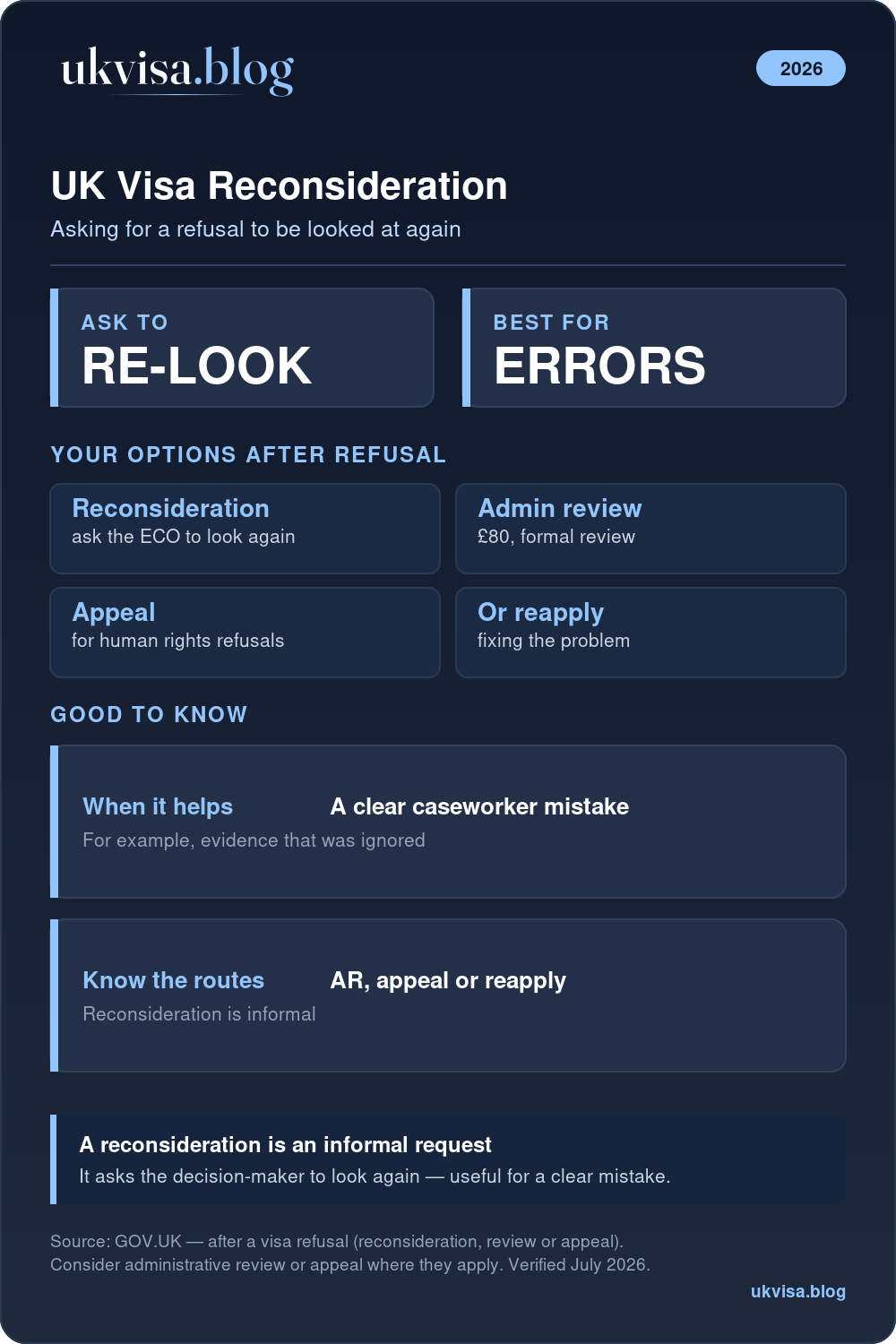
A reconsideration request is the informal mechanism by which UKVI may revisit a visa refusal where a clear factual error, overlooked evidence, or mis-applied Immigration Rule contributed to the outcome. It is distinct from Administrative Review (a formal statutory process under Appendix AR with an £80 fee and 14-day deadline), tribunal appeals (for human rights, protection, and EEA cases), and judicial review (High Court or Upper Tribunal challenge to decision-making lawfulness). The reconsideration request has no fee and no statutory deadline but offers no guaranteed review — UKVI exercises discretion in deciding whether to revisit the decision. Where Administrative Review or appeal rights apply, those should be used in preference to reconsideration.
What is a Reconsideration Request to the Home Office?
A reconsideration request to the Home Office is an informal written request asking UKVI to review a visa refusal decision based on a clear caseworker error, an overlooked piece of material evidence, or mis-applied Immigration Rules. It is not a formal appeal — it has no fee, no statutory deadline, and is discretionary. The Home Office may decide to overturn the original decision, decline to supersede it, or simply not respond. Reconsideration is most appropriate where Administrative Review and appeal rights do not apply.
The reconsideration request fills a narrow gap in UK immigration remedies. Where a decision letter grants Administrative Review rights, that formal route (£80 fee, 14-day deadline, considers only existing evidence) is the appropriate first step. Where a decision letter grants appeal rights to the First-tier Tribunal (human rights, protection, EEA cases), that route should be used. The reconsideration request becomes useful where neither Administrative Review nor appeal applies — typically for Transfer of Conditions errors, eVisa or BRP issuance errors, or where new material evidence has come to light that was available but not considered at the original decision.
Key Characteristics of Reconsideration Requests
- Informal mechanism: Not codified in the Immigration Rules — operates through Home Office caseworker discretion
- No application fee: Unlike Administrative Review (£80) or appeals (£80 paper / £140 oral)
- No statutory deadline: Prompt submission (within 14 days) recommended but not mandatory
- Discretionary review: Home Office is not obliged to consider the request
- No tribunal involvement: Decision made by UKVI caseworker — typically the original decision team or a senior officer
- Limited grounds: Best for clear factual errors, mis-applied rules, or material evidence not previously considered
Eligibility for Reconsideration — When You Can Request It
You can request reconsideration of a Home Office decision where you believe there was a clear factual error, mis-applied Immigration Rule, or material evidence that was available but not considered. Reconsideration is generally not appropriate where you have Administrative Review rights, appeal rights, or have already submitted a fresh application. Visitor visa refusals made overseas typically cannot be reconsidered — entry clearance decisions follow different procedures. The decision letter specifies which remedies apply to your specific case — see our refusal notice and grounds explanation guide for context.
Decisions Typically Eligible for Reconsideration
- Transfer of Conditions (TOC/NTL) errors: Mistakes when transferring visa conditions to a new eVisa or Biometric Residence Permit record
- eVisa or BRP issuance errors: Incorrect dates, conditions, or details on your digital status or a Biometric Residence Permit
- Extension applications with caseworker error: Where the refusal involved clear mis-application of Immigration Rules and no Administrative Review right applies
- Settlement (ILR) decisions: Where the refusal involved a clear factual error
- Cases with overlooked material evidence: Evidence that existed before the decision but was not considered — most commonly bank statements, employer letters, or relationship evidence sent but apparently not received by UKVI
- Address or postal errors: Where decision letters were sent to wrong address resulting in missed deadlines
When Reconsideration is NOT the Right Remedy
- Existing Administrative Review rights: Most Points-Based System refusals carry Administrative Review rights under Appendix AR — use that route
- Existing appeal rights: Refusals on human rights, protection, EEA, or family route cases typically carry First-tier Tribunal appeal rights
- New application submitted: If you have already filed a fresh application before or after the reconsideration request
- Left the UK: If you have departed the UK and permission has expired
- Removed or deported: If you have been removed or deported from the UK
- Appeal rights exhausted: If you have already lost an appeal or judicial review on the same decision
- Entry clearance refusals overseas: Visitor visa refusals from posts abroad generally cannot be reconsidered — reapply or pursue judicial review where lawfulness is in question
How to Write a Reconsideration Request — Sample Letter
A reconsideration request letter should include your personal details, Home Office reference numbers, decision date, a clear statement of the error or new evidence, specific references to Immigration Rules paragraphs that were misapplied, and supporting documentation. Keep the tone professional and factual — avoid emotional language. The letter is typically 1-2 pages with supporting evidence enclosed. The sample letter template below shows the standard structure used by immigration practitioners for reconsideration submissions to UKVI.
Essential Elements of a Reconsideration Request
- Your personal details: Full name, date of birth, nationality, and current UK address
- Home Office references: Home Office reference number, GWF number, IHS reference, and any case ID from the refusal letter
- Decision details: Date of the refusal letter and visa type that was refused
- Clear statement of error: Specifically identify what was wrong — caseworker error, mis-applied rule, or overlooked evidence
- Immigration Rule references: Cite the specific paragraphs (e.g. Appendix FM E-LTRP.3.1) that were misapplied
- Material evidence not considered: Describe what evidence was available before the decision but not considered, and explain why it changes the outcome
- Supporting documents: Enclose copies of the relevant evidence (do not send originals)
- Professional sign-off: Date the letter and sign in ink — keep a copy for your records
Sample Letter of Reconsideration for Visa Application
Sample Letter Template
[Your Full Name]
[Your UK Address]
[Postcode]
[Date]
To: [Address from Decision Letter]
UK Visas and Immigration
[Specific UKVI Address from Letter]
RE: Reconsideration Request
Home Office Reference: [Your Reference Number]
GWF Number: [Your GWF Number]
Date of Birth: [Your DOB]
Nationality: [Your Nationality]
Dear Sir/Madam,
I write to request reconsideration of the decision dated [date of decision] refusing my application for [specific visa type — e.g. Skilled Worker Extension].
I respectfully submit that the decision was made in error for the following reasons:
1. Caseworker error / mis-applied rule: The decision states that [quote the specific refusal reason from the letter]. However, this conclusion is incorrect because [explain factually why — reference the specific Immigration Rule paragraph that should have applied, e.g. Appendix Skilled Worker SW 10.1].
2. Material evidence not considered: I submitted [specific document] with my application on [date], which addresses the issue raised in the refusal. The decision letter does not appear to engage with this evidence. A copy of [document] is enclosed for ease of reference.
For these reasons, I respectfully request that the original decision be reconsidered and overturned. I enclose the following supporting evidence:
- Copy of my application submission confirmation
- [Document A] dated [date]
- [Document B] dated [date]
- Bank statements covering [period]
I look forward to your response. Should you require further information, I can be contacted at [phone] or [email].
Yours faithfully,
[Signature]
[Print Name]
Refusal to Supersede — Meaning and What It Implies
"Refusal to supersede" is the formal Home Office term for declining to overturn an earlier decision following a reconsideration request. It means the original refusal stands — your application remains refused. A refusal to supersede is not itself a new immigration decision, so it does not generate fresh Administrative Review or appeal rights. After a refusal to supersede, your options are: (1) judicial review of the original decision (where the decision-making process was unlawful); (2) a fresh application addressing the original refusal reasons; or (3) accepting the decision and considering alternative routes.
The phrase "refusal to supersede" is technical Home Office terminology that confuses many applicants. "Supersede" here means "replace" — and the Home Office is declining to replace its original decision with a different one. The original refusal therefore continues to operate as the immigration decision. If you wish to challenge the underlying decision after a refusal to supersede, you generally need to do so via judicial review (challenging the lawfulness of the original decision-making process) — not by appealing the refusal-to-supersede letter itself, which is not an immigration decision in the technical sense.
What Refusal to Supersede Does and Does Not Mean
- Does mean: Your original refusal remains the operative immigration decision
- Does mean: The Home Office considers the reconsideration request closed
- Does mean: You may need to consider judicial review or fresh application as next steps
- Does not mean: You have lost a new immigration appeal — the original decision is the relevant decision
- Does not mean: Fresh Administrative Review or appeal rights are generated
- Does not mean: Your status has worsened — your immigration status remains as it was after the original refusal
Reconsideration Request Response Time
The Home Office does not publish a statutory response time for reconsideration requests. In practice, most requests receive a response within 4-8 weeks of submission. Complex cases involving substantial new evidence or human rights elements may take 8-12 weeks. There is no guaranteed timeframe — UKVI processes requests according to its operational priorities. If you have not received a response after 8 weeks, you can contact UKVI for an update, though this rarely accelerates the timeline. For comparison, Administrative Review has a 28-day target service standard.
Typical Reconsideration Timeline
| Stage | Typical Timeframe | Notes |
|---|---|---|
| Recommended submission | Within 14 days of decision | Not statutory but improves prospects |
| Acknowledgement | 1-2 weeks (not always provided) | UKVI does not consistently acknowledge receipt |
| Initial assessment | 2-4 weeks | Eligibility and procedural check |
| Full review | 4-8 weeks total | Standard cases |
| Complex cases | 8-12 weeks | Where substantial evidence is involved |
| Decision notification | Written response by post or email | Sent to the address on the request |
If your reconsideration request is urgent — for example, due to imminent employment, study, or travel — you should mention this in the cover letter and provide supporting evidence (employer letter, university enrolment, booked travel). However, urgency does not guarantee faster processing. The reconsideration request does not extend your existing leave or grant Section 3C protection — if your previous leave has expired, you do not gain lawful status by virtue of the pending reconsideration request.
Mandatory Reconsideration — DWP vs UK Immigration
"Mandatory Reconsideration" is Department for Work and Pensions (DWP) terminology used in benefits decisions — not UK immigration. The DWP requires applicants to request mandatory reconsideration before appealing to a tribunal on benefits matters. UK immigration has no equivalent "mandatory" stage — instead, the formal review mechanism is Administrative Review under Appendix AR of the Immigration Rules. The informal Home Office reconsideration request is voluntary and discretionary, not mandatory. If you searched for "mandatory reconsideration" in a UK visa context, you likely want Administrative Review or an informal reconsideration request.
The confusion between DWP mandatory reconsideration and UK immigration reconsideration is common — both involve asking a government department to review a refusal. The key differences: DWP mandatory reconsideration is a statutory pre-tribunal step (you must request it before appealing); UK immigration has no equivalent mandatory step. For Points-Based System refusals (Skilled Worker, Student, Global Talent), the formal review mechanism is Administrative Review under Appendix AR — £80 fee, 14-day deadline, considers only existing evidence. For family and human rights refusals, the formal route is direct appeal to the First-tier Tribunal. The informal reconsideration request fills the gap where neither Administrative Review nor appeal applies.
Pre-Action Protocol Letter to Home Office — Alternative Route
A Pre-Action Protocol (PAP) letter to the Home Office is the formal first step in judicial review under CPR Part 54 — it precedes filing a judicial review claim. Unlike a reconsideration request (informal, no fee, discretionary), the PAP letter signals intended litigation and triggers a 14-day response window. PAP letters resolve a meaningful share of UK visa judicial review cases without proceeding to court — the Home Office often reconsiders its position once formal litigation is signalled. For complex cases or those involving fundamental legal errors, a PAP letter is generally more effective than an informal reconsideration request. See our UK visa judicial review process guide for the PAP framework.
The Pre-Action Protocol letter and the informal reconsideration request serve overlapping but distinct purposes. Reconsideration is best used early (within 14 days of decision), where the issue is a clear factual error, and where you do not yet wish to commit to litigation. The PAP letter is appropriate where there is a clear legal error in the decision-making process and you are prepared to file judicial review if the Home Office does not respond satisfactorily. PAP letters carry more weight than informal reconsideration because they trigger costs consequences if the Home Office maintains an unlawful position. For decisions involving fundamental human rights or procedural fairness concerns, PAP is usually the stronger remedy.
Reconsideration vs Administrative Review vs Appeal vs Judicial Review
The four main UK visa refusal remedies have different scopes and procedural rules. Reconsideration is informal, discretionary, no fee, no deadline — best for caseworker errors. Administrative Review is formal, £80 fee, 14-day deadline, considers only existing evidence — for Points-Based System refusals. Appeal to the First-tier Tribunal applies to human rights, protection, and EEA cases. Judicial Review challenges the lawfulness of the decision-making process at the Upper Tribunal or High Court. Your decision letter specifies which remedies apply — generally you cannot pick and choose between them.
Remedy Comparison Table
| Remedy | Nature | Fee | Deadline | Timeframe |
|---|---|---|---|---|
| Reconsideration | Informal UKVI review | None | None (14 days recommended) | 4-8 weeks |
| Administrative Review | Formal Appendix AR review | £80 | 14 days (28 days overseas) | 28 days target |
| First-tier Tribunal Appeal | Independent tribunal hearing | £80 paper / £140 oral | 14 days in-country / 28 days out-of-country | 6-18 months |
| Pre-Action Protocol | Pre-litigation letter | None | 3 months promptly | 14-day response |
| Judicial Review | Upper Tribunal / High Court | £174 + £438 + £874 | 3 months (promptly) | 6-18 months |
For most Points-Based System refusals (Skilled Worker, Student, Global Talent, Innovator Founder), Administrative Review under Appendix AR is the correct first step — see our Administrative Review guide. For family route refusals, First-tier Tribunal appeal on Article 8 ECHR grounds is the standard route — see our spouse visa appeal process guide. For human rights claims see our human rights UK visa guide. Reconsideration is most useful where none of these formal remedies apply but a clear caseworker error has occurred.
Outcomes and Next Steps After Reconsideration
A reconsideration request can result in three outcomes: (1) the original decision is overturned and the visa or leave is granted; (2) the Home Office issues a "refusal to supersede" — the original refusal stands; or (3) UKVI declines to process the request as ineligible. If the original decision is overturned, you receive the visa or leave originally denied. If you receive a refusal to supersede, your options are limited — judicial review of the original decision (if procedural unlawfulness exists), a fresh application addressing the original refusal reasons, or considering alternative immigration routes.
Possible Outcomes
- Original decision overturned: The Home Office accepts the reconsideration arguments and grants the original application — visa or leave issued
- Partial reconsideration: Some elements of the original decision corrected (dates, conditions) without changing the overall outcome
- Refusal to supersede: Home Office declines to overturn — original refusal stands
- No response: UKVI may decline to engage with the reconsideration request — silence is effectively a refusal to supersede
- Ineligibility notice: UKVI declines to consider the request as ineligible (e.g. where Administrative Review or appeal rights existed)
What Happens if ILR is Refused After Reconsideration?
If your ILR settlement framework application has been refused and reconsideration has been declined, your next options depend on your underlying circumstances. ILR refusals typically carry Administrative Review rights (£80 fee, 14-day deadline) — use that route in preference to informal reconsideration where available. Where Administrative Review has been exhausted, judicial review of the original decision may be available. A fresh ILR application is also possible if you can address the original refusal reasons or have now completed the necessary qualifying period. See our reapplication and refusal recovery options guide for the framework.
- Reconsideration is an informal Home Office mechanism — not codified in the Immigration Rules
- No application fee (unlike £80 Administrative Review fee)
- No statutory deadline — 14 days recommended but not mandatory
- Discretionary review — Home Office not obliged to consider the request
- Best used where Administrative Review and appeal rights do not apply
- Refusal to supersede means the Home Office declines to overturn — original refusal stands
- Typical response time: 4-8 weeks (no statutory service standard)
- Mandatory Reconsideration is DWP terminology — UK immigration equivalent is Administrative Review
- Pre-Action Protocol (PAP) letters resolve a meaningful share of UK visa judicial review cases — often more effective than informal reconsideration for legal errors
- For Points-Based System refusals use Administrative Review; for family/human rights use First-tier Tribunal appeal
Frequently Asked Questions about Reconsideration Requests
A reconsideration request is an informal written request to UK Visas and Immigration (UKVI) asking the Home Office to review a visa or immigration refusal based on a clear caseworker error, mis-applied Immigration Rule, or material evidence that was available before the decision but not considered. It has no application fee, no statutory deadline, and is discretionary — UKVI is not obliged to engage with the request. Reconsideration is distinct from Administrative Review (formal statutory process under Appendix AR with £80 fee and 14-day deadline), tribunal appeals, and judicial review.
Submit your reconsideration request in writing to the UKVI address on your decision letter. Include your full name, date of birth, nationality, current UK address, Home Office reference number, GWF number, date of the refusal, type of application refused, and a clear explanation of the error or new evidence. Reference specific Immigration Rule paragraphs where relevant. Enclose copies (not originals) of supporting evidence. There is no Home Office form for reconsideration — a formal letter is standard. Keep copies of everything you send for your records.
The Home Office does not publish a statutory response time for reconsideration requests. In practice, most requests receive a response within 4-8 weeks of submission, though complex cases involving substantial new evidence may take 8-12 weeks. There is no guaranteed timeframe — UKVI processes requests according to operational priorities. If you have not received a response after 8 weeks, you can contact UKVI for an update, though this rarely accelerates the timeline. For comparison, the formal Administrative Review process has a 28-day service standard.
Refusal to supersede means the Home Office has decided not to overturn the original decision after considering your reconsideration request. The original refusal remains the operative immigration decision. The refusal to supersede letter itself is not a new immigration decision and does not generate fresh Administrative Review or appeal rights. If you wish to challenge the underlying decision after a refusal to supersede, you generally need judicial review of the original decision (challenging the lawfulness of the decision-making process), a fresh application, or to accept the decision and consider alternative routes.
No, a reconsideration request is not the same as an appeal. Reconsideration is an informal Home Office review process — no fee, no statutory deadline, discretionary. An appeal is a formal legal process heard by the First-tier Tribunal (Immigration and Asylum Chamber), independent of the Home Office, where you can challenge the decision on legal grounds. Appeals apply to human rights, protection, EEA, and family route cases. You cannot choose reconsideration if you have appeal rights — the appeal route should be used. Your decision letter specifies which remedies apply.
No — mandatory reconsideration is Department for Work and Pensions (DWP) terminology used in benefits decisions, not UK immigration. The DWP requires claimants to request mandatory reconsideration before appealing benefits decisions to a tribunal. UK immigration has no equivalent mandatory step. For Points-Based System visa refusals, the formal review mechanism is Administrative Review under Appendix AR. For family and human rights refusals, the route is First-tier Tribunal appeal. The informal Home Office reconsideration request is voluntary and discretionary — not mandatory in the DWP sense.
A reconsideration request does not extend your existing leave or grant Section 3C automatic leave protection. Your immigration status depends entirely on the leave granted before the refusal and the consequences of the refusal itself. If your previous leave has expired and the refusal has cancelled it, you are likely an overstayer at the date of the reconsideration request — and the request does not regularise that status. Reconsideration is most useful where you still have lawful leave (for example, where the refused application was an extension and the original leave has not yet expired). Seek legal advice for status questions.
If your reconsideration request results in a refusal to supersede, your options depend on the original decision and your circumstances. Judicial review of the original decision may be available where the decision-making process was procedurally unlawful — file at the Upper Tribunal (Immigration and Asylum Chamber) within 3 months of the original refusal, with a Pre-Action Protocol letter sent first. A fresh application is available if you can address the original refusal reasons or your circumstances have changed. Professional immigration advice is strongly recommended for assessing which route best fits your case.
A reconsideration request letter should include your personal details (name, DOB, nationality, UK address), Home Office reference numbers (HO reference, GWF number), the date of the refusal, the visa type, a clear statement of the error or new evidence, specific references to Immigration Rule paragraphs that were misapplied, and copies of supporting documents. Keep the tone professional and factual — avoid emotional language. Reference specific paragraphs of the Immigration Rules to demonstrate the misapplication. Include only evidence that existed before the original decision date. Sample letter template available in the main guide above.
No — there is no application fee for an informal reconsideration request to the Home Office. This distinguishes it from Administrative Review (£80 fee), First-tier Tribunal appeals (£80 paper / £140 oral), and judicial review (£174 + £438 + £874 court fees across the stages). The absence of a fee reflects the informal, discretionary nature of reconsideration — it is not a statutory remedy. The trade-off is that reconsideration carries no guaranteed review, no statutory deadline for response, and no formal appeal rights against the refusal to supersede.
For the official Home Office position on reconsideration requests, see the gov.uk visa and immigration reconsideration requests page. For the formal Administrative Review process under Appendix AR — the statutory alternative to informal reconsideration for Points-Based System refusals — see gov.uk ask for a decision to be reviewed. For the consolidated Immigration Rules including Appendix AR, see the Immigration Rules. For First-tier Tribunal appeal procedure — relevant where appeal rights apply instead of reconsideration — see the First-tier Tribunal Immigration and Asylum Chamber.