
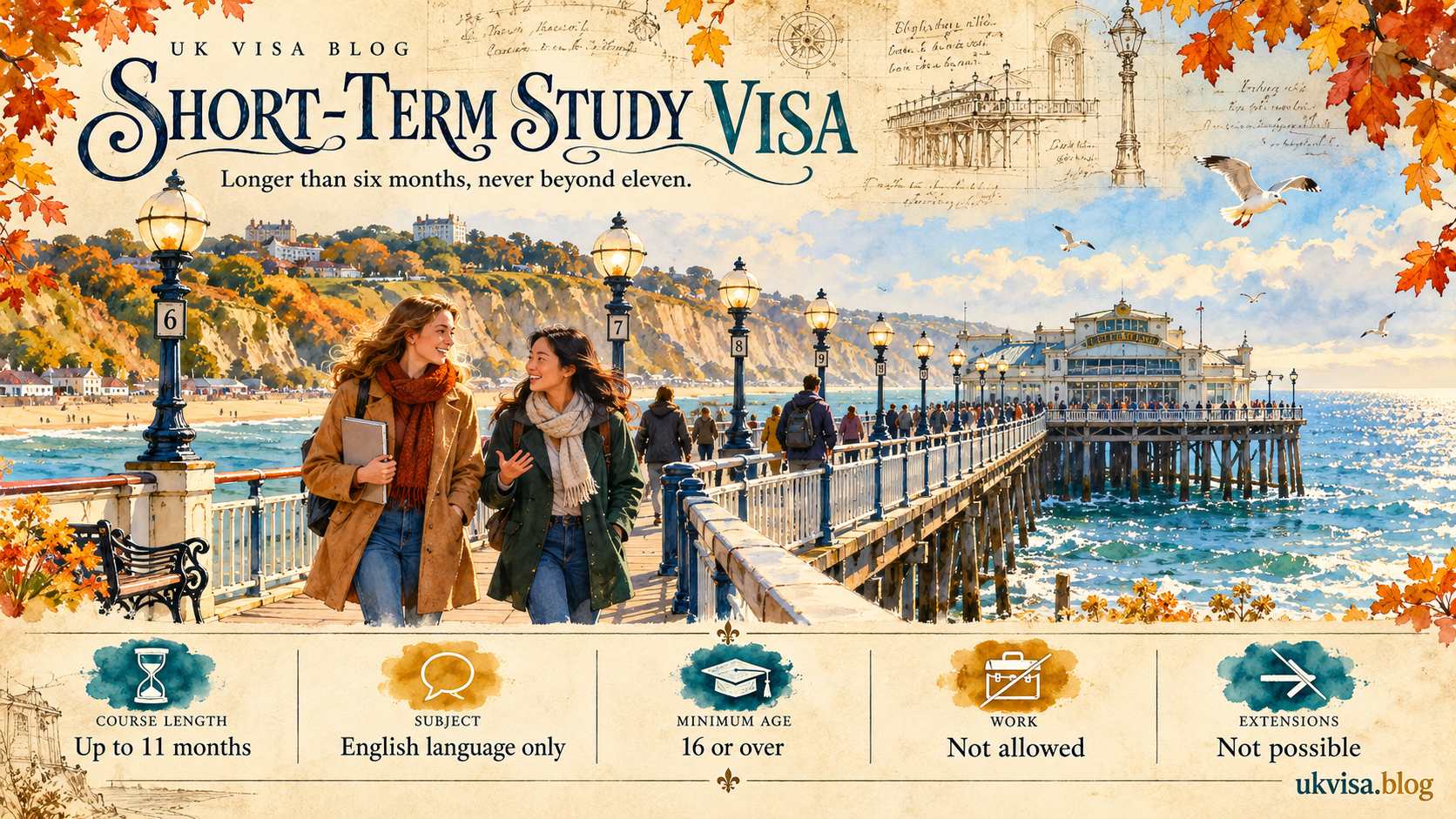
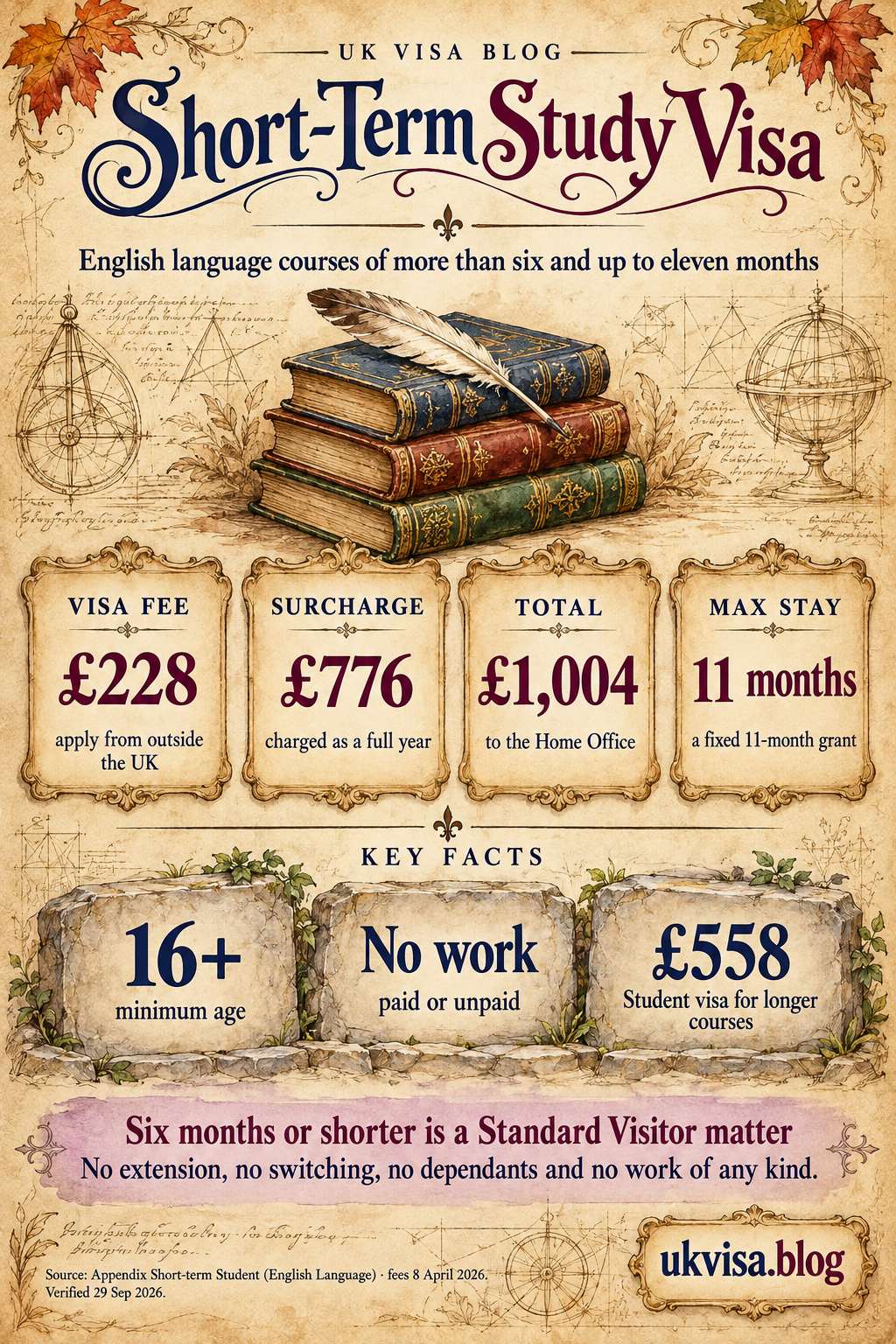
The Short-term study visa now does one job: English language courses longer than six months and no more than eleven. It costs £228 plus £776 in health surcharge, needs no CAS and no English test, and permits nothing else — no work of any kind, no extension, no switching, no family. A course of exactly six months belongs on a different route.
UK Student Visas
Short-Term Study Visa UK 2026: Eligibility, Fees and Conditions
What the Short-Term Study Visa Covers
An English language course lasting more than six months and up to eleven, at an accredited institution, for anyone aged 16 or over. You stay for the course plus 30 days, capped at eleven months overall. Six months or shorter is a Standard Visitor matter; longer than eleven months needs the full Student route. It cannot be extended, switched from, or used for any work.
The route sits in Appendix Short-term Student (English Language), and the boundaries are drawn by course length rather than by subject depth. Only English language tuition qualifies: a course combining English with another subject falls outside it, as does any course at a state-funded school or academy.
The Six-Month Line Is Exact
GOV.UK draws it precisely: the course must last longer than six months but not more than eleven. A course of exactly six months, or shorter, is done as a Standard Visitor. That single word — longer — is why applications get returned to the wrong route, and it is worth checking your acceptance letter’s dates against it before you pay anything.
Short-Term Study Against the Student Route
| Feature | Short-term study | Student |
|---|---|---|
| Course | English language only | Any course with a licensed sponsor |
| Length | Over 6 and up to 11 months | Up to 5 years at degree level |
| CAS | Not required | Required, issued within 6 months |
| English test | Not required | CEFR B2, or B1 below degree level |
| Fee | £228 | £558 |
| Work | None permitted | Up to 20 hours in term time |
| Extend or switch | Neither | Both, subject to the rules |
| Dependants | None | Doctoral, research and sponsored students |
| Graduate route after | No | Yes |
Source: GOV.UK Short-term study and Student route pages; Home Office fees, 8 April 2026.
The English levels that apply to the Student route, and not to this one, are set out in our guide to how English is proved for UK visas. The full route itself is covered in our Student visa requirements guide.
Requirements
Four things have to be shown: your age, your course and its provider, your money, and — if you are under 18 — your arrangements. There is no points test and no sponsor to satisfy, which makes the evidence you file the whole of your case.
- Age: 16 or over at the date of application.
- Acceptance: on an English language course longer than six months and up to eleven, including no other subjects.
- The provider: an accredited institution, or an eligible overseas provider where part of an overseas course is taught here.
- Money: enough to support yourself without working or public funds — or evidence that relatives or friends will support and house you.
- The journey home: the means to pay for your return or onward travel.
- Under 18: arrangements made for your travel and stay, and your parent or guardian’s consent to study here.
What Makes an Institution Accredited
Either it holds a student sponsor licence, or it holds valid accreditation and is listed by one of the recognised bodies: the Accreditation Service for International Colleges, Accreditation UK, the British Accreditation Council, the Education and Training Inspectorate in Northern Ireland, Estyn in Wales, Education Scotland, the Independent Schools Inspectorate, Ofsted, the Office for Students, or the Quality Assurance Agency for Higher Education.
The Overseas Provider Route
A second door exists that most guides omit. If you study at an overseas higher education institution and part of your English language course takes place in the UK, you may use this visa — provided the institution holds its own national accreditation, delivers no more than half of its programme in the UK, and offers programmes equivalent to a UK degree.
The Money Test Is Adequacy, Not a Fixed Figure
There is no monthly maintenance table here, unlike the £1,529 and £1,171 figures that govern the Student route and are explained in our money you must show for a Student visa. What GOV.UK asks is that you can support yourself without working and without public funds, or that relatives and friends will support and house you, and that your fees are paid or payable.
In practice that means showing a realistic budget for a stay of that length, with bank statements or payslips for the last six months as the usual evidence. Because there is no published figure to hit, the caseworker’s judgement of whether your money matches your plan is doing all the work.
Fees and What They Buy
Two Home Office charges, both payable when you apply online. The visa fee rose to £228 under the 8 April 2026 schedule, and the surcharge is charged at the discounted rate rather than the £1,035 standard one.
Home Office Charges
| Charge | Amount |
|---|---|
| Application fee | £228 |
| Immigration Health Surcharge | £776 |
| Total to the Home Office | £1,004 |
| Faster decision services, where offered | £500 priority; £1,000 super priority |
Source: Home Office immigration and nationality fees, 8 April 2026; GOV.UK healthcare surcharge rates.
Because permission runs longer than six months, the surcharge is charged as a full year rather than half — £776 whether your course is seven months or eleven. It buys NHS care on the same footing as a resident for the period granted. Route-by-route pricing sits in our breakdown of current UK visa charges.
What the Visa Does Not Allow
GOV.UK lists the prohibitions plainly, and they are more absolute than on any study route. You cannot study any other course or change course while here; you cannot study at a state-funded school; you cannot work or carry out any business, and that expressly covers paid work, unpaid work, work experience and work placements; you cannot extend; you cannot bring dependants; and you cannot claim public funds or the State Pension.
The bar on this route is on work, not on payment. Unpaid work, work experience and work placements are named alongside paid employment as prohibited, which puts this route in a different position from the Student visa — where 20 hours a week is permitted and assessed placements sit outside the limit, as our guide to Student visa working hours explains. A breach can end the permission and, where deception is involved, bring a re-entry ban of up to ten years. Nothing about this route rewards testing its edges.
Applying
You must apply online from outside the UK, and the earliest you can do so is three months before you travel. There is no in-country application and no switching into the route, so the timing of that three-month window is the whole planning problem.
Documents
A current passport or travel document; evidence you can support yourself, such as bank statements or payslips for the last six months; details of where you will stay and your travel plans; and evidence that course fees are paid or that you can pay them. Add a TB test result if you are applying from a listed country, contact details for a parent or guardian if you are under 18, and certified translations of anything not in English or Welsh.
Written proof of the course itself is separate and specific: a letter of acceptance naming the course, its duration and its cost, including accommodation. GOV.UK also advises not paying for accommodation or travel until the visa is granted — sound advice on a route with no extension and no second chance in country.
If You Are Under 18
You may travel to the UK without an adult, but written consent is required from both parents, or one with sole responsibility, or your legal guardian. It must cover the application, the travel, your living and care arrangements, and the plan for your arrival — including who will meet you, their name, date of birth and relationship to you, and where you will live.
Travelling with an adult, you name them in the application, up to two, and each needs their own visa if they require one. Keep a copy of the consent with you on arrival. Where you have a disability, or will be looked after for more than 28 days by someone who is not a close relative, your parent, guardian or school must notify the local authority — the private foster care rule — and any reply should be provided.
Decision Times
Once you have applied online, proved your identity and provided your documents, a decision usually comes within three weeks. Faster services are offered at some locations and not others, so check with your visa application centre rather than budgeting for one. Cancelling an application only refunds the fee where processing has not begun.
Why Applications Are Refused
There is no published grant rate for this route, so figures quoted elsewhere are guesswork. What is knowable is the pattern of refusals, and almost all of it traces back to the same three things: the course, the money, and whether the plan reads as genuine.
The Course Itself
A course of exactly six months or less, a course running past eleven, a course mixing English with another subject, or a provider that turns out not to be accredited — each is fatal and each is checkable before you pay. Verify the provider against the accrediting bodies listed above before any money changes hands.
Money and Intention
Thin evidence of funds, an unexplained deposit shortly before applying, or a budget that does not match an eleven-month stay all invite refusal, and so does a weak account of why you are coming and what you return to. Our guide to common refusal grounds covers how those judgements are made across routes; the questions resemble those in our credibility interview guide where an interview is requested.
What This Route Cannot Lead To
Time here does not open the post-study work visa, which is only for those who completed a course on the Student route. It does not permit business activity either, and the lawful sequence for that is set out in our guide to starting a business on a Student visa. Nor does it carry any right to bring family — our Student dependant guide covers who may, and it is a narrow group.
Moving to the full Student route means leaving and applying from abroad with a CAS from a licensed sponsor. Many learners use these months to reach B1 or B2 and do exactly that — a sound plan, provided you build the trip home into it from the start.
Sources: Appendix Short-term Student (English Language); the Study English in the UK route page on GOV.UK, covering overview, eligibility, course, documents and applying; Home Office immigration and nationality fees, 8 April 2026; the list of countries requiring a TB test. Figures verified 22 August 2026.
Frequently Asked
Questions about the Short-Term Study Visa
Longer than six months and not more than eleven. Exactly six months or shorter takes a Standard Visitor visa instead; longer than eleven months takes the Student route. You may stay for the length of the course plus 30 days, provided the whole stay does not exceed eleven months. Check the dates on your acceptance letter against that boundary before paying any fees.
£228 for the application, which rose from £214 under the 8 April 2026 fee schedule, plus £776 for the Immigration Health Surcharge — £1,004 to the Home Office in total. Because permission runs beyond six months the surcharge is charged as a full year. Faster decision services are offered at some application centres for £500 or £1,000, but not everywhere.
No. GOV.UK prohibits work or carrying out any business, and expressly names paid work, unpaid work, work experience and work placements. There is no hours allowance and no unpaid exception, which makes this route materially stricter than the Student visa. Breaching the condition can end your permission and, where deception is involved, attract a re-entry ban of up to ten years.
Neither. There is no Confirmation of Acceptance for Studies because there is no licensed sponsor in the arrangement, and no Secure English Language Test because the point of the visa is to learn English. What you need instead is written acceptance from an accredited institution naming the course, its duration and its cost, including accommodation.
It must either hold a student sponsor licence or hold valid accreditation and appear on a list kept by one of the recognised bodies: ASIC, Accreditation UK, the British Accreditation Council, the Education and Training Inspectorate, Estyn, Education Scotland, the Independent Schools Inspectorate, Ofsted, the Office for Students, or the QAA. Check before you pay course fees, not after.
Yes, where part of your English language course takes place in the UK as part of an overseas course. The institution must hold its own national accreditation, deliver no more than half of its educational programme in the UK, and offer programmes equivalent to a UK degree. This is a genuine alternative to the accredited-UK-institution route and is easily missed.
There is no fixed figure. You must show you can support yourself without working and without public funds — or that relatives or friends will support and house you — that your course fees are paid or payable, and that you can pay for your return or onward journey. Bank statements or payslips for the last six months are the usual evidence.
Online from outside the UK, no earlier than three months before you travel. After applying online, proving your identity and providing your documents, a decision usually arrives within three weeks. Do not pay for accommodation or travel until the visa is granted. Cancelling only refunds the fee if UKVI has not started processing the application.
No to both. The visa cannot be extended, and you cannot switch into another category from inside the UK. To continue studying you must leave, obtain a CAS from a licensed sponsor and apply for a Student visa from abroad. Many learners plan for exactly that, using these months to reach the B1 or B2 level the Student route requires.
Arrangements made for your travel and stay, and written consent from both parents, one with sole responsibility, or your legal guardian, covering the application, the travel, your living and care arrangements and your arrival plan. Name any adult travelling with you, up to two. Where you will be looked after for more than 28 days by someone who is not a close relative, the local authority must be told.