
This guide explains how to get a UK visa from Iran in 2026, covering fees in US Dollars, the latest grant rates, and the practical hurdles Iranian applicants face. Iranian nationals need a visa for every type of UK trip, and the process carries complications few other nationalities meet — a fluctuating visa centre situation and sanctions that affect financial evidence. Iranians lodged over 20,000 applications in the year to March 2026. The visitor route is difficult at 55%, but the family route, serving a large UK-Iranian community, succeeds 95% of the time. The 6-month visitor visa costs $186.
Source: Home Office Immigration System Statistics, year ending March 2026. Fees from the Home Office visa fee calculator, 8 April 2026 schedule.
Two issues set Iran apart. First, the UK visa application centre situation in Tehran fluctuates with diplomatic circumstances, so many Iranians give biometrics in a third country such as Turkey or the UAE — always check the current GOV.UK Iran status before applying. Second, sanctions mean Iranian banks cannot transfer funds directly to the UK, which complicates the financial evidence every application needs. Successful applicants now receive a digital eVisa.
UK Visa Fees and Statistics from Iran 2026
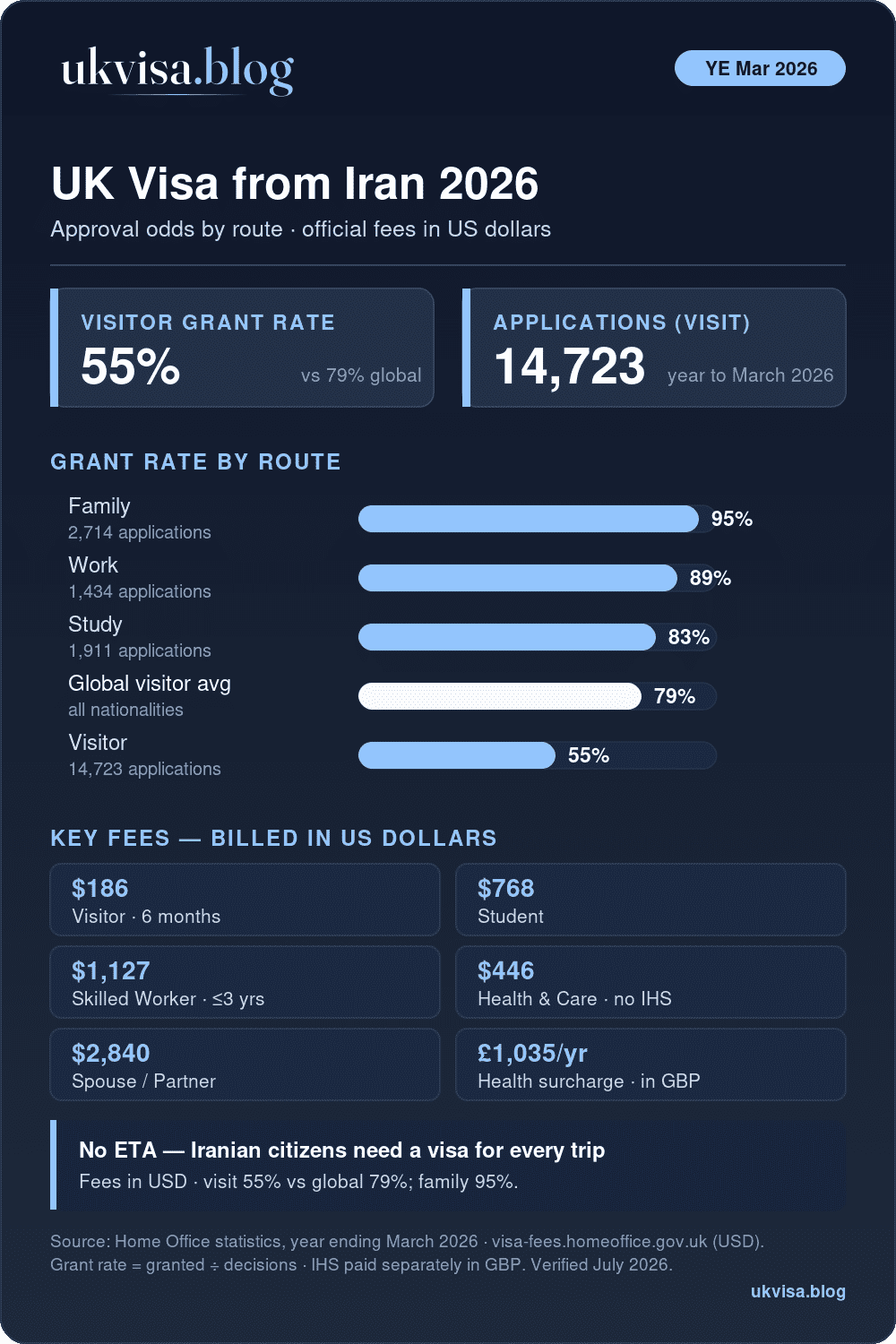
Iranians submitted 20,151 UK visa applications in the year ending March 2026. The pattern is unusual: a large, established UK diaspora drives strong family demand, while the visitor route is among the harder ones to clear. Visitor applications succeed just 55% of the time, but family applications reach 95%, work 89%, and study 83%.
A 6-month UK visitor visa from Iran costs $186, the Student visa $768, the Skilled Worker visa $1,127, and the Spouse visa $2,840. Fees are paid in US Dollars, and biometrics are usually given at a visa centre in a third country. Iranian applicants have a 55% visitor grant rate but a strong 95% family grant rate.
| Visa Category | Applications | Grant Rate | Refused |
|---|---|---|---|
| Visitor | 14,558 | 55% | 6,548 |
| Family | 2,162 | 95% | 139 |
| Study | 1,830 | 83% | 297 |
| Work | 1,464 | 89% | 151 |
Source: Home Office Immigration System Statistics, year ending March 2026.
Iran's numbers tell a clear story. The visitor route is genuinely difficult — at 55%, nearly half of applications are refused, reflecting the challenge of proving finances and ties under sanctions. But the family route, serving one of the UK's most established diaspora communities, succeeds 95% of the time. Iranians applying to join relatives are in a far stronger position than first-time visitors, a contrast our grant rate analysis sets in context.
Complete UK Visa Fee Table from Iran 2026
UK visa fees from Iran are charged in US Dollars. The Immigration Health Surcharge applies separately to most work, study, and family visas at £1,035 per year (£776 for students), always in pounds sterling. The table below shows the main routes Iranian applicants use.
| Visa Type | Fee (USD) | Grant Rate |
|---|---|---|
| 6-month Visitor | $186 | 55% |
| 2-year Visitor | $696 | 55% |
| 5-year Visitor | $1,242 | 55% |
| 10-year Visitor | $1,552 | 55% |
| Student | $768 | 83% |
| Skilled Worker (≤3 years) | $1,127 | 89% |
| Health and Care Worker | $446 | 89% |
| Spouse / Partner | $2,840 | 95% |
| Adult Dependent Relative | $5,001 | 95% |
| Priority service | $688 | — |
UK Visitor Visa from Iran 2026
The 6-month UK visitor visa from Iran costs $186, with long-term options at $696 (2 years), $1,242 (5 years), and $1,552 (10 years). At 55%, the visitor grant rate is one of the lowest of any major nationality, so financial evidence and clear ties to Iran are critical. Each visit is capped at 180 days.
The Standard Visitor visa covers tourism, family visits, and business. Iran's 55% rate makes this the hardest route, largely because sanctions complicate the financial evidence caseworkers expect. Applicants visiting relatives should read our guide on inviting a relative from Iran, and frequent travellers may prefer the long-term multiple-entry options. If an application is refused, our guide to common refusal reasons explains the usual causes.
UK Family & Spouse Visa from Iran 2026
The UK Spouse visa from Iran costs $2,840 and the Adult Dependent Relative visa $5,001. The UK sponsor must earn at least £29,000 a year. The Iranian family grant rate is a strong 95% — by far the most reliable route. The first spouse visa lasts 33 months, leading to settlement after 5 years.
With one of the largest Iranian diaspora communities in Europe, family migration is central to Iran's UK relationship — and at 95%, it is the route most likely to succeed. The UK Spouse visa lets Iranian nationals join a British or settled partner under Appendix FM of the Immigration Rules. The main practical challenge is documenting the sponsor's income and the relationship while navigating the banking restrictions that affect money transfers from Iran.
| Family Visa Type | Fee (USD) |
|---|---|
| Spouse / Partner / Child | $2,840 |
| Fiancé(e) visa | $2,840 |
| Adult Dependent Relative | $5,001 |
| Parent of a Student child | $999 |
UK Student Visa from Iran 2026
The UK Student visa from Iran costs $768, plus the Immigration Health Surcharge of £776 per year of study. A Confirmation of Acceptance for Studies (CAS) from a licensed sponsor is required. The Iranian student grant rate is 83%, and applicants must show maintenance funds despite the difficulty of transferring money from Iran.
The UK Student visa is a well-used route, with 1,830 Iranian applications and an 83% grant rate. Beyond the CAS and English requirement, the central hurdle is proving maintenance funds of £1,483 per month for London or £1,136 elsewhere — sanctions mean these funds often must be held or shown outside the Iranian banking system. Graduates can then move to the Graduate Route for two years of post-study work.
UK Work Visa from Iran 2026
The Skilled Worker visa from Iran costs $1,127 for up to 3 years, or $2,226 for longer. Applicants need a degree-level job, a £41,700 minimum salary, and a sponsoring UK employer. The Iranian work grant rate is a strong 89%. The Global Talent route suits leading researchers and academics.
Work applications are smaller in number but succeed at 89%. The Skilled Worker visa requires a Certificate of Sponsorship from a licensed employer and a salary meeting the going rate under the Home Office eligible occupations list. The Global Talent route is notable for Iranian academics and scientists, as it needs no job offer and no proof of maintenance funds — a real advantage given the banking constraints.
| Work Visa Type | Fee (USD) |
|---|---|
| Skilled Worker (≤3 years) | $1,127 |
| Skilled Worker (over 3 years) | $2,226 |
| Health and Care Worker | $446 |
| Global Talent (with approval letter) | $282 |
| High Potential Individual | $1,211 |
UK Visa Requirements & Sanctions Issues for Iranians
Iranian applicants meet the standard UK documentary requirements plus complications unique to Iran. Getting the financial evidence right is the single biggest factor in the low visitor grant rate.
International sanctions mean Iranian banks cannot transfer funds directly to UK banks through the SWIFT network, so the usual proof of a clean bank-to-bank transfer is rarely possible. Applicants typically rely on Iranian bank statements with certified English translations, funds held abroad, or a UK sponsor's finances. This is a complex area, and professional advice is sensible where large sums or settlement are involved; the UK government's Iran sanctions guidance sets out the underlying restrictions. Name transliteration from Farsi should be consistent across every document.
- Valid Iranian passport with at least 6 months remaining.
- Completed online application and biometric appointment booking.
- Bank statements with certified English translations.
- Employer letter or proof of business or studies in Iran.
- Evidence of property, family, or other ties to Iran.
- Accommodation details or a UK host's invitation.
- Consistent name transliteration across all documents.
Our document checklist covers each route, and the processing times after biometrics guide sets out how long a decision takes once you have attended your appointment.
How to Apply for a UK Visa from Iran
Applications are made online at gov.uk and paid in US Dollars, with biometrics given at a visa application centre. Because the Tehran centre's status varies, many Iranians attend a centre in a third country such as Turkey or the UAE. Iran's neighbours in the region — Jordan, Iraq, Lebanon, and the Gulf states — follow the same online process. Begin at gov.uk.
- 1. Complete the online application on gov.uk and select Iran.
- 2. Pay the visa fee in US Dollars during the application.
- 3. Check the current visa centre status on the GOV.UK Iran page.
- 4. Book your appointment — in Iran if available, or a third country.
- 5. Attend and give biometrics — fingerprints and a photograph.
- 6. Submit translated documents with certified English versions.
- 7. Access your eVisa through your UKVI account once approved.
For settlement and family cases, where the stakes and the sanctions complications are highest, our guide to applying from the wider region and the priority visa service explains the options for faster decisions where the centre offers them.
- 6-month Visitor visa: $186, with a difficult 55% grant rate.
- Family route is the strongest at 95% — the diaspora advantage.
- Sanctions block direct bank transfers, complicating financial proof.
- The Tehran visa centre status varies; many apply in a third country.
- Skilled Worker visa: $1,127; Global Talent needs no maintenance funds.
- Spouse visa: $2,840, requiring £29,000 sponsor income.
- Use consistent Farsi name transliteration across all documents.
Frequently Asked Questions about UK Visa from Iran
UK visa fees from Iran in 2026 are: 6-month Visitor $186, 2-year Visitor $696, Student $768, Skilled Worker $1,127 for up to 3 years, and Spouse $2,840. Fees are paid in US Dollars. Work, study, and family visas also require the Immigration Health Surcharge, paid in pounds. Biometrics are usually given at a visa centre, often in a third country given the situation in Tehran.
Iranians complete the online application at gov.uk, then give biometrics at a visa application centre. The centre situation in Tehran fluctuates with diplomatic circumstances, so many Iranian applicants attend a centre in a third country such as Turkey or the UAE. Always check the current status on the GOV.UK Iran page before booking, as availability can change at short notice.
Iran's 55% visitor grant rate is among the lowest of any major nationality. The main reason is financial evidence: international sanctions prevent Iranian banks from transferring funds directly to the UK, so applicants cannot show the straightforward bank transfers caseworkers expect. Strong translated bank statements, clear ties to Iran, and a well-documented purpose of visit are essential to improve the chances of approval.
Yes, and it is the most reliable route — the Iranian family grant rate is 95%. The Spouse visa costs $2,840 and lets you join a British or settled partner, provided the UK sponsor earns at least £29,000. The Adult Dependent Relative route, at $5,001, is far harder and reserved for relatives needing long-term care. Given the large UK-Iranian community, family applications are common and generally successful.
Sanctions mean Iranian banks cannot send money directly to UK banks, which complicates the financial evidence every application needs. Applicants usually rely on translated Iranian bank statements, funds held outside Iran, or a UK sponsor's finances instead. Visa fees themselves must be paid in US Dollars during the online application. Where settlement or large sums are involved, professional immigration advice is sensible.
Yes, and it is particularly useful for Iranians. The Global Talent visa is aimed at leaders in academia, research, the arts, and technology. Its key advantage for Iranian applicants is that it requires no job offer and no proof of maintenance funds — removing the banking obstacle that complicates most other routes. The fee is $282 where an approval letter is required, and the route can lead to settlement.