
This comprehensive guide explains how exceptional circumstances and compelling compassionate grounds can influence UK family visa applications in 2026. Under Appendix FM of the Immigration Rules, the Home Office may grant visas to applicants who do not meet standard requirements when refusing would result in unjustifiably harsh consequences. Whether you are applying for a spouse visa, parent visa, or adult dependent relative visa, understanding these provisions could be crucial to your application's success.
Exceptional circumstances provisions exist as a deliberate safety valve in the Immigration Rules. Where a strict application of the rules would breach Article 8 ECHR, the Home Office must consider granting leave even when standard requirements (financial threshold, English language, accommodation) are not met. Successful exceptional circumstances applicants typically enter the 10-year route to settlement rather than the standard 5-year partner route — but they retain the right to family life in the UK.

- What Are Exceptional Circumstances in UK Immigration?
- Compelling and Compassionate Circumstances Explained
- Appendix FM and Family Visa Requirements
- Evidence Required to Prove Exceptional Circumstances
- Discretionary Grants Outside the Immigration Rules
- Refusal, Reapplication & Appeal
- Frequently Asked Questions
Exceptional Compassionate Circumstances UK Visa: Overview
When applying for a UK family visa, most applicants must meet specific requirements under Appendix FM of the Immigration Rules, including financial thresholds, English language requirements, and relationship evidence. However, the rules also recognise that rigid application of these requirements can sometimes cause unjustifiably harsh consequences for applicants and their families.
The exceptional circumstances provisions exist to allow the Home Office flexibility when refusing a visa would result in a disproportionate interference with an applicant's right to private and family life under Article 8 human rights claims framework. This guide examines how these provisions work in practice and what evidence you need to demonstrate that your circumstances are genuinely exceptional.
What Are Exceptional Circumstances in UK Immigration?
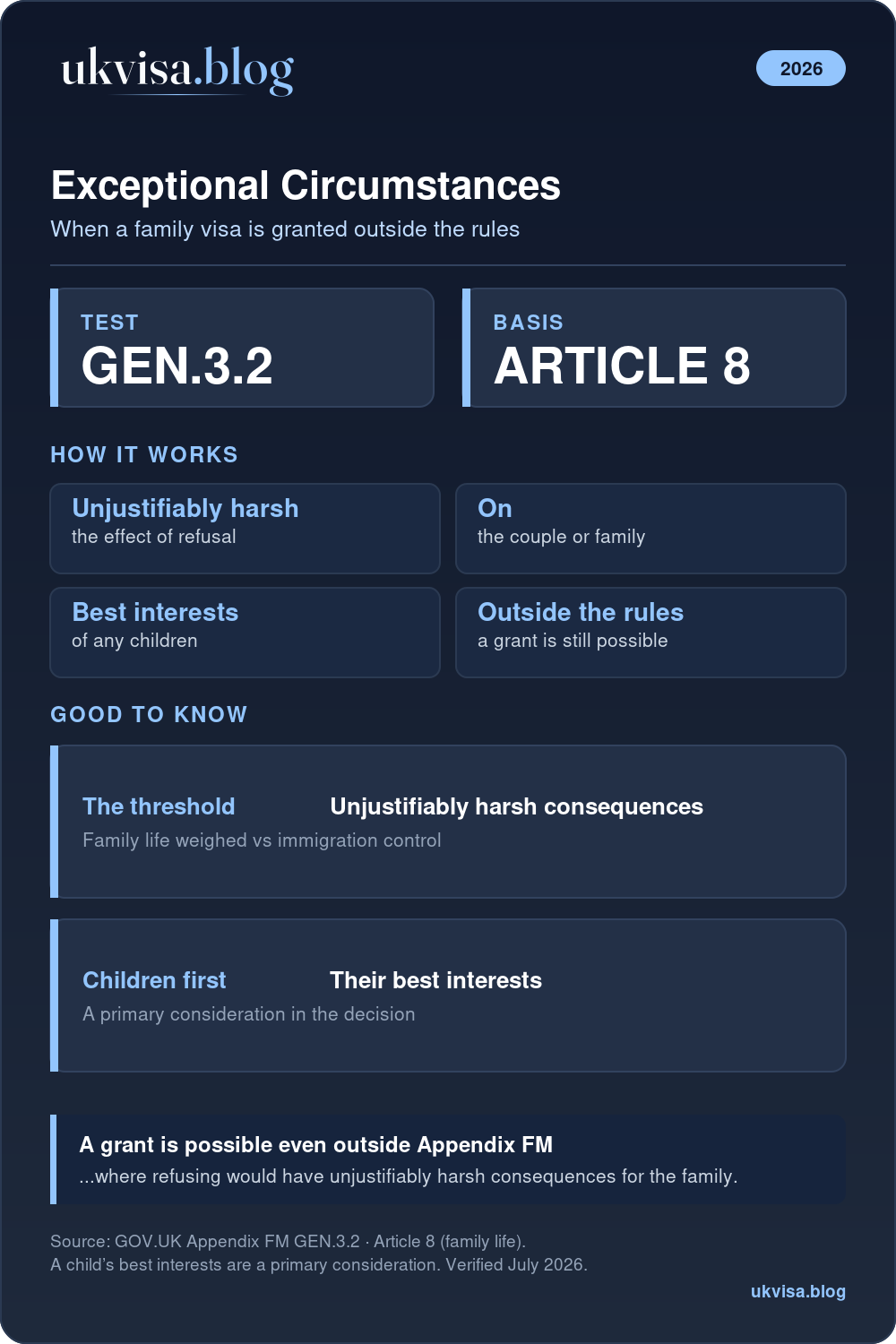
Exceptional circumstances in UK immigration are situations where applying the standard Immigration Rules would cause unjustifiably harsh consequences. They allow the Home Office to grant visas to applicants who do not meet all requirements when refusal would disproportionately affect their family life. Each case is assessed individually based on its unique factors.
The term "exceptional" has a specific legal meaning in immigration law. It does not simply mean unusual or difficult — almost every refused visa applicant experiences some level of hardship. Instead, exceptional circumstances must demonstrate consequences that are significantly more severe than what would normally result from a visa refusal.
What Makes Circumstances "Exceptional" Under Immigration Rules?
The Home Office and immigration tribunals have established that exceptional circumstances typically involve one or more of the following factors:
- Severe medical conditions: Life-threatening illness requiring treatment unavailable in the home country, or need to care for a seriously ill family member in the UK
- Child welfare concerns: Significant impact on a child's best interests, education, or development if the application is refused
- Risk of harm: Genuine risk of persecution, violence, or serious harm if the applicant returns to their home country
- Long residence and integration: Established private life in the UK over many years with strong community ties — see also our private life applications under Article 8 guide
- Family separation: Consequences of separation that go beyond normal difficulties, particularly where children are involved — relevant where proving genuine relationship is itself in dispute
Compelling and Compassionate Circumstances Explained
Compelling compassionate circumstances invoke strong humanitarian considerations, typically involving acute hardship, distress, or urgent need. Unlike general "exceptional circumstances," these specifically relate to situations requiring immediate compassionate response, such as caring for a critically ill relative, fleeing domestic violence, or protecting vulnerable individuals from serious harm.
The distinction between "exceptional" and "compelling compassionate" circumstances is important. While all compelling compassionate circumstances are exceptional, not all exceptional circumstances involve compelling compassion. Compelling compassionate cases typically involve urgent humanitarian need, emotional distress, or situations where basic human dignity is at stake.
Comparison: Exceptional vs Compelling Compassionate Circumstances
| Factor | Exceptional Circumstances | Compelling Compassionate |
|---|---|---|
| Primary focus | Unjustifiably harsh consequences | Urgent humanitarian need |
| Typical examples | Long residence, financial hardship | Medical emergency, domestic violence |
| Urgency level | Variable | Usually immediate/urgent |
| Evidence emphasis | Impact and consequences | Immediate risk and vulnerability |
| ECHR Article | Article 8 (family life) | Articles 3 and 8 |
Examples of Compelling Compassionate Circumstances
The following situations have been recognised as compelling compassionate circumstances in UK immigration decisions:
- Critical illness: Applicant or UK-based family member with life-threatening condition requiring urgent care or support
- Domestic violence: Victims of domestic abuse who need protection and cannot safely return home
- Human trafficking: Victims requiring protection and support in the UK
- Child at risk: Situations where a child would face serious harm if the parent's application is refused
- End-of-life care: Need to be with a dying family member in the UK
Appendix FM and Family Visa Requirements
Appendix FM governs applications from family members of British citizens or persons settled in the UK. It contains the detailed requirements for various family visa categories, along with provisions for exceptional circumstances under paragraphs GEN.3.1 to GEN.3.3.
UK Family Visa Categories Under Appendix FM
| Visa Category | Purpose | Key Requirements |
|---|---|---|
| Spouse/Partner Visa | Join spouse or partner | Relationship, £29,000 income, English |
| Fiancé(e) Visa | Marry within 6 months | Genuine intention, financial requirement |
| Parent Visa | Parent of British child | Sole responsibility or access rights |
| Bringing parents to the UK on a visa | Long-term care needs | Care unavailable in home country |
How Exceptional Circumstances Apply Under Immigration Rules
Under the Immigration Rules, exceptional circumstances can allow applicants to succeed even when they do not meet specific requirements like the financial threshold or English language test. The decision-maker must consider whether refusing would breach Article 8 ECHR rights, taking into account all relevant factors including the applicant's circumstances, ties to the UK, and best interests of any children.
Appendix FM contains specific provisions (paragraphs GEN.3.1 to GEN.3.3) that require decision-makers to consider whether there are exceptional circumstances that would make refusal a breach of ECHR Article 8. Where the standard financial threshold (£29,000) cannot be met but other support is available, exceptional circumstances may justify a grant of leave on the 10-year route via exceptional circumstances rather than the standard 5-year partner route.
Evidence Required to Prove Exceptional Circumstances
Successfully claiming exceptional circumstances requires comprehensive, credible evidence that clearly demonstrates why your situation is genuinely exceptional. Vague claims or general statements about hardship are insufficient — you must provide specific, documented proof.
What Evidence Do You Need for Exceptional Circumstances?
Evidence must be specific to your circumstances and come from credible sources. Medical conditions require detailed reports from specialists, not just GP letters. Child welfare claims need assessments from social workers or CAFCASS. Financial hardship requires comprehensive documentation of income, assets, and expenses. Third-party evidence from employers, community leaders, or professionals adds credibility.
- Medical evidence: Specialist reports, treatment plans, prognosis, care requirements
- Financial documentation: Bank statements, payslips, tax returns, debt statements
- Child welfare: School reports, CAFCASS assessments, child psychologist reports
- Risk evidence: Police reports, country condition reports, threat documentation
- Third-party statements: Employer letters, community leader statements, expert opinions
- Personal statement: Detailed explanation of circumstances and their impact
Common Reasons Applications Fail
Understanding why exceptional circumstances claims fail can help you avoid common mistakes. The most frequent reasons for spouse visa refusal on exceptional circumstances grounds include:
- Generic evidence: Providing general country condition reports without showing specific impact on the applicant
- Insufficient medical detail: GP letters stating "patient has health condition" without specialist diagnosis, treatment needs, or prognosis
- Lack of UK ties: Failing to demonstrate why family life must continue in the UK rather than elsewhere
- No comparative analysis: Not explaining why circumstances are exceptional compared to similar cases
- Missing child impact: Failing to provide evidence about how refusal would affect any children
Discretionary Grants Outside the Immigration Rules
The Home Office has discretion to grant leave outside the Immigration Rules when refusal would breach human rights obligations, even if the applicant does not qualify under any specific visa category. This is a last resort considered only when all rule-based options have been exhausted and there are compelling reasons why the applicant must remain in or enter the UK.
Discretionary grants are relatively rare and typically result in "Leave Outside the Rules" (LOTR) or discretionary leave rather than a standard visa. This type of leave may have different conditions and may not lead directly to settlement. However, it can provide crucial protection for those with genuinely exceptional circumstances who have no other immigration route available.
Refusal, Reapplication & Appeal
If your exceptional circumstances claim is refused, you have several options. Where the refusal followed a partner visa application, our spouse visa refusal appeal guide explains the tribunal process. For broader strategic considerations including timing, evidence improvements, and route changes, see our reapplication strategy after refusal guide.
First-tier Tribunal Appeals
Applications including a human rights claim under Article 8 generally carry a right of appeal to the First-tier Tribunal (Immigration and Asylum Chamber). Our appeal options guide walks through deadlines, procedure, and what to expect. Many exceptional circumstances refusals succeed at appeal where the tribunal considers fresh evidence or finds that the Home Office failed to properly weigh Article 8 factors.
Reapplication Strategy
If you decide to reapply rather than appeal, address the specific reasons for refusal in your fresh evidence. Generic reapplications without new evidence typically fail again. Where exceptional circumstances form part of the application, the new application must overcome both the original deficiency and any reasons given for rejecting the exceptional circumstances argument.
- "Exceptional" means significantly more severe than normal hardship — not just difficult or unusual
- Compelling compassionate circumstances involve urgent humanitarian need or risk of serious harm
- Evidence must be specific, detailed, and from credible professional sources
- Article 8 protection applies mainly to partners and parent-child relationships, not extended family
- Successful exceptional circumstances grants typically lead to the 10-year route to settlement
- GEN.3.1 to GEN.3.3 of Appendix FM contain the formal exceptional circumstances framework
- Professional legal advice is strongly recommended for complex exceptional circumstances cases
For more information on UK family visa requirements, visit the official gov.uk visas and immigration page. For the formal exceptional circumstances provisions, see paragraphs GEN.3.1 to GEN.3.3 of Appendix FM in the Immigration Rules.
Frequently Asked Questions about Exceptional Circumstances UK Family Visa
What are exceptional circumstances in UK family visa applications?
Exceptional circumstances are situations significantly different from normal cases that warrant special consideration by the Home Office. They apply when refusing a visa would result in unjustifiably harsh consequences, such as severe medical conditions, child welfare concerns, or risk of serious harm. The circumstances must go beyond typical hardship that any refused applicant might experience.
What is the difference between exceptional and compelling compassionate circumstances?
While both involve situations warranting special consideration, compelling compassionate circumstances specifically invoke urgent humanitarian need, such as medical emergencies, domestic violence, or immediate risk of harm. All compelling compassionate circumstances are exceptional, but exceptional circumstances may also include non-urgent situations like long residence or significant family ties without immediate danger.
Can exceptional circumstances waive the financial requirement for spouse visas?
Yes, in genuinely exceptional circumstances, the financial requirement can be waived or the applicant placed on the 10-year route instead of the 5-year route. However, this requires strong evidence that refusing the visa would breach Article 8 ECHR rights and that the circumstances are truly exceptional. Simply being unable to meet the £29,000 threshold is not sufficient — you must demonstrate additional factors that make your situation genuinely exceptional.
What evidence is needed to prove exceptional circumstances?
Evidence must be specific, detailed, and from credible sources. Medical claims require specialist reports with diagnosis, treatment plans, and prognosis. Child welfare cases need assessments from education or social work professionals. Risk claims require official documentation like police reports or country expert evidence. Generic statements or letters without supporting detail are insufficient.
Does Article 8 ECHR apply to all family relationships?
No. Article 8 protection for "family life" primarily covers relationships between partners (married or unmarried) and between parents and minor children. It generally does not protect relationships between adult children and parents, adult siblings, grandparents, aunts/uncles, or other extended family unless there are exceptional factors showing dependency beyond normal emotional ties.
Can I appeal if my exceptional circumstances claim is refused?
Yes, if your application made a human rights claim based on Article 8 and was refused, you generally have the right to appeal to the First-tier Tribunal. An independent immigration judge will reassess your case, including whether the Home Office properly considered your exceptional circumstances. Appeals can be successful, particularly when new evidence is presented or the original decision was flawed.
What is a discretionary grant outside the Immigration Rules?
A discretionary grant is leave to remain given when an applicant does not meet the Immigration Rules but refusing would breach human rights obligations. This results in "Leave Outside the Rules" (LOTR) which may have different conditions and duration than standard visas. It is a last resort when no rule-based route applies but compelling circumstances require allowing the person to stay.
What is EX.1 and how does it relate to exceptional circumstances?
EX.1 is a paragraph in Appendix FM that provides for grants of leave where there are insurmountable obstacles to family life continuing outside the UK, or where it would not be reasonable for a qualifying child to leave. EX.1 is the most common gateway for exceptional circumstances cases and typically results in the applicant being placed on the 10-year route to settlement rather than refusing the application outright.
Should I get legal help for an exceptional circumstances application?
Professional legal advice is strongly recommended for exceptional circumstances cases. These applications are complex, require careful evidence presentation, and have a high threshold for success. An experienced immigration solicitor can assess whether your circumstances genuinely qualify, identify the strongest evidence, structure your case effectively, and represent you on appeal if necessary.