
Meeting the UK Student visa financial requirements is one of the most critical aspects of a successful application. International students must demonstrate sufficient funds to cover tuition fees and 9 months of living expenses without relying on public funds. This guide covers the exact maintenance funds needed for 2026 — £1,529/month for London and £1,171/month outside London — plus bank statement requirements, the strictly-enforced 28-day rule, the £776/year Immigration Health Surcharge, and acceptable proof of funds for parents, sponsors, and student loans.
Source: Home Office Immigration Rules: Appendix Student (2025-26 academic year onwards)
Understanding UK Student Visa Financial Requirements in 2026
The UKVI financial requirements for international students are set out in Appendix Student of the Immigration Rules. To score the mandatory 10 points for financial capacity, applicants must demonstrate they can cover their outstanding course fees plus living expenses for up to 9 months. Failure to meet these requirements is one of the most common reasons for UK Student visa refusals — particularly the strictly enforced 28-day continuous holding rule.
For the broader points-based eligibility framework, including the 50-point CAS requirement and 10 points for English language, see our complete UK Student visa requirements guide.
How Much Bank Balance is Required for UK Student Visa?
What is the minimum bank balance for a UK Student visa in 2026?
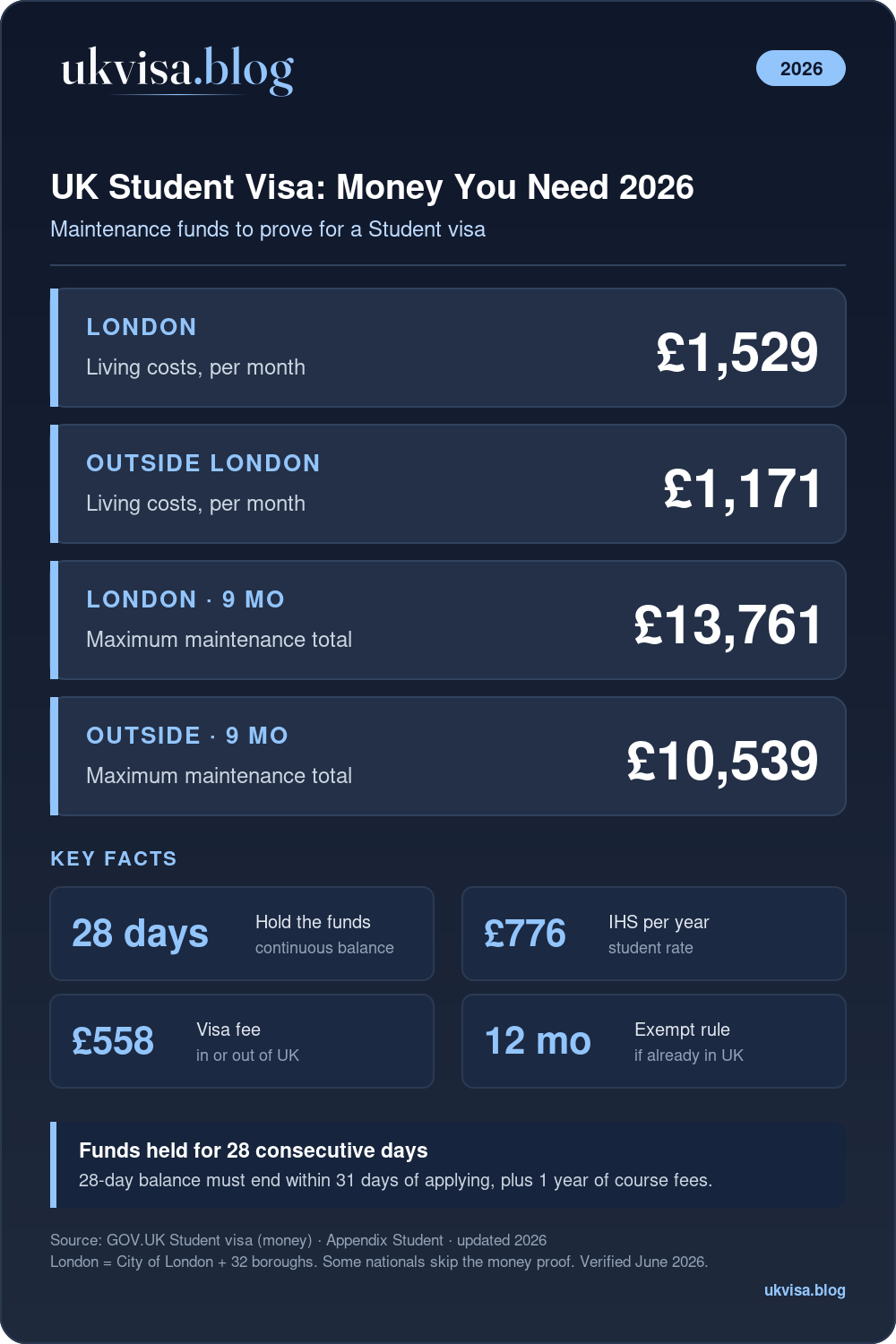
The minimum bank balance for a UK Student visa depends on your study location and outstanding tuition fees. For 2026, students must show £1,529/month (London) or £1,171/month (outside London) for up to 9 months, plus any unpaid course fees. A student with £10,000 in unpaid fees studying in London needs a minimum bank balance of £23,761.
The total funds you need to demonstrate is calculated by adding your outstanding tuition fees (as shown on your CAS) to your maintenance fund requirement. If you have already paid some or all of your tuition, this reduces the amount you need to show. Your CAS will confirm any payments made toward your course fees.
| Study Location | Monthly Rate | 9-Month Total |
|---|---|---|
| Studying in London | £1,529/month | £13,761 |
| Studying Outside London | £1,171/month | £10,539 |
Bank Balance Calculation Examples
Example 1 — London: Annual tuition fee £15,000, already paid £5,000. Outstanding fees = £10,000. Total required = £10,000 + £13,761 = £23,761
Example 2 — Outside London: Annual tuition fee £12,000, already paid £6,000. Outstanding fees = £6,000. Total required = £6,000 + £10,539 = £16,539
Example 3 — London with accommodation offset: Annual tuition £15,000, paid £5,000. Outstanding fees = £10,000. Already paid £1,200 accommodation deposit to university. Total required = £10,000 + £13,761 − £1,200 = £22,561
If you have paid an accommodation deposit directly to your institution, you can deduct up to £1,529 from your living cost requirement, provided this payment is recorded on your CAS. This deduction applies only to deposits paid to the educational institution, not to private landlords or third-party providers.
Living Expenses and Maintenance Funds for UK Student Visa
What are the UKVI living expenses requirements?
UKVI living expenses (maintenance funds) are calculated for up to 9 months of your course, regardless of actual course length. Students in London must show £1,529 per month (£13,761 total), while those studying outside London need £1,171 per month (£10,539 total). Partial months are rounded up to full months.
The maintenance fund requirement is capped at 9 months, even if your course is longer. For courses shorter than 9 months, you calculate based on the actual course length (rounded up for partial months). For example, a 6-month and 15-day course requires funds for 7 full months. This rule particularly affects students applying for the Short-Term Study visa route, which has different fee and maintenance structures.
UKVI Living Expenses: London vs Outside London
The distinction between London and outside London rates applies based on where your main campus is located, not where you choose to live. Universities within the Greater London area (City of London plus the 32 London boroughs) attract the higher London rate, while institutions elsewhere in England, Scotland, Wales, and Northern Ireland qualify for the lower rate.
| Course Duration | London | Outside London |
|---|---|---|
| 3 Months | £4,587 | £3,513 |
| 6 Months | £9,174 | £7,026 |
| 9 Months (Maximum) | £13,761 | £10,539 |
Exemptions from Financial Requirements
Certain applicants are automatically awarded the 10 points for financial requirements without needing to provide evidence:
- 12-month UK residents: Lawfully resident in the UK for 12 months or more with valid immigration permission at the time of your application
- Sabbatical Officers: Student Union Sabbatical Officers
- Foundation training: Postgraduate doctors or dentists on foundation training programmes
- Differentiation arrangements: Applicants from certain low-risk countries may not need to submit financial evidence upfront, though UKVI may request it later
Even if exempt, it is advisable to maintain proof of funds in case you are called for a UK Student visa credibility interview or random verification check.
UK Student Visa Bank Statement Requirements
What is the 28-day rule for UK Student visa bank statements?
The 28-day rule requires applicants to maintain the minimum required balance in their bank account for 28 consecutive days. The final day of this 28-day period must fall within 31 days of your visa application submission date. Your bank statement must clearly show this continuous balance without any dips below the required amount, even momentarily.
Example calculation: If you submit your visa application on 15 October 2026, your bank statement must show the required balance was maintained from at least 14 September to 14 October 2026 (28 consecutive days), with 14 October falling within 31 days of your application date.
UKVI Acceptable Financial Institutions
Not all bank accounts are acceptable for UK Student visa applications. UKVI has specific requirements about which financial institutions and account types qualify as valid evidence.
- Current accounts (checking accounts)
- Savings accounts with immediate access
- Fixed deposits (only if accessible without penalty)
- Building society accounts
- Account at an institution regulated by your country's financial authority
Not acceptable: Shares, stocks, bonds, pension funds, credit card balances, cryptocurrency, mutual funds, ISAs (where notice is required for withdrawal), or any funds that cannot be immediately accessed without penalty. The account must be regulated by the appropriate financial authority in your country, and UKVI maintains a list of restricted financial institutions whose statements they will not accept.
Bank Statement Information Requirements
Your bank statement must clearly display:
- Your name matching your passport exactly
- Account number visible on every page
- Bank name and logo on official letterhead or watermark
- Bank contact details (address, phone number, website)
- All transactions during the 28-day period showing balance maintained
- Closing balance clearly displayed
- Statement issue date within 31 days of application
Electronic statements are acceptable if they meet these criteria and are printed on official letterhead or contain verifiable authentication (such as a bank stamp, official online portal print-out, or QR code verification). PDF statements downloaded directly from your online banking portal are generally accepted.
Proof of Funds for UK Student Visa
What documents can be used as proof of funds?
Acceptable proof of funds includes personal bank statements, parent or guardian bank statements with a financial declaration, official financial sponsorship letters from governments or organisations, and student loan confirmation letters from regulated providers. All documents must demonstrate funds have been held for the required 28-day period.
Using Parental Funds
If you are using funds from a parent or legal guardian's account, you must provide:
- Parent/guardian bank statements meeting the 28-day requirement
- Signed declaration letter from parent/guardian confirming relationship and consent to fund your studies
- Birth certificate or family registration document proving the relationship
- Parent/guardian passport copy or national ID for identity verification
The declaration letter must explicitly state that the funds are available for your use during your UK studies. Funds from grandparents, siblings, uncles, aunts, or other relatives are NOT accepted — only direct parents or legal guardians qualify.
Official Financial Sponsorship
If you have an official financial sponsor (such as a government, international organisation, or your educational institution), the sponsorship must cover at least one of the following: fees, living costs, or both. The sponsorship details should appear on your CAS or be supported by a separate confirmation letter from your sponsor dated within 6 months of your application. Sponsorship from private companies is also acceptable if they meet UKVI's recognised sponsor criteria.
Student Loans as Proof of Funds
A regulated student loan from a government, government-sponsored loan company, or recognised academic loan scheme can serve as proof of funds. The loan letter must:
- Be dated no more than 6 months before your visa application
- Confirm the loan amount and currency
- State the loan is for you specifically
- Confirm there are no conditions on the release of funds
- Confirm funds will be paid to you or your sponsor before your course starts
Differential Evidence Requirements
Applicants from certain countries or holding specific passport types may benefit from "differentiation arrangements." This means you may not be required to submit financial evidence with your application, although UKVI reserves the right to request it later. Even if you qualify for differentiation, you must still meet the financial requirements and should have the evidence ready if requested.
If you intend to bring family members, additional maintenance funds apply on top of your own — see our UK Student dependant visa for the spouse/partner and child financial thresholds.
Note that you cannot demonstrate funds from a business you operate or intend to start in the UK — Student visa holders are prohibited from self-employment. See our starting a business on a Student visa for the rules around entrepreneurship while on a Student visa and the pathway to switching onto an Innovator Founder visa.
Immigration Health Surcharge (IHS) Fee for UK Student Visa
How much is the IHS fee for a UK Student visa?
Students pay a discounted IHS rate of £776 per year (compared to £1,035 for other visa categories). For courses lasting less than a full year, the charge is £388 for periods of 1-6 months and £776 for periods of 6-12 months. The IHS must be paid upfront when submitting your visa application. Dependants of students also pay the discounted £776 student rate.
The Immigration Health Surcharge provides access to the UK's National Health Service (NHS) during your studies. This covers GP appointments, hospital treatment, A&E and emergency care. Dental treatment, eye tests, and prescriptions may incur additional charges. The IHS is calculated on the full duration of your visa (which is typically your course length plus a wrap-up period of up to 4 months), not just the academic year.
| Visa Duration | IHS Cost (Student Rate) |
|---|---|
| 1-6 months | £388 |
| 1 year | £776 |
| 2 years | £1,552 |
| 3 years | £2,328 |
| 4 years | £3,104 |
| 5 years | £3,880 |
Note that the IHS is charged in 6-month blocks rounded up — a 1-year master's typically receives a 16-month visa (12-month course + 4-month wrap-up), which means paying for 2 full years of IHS (£1,552), not just one. For complete fee details across all UK visa categories, see our UK visa cost guide.
EU and Swiss nationals with a valid European Health Insurance Card (EHIC) may be eligible for a partial or full refund of the IHS — check the GOV.UK IHS refund page for eligibility details.
- Maintenance funds: £1,529/month London or £1,171/month outside (max 9 months)
- Total London 9 months: £13,761 plus outstanding tuition fees
- Total outside London 9 months: £10,539 plus outstanding tuition fees
- 28-day rule: Funds held continuously for 28 days, balance dated within 31 days
- Acceptable accounts: Current, savings, accessible fixed deposits at regulated institutions
- Not acceptable: Shares, bonds, pensions, crypto, credit cards, ISAs requiring notice
- Parental funds: Allowed with declaration letter + birth certificate + parent statements
- Accommodation offset: Up to £1,529 deductible if paid to sponsor (not private landlord)
- IHS: £776/year for students (£1,552 for 2-year visa, £2,328 for 3-year)
- Exempt: 12+ month UK residents, Sabbatical Officers, foundation doctors/dentists
Frequently Asked Questions about UK Student Visa Financial Requirements
How much bank balance is required for a UK Student visa in 2026?
For 2026, students must show maintenance funds of £1,529 per month for studying in London (£13,761 for 9 months) or £1,171 per month for studying outside London (£10,539 for 9 months), plus any outstanding tuition fees shown on their CAS. The total required depends on how much you have already paid toward your course. These funds must be held for 28 consecutive days, ending within 31 days of your visa application date.
What is the 28-day rule for UK Student visa bank statements?
The 28-day rule requires you to maintain the minimum required balance in your bank account for an uninterrupted period of 28 consecutive days. The last day of this 28-day period must fall within 31 days of your visa application submission date. Your bank statement must show the balance never dropped below the required amount during this entire period — even a single transaction breaching the threshold breaks the continuity. Failure to meet this requirement is one of the most common reasons for visa refusals.
Can I use my parent's bank account to show funds for a UK Student visa?
Yes, you can use your parent's or legal guardian's bank account as proof of funds. You must provide their bank statements showing the 28-day requirement is met, a signed declaration letter confirming they are your parent/guardian, that they consent to funding your studies, and that the funds are available for your use. You should also include evidence of your relationship (such as a birth certificate). Funds from grandparents, siblings, or other relatives are NOT accepted — only direct parents or legal guardians qualify.
Which bank accounts are acceptable for UK Student visa applications?
UKVI accepts current accounts, savings accounts with immediate access, and fixed deposits that can be withdrawn without penalties. The account must be held at a regulated financial institution. Not acceptable: shares, stocks, bonds, pension funds, cryptocurrency, credit card limits, mutual funds, or any funds that cannot be immediately accessed. The bank must be able to provide official statements showing your name, account number, and full transaction history for the 28-day period.
Are there any exemptions from UK Student visa financial requirements?
Yes, certain applicants are exempt from providing financial evidence. You automatically meet the financial requirement if you have been lawfully resident in the UK for 12 months or more with valid immigration permission. Student Union Sabbatical Officers and postgraduate doctors or dentists on foundation training programmes are also exempt. Additionally, applicants from certain countries may benefit from "differentiation arrangements" where financial evidence is not required upfront, though UKVI may request it later.
How much is the Immigration Health Surcharge (IHS) for students?
Students pay a discounted IHS rate of £776 per year, compared to £1,035 for other visa categories. For courses lasting 1-6 months, the fee is £388. For 2 years it's £1,552, and for 3 years £2,328. The IHS must be paid upfront when submitting your visa application and provides access to NHS services during your stay. Dependants of students also pay the discounted £776 student rate.
Can I work while studying to help fund my living expenses?
Yes, most Student visa holders can work while studying. Degree-level students can work up to 20 hours per week during term time and full-time during official vacations. However, you cannot rely on future UK earnings to meet the financial requirements at application stage — you must show you already have the funds before arriving. After completing your course, the Graduate Route allows 2 years of unrestricted work (or 18 months for applications from January 2027).
Can I deduct my accommodation deposit from the financial requirement?
Yes, if you have paid an accommodation deposit directly to your educational institution, you can deduct up to £1,529 from your living cost requirement. This deduction only applies if the payment is clearly recorded on your CAS (Confirmation of Acceptance for Studies). Deposits paid to private landlords or accommodation providers outside your institution cannot be deducted. For example, if you paid a £1,200 accommodation deposit to your London university, your living cost requirement reduces from £13,761 to £12,561.
Can I rely on a student loan to meet financial requirements?
Yes, a regulated student loan from a government, government-sponsored loan company, or recognised academic loan scheme is acceptable. The loan letter must be dated within 6 months of your application, confirm the amount, state the loan is for you specifically, confirm there are no conditions on release of funds, and confirm funds will be paid to you or your sponsor before your course starts. Personal loans from family members, friends, or unregulated lenders are not accepted.