
Bringing an adopted child to the UK runs on two tracks that have to be completed in order: the adoption process, assessed by an adoption agency and certified by the Department for Education, and then the immigration application. Starting the second before the first is complete is the commonest and most expensive mistake.
Intercountry Adoption
Bringing an Adopted Child to the UK
How the Route Works
There is no standalone adoption visa. The child enters on an immigration route appropriate to the adoption's legal status, and which route that is depends on whether the adoption is recognised in UK law. Establishing that first is what determines everything else.
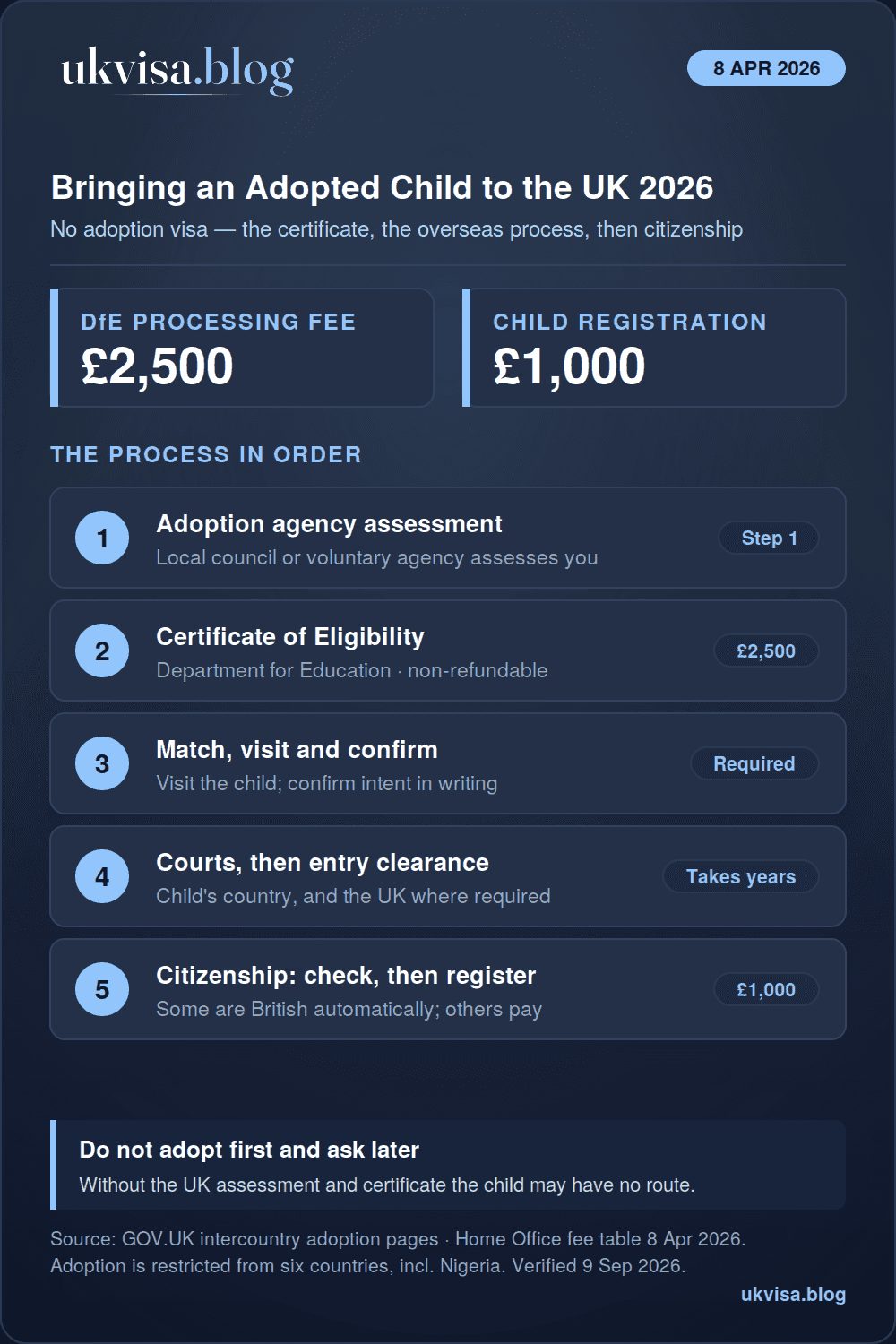
An adoption agency must assess you as eligible and suitable to adopt from overseas. Your application then goes to the Department for Education, which issues a Certificate of Eligibility to Adopt and forwards it to the overseas authority. The DfE charges a non-refundable £2,500 for processing. Only after the placement is finalised do you arrange entry clearance for the child.
An adoption completed overseas without the UK assessment and certificate may not be recognised here, and the child may then have no route into the UK at all. The £2,500 DfE fee is non-refundable, but it is a fraction of the cost of an adoption that cannot be given effect. Start with the agency, not with the adoption.
Adopting a Relative From Overseas
This is the most common enquiry and the one most often misunderstood. Adopting a nephew, niece or other relative living abroad is not a shortcut around the immigration rules, and it is not treated more leniently because the child is family. The same assessment, certificate and recognition questions apply.
- Assessment by an adoption agency: your local council or a voluntary agency specialising in overseas adoption.
- A Certificate of Eligibility to Adopt: issued by the Department for Education after that assessment.
- Compliance with the child's country's process: including its courts where required.
- A visit to the child: and written confirmation of your intention to proceed.
- Entry clearance: arranged after the placement is finalised.
Where the motivation is to give a relative's child a better start rather than to provide a permanent family for a child who needs one, the process is unlikely to succeed and the child's welfare assessment is where it will fail. That is the test being applied, not a family preference.
How the Child's Country Affects Everything
The framework differs according to whether the child's country operates under the Hague Convention on intercountry adoption, whether its adoptions are recognised by the UK, or neither. That classification decides whether the adoption is automatically effective in UK law or whether a further UK process is needed.
Because the position varies country by country and changes, check the current classification for the specific country before beginning. Adoption law in the child's country also has to be complied with in its own right — a UK-compliant process is not enough if the overseas process is defective.
Bringing a Child for a Visit Is Not a Step Towards This
Families sometimes bring a relative's child to the UK as a visitor while an adoption is contemplated. That is a different application with a different test: a visitor must intend to leave at the end of the visit, and an application made while a permanent move is planned is not a genuine visit.
A refusal on that basis then sits on the child's record and complicates the adoption route later. Keep the two separate, and do not use a visit to bridge a gap in a process that has not been completed.
Citizenship Through Adoption
Some adopted children become British automatically; others need to register. Which applies depends on where the adoption order was made and on the adopters' own status. It is a technical question, and getting it wrong in either direction is costly.
- Adoption order made in the UK: a child adopted by a British citizen generally becomes British automatically.
- Hague Convention adoption abroad: can confer citizenship automatically where the conditions are met.
- Other overseas adoptions: generally require registration at the Home Secretary's discretion.
- Where citizenship is automatic: the child needs a passport, not an application.
- Where it is not: registration as a British citizen costs £1,000 for a child.
Establish the position before paying anything. Registering a child who is already British wastes £1,000; assuming a child is British when they are not surfaces at the first passport application, often years later. See our page on citizenship and registration.
After Arrival: Status, Then Settlement
Where the child enters on an immigration route rather than as a British citizen, they hold limited permission with an expiry date like anyone else. Settlement follows the requirements of the route they are on, and their permission has to be maintained in the meantime — extensions applied for in time, and absences kept within whatever limit applies.
Children under 18 are exempt from the Life in the UK test and the English requirement, which simplifies a settlement application made while they are still a child. A child who reaches 18 before settling loses those exemptions, so the timing of the application matters — see our pages on settlement, the 180-day absence rule and children as dependants.
De Facto Adoption
De facto adoption is a distinct concept in the immigration rules, covering situations where a couple have lived abroad and cared for a child as their own for a defined period, without a formal adoption order that UK law recognises. It is narrow and heavily evidenced.
- Living abroad together: for the period the rules require.
- Assumption of parental responsibility: in fact, throughout that period.
- Sole responsibility, or its equivalent: for the child's upbringing.
- Genuine transfer of care: from the birth family, evidenced.
- Documentary support: schooling, medical records, accommodation and financial provision.
It exists for families who genuinely raised a child abroad, not for arrangements created to support an application. The evidence has to be contemporaneous, which means it cannot be assembled after the decision to come to the UK is made.
Where to Begin in Scotland and Northern Ireland
The agency route differs across the UK. In England and Wales the starting point is your local council or a voluntary adoption agency; in Scotland and Northern Ireland the relevant central authority handles the certificate stage rather than the Department for Education. Identify the right body before making any approach abroad.
The Process in Order
- Contact an adoption agency: your local council in England or Wales, or a voluntary agency specialising in overseas adoption.
- Complete the assessment: as eligible and suitable to adopt from overseas.
- Application to the Department for Education: which checks eligibility and issues the certificate.
- The certificate goes to the overseas authority: with your application.
- Match and visit: visit the child and confirm in writing that you intend to proceed.
- Court processes: in the child's country, and in the UK where required.
- Entry clearance: arranged once the placement is finalised.
Our pages on the application form and processing after biometrics cover the immigration stage. Expect the whole process to be measured in years rather than months.
What It Costs
Costs on the UK Side
| Item | Amount |
|---|---|
| Department for Education processing | £2,500, non-refundable |
| Adoption agency assessment | Varies by agency |
| Registration as a British citizen, child | £1,000 |
| Translation and legalisation of documents | Additional, varies |
| Entry clearance | Depends on the route the child enters on |
Source: GOV.UK intercountry adoption pages and the Home Office fee table, 8 April 2026. Checked 22 August 2026.
The overseas costs — legal fees, court fees, travel, accommodation during the visit and any agency charges in the child's country — are usually the larger part of the total. Our pages on entry clearance fees and in-country fees cover the UK immigration side.
Documents to Prepare Early
- The child's birth certificate: and any document recording the birth parents' position.
- The adoption order or court documents: from the child's country, legalised where required.
- The Certificate of Eligibility to Adopt: and the agency's assessment.
- Evidence of consent: from the birth family, where the process requires it.
- Certified translations: each carrying the translator's confirmation, the date, their name and signature and their contact details.
- Your own documents: identity, status and evidence that you can accommodate and support the child.
Legalisation and translation take longer than most families expect, and both have to be done to a standard the Home Office can verify independently. Starting them while the overseas process is still running removes a delay from the end of the sequence, where it is hardest to absorb.
Countries Where Adoption Is Restricted
The UK has restricted adoptions from Cambodia, Guatemala, Nepal, Haiti, Ethiopia and Nigeria. Requests for an exception are possible in compelling circumstances, such as adopting a family member, but they are exceptions rather than an alternative process.
Restrictions exist because of concerns about the integrity of adoption processes in those countries, which means an exception request has to address those concerns directly rather than only the merits of the individual case. This is a category where professional advice is warranted from the outset.
Sources: the GOV UK adoption pages, the intercountry adoption guidance, the GOV UK guidance on citizenship through adoption and the Adoption and Children Act 2002. Figures verified 22 August 2026.
Frequently Asked
Adoption and Immigration Questions
Is there an adoption visa?
No. The child enters on a route appropriate to the adoption's legal status, which depends on whether the adoption is recognised in UK law.
Can I adopt my nephew or niece from abroad?
The same process applies as to any overseas adoption: agency assessment, a Certificate of Eligibility, compliance with the child's country's law, then entry clearance. Family relationship does not shorten it.
What does the Department for Education charge?
£2,500 for processing, and it is non-refundable. Translation and legalisation costs are additional.
Can I adopt first and sort the immigration out afterwards?
No. An adoption completed without the UK assessment and certificate may not be recognised here, leaving the child with no route into the UK.
Will my adopted child be British automatically?
Sometimes. It depends on where the adoption order was made and on the adopters' status. Establish it before paying anything, because registration costs £1,000 and is wasted if the child is already British.
Which countries are restricted?
Cambodia, Guatemala, Nepal, Haiti, Ethiopia and Nigeria. Exception requests are possible in compelling circumstances, such as adopting a family member.
What is de facto adoption?
A narrow provision for families who lived abroad and cared for a child as their own for a defined period without a recognised adoption order. It is heavily evidenced and cannot be constructed retrospectively.
How long does the whole process take?
Years rather than months, because the agency assessment, the DfE certificate, the overseas process and the immigration application all run in sequence.
Do I have to visit the child?
Yes. You must visit and confirm in writing that you intend to proceed before the placement can be finalised.
Can I bring the child on a visit visa in the meantime?
A visitor must intend to leave at the end of the visit. An application made while a permanent move is planned is not a genuine visit, and the refusal then complicates the adoption route.
When can an adopted child settle?
Where they enter on an immigration route, settlement follows that route's requirements. Applying while they are still under 18 avoids the Life in the UK test and the English requirement.
Should I take professional advice?
Yes. The interaction between adoption law in two countries, recognition in UK law, and the nationality consequences is where families most often go wrong, and the mistakes are expensive and slow to undo.