
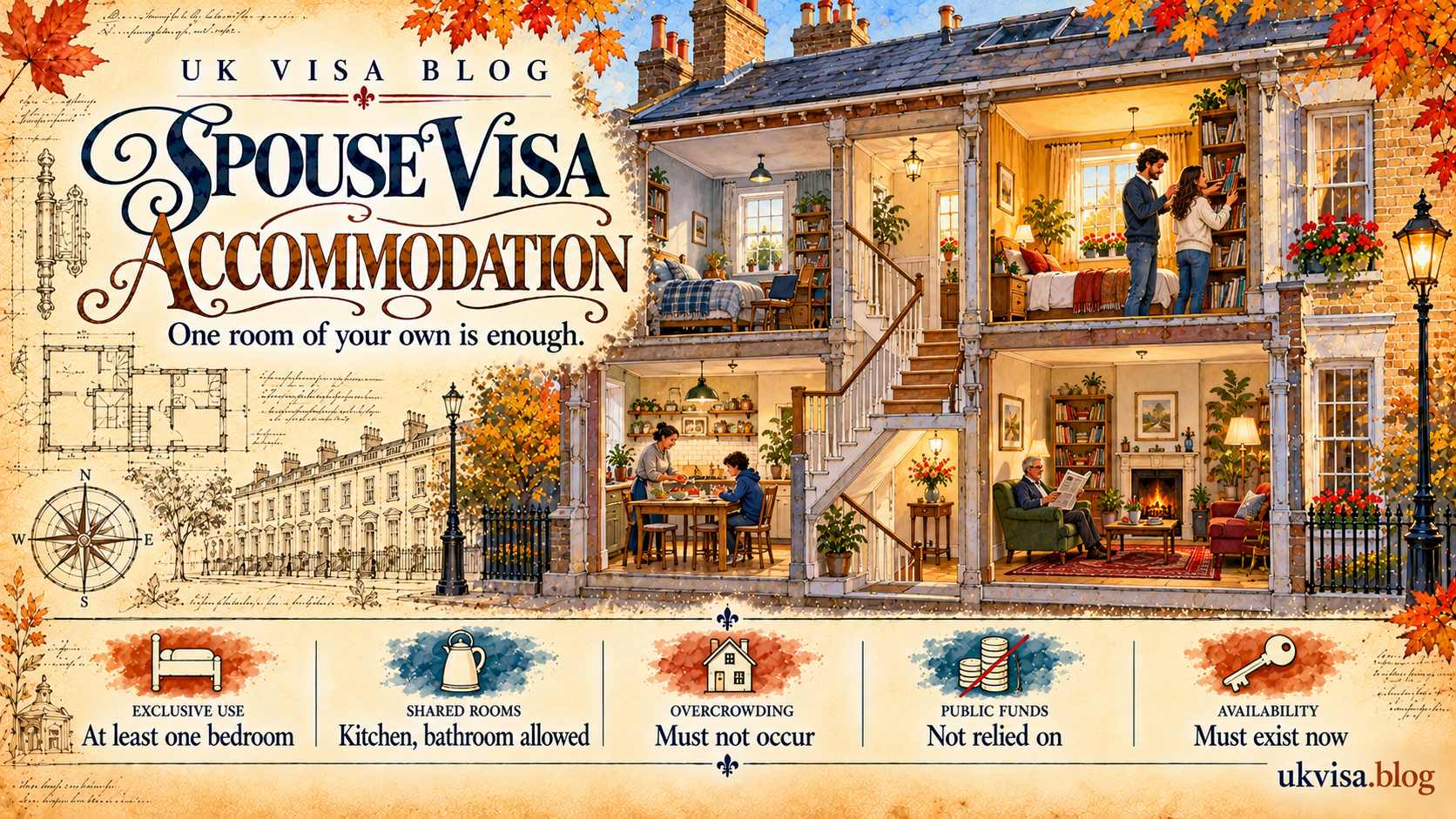
The spouse visa accommodation requirement asks three things: that the home is available now rather than planned, that part of it is yours exclusively, and that adding your partner will not make it statutorily overcrowded. The overcrowding test is arithmetic, and you can run it yourself before you apply.
UK Family Visas
Understanding UK Spouse Visa Accommodation Requirements in 2026
What Is the Adequate Accommodation Requirement?
You must show there will be adequate accommodation for the family without public funds. The property must be owned or occupied by you, with at least part of it — in practice a bedroom — for the family’s exclusive use. It must not be overcrowded under the Housing Act 1985 and must not breach public health rules. It has to exist at the date of application, not in prospect.
The rule sits at paragraph E-ECP.3.4 of Appendix FM for entry clearance and E-LTRP.3.4 for leave to remain, so it applies to the first UK Spouse visa application, to the UK Spouse visa extension, and again at the Spouse visa ILR stage with fresh evidence each time.
What “Occupied Exclusively” Actually Means
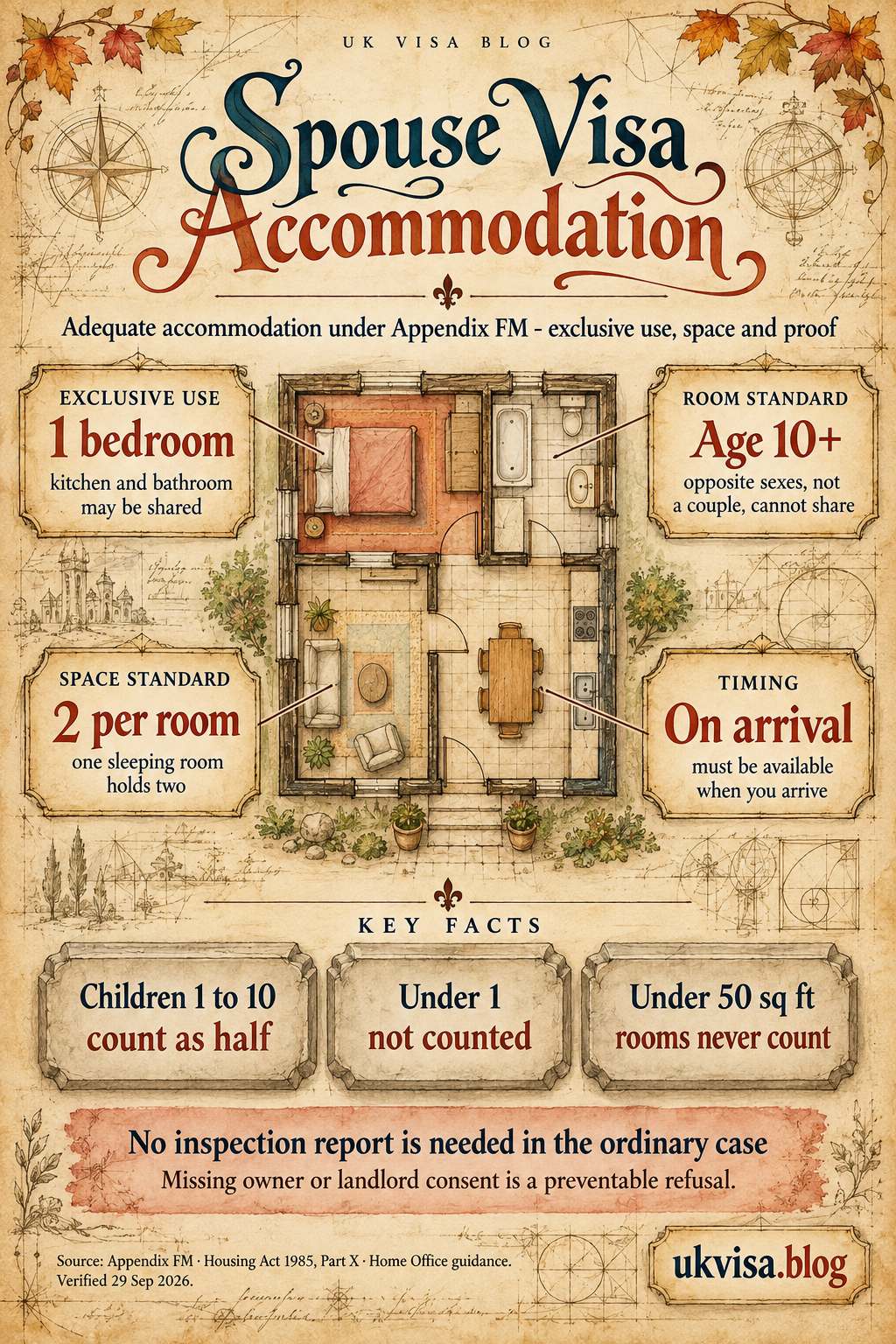
This is the point most applicants misread. The Home Office guidance does not require the whole property to be yours alone. It requires that at least part of the accommodation is for the exclusive use of the family unit — the bedroom. Kitchens, bathrooms and living rooms may be shared with the wider household.
A room in a parent’s or relative’s house therefore qualifies, provided that room is genuinely available to you and your partner and no one else. Renting is equally acceptable. What is not acceptable is an arrangement in which the family has no dedicated space at all.
Documents by Housing Situation
| Situation | Evidence expected |
|---|---|
| You own the property | Title deeds or mortgage statement, council tax bill, utility bills |
| You are the named tenant | Tenancy agreement, landlord’s consent letter, rent receipts, council tax bill |
| Living with family or friends | Owner’s permission letter, their proof of ownership or tenancy, council tax bill |
| Shared accommodation | Tenancy agreement, list of all occupants, evidence of dedicated private space |
Source: Home Office guidance on adequate maintenance and accommodation, version 13.0, 11 November 2025.
The wider bundle sits in our document checklist for Spouse visa applications. The guidance is broader than most checklists suggest: landlord letters, mortgage correspondence, rent books, council tax confirmations and a description of the property all count as acceptable evidence.
Unlike some requirements, this one is tested on the date of application. A property you intend to rent or buy once the visa is granted does not satisfy it, however firm the plan. If you are house-hunting, secure the accommodation and gather the documents before you submit — not after.
Letter Signed by the Owner of the Property
Where the sponsor lives in a property they neither own nor rent in their own name — most often a parent’s house — the Home Office needs written confirmation from the owner that everyone occupying the property is entitled to be there, including the incoming partner.
- Identity: the owner’s full name, address and contact details, with a signature and date.
- Property: the full address and postcode, and a description — number of bedrooms and reception rooms.
- Relationship: how the owner is connected to the sponsor.
- Title: confirmation of ownership or tenancy, with the deeds, mortgage statement or tenancy agreement attached.
- Permission: explicit consent for both the sponsor and the applicant to live there.
- Occupancy: everyone currently living at the property, by name and relationship.
- Standards: confirmation the property will not be overcrowded once the applicant moves in.
- Sub-letting: where the owner is themselves a tenant, their own landlord’s consent.
Keep the letter factual and attach the proof it refers to. A letter asserting that a property is not overcrowded, unsupported by any document showing how many rooms it has or who lives in it, gives a caseworker nothing to verify and is treated accordingly.
Property Inspection Reports
A property inspection report is a surveyor’s assessment confirming that a home meets the overcrowding standards and is safe to live in. It is worth being clear about its status: the Home Office guidance does not list it among the standard evidence, and it is not required in the ordinary case.
When One Is Worth Commissioning
The value of a report rises with the complexity of the household. Where several people already live at the property, where the family occupies part of a relative’s home, where a previous application was refused on accommodation grounds, or where the property is a house in multiple occupation, a professional assessment answers the question a caseworker would otherwise have to guess at.
A useful report covers the address and property type, each room with its measured floor area, the current and proposed occupants with ages and relationships, the Room Standard and Space Standard calculations, a hazard assessment, photographs, and the inspector’s own qualifications. Fees vary by area and property size — take the quote from the surveyor rather than a published range.
Commission from a qualified housing surveyor, chartered surveyor or environmental health practitioner. A report from an estate agent or an unqualified inspector carries little weight, and the credentials should be visible on the face of the document.
Landlord Consent for Rented Accommodation
Most tenancy agreements limit who may live at the property or require consent before anyone is added. A short letter from the landlord confirming no objection to your partner living there solves the immigration question and the tenancy question at the same time.
- The tenancy: the property address, the named tenant, and the date of the agreement.
- The consent: that the landlord has no objection to the applicant residing there once the visa is granted.
- The property: the number of bedrooms and the fact that adding one person will not cause overcrowding.
- Contact details: a phone number or email address for verification, plus signature and date.
Ask early. Landlords and letting agents frequently take weeks to produce a letter, and some need to update insurance or a licence for the additional occupant first. A missing consent letter is a preventable refusal that costs the whole fee.
Housing Act 1985 Overcrowding Standards
Part X of the Housing Act 1985 sets two tests, and a property is overcrowded if it fails either one. Both are mechanical, so the arithmetic can be done at the kitchen table before any money is spent.
The Room Standard
The room standard is breached when two people aged 10 or over, of opposite sexes and not living together as a couple, have to sleep in the same room. Couples and civil partners may share whatever the room size. Two people of the same sex may share. Children under 10 are outside the test entirely.
Rooms normally used for sleeping or as living rooms both count as sleeping accommodation for this purpose, which is why a household can sometimes pass by reorganising rather than moving.
The Space Standard: Permitted Occupants by Room Count
| Sleeping rooms | Maximum persons |
|---|---|
| 1 | 2 |
| 2 | 3 |
| 3 | 5 |
| 4 | 7.5 |
| 5 | 10 |
| 6 or more | 10, plus 2 for each room above five |
Source: Housing Act 1985 Part X; adequate maintenance and accommodation guidance version 13.0.
How to Count People and Rooms
Children under one are not counted at all. Children aged one to ten count as half a person each. So a four-room property with a ceiling of 7.5 can lawfully hold seven adults and one child aged between one and ten.
On the rooms side, kitchens and bathrooms never count. Any room under 50 square feet — about 4.65 square metres — is excluded from the calculation whatever it is used for. Measure before assuming a box room helps the arithmetic.
When Overcrowding Is Permitted Anyway
The guidance recognises three situations where overcrowding does not disqualify: where it results from a new baby or a child crossing an age threshold while alternative arrangements are being made, where it is genuinely temporary such as a short family visit, and where the local authority has licensed it. Each needs evidence rather than assertion.
Where Applications Fail on Accommodation
No proof of a legal right to occupy. Overcrowding once the applicant is added. Addresses that disagree across the tenancy, the council tax bill and the application form. Missing landlord consent. A property still being looked for. Reliance on social housing or housing benefit to make the sums work. Our spouse visa refusal grounds guide sets the wider pattern out.
The Ten-Year Route Works Differently
Paragraph EX.1 of Appendix FM disapplies the accommodation requirement for in-country applications granted on private life or exceptional circumstances grounds — the Family Life 10-year route. It has no equivalent for entry clearance, so an application from abroad must meet the requirement whatever the circumstances. See our exceptional circumstances guide for how that discretion is exercised.
Accommodation is one of three core tests, alongside the UK Spouse visa financial requirements and proof of genuine partnership. Sources: the family visa pages on GOV.UK; Appendix FM of the Immigration Rules, paragraphs E-ECP.3.4 and E-LTRP.3.4; Housing Act 1985 Part X; and Home Office guidance on adequate maintenance and accommodation, version 13.0 of 11 November 2025. Figures verified 22 August 2026.
Frequently Asked
Questions about UK Spouse Visa Accommodation
You must show adequate accommodation will be available for the family without public funds. The property must be owned or occupied by you with at least part of it — normally a bedroom — for the family’s exclusive use, must not be overcrowded under the Housing Act 1985, and must not breach public health rules. Paragraphs E-ECP.3.4 and E-LTRP.3.4 of Appendix FM set it out.
Not in the ordinary case. The Home Office guidance does not list inspection reports among the standard evidence. They earn their cost where the household is complicated — several existing occupants, a room in a relative’s home, a house in multiple occupation, or a previous refusal on accommodation grounds. Use a qualified surveyor or environmental health practitioner, not an estate agent.
Yes. The guidance requires only that part of the accommodation is for the family’s exclusive use, so a bedroom of your own in a shared house or a relative’s home satisfies it. Kitchens, bathrooms and living rooms can be shared. You still need the owner’s written permission and the property must pass both overcrowding tests with you in it.
It caps occupants by the number of sleeping rooms: one room allows two people, two rooms three, three rooms five, four rooms 7.5, five rooms ten, and two more for each room beyond five. Children under one are not counted; children aged one to ten count as half. Kitchens, bathrooms and any room under 50 square feet are excluded.
It is breached where two people aged ten or over, of opposite sexes and not a couple, must sleep in the same room. Couples and civil partners may share regardless of room size, as may two people of the same sex. Children under ten fall outside the test. Living rooms count as sleeping accommodation for this calculation.
Yes. Most tenancy agreements limit named occupants, so adding a partner without consent breaches the tenancy as well as leaving a gap in the application. Ask for a short letter confirming no objection, the property address, the number of bedrooms and that the addition will not cause overcrowding. Landlords often take weeks, so request it early.
No. The requirement is tested at the date of application, so a property you intend to rent or buy once permission comes through does not count however definite the arrangement. Secure the accommodation, gather the tenancy or ownership documents and the consent letters, and only then submit.
Yes, and asymmetrically. Paragraph EX.1 of Appendix FM disapplies the accommodation requirement for in-country applications succeeding on private life or exceptional circumstances grounds. There is no equivalent for entry clearance, so an application made from outside the UK must meet the requirement in full whatever the circumstances of the family.
Yes. The commonest causes are no evidence of a legal right to occupy, a property that would be overcrowded once the applicant arrives, missing landlord consent, addresses that disagree between documents, accommodation that is still only planned, and reliance on housing benefit or social housing. All of them are avoidable before submission.