
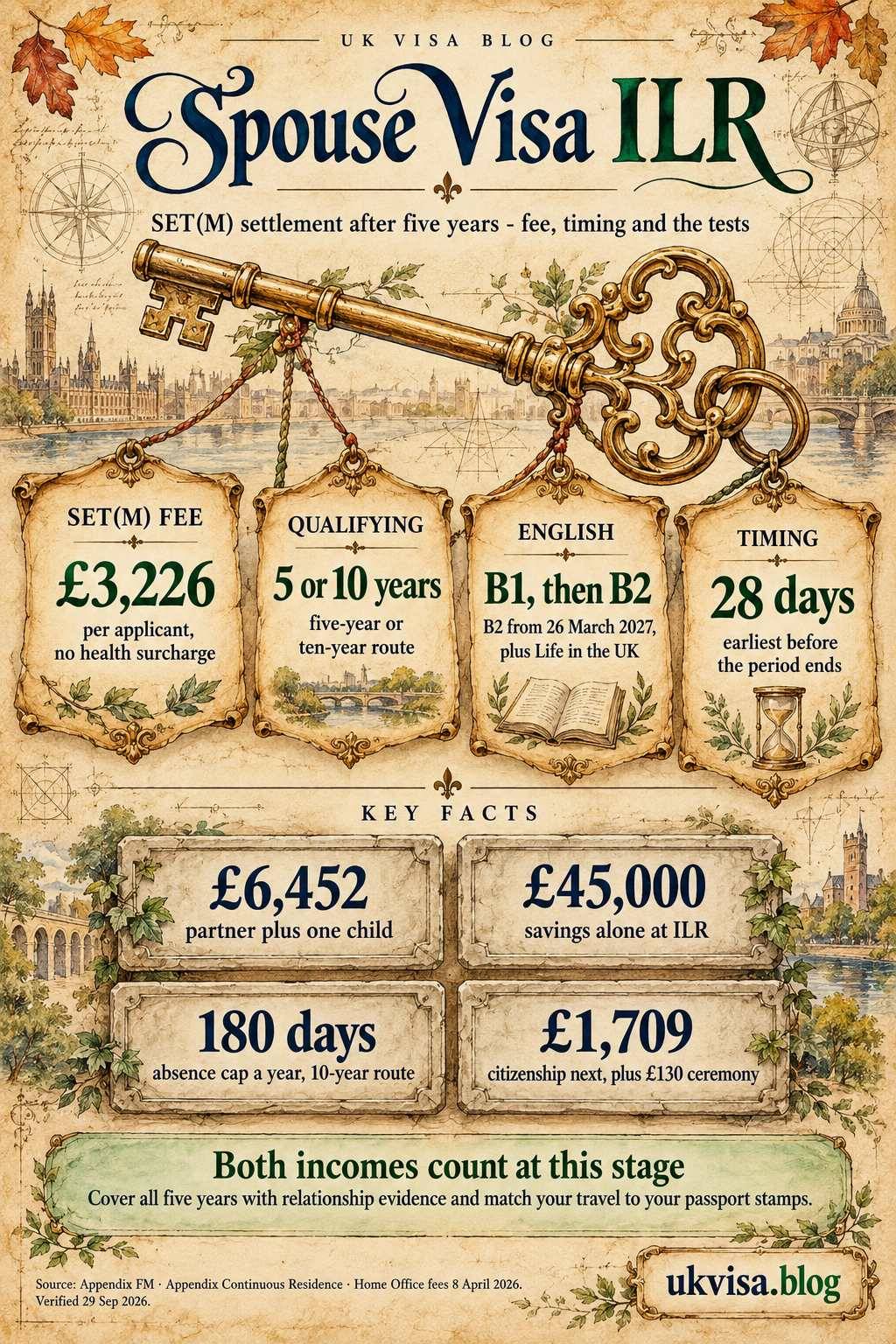
Five years on the partner route ends at indefinite leave to remain on form SET(M), for £3,226 with no health surcharge. You need B1 English, the Life in the UK test and a relationship that has held together. The absence rules are not the ones most guides describe, and they differ between the two routes.

UK Family Visas
Understanding Spouse Visa ILR Requirements for UK Settlement 2026
What Are the ILR Requirements for Spouse Visa Holders?
Five continuous years on the partner route, a relationship that is still genuine and subsisting with the same sponsor, the financial requirement met, adequate accommodation, B1 English and the Life in the UK test. You apply on SET(M) from inside the UK, no earlier than 28 days before the five years complete. The fee is £3,226 and no health surcharge is payable.
Settlement is the end of the road that began with the first UK Spouse visa: 33 or 30 months, then a 30-month FLR(M) extension, then SET(M). Once granted, indefinite leave removes the time limit and the no-recourse condition.
Citizenship Does Not Require Another Year
Settled migrants generally have to hold indefinite leave for 12 months before naturalising. Spouses of British citizens do not. Provided you have lived in the UK for three years and hold settled status at the date of application, you can apply straight away — see our naturalisation requirements guide.
Five-Year Route and Ten-Year Route Compared
| Requirement | Five-year route | Ten-year route |
|---|---|---|
| Qualifying period | Five years on the partner route | Ten years of continuous residence |
| Financial requirement | £29,000, or £18,600 if protected | Exceptions possible on Article 8 grounds |
| English and Life in the UK | B1 and the test | B1 and the test |
| Absences | No fixed cap; judged on the facts | 180 days in any 12-month period |
| Fee | £3,226 | £3,226 |
Source: Appendix FM; Appendix Settlement Family Life; Appendix Continuous Residence; fee table of 8 April 2026.
Continuous Residence and the Absence Rules
This is where most published guidance goes wrong, because it applies one rule to two different routes. Appendix Continuous Residence — the source of the well-known 180-day limit — lists the routes it governs, and Appendix FM is not among them.
On the Five-Year Partner Route
There is no fixed absence cap. What the Home Office asks instead is whether the relationship remained genuine and subsisting and whether the UK was actually your home across the qualifying period. A single long posting abroad, or a pattern of frequent extended trips, can defeat that even though no numerical limit was breached.
The practical consequence is that time abroad needs an explanation rather than a calculation. Keep the dates, keep the reasons, and keep the evidence that the couple’s life stayed anchored here — our continuous residence rules guide sets out how the concept works across routes.
On the Ten-Year Route the 180-Day Rule Does Apply
Settlement on the 10-year route falls under Appendix Settlement Family Life, which is covered by Appendix Continuous Residence. There the limit is real: no more than 180 days outside the UK in any rolling 12-month period, measured across the whole ten years.
The permitted exceptions are narrow — humanitarian or environmental crisis work, travel disruption from natural disaster, conflict or pandemic, and compelling personal circumstances such as life-threatening illness or the death of a close relative. Settlement Family Life applicants also have absences for work, study or supporting family overseas allowed for.
- Time: five years completed on the partner route, or ten on the ten-year route.
- Relationship: still genuine and subsisting with the same sponsor.
- Money: the spouse visa financial requirement met — savings count in full above £16,000 at this stage.
- Knowledge: the KoLL test passed and English at B1, rising to B2 for applications from 26 March 2027.
- Housing: adequate accommodation that is not overcrowded.
- Suitability: no serious criminality, deportation order or immigration breach.
- Presence: you and any dependants physically in the UK when you apply.
When to Apply
The earliest date is 28 days before the qualifying period completes. Earlier than that and the application is refused with no refund. Later than the expiry of your current permission and you are an overstayer. Apply on the ILR application form SET(M) while your existing leave is still running, and section 3C protects you until the decision.
There Is Also a Two-Year Route
GOV.UK lists a two-year qualifying period alongside the five and ten-year ones. It applies to partners granted permission under the older rules that preceded the 2012 changes. If your first grant as a partner was made before July 2012, check which period applies to you before assuming five years.
Fees and Processing Times
Settlement is the single most expensive application on the route, and it is charged per person. There is no reduction for children and no surcharge to add, since indefinite leave carries no health surcharge at all.
ILR Costs from 8 April 2026
| Charge | Amount | Notes |
|---|---|---|
| SET(M) application | £3,226 | Per applicant; was £3,029 |
| Priority service | £500 | Target five working days |
| Super priority service | £1,000 | Target next working day |
| Life in the UK test | £50 | Payable per attempt |
| Health surcharge | Not payable | Settlement applications are exempt |
| Naturalisation afterwards | £1,709 | Plus a £130 ceremony fee |
Source: Home Office immigration and nationality fees, 8 April 2026.
A partner applying with one child therefore pays £6,452, and with two children £9,678, in application fees before anything else. Full figures across the route sit in our guide to Home Office fees for ILR, BRP and citizenship. English test fees vary by provider — take them from the provider’s booking page.
How Long It Takes
Up to six months as standard, measured from biometrics rather than from submission. Priority targets five working days and super priority the next working day, both of them targets rather than promises. Extensive travel history, earlier refusals and complicated income all slow a case down whatever service is bought.
Stay in the UK while the application is pending. Leaving ends section 3C leave and, on a case already being examined for absences, adds the very fact the caseworker is weighing.
Documents for the SET(M) Application
Settlement asks for evidence spanning the full qualifying period rather than a recent snapshot. The two categories people underprepare are cohabitation across five years and a complete, accurate travel history. Our UK Spouse visa documents guide covers the evidential standard for each.
- Identity: current passport and every previous passport covering the qualifying period.
- Relationship: marriage or civil partnership certificate, and evidence spanning the whole five years.
- Cohabitation: several sources for each year — council tax, utilities, joint accounts, tenancy or mortgage.
- Financial: six months of payslips and matching statements, or self-employment evidence under Category F or G.
- English: a valid B1 certificate, or proof of an exemption.
- Life in the UK: the pass notification — it does not expire.
- Accommodation: tenancy agreement, mortgage statement, or the owner’s letter.
- Travel: every trip outside the UK with dates, supported by stamps and boarding passes.
- Status history: previous permits, decision letters or eVisa records showing unbroken permission.
The form requires a complete list of absences, and the Home Office can check it against passport stamps and its own records. An omitted weekend abroad is not a problem; an inconsistency between what you declared and what the stamps show is, because it goes to credibility and can pull the refusal under suitability rather than eligibility. Accuracy matters more than a low total.
Why ILR Applications Are Refused
The refusal grounds at settlement are the familiar ones with two additions: the qualifying period and the travel record. Our guide to spouse visa refusal reasons covers the shared ground in more detail.
Common Grounds and How to Avoid Them
| Ground | What prevents it |
|---|---|
| Absences undermining the case | Explain and evidence every long trip; on the ten-year route keep within 180 days per 12 months |
| Financial requirement not met | Both incomes count at this stage, and savings count in full above £16,000 |
| Thin relationship evidence | Cover all five years, not just the months before applying |
| Life in the UK or English missing | Sit both before submitting; the test pass does not expire |
| Applying too early | Wait until you are within 28 days of completing the period |
| Inconsistent travel declarations | Reconcile the list against passport stamps before you submit |
| Break in permission | Extend before each expiry so the leave is unbroken |
Source: Appendix FM; settlement — family and private life guidance version 4.0, 29 July 2025.
A Refusal Is Not Always the End
The settlement caseworker guidance records a discretion worth knowing about: rather than refusing outright, a caseworker may vary a settlement application into one for further leave to remain, granting another 30 months so the applicant can put the missing element right and apply again.
Where a refusal does follow, the letter says which remedy is open. A refused human rights claim carries a right of appeal to the First-tier Tribunal; administrative review is available only for decisions listed as eligible, on a short deadline. Our UK Spouse visa refusal appeal process guide sets out both.
If the Relationship Ends First
Two routes survive the end of the relationship. Where it broke down because of domestic abuse, settlement is available under SET(DV). Where the sponsor has died, Appendix Bereaved Partner allows settlement with no minimum qualifying period and no financial or English requirement — see our bereaved partner ILR guide.
Sources: the settlement pages for family visas on GOV.UK; Appendix FM of the Immigration Rules; Appendix Continuous Residence; and Home Office guidance, settlement — family and private life, version 4.0 of 29 July 2025. Figures verified 22 August 2026.
Frequently Asked
Questions about UK Spouse Visa ILR
Five continuous years on the partner route, a relationship still genuine and subsisting with the same sponsor, the financial requirement met, adequate accommodation, B1 English and a pass in the Life in the UK test. You must be in the UK to apply, on form SET(M), no earlier than 28 days before the five years complete. The fee is £3,226 with no health surcharge.
Not on the five-year partner route. Appendix Continuous Residence, which sets the 180-day limit, lists the routes it governs and Appendix FM is not one of them. Absences are instead judged against whether the relationship stayed genuine and the UK stayed your home. The 180-day rule does apply on the ten-year route, which falls under Appendix Settlement Family Life.
£3,226 per person from 8 April 2026, up from £3,029, with no Immigration Health Surcharge because settlement applications are exempt. A partner applying with one child pays £6,452, and with two children £9,678. Add £50 for each attempt at the Life in the UK test, and £500 or £1,000 for priority or super priority where those services are offered.
No earlier than 28 days before you complete the qualifying period, and before your current permission expires. Applying earlier means refusal with no refund, so calculate from the date your first partner permission was granted. Note that GOV.UK also recognises a two-year qualifying period for partners granted permission under the pre-2012 rules.
Less than at the earlier stages. The guidance divides savings above £16,000 by 2.5 only at entry clearance and extension, because those grants fund a further 30 months. At settlement the whole amount above £16,000 counts as income, so savings alone need to reach £45,000 against a £29,000 requirement rather than £88,500.
Up to six months as standard, measured from your biometrics appointment rather than from submission. Priority targets five working days and super priority the next working day. Complex travel history, earlier refusals and self-employed income all extend the timescale regardless of the service purchased. Stay in the UK while the decision is pending.
Yes. Each dependent child needs their own application and pays the full £3,226. Children under 18 do not sit the Life in the UK test or the English test, though they will need both for citizenship later. A child born in the UK after a parent obtained settlement is British at birth and needs no application at all.
If your sponsor is a British citizen, immediately. The usual 12-month wait after indefinite leave does not apply to spouses of British citizens — you need three years’ residence in the UK and settled status at the date of application. Naturalisation costs £1,709 plus a £130 ceremony fee, and requires the good character test.
Yes. Settlement does not expire by date, but it lapses if you remain outside the UK continuously for more than two years. If long-term travel is likely, naturalising first is worth considering, because citizenship cannot be lost through absence. Where settlement has already lapsed, a returning resident application may restore it on evidence of continuing ties.