
The Service Supplier visa is the Global Business Mobility route for overseas employees and self-employed professionals delivering contracted services to UK clients under a trade agreement. The fee is £340 from 8 April 2026. The UK-India CETA, in force since 15 July 2026, added Indian nationals for covered services — with a 1,800-place annual cap on chefs, classical musicians and yoga instructors. Stays run 6 months under most agreements; 12 under the EU TCA, Swiss SMA, Australia FTA and CPTPP.

Global Business Mobility
Service Supplier Visa UK 2026: GBM Route Under International Trade Agreements
What is the Service Supplier Visa?
The Service Supplier visa lets two kinds of overseas service providers work temporarily in the UK: employees of an overseas business delivering a contracted service to a UK client, and self-employed professionals based overseas who hold the UK service contract personally. Both need a Certificate of Sponsorship from the UK client, 12 months’ relevant overseas experience, and a service covered by a qualifying trade agreement. Fee £340, IHS £1,035 per year, no English test, no salary floor, no settlement pathway.
Most UK work visas answer an employment question: who is hiring, in what job, at what salary. The Service Supplier visa answers a trade question: what has Britain promised its trading partners, and to whom does the promise apply? It is the one route in the five-route Global Business Mobility framework that owes nothing to corporate ownership. The other four move employees within a corporate group. This one moves them between separate businesses, on the strength of a service contract — provided a UK trade agreement covers that service, delivered by a person of that nationality.
A Sponsor That Is Not Your Employer
The arrangement this produces is genuinely odd, and worth pausing on. The sponsor is the UK client — the customer — which must hold a Home Office sponsor licence and assign your Certificate of Sponsorship. Throughout the assignment you remain employed by your overseas firm, or by yourself if you are an independent professional, and your permission is welded to the one contract named on that certificate. You may study. You may not take a second job, swap contracts without updating the visa, or claim public funds.
From Tier 5 to “Mode 4”
The route descends from the Tier 5 International Agreement provisions, retired when the GBM family launched on 11 April 2022. Its legal engine is what trade lawyers call “Mode 4” — the commitments on temporary movement of people written into trade agreements. Everyone else calls it flying in the consultant.
The Cheapest Sponsored Visa in the System
What the route lacks in duration it repays in cost. This is the cheapest sponsored work visa Britain offers: no English test, no minimum salary (the National Minimum Wage still applies), no Immigration Skills Charge, and a Certificate of Sponsorship at £55 where the Worker routes charge £525. The bill for that generosity is presented elsewhere — stays of 6 or 12 months, a single contract, and no path to settlement, however many times you return.
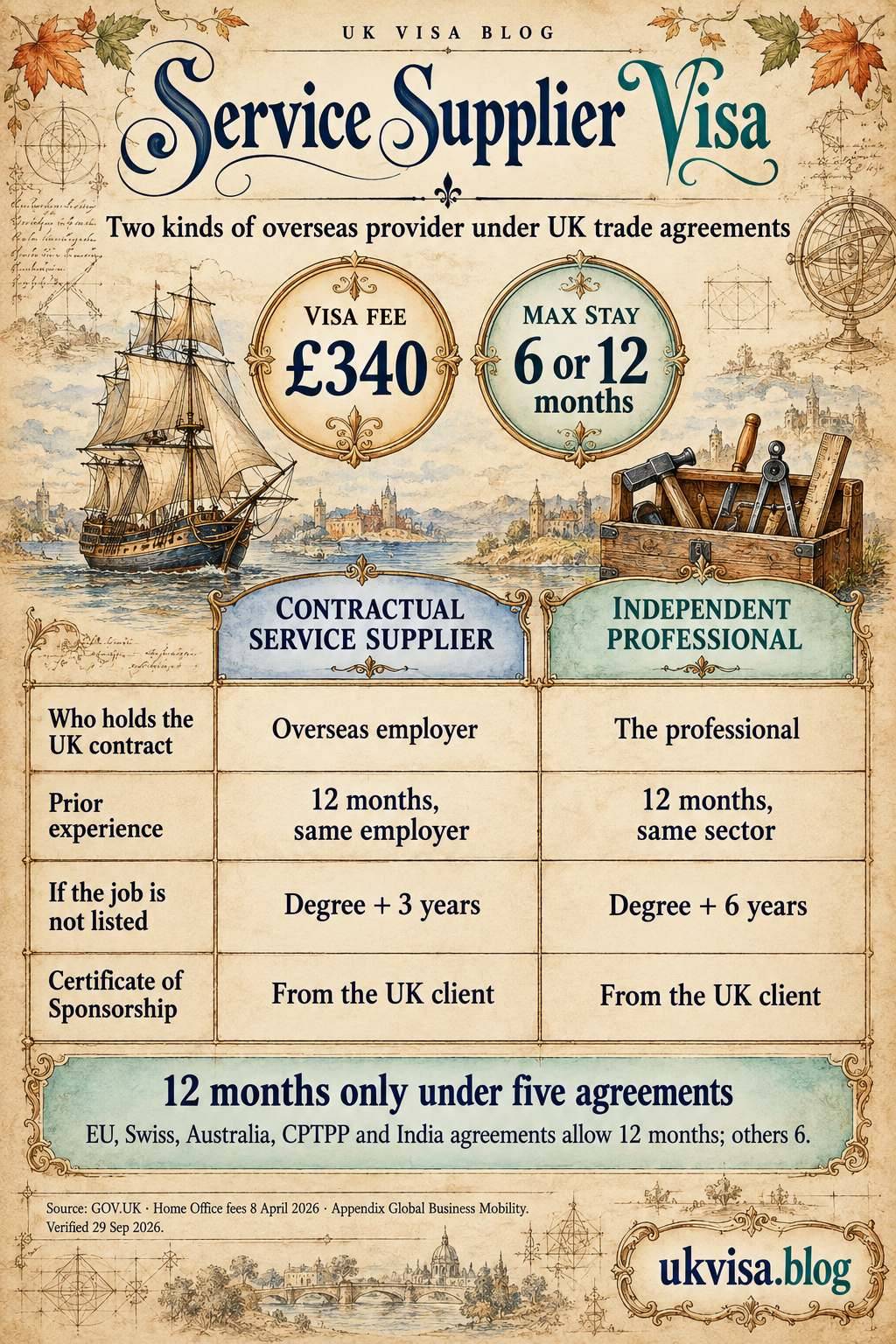
Contractual Service Suppliers vs Independent Professionals
The route admits two profiles, and the distinction is not cosmetic — it decides who signs the contract and whose paperwork carries the application:
The Two Profiles Compared
| Feature | Contractual Service Supplier (Employee) | Independent Professional (Self-Employed) |
|---|---|---|
| Profile | Employee of an overseas service-providing business | Self-employed practitioner based overseas |
| Who holds the UK contract | The overseas employer | The practitioner personally |
| Prior experience | 12 months working for the current employer outside the UK | 12 months in the same sector, immediately before applying |
| If the job is not on the eligible occupations list | Degree or equivalent technical qualification + 3 years’ relevant experience | Degree or equivalent technical qualification + 6 years’ relevant experience |
| Certificate of Sponsorship | Assigned by the UK client (sponsor) | Assigned by the UK client (sponsor) |
Source: Immigration Rules, Appendix Global Business Mobility routes; GOV.UK route pages and the 8 April 2026 fee table. Verified 22 August 2026.
Where the Burden Falls
The self-employed carry the heavier file. Independent professionals must prove the overseas practice exists — tax registration, business registration, professional licensing — and their 12 months of experience must sit in the same sector as the UK contract, immediately before applying. A consultant who has recently changed fields will find the Home Office unpersuaded. A handful of services follow their own rules: chefs de cuisine need an advanced technical qualification and 6 years’ experience, while entertainment, fashion and modelling need no qualifications at all — a comparison best left uninterpreted.
Trade Agreements and Maximum Stay
The trade agreement performs three jobs at once. It decides which nationalities qualify, which services are covered, and how long the visa can last. The grant is always the shorter of the agreement’s maximum and the period on the Certificate of Sponsorship plus 14 days.
The 12-Month Club Is Smaller Than Advertised
Coverage of new trade deals routinely promises “12-month UK assignments”; the caseworker guidance reserves that tier for exactly four cohorts, and everything else — however recent the agreement — sits at 6 months:
Maximum Stay by Agreement
| Trade Agreement Cohort | Maximum Single Assignment |
|---|---|
| UK-EU Trade and Cooperation Agreement (TCA) | 12 months |
| UK-Switzerland Services Mobility Agreement | 12 months |
| UK-Australia Free Trade Agreement | 12 months |
| CPTPP (qualifying “business persons” under Article 12.1) | 12 months |
| All other agreements — including UK-India CETA, UK-Japan CEPA, UK-Singapore FTA, UK-Canada TCA, CARIFORUM-UK and GATS-based commitments | 6 months |
Source: Immigration Rules, Appendix Global Business Mobility routes; GOV.UK route pages and the 8 April 2026 fee table. Verified 22 August 2026.
Source: Global Business Mobility routes caseworker guidance v15.0, period of grant (August 2026).
The Cap That Catches Serial Contractors
Time on this route counts towards a ceiling of 5 years in any 6-year period, shared across all GBM routes and their intra-company predecessors. Six-month assignments feel disposable; cumulatively they are not. Extensions are possible within the agreement maximum, but the Home Office deducts whatever you have already spent since your last Service Supplier grant.
UK-India CETA: What Actually Changed on 15 July 2026
The UK-India CETA’s entry into force was widely reported as opening 12-month UK assignments for Indian professionals. The immigration rules, as implemented, say something narrower — and on a route this technical, the difference matters commercially.
What Changed
What CETA verifiably did is make Indian nationals a qualifying nationality wherever the contracted service is covered by a CETA commitment. That is a real change: Indian IT consultants, engineers and accountants now sit inside a framework that previously excluded them, and India’s services exporters gained a lawful, sponsored channel into the UK market.
The 1,800-Place Cap — and Who It Actually Covers
One cap applies, and it is narrower than the headlines implied. Grants to Indian nationals in three occupations — traditional chef / chef de cuisine (CPC 87909), classical musician (CPC 96191 and 96192) and yoga instructor (CPC 929) — must not exceed 1,800 in any calendar year, counted cumulatively across the three roles from 1 January to 31 December. The mainstream service sectors face no numerical cap at all.
The Home Office’s August 2026 caseworker guidance does not list CETA among the 12-month agreements, so Indian assignments sit in the 6-month tier. The 12-month overseas-experience rule applies in full, the job must still be an eligible occupation or meet the qualifications fallback, and applications run on the standard 3-week service — no CETA-specific priority processing exists in the guidance or on GOV.UK.
Eligibility Requirements
Eligibility is a chain with five links — nationality, service coverage, sponsorship, experience and occupation — and every link must hold. In full:
- Nationality and coverage: you are a national of a country whose UK trade agreement covers the specific service in the contract.
- Service contract: your overseas employer holds the contract with the UK client — or you hold it personally if self-employed.
- Approved sponsor: the UK client holds a Home Office sponsor licence and assigns your Certificate of Sponsorship.
- Experience: 12 months with your current employer outside the UK (employees), or 12 months in the same sector immediately before applying (self-employed).
- Eligible occupation: the 4-digit occupation code on your CoS appears on the GBM eligible occupations table — or you meet the fallback: a degree or equivalent technical qualification, plus 3 years’ experience for employees or 6 for the self-employed.
- Maintenance: £1,270 held for 28 consecutive days ending within 31 days of the application — waived if the sponsor certifies maintenance, or if you have been in the UK on a valid visa for 12 months or more.
- Pay: no salary threshold, but the arrangement must comply with the National Minimum Wage and Working Time Regulations.
- No English test: the route has no language requirement at any level.
- TB certificate if applying from a listed country; no criminal record certificate is required on this route.
Fees and Costs from 8 April 2026
The worker’s bill is £340 plus the Immigration Health Surcharge at £1,035 per adult per year (£776 for under-18s) — £1,375 for a 12-month single adult. The sponsor’s side is lighter still: a £611 Temporary Worker licence, £55 per Certificate of Sponsorship, and no Immigration Skills Charge. Few sponsored routes cost a UK business less to run.
Fees at a Glance
| Fee Component | Amount from 8 April 2026 | Notes |
|---|---|---|
| Application fee (main applicant or dependant) | £340 per person | Up from £319; same fee to extend |
| Immigration Health Surcharge | £1,035/year adult · £776/year under-18 | Paid up front for the grant period |
| Personal maintenance | £1,270 | Plus £285 partner, £315 first child, £200 each further child; waived if sponsor certifies |
| Priority / super-priority service | +£500 / +£1,000 | Where available at the application location |
| Sponsor: Temporary Worker licence | £611 flat | Same fee regardless of sponsor size |
| Sponsor: Certificate of Sponsorship | £55 per worker | Against £525 on Worker routes |
| Immigration Skills Charge | £0 | Route is exempt |
Source: Immigration Rules, Appendix Global Business Mobility routes; GOV.UK route pages and the 8 April 2026 fee table. Verified 22 August 2026.
Source: GOV.UK Service Supplier visa fee pages; Immigration and Nationality (Fees) Order uplift, 8 April 2026.
For how these figures sit against the rest of the sponsored system, see the UK work visa fees and ISC comparison. Indian applicants budgeting in rupees can run the numbers through the UK visa fees in Indian Rupees calculator.
How to Apply
Applications are made online, up to 3 months before the work start date on the Certificate of Sponsorship. Standard processing is 3 weeks from outside the UK and 8 weeks for in-country extensions and switches.
The Sequence, Sponsor First
The sequence runs from the sponsor outwards: the UK client confirms the contract is covered by a qualifying trade agreement and holds (or obtains) a Temporary Worker licence, then assigns the Certificate of Sponsorship naming the agreement, the service and the dates. From there the applicant completes the GOV.UK form, pays the £340 fee and the IHS, proves identity — the UK Immigration: ID Check app for eligible passports, a biometric appointment otherwise — and uploads the evidence: passport, CoS reference, employment or self-employment records, qualifications where relied on, maintenance, and a TB certificate if applicable.
Switching from Inside the UK
Switching in-country is possible, with the usual exclusions: not from a visit visa, a short-term student visa, a Parent of a Child Student visa, a seasonal or domestic-worker visa, on immigration bail, or on leave outside the rules. Students qualify once the sponsored course is complete, the job starts after it ends, or after 24 months of full-time PhD study.
Service Supplier vs Other GBM Routes
The five GBM routes answer different commercial questions, and the fastest way to choose between them is the qualifying mechanism. If the arrangement is corporate group mobility, it is not a Service Supplier case:
The Five GBM Routes
| GBM Sub-Route | Qualifying Mechanism | Max Stay | Salary Floor |
|---|---|---|---|
| Service Supplier | UK trade agreement coverage | 6 or 12 months | None (NMW applies) |
| Secondment Worker | £50M+ contract or investment | 2 years | None (NMW applies) |
| Senior or Specialist Worker | Intra-corporate transfer (UK entity trading) | 5 years (9 if salary ≥ £73,900) | £52,500 |
| UK Expansion Worker | New UK presence, pre-trading | 2 years; 5-worker cap | £52,500 |
| Graduate Trainee | Structured intra-corporate graduate programme | 12 months | £27,300 |
Source: Immigration Rules, Appendix Global Business Mobility routes; GOV.UK route pages and the 8 April 2026 fee table. Verified 22 August 2026.
The perennial confusion is with the Secondment Worker route, since both involve overseas-employed workers serving a UK client. The decisive line is what qualifies you: Secondment Worker needs a single contract worth at least £50 million and buys 2-year stays; Service Supplier needs trade-agreement coverage and buys 6 or 12 months. A parent company moving staff into its own trading UK subsidiary wants Senior or Specialist Worker; a pre-trading UK launch takes the UK Expansion Worker route; structured graduate rotations run on the Graduate Trainee visa.
Dependants and the Settlement Question
Partners — spouse, civil partner, or unmarried partner in a 2-year durable relationship — and children under 18 apply as dependants at £340 each plus IHS, through the standard UK dependant visa process. Maintenance stacks on the main applicant’s £1,270: £285 for a partner, £315 for the first child, £200 for each further child. Dependants, unlike the main applicant, may work in any sector and study freely.
No Road to Settlement — By Design
On settlement the route is blunt: there is none. Service Supplier time does not count towards the 5-year residence period for ILR, and no GBM route leads there directly. The realistic onward move is a switch to the Skilled Worker visa — which starts the clock from zero and revives everything this route waives: the £41,700 general salary threshold and CEFR B2 English from 8 January 2026. Indian professionals aged 18–30 hold one further card: the India Young Professionals Scheme ballot, a non-sponsored 2-year permission drawn by lot.
The official entry point is the GOV.UK Service Supplier visa overview; the legal framework sits in Appendix Global Business Mobility: Service Supplier, applied through the Global Business Mobility caseworker guidance. The trade framework behind the Indian provisions is collected under the UK-India CETA collection on GOV.UK. Figures verified 20 August 2026.
Frequently Asked
Questions about the Service Supplier visa
No. The visa authorises the specific contract on your Certificate of Sponsorship. Changing jobs or contracts requires updating your visa first, and a second job is not permitted at all. Unpaid voluntary work for a registered charity, voluntary organisation or statutory body is allowed.
No — this is the most repeated misreading of the agreement. The Home Office guidance in force from August 2026 lists 12-month assignments only under the UK-EU TCA, the UK-Switzerland Services Mobility Agreement, the UK-Australia FTA and the CPTPP. Indian CETA applications fall in the 6-month tier, and no CETA-specific priority processing exists.
The sponsor must report the change to the Home Office within 10 working days, and your permission is likely to be curtailed. You would normally receive up to 60 days (or the remainder of your permission, if shorter) to leave the UK, secure a new qualifying arrangement, or switch routes. Overstaying that window damages every future UK application.
Yes, from inside the UK, for a further £340 — but only up to the trade-agreement maximum. The Home Office deducts the time you have already spent since your last Service Supplier grant, so a worker who entered for 6 months under the EU TCA can extend by at most 6 more, and a 6-month-tier worker who used the full period cannot extend at all.
Often, yes — but not from a visit visa, short-term student visa, Parent of a Child Student visa, seasonal or domestic worker visa, on immigration bail, or on leave outside the rules. Students qualify once the sponsored course is complete, the job starts after it ends, or after 24 months of full-time PhD study.
No. The Service Supplier route has no English requirement at any stage — no IELTS, no Trinity GESE, no CEFR level. That distinguishes it sharply from Skilled Worker, which requires CEFR B2 from 8 January 2026. The exemption ends the moment you switch: the full Skilled Worker language rules apply on switching.
Yes. Every day on the route counts towards the 5-years-in-any-6 ceiling shared across all five GBM routes and the former intra-company routes, calculated on the rolling 6-year window at each application. Serial contractors should map their history before committing to a new assignment.