
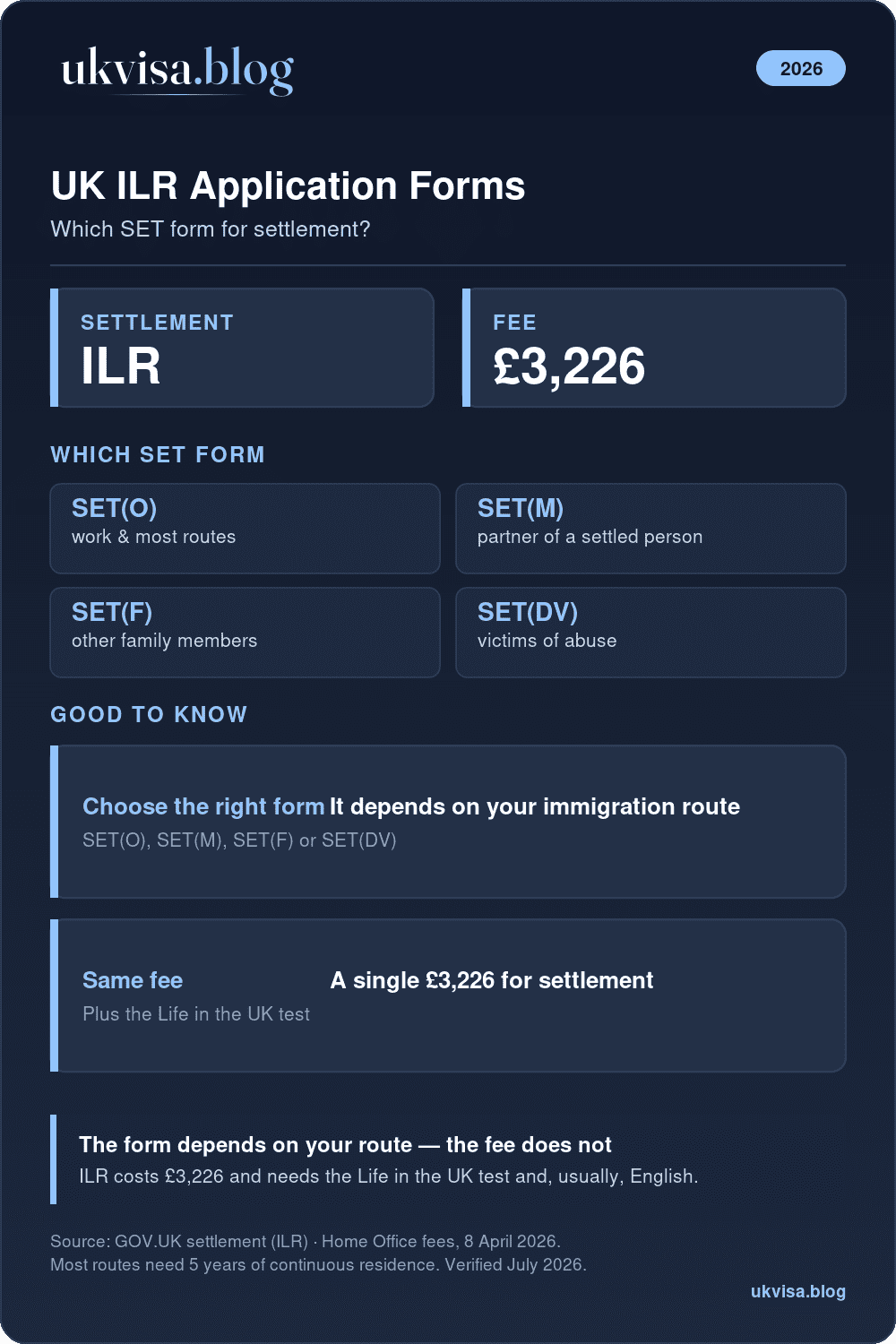
Choosing the correct ILR application form is critical for a successful UK settlement application. The Home Office uses six main SET (Settlement) forms — SET(O) for work and talent visas, SET(M) for partners and spouses, SET(LR) for 10-year long residence, SET(F) for children under 18, SET(DV) for domestic abuse victims, and SET(AF) for Armed Forces. Selecting the wrong form is among the most common reasons for ILR refusal. From 8 April 2026 the standard ILR fee is £3,226 per applicant (raised from £3,029). All applicants must pass the Life in the UK test and meet the English requirement at CEFR Level B1 unless exempt.
Source: UKVI Indefinite Leave to Remain caseworker guidance; Appendix Long Residence, Appendix Continuous Residence, Appendix FM, Appendix Skilled Worker (Immigration Rules); Home Office fee schedule effective 8 April 2026; HC 1691 (laid 5 March 2026)
From 8 April 2026 the standard ILR fee rose to £3,226 (from £3,029), applying to all SET forms equally. Priority Service remains £500 (5 working days); Super Priority £1,000 (next working day). The Long Residence framework moved from paragraph 276B to Appendix Long Residence in April 2024, with absences now under Appendix Continuous Residence. HC 1691 (laid 5 March 2026) introduces a B2 settlement English standard from 26 March 2027 — the B1 requirement remains for earlier applications. The Earned Settlement consultation closed 12 February 2026, outcome pending.
- What is ILR? Understanding ILR Application Forms
- SET(O) Application Form — Work and Talent Visas
- SET(M) Application Form — Partners and Spouses
- SET(LR) Application Form — 10-Year Long Residence Route
- SET(F) Application Form — Children Under 18
- SET(DV) Application Form — Domestic Abuse Victims
- SET(AF) Application Form — Armed Forces
- Documents Required for ILR Applications
- ILR Application Process — Step by Step
- ILR Fees and Processing Times 2026
- Common Mistakes and Refusal Reasons
- Frequently Asked Questions
ILR Application Forms 2026 — Complete Guide to SET(O), SET(M), SET(LR), SET(F), SET(DV), SET(AF)
The six current ILR application forms cover distinct settlement routes under the Immigration Rules. SET(O) handles work and Immigration Rules categories including Skilled Worker, Global Talent, and Innovator Founder. SET(M) covers family Appendix FM partner routes. SET(LR) covers the 10-year long residence route under Appendix Long Residence. SET(F) is for children under 18. SET(DV) provides accelerated settlement for domestic abuse victims. SET(AF) covers Armed Forces members and their families. All ILR applications are submitted online through gov.uk, with mandatory biometric enrolment at a UKVCAS service centre. From 8 April 2026 the application fee is £3,226 across all SET forms.
What is ILR? Understanding ILR Application Forms
ILR stands for Indefinite Leave to Remain — the UK's permanent settlement status granted after completing a qualifying period of continuous lawful residence. ILR application forms (SET forms) are the official Home Office documents for settlement applications. The "SET" prefix means "Settlement" — each variant covers specific routes: SET(O) for work, SET(M) for partners, SET(LR) for long residence, SET(F) for children, SET(DV) for domestic abuse victims, SET(AF) for Armed Forces. ILR is the final step before British citizenship eligibility.
All ILR application forms are submitted online through the gov.uk Indefinite Leave to Remain portal. The online system routes applicants to the correct SET form based on answers about current visa category and qualifying route. For framework and broader settlement context, see our ILR qualifying period framework guide. Once granted, ILR holders can apply for British citizenship after a further 12 months (no waiting period for British spouses with ILR).
ILR Application Forms Comparison Table
| Form | Full Name | Primary Use | Typical Qualifying Period |
|---|---|---|---|
| SET(O) | Settlement – Other | Skilled Worker, Global Talent, Innovator Founder, work-based routes | 5 years (3 years some Global Talent / Innovator) |
| SET(M) | Settlement – Marriage / Partner | Spouses, civil partners, unmarried partners under Appendix FM | 5 years (or 10 on FLR(FP) route) |
| SET(LR) | Settlement – Long Residence | 10 years continuous lawful UK residence (any visa) | 10 years lawful |
| SET(F) | Settlement – Family (child) | Children under 18 settling with parents who have ILR | Concurrent with parent |
| SET(DV) | Settlement – Domestic Violence | Victims of domestic abuse on partner visas | No minimum (accelerated) |
| SET(AF) | Settlement – Armed Forces | Armed Forces members and their family dependants | 4 years (HM Forces service) |
SET(O) Application Form — Work and Talent Visas
The SET(O) application form (Settlement – Other) is the most commonly used ILR form, covering work and Immigration Rules-based settlement applications. SET(O) applies to Skilled Worker sponsored employment holders (5-year qualifying period), Global Talent endorsement holders (3 or 5 years depending on category), Innovator Founder route applicants (3 years with endorsing body confirmation), Scale-up visa holders, Representative of an Overseas Business, and former Tier 1 / Tier 2 holders progressing to settlement.
Who Uses the SET(O) Application Form?
- Skilled Worker visa holders: After 5 years continuous residence in the qualifying occupation (or sponsored role) — most common SET(O) cohort
- Global Talent visa holders: After 3 years (endorsed leaders in eligible fields) or 5 years (other Global Talent endorsements)
- Innovator Founder visa holders: After 3 years with continued endorsing body confirmation and successful business outcomes
- Scale-up visa holders: After 5 years continuous residence on the Scale-up route
- Representative of an Overseas Business: After 5 years continuous residence as the UK sole representative
- Former Tier 1 / Tier 2 holders: Those who started under the previous Points-Based System and continued under transitional arrangements
- UK Ancestry visa holders: After 5 years on the UK Ancestry route — applicants with a UK-born grandparent
SET(O) Application Requirements
SET(O) applicants must meet the 180-day continuous residence rule, demonstrate ongoing employment in the qualifying category, and meet knowledge of language and life requirements. Specific requirements: continuous residence with no more than 180 days outside the UK in any consecutive 12-month period; English language at CEFR Level B1 (Secure English Language Test from approved provider); pass the Life in the UK settlement test; ongoing employment evidence (Skilled Worker route) or continued endorsement (Global Talent, Innovator Founder); no relevant criminal convictions; no breach of Immigration Rules during the qualifying period.
SET(O) Documents Specific to the Work Route
- Sponsor licence and CoS history: All Certificates of Sponsorship issued during the qualifying period plus current sponsor licence confirmation
- Employment evidence: Letter from current employer confirming role, salary, and continuous employment
- Salary documentation: P60s for each tax year of the qualifying period, recent payslips (6 months), tax returns for self-employed
- Endorsing body letter (Global Talent / Innovator): Confirmation that endorsement continues to be valid
- Travel records: Detailed absence history with dates, reasons, and supporting evidence (boarding passes, hotel bookings if relevant)
SET(M) Application Form — Partners and Spouses
The SET(M) application form (Settlement – Marriage / Partner) is for partners, spouses, civil partners, unmarried partners, and parents of British citizens or settled persons applying for ILR under Appendix FM. The 5-year SET(M) route covers two 30-month grants (initial entry clearance + FLR(M) extension). The 10-year SET(M) route — for those who could not meet the £29,000 income threshold on the 5-year path — requires four 30-month grants before SET(M) eligibility. Both routes require the same SET(M) form at settlement stage.
SET(M) Eligibility Categories
- Spouses: Legally married partners of British citizens or persons with ILR — most common SET(M) category
- Civil partners: Those in a registered civil partnership with a British or settled person
- Unmarried partners: Those who have lived together in a relationship akin to marriage for at least 2 years before the settlement application
- Same-sex partners: Married, civil partnership, or unmarried cohabiting same-sex couples — same evidential requirements as opposite-sex partners
- Parents of British children: Sole parent or co-parent of a British citizen child, where the partner relationship has broken down or is not the qualifying relationship
SET(M) Application Requirements
SET(M) requires comprehensive evidence across financial, relationship, accommodation, English language, and continuous residence domains. The 5-year UK spouse visa route qualifies after two 30-month leave grants (60 months total continuous residence). Financial requirement: £29,000 minimum gross annual income (raised from £18,600 in March 2024) — met through employment, self-employment, pension, non-employment income, savings, or specified combinations. English language: CEFR Level B1 (higher than the A1 required for initial entry clearance and A2 for FLR(M) extensions). Continuous residence: no more than 180 days outside the UK in any 12-month period during the qualifying period.
SET(LR) Application Form — 10-Year Long Residence Route
The SET(LR) application form (Settlement – Long Residence) is for individuals who have completed 10 continuous years of lawful residence in the UK under Appendix Long Residence (replacing paragraph 276B from April 2024). SET(LR) is available regardless of original visa category — it accommodates applicants whose immigration history includes multiple visa types (student, work, family) as long as the residence was lawful throughout. From 8 April 2026 the SET(LR) fee is £3,226. Absences follow Appendix Continuous Residence — the standard 180-day rolling 12-month rule, with transitional caps (184 days single / 548 days total) for any part of the period before 11 April 2024.
SET(LR) Eligibility Under Appendix Long Residence
SET(LR) eligibility moved from paragraph 276B to Appendix Long Residence in April 2024 as part of the broader Immigration Rules restructuring. The core requirement remains 10 years continuous lawful UK residence — any combination of student visas, work visas, family visas, or other lawful immigration categories counts toward the qualifying period. Unlike the discretionary 14-year long residence rule (now abolished), the 10-year SET(LR) route applies only to lawful residence — periods of overstaying or unlawful presence do not count and may break the continuous residence requirement entirely.
SET(LR) Absence Rules
- Standard rule (from 11 April 2024): No more than 180 days outside the UK in any rolling 12-month period — the same Appendix Continuous Residence rule that applies to other ILR routes
- Transitional single-absence cap (pre-11 April 2024): Any single absence that began before 11 April 2024 must not exceed 184 days
- Transitional total cap (pre-11 April 2024): Total absences in the part of the qualifying period before 11 April 2024 must not exceed 548 days
- Dual calculation: A 10-year period spanning April 2024 is assessed in two parts — the transitional 184/548 caps before, the 180-day rolling rule after
- Continuous residence breaks: Exceeding the applicable limit breaks continuous residence and resets the 10-year clock
- Permitted absences: Limited discretion for work, study, supporting family overseas, or compelling and compassionate circumstances (serious illness, bereavement) — strict assessment applies
SET(LR) Documents Required
SET(LR) applications require the most comprehensive documentation of any settlement route — applicants must demonstrate lawful residence across the entire 10-year period. Core SET(LR) documents: all passports covering the 10-year qualifying period; eVisa record and any biometric residence permits (BRPs) issued during the period; complete bank statement history (10 years where possible, minimum 6 months continuous for each year); P60 tax records for each UK tax year; employment letters and payslips for all employed periods; tenancy agreements and council tax records evidencing UK address; complete travel history with supporting evidence; Life in the UK test certificate; English language certificate at CEFR Level B1.
SET(LR) Application Fee 2026
The SET(LR) application fee from 8 April 2026 is £3,226 per applicant — the same as all other SET forms. Priority Service costs an additional £500 for a decision within 5 working days; Super Priority £1,000 for next-working-day decisions. Note that SET(LR) cases are often more complex than other routes due to the 10-year documentation burden, and may not qualify for Super Priority Service if the absence history requires manual verification. For underlying processing time analysis, see our indefinite leave processing time guide.
SET(F) Application Form — Children Under 18
The SET(F) application form (Settlement – Family) is for children under 18 applying for ILR alongside or after a parent who holds or is being granted ILR. SET(F) is completed by a parent or legal guardian on the child's behalf. Children under 18 are exempt from the Life in the UK test and English language requirements. The standard fee is £3,226 per child (no discount for dependant children). Required documents include the child's birth certificate, evidence of the parent's ILR or pending ILR, and where applicable school records and consent documentation.
SET(F) covers children who entered the UK as dependants of a parent on a qualifying visa route (Spouse, Skilled Worker, etc.) and have remained in the UK throughout their parent's qualifying period. The Home Office assesses each child individually under Section 55 BCIA 2009 (best interests of the child) and Article 8 ECHR family life considerations. Where one parent has ILR and the other does not, the child may still qualify for SET(F) if living with the ILR-holding parent. SET(F) applications are typically submitted concurrently with the parent's SET(O), SET(M), or SET(LR) application.
SET(DV) Application Form — Domestic Abuse Victims
The SET(DV) application form (Settlement – Domestic Violence) provides an accelerated ILR route for partners on UK spouse, civil partner, or unmarried partner visas whose relationship has broken down due to domestic abuse. SET(DV) bypasses the standard 5-year qualifying period — applicants can apply for settlement as soon as the abusive relationship has ended. Required evidence: police reports, medical records, refuge confirmation letters, court orders, or other independent corroboration of the abuse. The Migrant Victims of Domestic Abuse Concession (MVDAC) provides 3 months of access to public funds while the SET(DV) application is processed.
SET(DV) is a sensitive route processed with appropriate care by specialist Home Office caseworkers. The application is fee-waivable where the applicant is destitute (cannot afford the £3,226 fee). Applicants need not demonstrate the relationship was genuine from the outset — only that the abuse occurred and the relationship has permanently broken down because of it. SET(DV) applications are typically prioritised in processing, with decisions issued within weeks rather than the standard 6-month timeframe for SET(O), SET(M), and SET(LR). Independent legal advice is strongly recommended for SET(DV) cases given the evidential complexity.
SET(AF) Application Form — Armed Forces
The SET(AF) application form (Settlement – Armed Forces) covers serving and discharged members of HM Armed Forces and their family dependants. The qualifying period is 4 years of HM Forces service — shorter than the 5-year standard work route — recognising the unique nature of military service. SET(AF) applicants are exempt from the standard Skilled Worker requirements. Required documents: military service records, discharge papers (if applicable), unit confirmation letter, and family certificates for dependants. Spouses, civil partners, and children of qualifying Armed Forces members can apply as dependants on the same SET(AF) form.
SET(AF) applies to Commonwealth, Gurkha, and other non-British Armed Forces members. The 4-year qualifying period must be served in HM Forces (Royal Navy, British Army, Royal Air Force) — periods of UK residence outside Forces service do not count toward the SET(AF) qualifying period. Discharged Armed Forces members must apply within 2 years of leaving service to qualify under SET(AF); after that period, they must apply through standard SET(O) or SET(LR) routes. Family dependants may continue to qualify under SET(AF) even after the serving member has been discharged, where the family relationship existed during the qualifying service period.
Documents Required for ILR Applications
Essential ILR documents apply across all SET forms: current and previous passports covering the qualifying period; eVisa record (and any current Biometric Residence Permit); Life in the UK test pass certificate; CEFR Level B1 English language certificate (or exemption proof); 6 months bank statements; current employment letter and payslips (where applicable); proof of UK address (utility bills, council tax); detailed absence history with travel records; police certificate (if requested). Category-specific documents vary by SET form — see the form-specific sections above. Missing or incomplete documentation is the leading cause of ILR application delay and refusal.
- Current valid passport (biographical page plus all visa stamps)
- Previous passports covering the entire qualifying period (5, 10 years)
- eVisa record (View and Prove share code) and any current Biometric Residence Permit (BRP)
- Life in the UK test pass certificate (valid indefinitely once obtained)
- English language certificate at CEFR Level B1 from approved SELT provider
- Bank statements (minimum 6 months continuous)
- Employment letter from current employer with salary, role, dates
- Recent payslips (minimum 6 months) and P60 for last tax year
- Proof of UK address (utility bills, council tax, tenancy agreement)
- Detailed absence history — all trips outside the UK during qualifying period
- Police certificate from any country resided in over 12 months in last 10 years (if requested by Home Office)
- Category-specific evidence (CoS history for SET(O), relationship evidence for SET(M), etc.)
Documents Specific to Each SET Form
| SET Form | Additional Documents Required |
|---|---|
| SET(O) | Sponsor licence confirmation, Certificate of Sponsorship history, P60s covering qualifying period, tax returns (self-employed), endorsing body letter (Global Talent / Innovator Founder) |
| SET(M) | Marriage / civil partnership certificate, comprehensive relationship evidence (cohabitation records, joint finances, photographs), sponsor's UK status evidence, financial requirement documents |
| SET(LR) | Bank statements / P60s / tenancy agreements covering all 10 years; all previous visas issued; complete travel history with supporting evidence for any extended absences |
| SET(F) | Child's birth certificate, parent's ILR or pending ILR evidence, school records, consent forms from any non-applying parent |
| SET(DV) | Police reports, medical evidence of abuse, refuge letters, court orders, social worker reports, witness statements |
| SET(AF) | Military service records, discharge certificate (if discharged), unit confirmation letter, family relationship certificates |
ILR Application Process — Step by Step
The ILR application process involves seven core steps: (1) confirm eligibility under the correct SET form and qualifying period; (2) gather all required documents; (3) book and pass the Life in the UK test; (4) obtain an approved CEFR Level B1 English language certificate; (5) complete the online application on gov.uk and pay the £3,226 fee; (6) attend a biometric enrolment appointment at a UKVCAS service centre; (7) await the UKVI decision (6 months standard, 5 working days priority, next day super priority). Submit your application up to 28 days before completing the qualifying period — applying earlier results in refusal.
Step-by-Step ILR Application Process
- Confirm SET form and qualifying period: Identify which SET form applies to your route and verify you have completed (or are within 28 days of completing) the qualifying period
- Gather core and route-specific documents: Use the checklist above plus the form-specific table — missing documents are the leading cause of refusal
- Pass the Life in the UK test: 24 questions, 75% pass mark — book at one of 30+ centres across the UK; pass certificate valid indefinitely
- Obtain English language certificate: CEFR Level B1 from approved Secure English Language Test (SELT) provider (IELTS Life Skills, Trinity ISE I, etc.) — typically valid 2 years
- Complete the online application: Submit on gov.uk through the correct SET form portal; pay the £3,226 fee plus any priority service fee
- Attend biometric enrolment: Book and attend an appointment at a UKVCAS service centre to provide fingerprints and photograph
- Upload supporting documents: Through the UKVCAS portal — typically 1-2 days before or after the biometric appointment
- Await UKVI decision: Standard 6 months; Priority Service 5 working days; Super Priority next working day for straightforward cases
ILR Fees and Processing Times 2026
The ILR application fee from 8 April 2026 is £3,226 per applicant (raised from £3,029) — applies to all SET forms equally. UK visa priority service costs an additional £500 for a decision within 5 working days; Super Priority Service £1,000 for next-working-day decisions. The Immigration Health Surcharge does not apply at the ILR stage (it covered the FLR extension period). Biometric enrolment fee £19.20. Total cost for a single SET(O) ILR application with Super Priority Service: approximately £4,245.20.
ILR Fee Schedule (8 April 2026)
| Fee Component | Amount | Notes |
|---|---|---|
| ILR application fee | £3,226 | Per applicant; all SET forms equal (was £3,029) |
| Dependant child fee | £3,226 | SET(F) fee for each child applying |
| Priority Service | £500 | Decision within 5 working days |
| Super Priority Service | £1,000 | Next working day decision |
| Biometric enrolment | £19.20 | UKVCAS appointment fee |
| Life in the UK test | £50 | Per attempt at test centre |
| English SELT | £150-£250 | Varies by provider (IELTS, Trinity, etc.) |
Common Mistakes and Refusal Reasons
The most common ILR application mistakes include selecting the wrong SET form for your route, inaccurate absence records (under-reporting time outside the UK), submitting incomplete documentation, missing the Life in the UK test requirement, applying before completing the qualifying period, and gaps in lawful immigration status. Each of these can result in refusal or significant processing delay. Use the form comparison table above to confirm the correct SET form, and reconstruct your immigration history thoroughly before submission. See our common refusal grounds guide for context.
Mistakes That Lead to ILR Refusal
- Wrong SET form selected: Using SET(O) when SET(M) applies, or vice versa — leads to automatic refusal; Home Office does not transfer applications between form types
- Inaccurate absence records: Under-reporting time outside the UK is detected through entry/exit passport stamps and airline records
- Exceeding absence limits: More than 180 days outside UK in any 12-month period breaks continuous residence (transitional 184/548 caps apply to SET(LR) periods before 11 April 2024)
- Missing Life in the UK test: Applications submitted without a valid pass certificate are refused — pass certificate has no expiry date but must be in your name
- Expired English language certificate: SELT certificates have validity periods — verify yours is current before submission
- Applying too early: Submitting more than 28 days before completing the qualifying period results in refusal — calculation runs from first relevant visa grant date
- Gaps in lawful status: Periods of overstaying — even short — can break continuous residence requirements and reset qualifying clocks
- Incomplete employment evidence: Gaps in employment history without explanation raise concerns for SET(O) and SET(M) financial requirement cases
- Six current ILR application forms: SET(O), SET(M), SET(LR), SET(F), SET(DV), SET(AF) — each covering distinct settlement routes
- SET(O) is the most-used form covering work and Immigration Rules routes (Skilled Worker, Global Talent, Innovator Founder)
- SET(M) covers partners and spouses under Appendix FM — 5-year or 10-year route at settlement stage
- SET(LR) covers 10-year continuous lawful UK residence under Appendix Long Residence (replaced paragraph 276B in April 2024)
- SET(F) for children under 18 (exempt from Life in the UK test and English language)
- SET(DV) accelerated route for domestic abuse victims on partner visas — no minimum qualifying period
- SET(AF) for Armed Forces members and dependants — 4 years HM Forces service qualifying period
- From 8 April 2026: ILR application fee £3,226 (raised from £3,029) — applies to all SET forms equally
- All ILR applicants must pass Life in the UK test and meet CEFR Level B1 English (B2 from 26 March 2027 under HC 1691)
- Maximum 180 days outside the UK in any rolling 12-month period; transitional 184/548 caps apply to SET(LR) periods before 11 April 2024
- Selecting the wrong SET form is among the most common reasons for refusal
Frequently Asked Questions about ILR Application Forms
ILR stands for Indefinite Leave to Remain — the UK's permanent settlement status. Once granted, ILR allows you to live, work, and study in the United Kingdom without immigration time limits. ILR is the final step before British citizenship eligibility — most ILR holders can apply for naturalisation after holding ILR for 12 months (no wait for British spouses). ILR is granted through one of six SET (Settlement) application forms depending on your immigration route: SET(O), SET(M), SET(LR), SET(F), SET(DV), or SET(AF).
SET(O) is used by work visa holders applying for ILR — Skilled Worker, Global Talent, Innovator Founder, Scale-up, Representative of Overseas Business. SET(M) is specifically for partners, spouses, civil partners, and unmarried partners of British citizens or settled persons under Appendix FM. SET(O) requires evidence of qualifying employment and continued sponsor relationship; SET(M) requires relationship evidence, the £29,000 financial requirement, and genuine and subsisting partnership. Using the wrong form results in refusal — the Home Office does not transfer applications between form types.
The SET(LR) application form is for the 10-year long residence route to ILR. It applies to individuals who have lived continuously and lawfully in the UK for at least 10 years, regardless of their visa category — any combination of student, work, family, or other lawful immigration counts toward the qualifying period. Under Appendix Long Residence (which replaced paragraph 276B in April 2024), absences are governed by Appendix Continuous Residence: 180 days in any rolling 12-month period, with transitional 184-day single / 548-day total caps for any part of the period before 11 April 2024. The SET(LR) application fee from 8 April 2026 is £3,226.
SET(O) applications require core ILR documents plus route-specific evidence. Core documents: current and previous passports, eVisa record (and any current Biometric Residence Permit), Life in the UK test certificate, CEFR Level B1 English language certificate, 6 months bank statements, employment letter, payslips, P60s, proof of UK address, detailed absence history. SET(O)-specific documents: sponsor licence confirmation, Certificate of Sponsorship history covering the qualifying period, tax returns (self-employed), endorsing body letter (Global Talent or Innovator Founder). For Health and Care Worker route: Care Quality Commission registration evidence.
From 8 April 2026, the ILR application fee is £3,226 per applicant — raised from £3,029 (an increase of £197). The fee applies to all SET forms equally: SET(O), SET(M), SET(LR), SET(F), SET(DV), SET(AF). Priority Service costs an additional £500 for a 5-working-day decision; Super Priority £1,000 for next-working-day decisions. Biometric enrolment £19.20. Life in the UK test £50. English SELT £150-£250. Total cost for a single SET(O) ILR with Super Priority: approximately £4,245.20.
Using the wrong ILR application form results in your application being refused. The Home Office does not transfer applications between form types — for example, an application submitted on SET(O) when SET(M) applies will be refused, requiring a fresh application on the correct form (and a new £3,226 fee). This is why confirming the correct SET form before starting is essential. Most applicants fall clearly into one route, but applicants with overlapping circumstances (work + family) should take professional advice to confirm form selection.
You can apply for ILR up to 28 days before completing your qualifying period. Applying earlier than this 28-day window results in refusal. The qualifying period is calculated from the date your first relevant visa was granted (not when you entered the UK). For most routes the period is 5 years (Skilled Worker, Spouse) or 10 years (long residence); some Global Talent and Innovator Founder categories qualify after 3 years. Check the specific qualifying period for your route before scheduling submission.
Standard ILR applications are typically decided within 6 months, though processing times vary by route and current Home Office workload. Priority Service at £500 delivers decisions within 5 working days. Super Priority at £1,000 provides next-working-day decisions for straightforward cases. SET(LR) applications often take longer than standard due to the 10-year documentation review. SET(DV) applications are usually prioritised by Home Office specialist caseworkers and processed within weeks. Complex cases — those involving previous refusals, criminal disclosure, or unusual absence patterns — may take longer than standard timeframes.
Children under 18 applying for ILR use the SET(F) form. SET(F) is completed by a parent or legal guardian on the child's behalf. Children under 18 are exempt from the Life in the UK test and English language requirements. The SET(F) fee is £3,226 per child — no discount for dependant children. Required documents: child's birth certificate, parent's ILR or pending ILR evidence, school records, and consent documentation from any non-applying parent. SET(F) applications are typically submitted concurrently with the parent's SET(O), SET(M), or SET(LR) application.
For most ILR routes (SET(O), SET(M), SET(F), SET(AF)), the maximum is 180 days outside the UK in any rolling 12-month period during the qualifying period. SET(LR) under Appendix Long Residence applies the same 180-day rolling rule from 11 April 2024, with transitional caps for earlier periods: any single absence beginning before 11 April 2024 must not exceed 184 days, and total absences in the part of the qualifying period before 11 April 2024 must not exceed 548 days. Exceeding the applicable limit breaks continuous residence and either resets the qualifying clock or results in refusal. Limited discretion applies for permitted reasons (work, study, supporting family overseas) and compelling and compassionate circumstances.
For official ILR application forms and detailed guidance, see the gov.uk Indefinite Leave to Remain overview. The SET(O) form and accompanying guidance is published at application to settle in the UK form SET(O). For SET(M) family route ILR, see application to settle in the UK form SET(M). For the absence framework, see Appendix Continuous Residence.