
This comprehensive UK immigration appeal guide covers the appeal process for asylum claims, human rights cases, family visa refusals, and other immigration decisions in 2026. Understanding your appeal rights and the tribunal process is essential when challenging a Home Office decision. This guide explains when you can appeal, the First-tier and Upper Tribunal procedures, current waiting times, success rates, and what to expect at each stage of your immigration appeal.
Source: HM Courts & Tribunals Service — Tribunal Statistics Quarterly, January to March 2026; First-tier Tribunal (Immigration and Asylum Chamber)
Tribunal waiting times have lengthened sharply. The asylum appeal backlog reached 87,450 cases in the January–March 2026 quarter, with the mean age of an asylum appeal at conclusion now 67 weeks — up from 48 weeks in 2024. Human rights and family appeals typically conclude faster, but 12 to 18 months from lodging to decision is now realistic planning for most routes. Fees are unchanged: £80 paper, £140 oral hearing. Appeal rights themselves remain narrow — asylum, protection, and human rights decisions only — with administrative review covering most Points-Based System refusals.
Who Has the Right to Appeal a UK Visa Refusal?
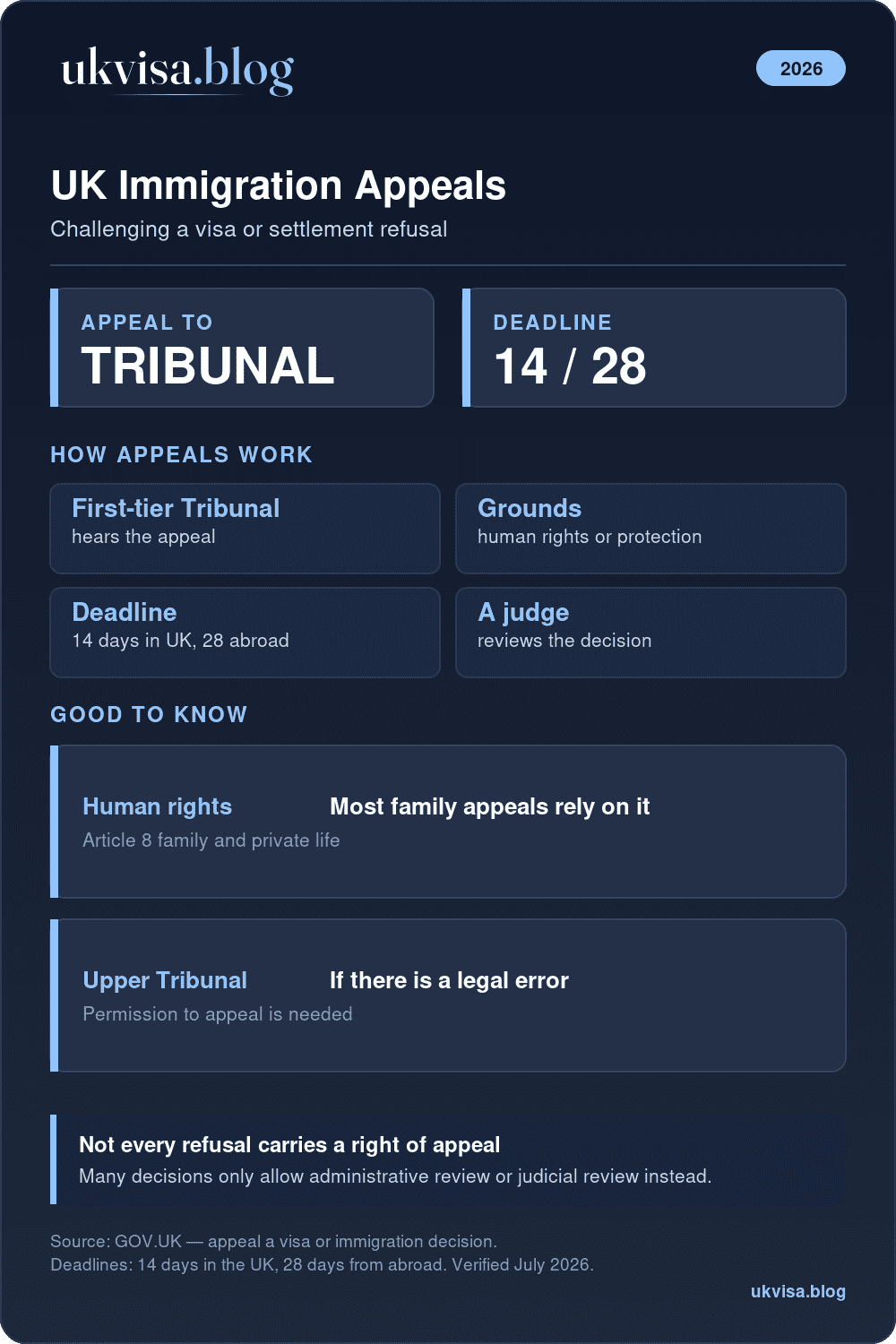
Not all UK visa refusals carry appeal rights. Your right to lodge a UK immigration appeal depends on the type of visa refused and the grounds for refusal. Appeal rights exist under section 82 of the Nationality, Immigration and Asylum Act 2002 only where the decision refuses a protection claim, refuses a human rights claim, or revokes protection status.
Which Visa Refusals Have Appeal Rights?
Appeal rights typically exist for: asylum and protection claims, decisions revoking refugee status, human rights claims under Article 8 ECHR (right to family and private life), and certain family visa refusals. Most visitor, student, and work visa refusals do NOT have appeal rights unless they engage human rights grounds — these generally have administrative review instead.
| Decision Type | Appeal Right? | Alternative |
|---|---|---|
| Asylum/Protection Claim | Yes | — |
| Refugee Status Revocation | Yes | — |
| Human Rights Claim (Article 8) | Yes | — |
| Family Visa (Spouse/Partner) | Yes (Article 8) | — |
| Visitor Visa Refusal | Usually No | Reapply or Judicial Review |
| Student Visa Refusal | Usually No | Administrative Review |
| Skilled Worker Visa Refusal | Usually No | Administrative Review |
Your refusal letter from Home Office will confirm whether you have the right to appeal and provide the deadline for lodging your appeal. If you believe you should have appeal rights but they have not been granted, seek legal advice immediately.
Asylum & Refugee Status Appeals
Asylum seekers whose claims are refused have the right to appeal to the First-tier Tribunal. The appeal focuses on whether you have a genuine fear of persecution or serious harm in your home country. You can submit new evidence and have your case heard by an independent immigration judge who will assess whether the Home Office made the correct decision.
Asylum appeals are the largest category of immigration appeal heard by the First-tier Tribunal — and the most congested, with 87,450 pending at the end of March 2026. If your asylum claim has been refused, you typically have 14 days to appeal if you're in the UK. The tribunal will consider whether returning you to your home country would breach the UK's obligations under the Refugee Convention or the European Convention on Human Rights.
Types of Asylum & Protection Appeals
- Asylum refusal: Appeal against refusal of refugee status based on fear of persecution
- Humanitarian protection refusal: When asylum is refused but you claim serious harm risk
- Refugee status revocation: When the Home Office seeks to remove your refugee status
- Deportation with protection claim: When facing deportation but claiming protection grounds
Human Rights Appeals (Article 8 ECHR)
Human rights appeals under Article 8 ECHR protect your right to respect for private and family life. These appeals arise when a Home Office decision would disproportionately interfere with your established life in the UK — such as long residence claims, parent-child relationships, or private life route applications. The tribunal must balance immigration control against your human rights.
Article 8 of the European Convention on Human Rights protects your right to private and family life. If a Home Office decision would result in separation from family members in the UK or disrupt your established private life, you may be able to appeal on human rights grounds. Spouse and partner refusals are the largest single category of Article 8 appeals — see our dedicated spouse visa refusal appeal route for the full process timeline and costs specific to family visa appeals.
Common Human Rights Appeal Scenarios
- Long residence: Living in the UK for 20+ years (or lawfully for 10+ years) and facing removal
- Private life route: Established life in UK with significant ties making removal disproportionate
- Parent-child separation: British citizen child or child with long UK residence
- Spouse/partner refusals: See our guide on spouse visa refusal grounds covering Appendix FM failures
- Exceptional circumstances Family visa: Compelling compassionate factors making removal unjustifiably harsh
Visitor, Student & Work Visa Appeals
Most visitor, student, and work visa refusals do NOT have appeal rights. Instead, you typically have two options: request an administrative review (where the Home Office checks for caseworking errors) or make a fresh application addressing the reasons for refusal. Appeals only exist if the refusal engages human rights grounds.
Options After Visitor Visa Refusal
If your visitor visa is refused, your options typically include:
- Reapply: Make a fresh application addressing the reasons for UK visa refusal with stronger evidence
- Judicial review: Pursue judicial review of the refusal decision in the Upper Tribunal or High Court (procedural errors only — expensive and rarely successful)
- Reconsideration: Submit a free, discretionary reconsideration request — no guaranteed response, but costless where exceptional circumstances apply
- Appeal (rare): Only if the refusal engaged human rights grounds (e.g., attending a funeral of close family member)
For most visitor visa refusals, reapplying with improved documentation is more practical than pursuing legal challenges. See our guide on chances of getting a visa after refusal for advice on strengthening your next application.
First-tier Tribunal Appeal Process
The First-tier Tribunal (Immigration and Asylum Chamber) hears initial immigration appeals. The process involves lodging your appeal within 14-28 days of refusal, paying the fee (£80-£140), exchanging evidence bundles with the Home Office, and attending a hearing where an independent judge decides your case. Most appeals now take 12 to 18 months from lodging to decision; asylum appeals concluded in early 2026 averaged 67 weeks.
- Step 1: Check your refusal letter confirms you have appeal rights
- Step 2: Complete form IAFT-1 (in-country) or IAFT-2 (out-of-country)
- Step 3: Pay the appeal fee (£80 paper / £140 oral hearing)
- Step 4: Submit within deadline: 14 days (UK) or 28 days (overseas)
- Step 5: Prepare your evidence bundle with all supporting documents
- Step 6: Attend hearing (in-person, video link, or paper determination)
- Step 7: Receive decision (usually within 4 weeks of hearing)
If you lodge an in-country appeal in time while holding valid leave, your immigration status is preserved by the Section 3C statutory extension until the appeal is finally determined — you are not an overstayer while the appeal is pending, although travelling abroad can end that protection.
Appeal Processing Time and Success Rates
| Metric | 2026 Data (Q1 2026 Tribunal Statistics) |
|---|---|
| Asylum Appeals Pending | 87,450 (record high, March 2026) |
| Mean Age of Asylum Appeal at Conclusion | ~67 weeks (up from 48 weeks in 2024) |
| Human Rights / Family Appeals | Typically 12–18 months lodging to decision |
| First-tier Tribunal Success Rate | ~48% of appeals allowed |
| Paper Hearing Fee | £80 |
| Oral Hearing Fee | £140 |
For current statistics, see the official Tribunal Statistics, and compare appeal outcomes against route-level grant and refusal rate data before deciding whether to appeal or reapply. If your case is experiencing delays beyond the average, see our guide on UK Home Office processing delays.
Upper Tribunal & Court of Appeal
If your First-tier Tribunal appeal is dismissed and you believe the judge made a legal error, you can seek permission to appeal to the Upper Tribunal (Immigration and Asylum Chamber). The Upper Tribunal only considers whether there was a legal error in the First-tier decision — it does not rehear the entire case. The success rate at the Upper Tribunal is approximately 59% for substantive hearings.
UK Immigration Appeal Hierarchy
| Level | Considers | Success Rate |
|---|---|---|
| 1. First-tier Tribunal | Facts and law; new evidence allowed | ~48% |
| 2. Upper Tribunal | Legal errors only | ~59% |
| 3. Court of Appeal | Points of law only | Varies |
| 4. Supreme Court | Cases of public importance | Rare |
Appeals to the Upper Tribunal and beyond require legal representation. If you believe the First-tier Tribunal made a legal error in your case, you should seek advice from an immigration solicitor immediately, as strict time limits apply for seeking permission to appeal.
- Appeal rights: typically exist for asylum, human rights, and refugee status decisions
- Most visitor, student, and work visa refusals have administrative review, not appeal
- Appeal deadlines: 14 days (in-UK) or 28 days (overseas)
- Appeal fees: £80 (paper) or £140 (oral hearing)
- Timelines 2026: 12–18 months typical; asylum appeals average 67 weeks at conclusion, backlog 87,450
- Success rates: ~48% at First-tier Tribunal; Upper Tribunal ~59% (legal errors only)
For official guidance on the immigration appeal process, visit gov.uk Immigration and Asylum Tribunal.
Frequently Asked Questions about UK Immigration Appeal
Most visitor visa refusals do not carry appeal rights. Your main options are to reapply with stronger evidence addressing the refusal reasons, or in rare cases, seek judicial review if there were procedural errors. Appeal rights only exist if the refusal engaged human rights grounds (e.g., preventing you from attending a close family member's funeral).
An immigration appeal goes to an independent tribunal that can overturn the Home Office decision based on law and evidence — you can submit new evidence and have your case fully reconsidered. An administrative review is an internal Home Office process that only checks for caseworking errors in the original decision — it cannot consider new evidence or reassess the merits of your case.
Most First-tier Tribunal appeals now take 12 to 18 months from lodging to decision. Asylum appeals concluded in the January–March 2026 quarter averaged 67 weeks, and with a record 87,450 asylum appeals pending, cases entering the queue now face longer waits. Human rights and family appeals typically conclude somewhat faster. If your appeal goes to the Upper Tribunal, add an additional 6–12 months to the timeline.
The success rate at the First-tier Tribunal is approximately 48%. At the Upper Tribunal, the success rate for substantive hearings is approximately 59%. Success rates vary by case type — asylum appeals have different outcomes than human rights appeals, and spouse and partner appeals typically succeed in 40 to 55% of cases. Proper preparation and legal representation significantly improve your chances.
You must lodge your appeal within 14 calendar days if you are in the UK, or 28 calendar days if you are outside the UK. The deadline runs from the date the decision notice was sent to you — not from when you read it. Late appeals are accepted only where the Tribunal exercises its discretion to extend time, so lodging promptly is essential to preserve your right to appeal.
Yes, you can submit new evidence during your immigration appeal to the First-tier Tribunal. This is one of the key advantages of an appeal over an administrative review. New evidence should directly address the reasons for refusal and must be submitted before the tribunal's deadline for evidence exchange.
If your appeal is allowed, the Home Office must reconsider its decision in light of the tribunal's findings. They may either accept the decision and grant your visa/status, or seek permission to appeal to the Upper Tribunal within the applicable deadline. If they don't challenge the determination, you'll receive instructions about obtaining your visa or status confirmation.
Legal representation is not mandatory but strongly recommended, especially for complex cases. Immigration law is highly technical, and experienced solicitors can significantly improve your chances of success. For asylum appeals, you may qualify for legal aid. For other appeals, consider seeking advice from an immigration solicitor to assess your case strength before proceeding.