
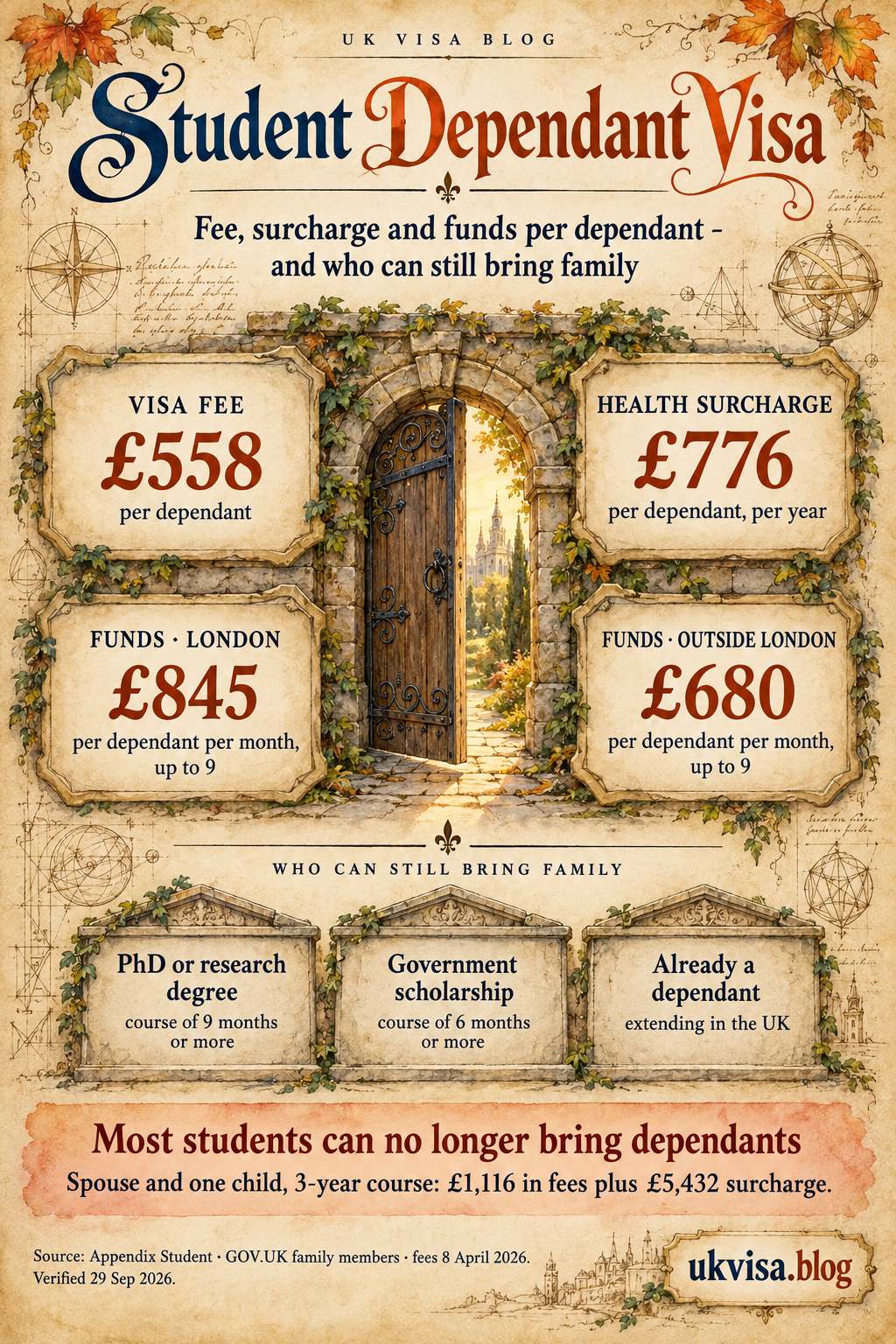
Since 1 January 2024 the Student dependant visa has been closed to most students. Only doctoral and research students, and those funded by a national government, can bring a partner or children — plus one overlooked group: students whose family were already their dependants. Each dependant shows £845 a month for up to nine months and pays £558 plus £776 a year in health surcharge.
UK Student Visas
UK Student Dependant Visa 2026: Who Qualifies, Funds and Work Rights
Who Can Bring Dependants on a Student Visa
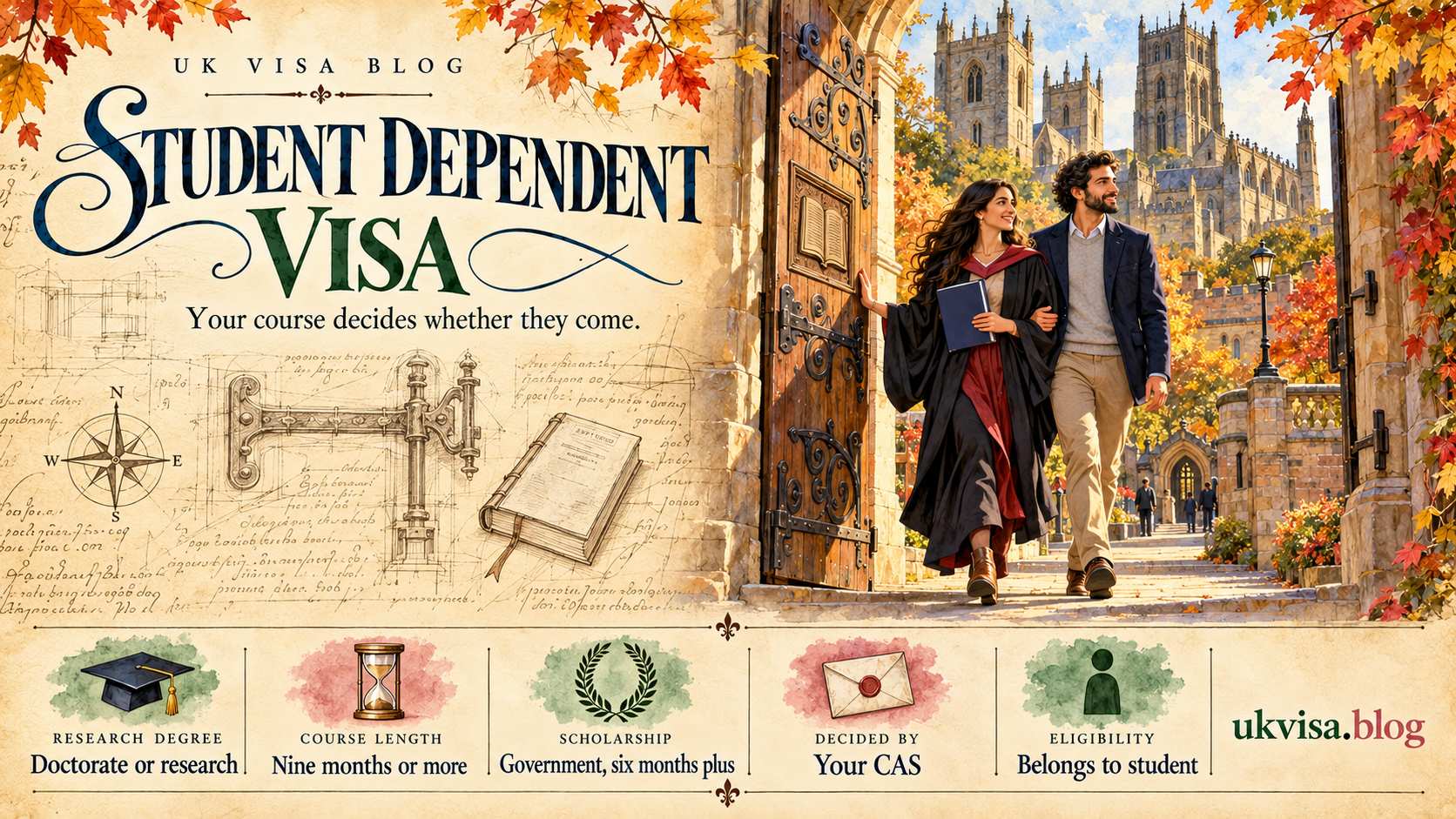
Three groups. Students on a course above degree level lasting nine months or more at a compliant higher education provider, where a course starting on or after 1 January 2024 is confirmed as a doctorate or a research-based higher degree. Students holding a national government scholarship for a course of six months or more. And students continuing from an earlier course of six months or more, for family who were already their dependants.
The rules sit at ST 31 of Appendix Student. Eligibility belongs to the student, not the family member: whether your partner can come is decided entirely by what you are studying and who is paying for it. The route itself is covered in our Student visa requirements guide.
The Research Requirement Is Decided by the CAS
A course label is not enough. Your sponsor confirms the level on the CAS through the Academic Course Level field, which distinguishes taught from research programmes at RQF 7 and RQF 8. A research-based higher degree is defined at paragraph 6.2(b) of the Rules as a programme whose research component — including a requirement to produce original work — is larger than any taught component measured by student effort.
So an MRes may qualify and an MSc by research may qualify, but neither does so because of its name. Check what your sponsor has recorded before you plan around it. Students on an integrated pre-master and research master programme applying with a combined CAS do meet the requirement.
What Changed in January 2024
Until then, any postgraduate course of nine months or more at a compliant higher education provider carried the right to bring family. From 1 January 2024 that right narrowed to doctorates and research-based higher degrees, closing the route to taught master’s students — the largest group by far.
Government Sponsorship Means a National Government
The sponsorship exception is narrower than it is usually described. The guidance requires the award to come from a national government department — HM Government or your own — which provides the funds, sets the eligibility criteria and assesses whether you met them. Where a separate body does any of that, it does not qualify, whatever the scheme is called.
HM Government schemes include the Marshall Scholarship, Chevening, the Commonwealth Shared Scholarship Scheme, Fulbright and IAESTE, and the list is not exhaustive. Relying on another country’s award, you will normally need a letter from the sponsor confirming it comes from a national government. The award need not cover your full fees and living costs, but where it does not, you must evidence the shortfall — and if it does not cover your dependants’ living costs, you must evidence theirs separately.
Appendix Student ST 31 keeps a door open that almost no guide mentions. A student who holds permission — or held it within the last three months — to study a full-time course of six months or more, and who is now applying for another full-time course of six months or more, may bring a partner or child who was already their dependant during that period. The same applies to a child born since the last grant, applying at the same time as the student or the dependant partner. This is not conditional on the new course being research-based. If your family were your dependants on an earlier course, take advice before assuming the 2024 rules shut you out.
Who Counts as a Dependant
Four categories only: a husband, wife or civil partner; an unmarried partner; and a child under 18 of either the student or their partner, including a child born in the UK during the stay. Child Students cannot bring dependants at all, and neither can a student whose course runs under six months.
Partners
The relationship requirement runs through ST 32 and Appendix Relationship with Partner, so the evidence rules are the same ones used across sponsored routes. Married and civil partners produce the certificate. Unmarried partners must show a relationship akin to marriage or civil partnership subsisting for at least two years before the application, evidenced across that period rather than bunched into recent months.
Where a caseworker doubts the relationship evidence, they may require an interview. Failure to attend without a reasonable explanation is itself a refusal ground, and rearranging is only possible where the interview team accepts the reasons given.
Children
A child must be under 18 at the date of application, unmarried and not in a civil partnership, and living with you unless away in full-time education. Two documents confirming their address are required — bank statements, credit card bills, a driving licence, NHS registration or an official letter from their university or college. If your child pays you rent or upkeep, you must give details. The age, care and relationship tests sit in the Appendix Children requirements.
Financial Requirements for Dependants
Each dependant shows their own living costs, on top of yours. The figure does not vary by city: £845 a month if you are studying in Greater London, £680 a month if you are not, capped at nine months in both cases.
Funds Required by Applicant
| Applicant | Per month | Nine-month maximum |
|---|---|---|
| Student, in London | £1,529 | £13,761 |
| Student, outside London | £1,171 | £10,539 |
| Each dependant, student in London | £845 | £7,605 |
| Each dependant, student outside London | £680 | £6,120 |
Source: Appendix Student ST 12, ST 33 and ST 37; GOV.UK Student route family members page.
A doctoral student in London with a spouse therefore evidences £13,761 plus £7,605 — £21,366, before any outstanding tuition. Outside London with a spouse and two children it is £10,539 plus three lots of £6,120, or £28,899. The main student’s own rules are in our Student visa financial requirements guide.
Where the Nine Months Is Counted From
Dependants evidence funds for the period they would be granted, up to nine months, and the start date is not always obvious. Applying for entry clearance it runs from the intended travel date or one month before the student’s course starts, whichever is later. Extending as an existing Student dependant, it runs from the day after current permission expires. Switching from another points-based route, it runs from the date of application.
Exemptions and Differential Evidence
A dependant who has held UK permission for 12 months or more at the date of application meets the requirement automatically. Separately, a dependant applying at the same time as the student may fall under the differentiation arrangements at ST 22.1 and be excused from filing funds evidence — but not from holding it, and if requested documents are not produced the caseworker must refuse.
Even under differentiation, a dependant must still supply their passport, their biometric residence permit, evidence of the relationship, evidence that a partner’s relationship is subsisting, and evidence of dependence — the last applying to children living away from home too.
Documents to Prepare
Two evidence problems account for most avoidable refusals: relationship evidence that is thin or clustered, and funds evidence that fails the 28-day test. Everything else is administrative.
- Passport: valid, and identity proved either through the UK Immigration: ID Check app or at a visa application centre.
- Relationship: marriage or civil partnership certificate, or two years of evidence for an unmarried partner; birth certificate for a child.
- Child’s address: two documents confirming where they live, plus details of any rent or upkeep paid to you.
- Funds: bank or building society statements meeting Appendix Finance, held 28 consecutive days ending within 31 days of the application.
- Sponsorship, if relied on: a letter from the student’s official financial sponsor stating that it covers the dependants’ living costs and naming them.
- TB certificate: required where the dependant is coming for more than six months and their country is listed in Appendix Tuberculosis.
- The student’s details: the application number, or CAS and status details where the student has already been granted.
Work and Study Rights
The contrast with the main student is stark. A Student dependant may take employment in the UK subject to normal employment law, with no weekly cap and no bar on self-employment — while the student is held to 20 hours a week and cannot be self-employed at all, as our guide to Student visa working hours sets out.
The Two Situations That Remove Work Rights
Employment is lost in two defined cases. Where the dependant is granted leave having previously been the dependant of a student on a full-time course of six months or longer, and the student is now applying for a new full-time course of under nine months — unless the student is continuing a course for which at least nine months’ permission was already granted. And where the student’s new course is below degree level.
What a Dependant Still Cannot Do
No access to public funds, and no employment as a professional sportsperson, including as a sports coach. Study is permitted at any level, but a dependant studying while over 18 is subject to the ATAS condition and cannot begin a course in a discipline covered by Appendix ATAS without a certificate obtained beforehand.
Applying: Timing, Fees and Grants
Dependants do not have to apply with you. They may apply at the same time, or later for entry clearance to join you, or from inside the UK for permission to stay — the exception being where the application relies on the continuing-dependant provision, which requires applying together.
Fees for Each Dependant
| Charge | Amount |
|---|---|
| Application fee, inside or outside the UK | £558 |
| Immigration Health Surcharge, per year | £776 |
| Priority service, where offered | £500 |
| Super Priority service, where offered | £1,000 |
Source: Home Office immigration and nationality fees, 8 April 2026. Dependants pay the discounted student surcharge rate, not £1,035.
A doctoral student with a spouse and one child applying from overseas for three years therefore faces £1,674 in fees and £6,984 in surcharge — £8,658 before tuition or maintenance. Route-by-route pricing is in our breakdown of current UK visa charges.
How Long the Permission Runs
A dependant is granted in line with the expiry of the student’s permission. The one variation concerns a dependant child where a parent in the UK holds permission expiring earlier — the child is then granted in line with whichever parent’s leave expires first. Where a dependant applies after the student has already been granted, they too are granted to the student’s end date.
Switching In from Another Route
Someone already in the UK cannot switch into the Student dependant route if they hold, or last held, permission on one of the routes listed at ST 28.4. The guidance allows that there may be other reasons a person in those circumstances should be permitted to switch, to be considered case by case — which is a reason to take advice rather than simply to apply.
Why Dependant Applications Are Refused
The commonest cause since 2024 is the simplest: the student is on a course that does not permit dependants, and no amount of evidence cures that. Beyond it, refusals cluster around relationship evidence, the 28-day rule, a missing TB certificate, and adverse immigration history.
The Dependency of the Dependant Application
A dependant can only be granted where the student already holds permission or is being granted it at the same time. If the student’s application is decided and not granted, the dependant fails ST 32 and is refused with them. Where credibility is the student’s problem, the answer lies in their case rather than the family’s — our credibility interview guide covers what is assessed.
Which Paragraph You Were Refused Under
Refusal notices cite the paragraph, and it tells you what to fix: ST 29 for suitability, ST 30 for entry, ST 31 for the student’s course, ST 32 for a partner’s relationship, ST 33 or ST 37 for finances, and ST 36A.1 with the Appendix Children requirements for a child’s relationship, care or age. Our guide to common refusal grounds covers the wider picture, and a poor immigration history can also bring a re-entry ban into play.
What Comes Next for the Family
When the student moves to the Graduate route, dependants can usually follow as dependants there, but the surcharge reverts to the standard rate. A student intending to build a business must switch routes first, as our guide to starting a business on a Student visa explains. Courses of six months or less run on the Short-term study route, which permits no dependants at all.
Sources: Appendix Student ST 28 to ST 39 and paragraph 6.2(b); Appendix Relationship with Partner; Appendix Children requirements; Appendix Finance FIN 5.1 and FIN 8.1; Appendix Tuberculosis; Student and Child Student caseworker guidance, version 14.0, published for Home Office staff on 3 August 2026; the GOV.UK Student route family members page; Home Office immigration and nationality fees, 8 April 2026. Figures verified 22 August 2026.
Frequently Asked
Questions about Student Dependants
Not on the strength of the course itself. For a course starting on or after 1 January 2024, the sponsor must confirm on the CAS that it is a doctorate or a research-based higher degree. Two other doors remain open: a scholarship from a national government for a course of six months or more, and the continuing-dependant provision where your partner was already your dependant on an earlier course of six months or longer.
Paragraph 6.2(b) of the Rules defines it as a postgraduate programme whose research component, including a requirement to produce original work, is larger than any taught component when measured by student effort. The label is not decisive — your sponsor records the answer on the CAS through the Academic Course Level field, which separates taught from research programmes at RQF 7 and RQF 8.
£845 a month if you study in Greater London, £680 a month if you study outside it, in each case for up to nine months — £7,605 or £6,120. That sits on top of your own maintenance. Funds must be held for 28 consecutive days ending within 31 days of the application, unless the dependant has had UK permission for 12 months or more at the date of application.
No. The award must come from a national government department — HM Government or your own government — which provides the funds, sets the eligibility criteria and assesses whether you met them. Where a separate body performs any of those functions it does not qualify. Marshall, Chevening, the Commonwealth Shared Scholarship Scheme, Fulbright and IAESTE are named examples, and the list is not exhaustive.
Yes, with no hours cap and no bar on self-employment, subject to ordinary employment law. They cannot access public funds or work as a professional sportsperson, including as a sports coach. Work rights are lost in two cases: where your new full-time course is under nine months following a previous course of six months or more, and where your new course is below degree level.
Yes, at any level. A dependant who begins study while over 18 is subject to the ATAS condition, which prohibits starting a course in a discipline covered by Appendix ATAS without first obtaining an Academic Technology Approval Scheme certificate. There is no English language requirement for dependants at any point — that applies only to the main Student applicant.
Usually not. They may apply with you, or later for entry clearance to join you, or from inside the UK for permission to stay. The exception is where the application relies on the continuing-dependant provision, which requires applying together. Either way, a dependant can only be granted where you already hold Student permission or are being granted it at the same time.
In line with the expiry of your permission. The one exception concerns a dependant child where a parent in the UK holds permission expiring earlier than yours — the child is granted to whichever parent’s leave expires first. When you extend, your dependants extend with you; when you move to another route, they normally apply as dependants there, subject to that route’s own rules.
Switching into the Student dependant route is barred where they hold, or last held, permission on one of the routes listed at ST 28.4. The guidance accepts there may be other reasons a person in those circumstances should be allowed to switch, decided case by case — so it is worth taking advice rather than submitting and hoping, since a refusal becomes part of their immigration history.
If they are coming for more than six months and are applying from a country listed in Appendix Tuberculosis, yes. It is a common and entirely avoidable cause of refusal, because the requirement attaches to the dependant’s own application rather than yours. Check the listed countries before booking anything, since certificates have a limited validity period.