
A human rights application argues that refusing you would breach a Convention right — most often family or private life under Article 8, occasionally Article 3 on medical grounds. It is made on the FLR(HRO) application, costs £1,407 from 8 April 2026, and is one of the few contexts where a fee waiver exists.

Human Rights
Human Rights Applications and FLR(HRO)
What the Application Is
FLR(HRO) is the online application to extend your stay for human rights claims, leave outside the rules, and other routes not covered by another form. It is the application for cases the ordinary rules do not accommodate, where the argument is that removal would be unlawful rather than that a rule is met.
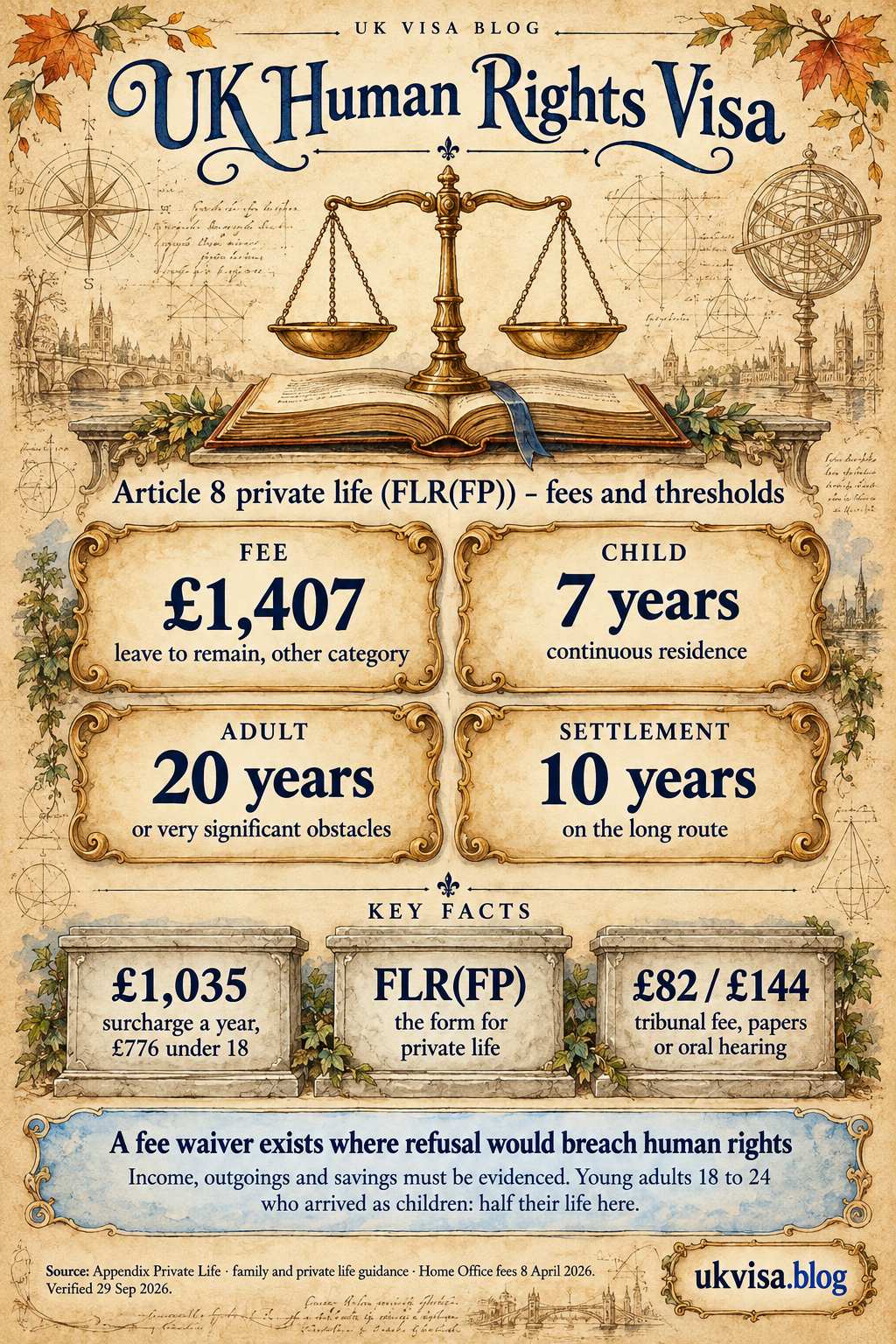
Leave to remain on the other category costs £1,407 from 8 April 2026, up from £1,321, plus the health surcharge. Appendix Private Life requires seven years’ continuous residence for a child, half their life for a young adult aged 18 to 24 who arrived as a child, and either twenty years’ residence or very significant obstacles to integration for an adult. Settlement follows a further five-year qualifying period.
Inside the Rules or Outside Them
Two things are often conflated. Appendix FM and Appendix Private Life contain human rights based provisions inside the Immigration Rules, with defined tests. Leave outside the rules is a separate exercise of discretion where nothing in the Rules fits. Identifying which you are relying on shapes the application and its evidence — see our page on exceptional circumstances in family cases.
The Kinds of Claim
- Article 8 family life: where removal would separate you from a partner, child or close family member in the UK.
- Article 8 private life: where your life established here makes removal disproportionate.
- Article 3 medical: where removal would expose you to a serious risk of inhuman or degrading treatment.
- Leave outside the rules: where compelling or compassionate circumstances justify a grant that no rule provides for.
Family Life
The strongest family life claims involve a British or settled partner, or children in the UK. Where a child is involved, their best interests are a primary consideration, and the reasonableness of expecting a child to leave the UK is a distinct question from the parent’s own position.
- The relationship over time: cohabitation, joint finances, correspondence and photographs across the relationship’s history.
- The children’s position: schooling, friendships, medical needs and length of residence.
- The partner’s ties: employment, family and any obstacle to relocating.
- Why family life cannot continue elsewhere: the insurmountable obstacles question.
- Independent evidence: letters from schools, doctors, employers and community organisations.
Where the family rules can be met, meeting them is better: Appendix FM leads to settlement in five years rather than ten. See our spouse route page.
Private Life
Appendix Private Life sets defined thresholds. A child must have been continuously resident in the UK for at least seven years. A young adult aged 18 to 24 who arrived as a child must have spent at least half their life continuously resident here. An adult must have either more than twenty years’ continuous residence, or face very significant obstacles to integration in the country they would have to go to.
It is not about preference, or about life being harder elsewhere. It asks whether you could establish a private life of substance in the country of return — language, family, cultural familiarity, the ability to work and to access services. Homesickness and a better standard of living here do not meet it.
Settlement on the private life route follows a further five-year qualifying period with eligible permission, which is why it is described as the ten-year route. See our page on the private life route.
The Seven-Year Child Provision in Practice
A child with seven years’ continuous residence is the single most powerful factor in many family cases, because it engages both the private life provision and the separate question of whether it is reasonable to expect that child to leave the UK. Seven years is not a threshold that grants permission automatically, but it changes what has to be justified and by whom.
Evidence about the child is what carries it: how long they have been in school here, what their education looks like, their friendships, any medical needs, and what they know of the country of return. A parent’s account of their own hardship, however genuine, is a weaker argument than a school’s account of the child’s life.
Medical Grounds
Article 3 medical claims are rare and demanding. The threshold set by the courts is not simply that treatment is better in the UK: it asks whether removal would expose the person to a real risk of a serious, rapid and irreversible decline in health resulting in intense suffering or a significant reduction in life expectancy.
Evidence has to be specific and clinical: the diagnosis, the current treatment, what would happen without it, and what is actually available and accessible in the country of return — including cost and geography, not merely whether a drug exists there. This is a category where expert medical and country evidence is essential.
Fees
Costs From 8 April 2026
| Item | Previous | From 8 April 2026 |
|---|---|---|
| Leave to remain, other category | £1,321 | £1,407 |
| Health surcharge, standard rate | £1,035 a year | £1,035 a year |
| Health surcharge, under 18 | £776 a year | £776 a year |
| Super priority, where available | £1,000 | £1,000 |
Source: Home Office immigration and nationality fees, 8 April 2026. Checked 22 August 2026.
Each family member pays separately. For a household on the ten-year route, that is four applications and four surcharge blocks at each stage, repeated across a decade — see our page on the health surcharge.
Fee Waivers
This is the context in which waivers exist. Where refusing an application would breach human rights and the applicant cannot afford the fee, the fee and the health surcharge can be waived. It is not a general hardship provision and it does not apply on work or study routes.
- Income evidence: for everyone in the household, including any support received.
- Outgoings: rent, utilities, food and essential costs, documented.
- Savings and assets: bank statements across the relevant period.
- Accommodation: whether it is adequate and how it is paid for.
- Any support from third parties: declared and explained.
The waiver is decided before the substantive application proceeds, which adds time. Applying for one and being refused does not defeat the application, but it does mean the fee then has to be paid within the period given.
How Long It Takes
These are the slowest in-country applications. Partner applications made on a private life basis, and parent applications, are published at twelve months against an eight-week standard for most other routes. A fee waiver decision comes first, extending it further.
Section 3C protects your status throughout, provided the application was made before your existing permission expired. That is what makes a twelve-month wait survivable, and it is why applying in time matters more here than almost anywhere — see our page on 3C leave.
Suitability Still Applies
A human rights claim does not disapply Part Suitability. Criminality, deception and previous breaches all still bite, and in the strongest cases they are weighed against the Article 8 interests rather than simply defeating them. A deception finding in the history makes a private life claim substantially harder without necessarily making it impossible.
The practical consequence is disclosure. A history that emerges from the Home Office’s own records, rather than from the application, converts a case about proportionality into a case about credibility — and credibility is the harder of the two to rebuild. See our pages on re-entry ban periods and our guide to the FLR applications.
What Makes These Applications Succeed
Specificity. A claim that asserts family life without documenting it, or asserts obstacles to integration without evidencing them, gives the decision maker nothing to weigh. The applications that succeed read like a case file: independent evidence, dated, from people with no interest in the outcome.
Where children are involved, evidence about the children rather than about the parents is what carries the argument — school letters, medical records, length of residence, and what moving would actually mean for them. Our page on suitability refusal grounds covers the suitability issues that can defeat an otherwise strong claim.
Take Advice on These
This is the category where representation changes outcomes most. The tests are evaluative rather than documentary, the evidence has to be assembled and framed rather than simply attached, and the consequences of a refusal — including for children — are more serious than on any route where a second application is a straightforward remedy.
Appeals
A refused human rights claim usually carries a right of appeal to the First-tier Tribunal, which is a significant advantage over most immigration decisions. Tribunal fees are £82 for a decision on the papers and £144 for an oral hearing.
Human rights appeals were allowed in around 44% of cases in the first quarter of 2026, against 39% across all immigration appeals — though the mean time to determination was 71 weeks. Section 3C continues while an in-time appeal is pending. See our pages on immigration appeals and judicial review at the Upper Tribunal.
Sources: Appendix Private Life, the Home Office family and private life policy guidance, the Home Office fee table and published tribunal statistics. Figures verified 22 August 2026.
Frequently Asked
Human Rights Application Questions
How much does a human rights application cost?
£1,407 from 8 April 2026, up from £1,321, plus the health surcharge at £1,035 a year or £776 for under-18s. Each family member pays separately.
Can the fee be waived?
Yes, where refusing would breach human rights and you cannot afford it. Income, outgoings, savings and accommodation all have to be evidenced, and the waiver is decided before the application proceeds.
How long must a child have lived here?
At least seven years’ continuous residence under Appendix Private Life. A young adult aged 18 to 24 who arrived as a child must have spent at least half their life here.
What about adults?
More than twenty years’ continuous residence, or very significant obstacles to integration in the country they would have to go to.
What counts as a very significant obstacle?
Something going to whether you could establish a private life of substance there — language, family, cultural familiarity, work and access to services. A lower standard of living does not meet it.
How long does settlement take on this route?
A further five-year qualifying period with eligible permission after the first grant, which is why it is called the ten-year route.
How long does a decision take?
Private life partner applications and parent applications are published at twelve months, against eight weeks for most other in-country routes. A fee waiver decision comes first.
Am I lawfully here while I wait?
Yes, where you applied before your existing permission expired. Section 3C continues it on the same conditions, including during an in-time appeal.
Can I appeal a refusal?
A refused human rights claim usually carries a right of appeal to the First-tier Tribunal. Fees are £82 on the papers and £144 for a hearing.
Does a criminal record defeat a human rights claim?
Not automatically. Suitability grounds still apply and are weighed against the Article 8 interests. Disclose everything: a history the Home Office finds for itself turns a proportionality case into a credibility one.
What difference do seven years make for a child?
It engages the private life provision and the separate question of whether it is reasonable to expect the child to leave. It does not grant permission, but it changes what has to be justified.
Should I use the family rules instead if I can?
Yes where you can meet them. Appendix FM leads to settlement in five years rather than ten, and the requirements are defined rather than evaluative.