
Whether you can bring family depends entirely on the route you are on, and the rules narrowed sharply between 2024 and 2026. Some routes allow dependants with full work rights, some restrict them to defined circumstances, and several allow none at all. Check your own route before making plans.

Dependants
Bringing Family as a Dependant in 2026
There Is No Single Dependant Visa
"Dependant visa" describes a category of application rather than a route. Each route sets its own dependant provisions in its own appendix — who qualifies, what they can do, and whether they are permitted at all. There is no general right to bring family attached to holding a UK visa.
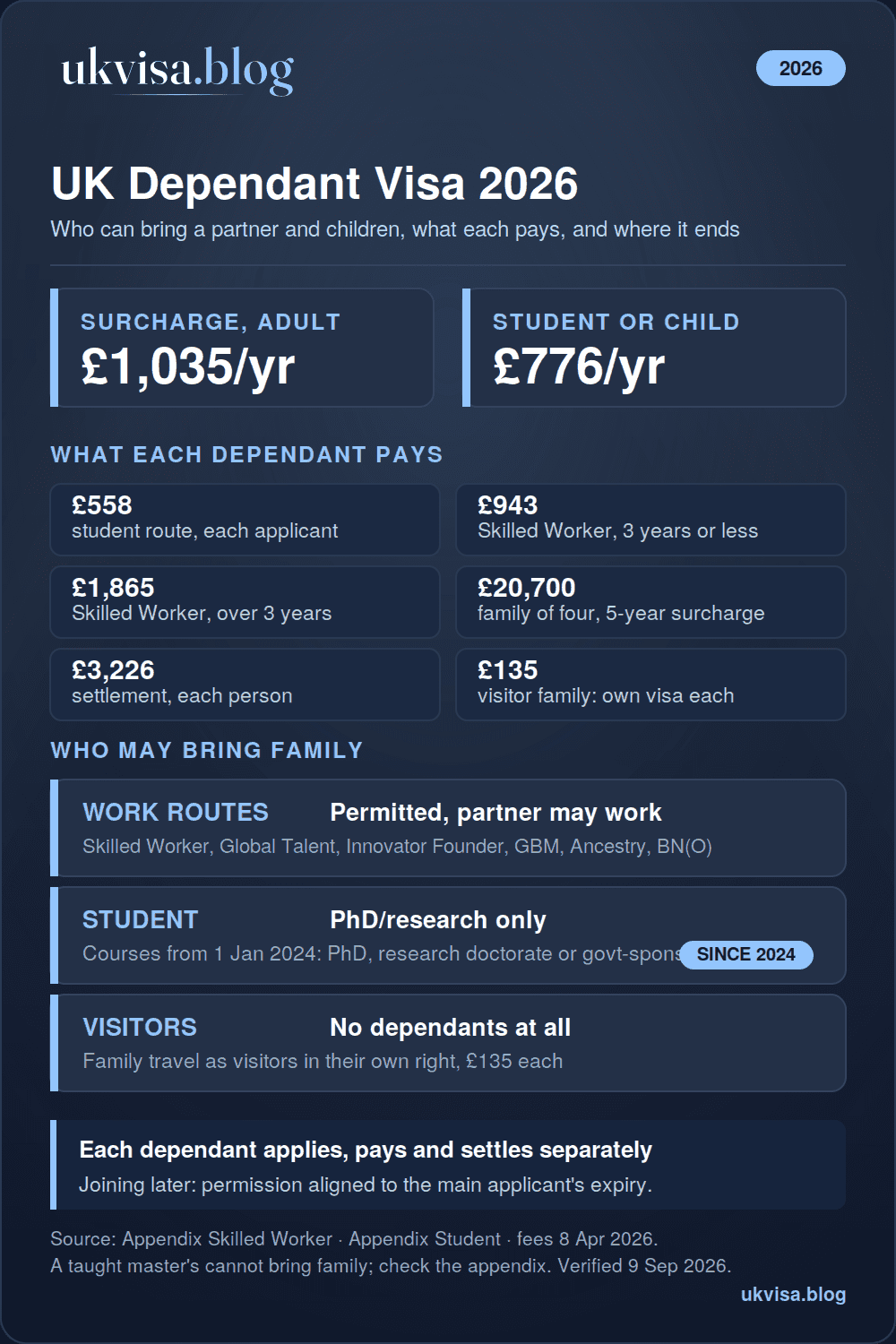
Skilled Worker, Global Talent, Innovator Founder, Global Business Mobility, UK Ancestry and the BN(O) route allow dependants. The student route allows them only for government-sponsored students on courses over six months and for full-time students on PhD or research-based doctoral courses lasting nine months or more. Visitors cannot bring dependants at all. Each dependant pays their own fee and health surcharge.
Everyone Applies Separately
A dependant makes their own application, pays their own fee and their own health surcharge, and gets their own permission with its own expiry date. Where applications are linked and submitted together they are usually decided together, but they are never a single application.
What Changed
The most significant restriction fell on the student route. For postgraduate courses starting on or after 1 January 2024, dependants are permitted only where the course is a PhD or doctorate at RQF level 8, or another research-based higher degree. Taught master's students can no longer bring family.
A twelve-month taught master's at RQF level 7 does not permit dependants under the current rules, even though it is postgraduate and longer than nine months. The distinction is research-based versus taught, and it decides whether a family can come at all.
Restrictions on other routes have followed a similar direction of travel, tightening who may accompany a main applicant and on what terms. Because these have been introduced in stages, guidance and commentary written even a year apart can describe different positions — check the current appendix for your route.
Who Counts as a Dependant
- Spouse or civil partner: with evidence of a genuine and subsisting relationship.
- Unmarried partner: with evidence of cohabitation over the required period.
- Children under 18: at the date of application.
- Children born in the UK: during the main applicant's stay.
- Children over 18 already in the UK as dependants: continuing on the same basis.
Parents, siblings and other relatives are not dependants on work or study routes. Where an elderly parent needs to join a family in the UK, the adult dependent relative route is the correct application, and it is a demanding one.
Children
A child under 18 applies as a dependant of the main applicant. A child born in the UK while the parent holds permission can be added, and does not become British automatically unless a parent is British or settled at the time of birth.
- Birth certificate: naming both parents, with a certified translation where needed.
- Both parents' consent: where only one parent is coming or holds permission.
- Evidence of care arrangements: where the child will not live with both parents.
- Adoption papers: where the relationship arises through adoption.
- Passports: for the child and for any parent not applying.
A child turning 18 during the route continues on their existing permission but is treated as an adult for the health surcharge on later applications, and loses the under-18 exemptions from the knowledge requirements at settlement.
Routes That Allow Dependants
Where Family Can Come
| Route | Dependants | Dependant work rights |
|---|---|---|
| Skilled Worker | Permitted | Generally unrestricted |
| Health and Care Worker | Permitted | Generally unrestricted |
| Global Talent | Permitted | Generally unrestricted |
| Innovator Founder | Permitted | Generally unrestricted |
| Global Business Mobility | Permitted | Generally unrestricted |
| UK Ancestry | Permitted | Generally unrestricted |
| BN(O) | Permitted | Work permitted, with limited exceptions |
| Student, research doctorate or government-sponsored | Restricted | Route-specific |
Source: the route appendices of the Immigration Rules and GOV.UK route pages. Checked 22 August 2026.
See our pages on the Skilled Worker route, Health and Care Worker, the Global Talent route, the Innovator Founder visa, Senior or Specialist Worker and UK Ancestry.
Routes That Do Not
- Visitors: family members travel in their own right as visitors — see our standard visitor page.
- Marriage Visitor: expressly excluded.
- Most taught postgraduate students: under the rules for courses starting from January 2024.
- Undergraduate students: and those below degree level.
- Short-term study: and other temporary categories.
- Parent of a Child Student: which expressly permits no dependants.
Check the Appendix, Not the Summary
Because dependant provisions sit in each route's own appendix and have changed in stages, a general article describing the position a year ago may be wrong about yours today. Read the dependant section of the appendix for your route before committing to a plan that assumes family can follow.
Tier 2 and Other Legacy Names
Tier 2 became Skilled Worker, and dependants of Tier 2 holders continued on equivalent terms. The old names still appear in decision notices, in employer HR documents and in older guidance, but the rules that apply are the current ones in Appendix Skilled Worker.
What Dependant Applications Need
- Relationship evidence: marriage or civil partnership certificate, or cohabitation evidence for unmarried partners.
- The main applicant's status: their permission, or their application if applying together.
- Maintenance funds: at the level the route sets, held for the required period.
- Identity documents: passports for every applicant.
- Tuberculosis certificates: where required for the country lived in.
- Certified translations: for anything not in English or Welsh.
The maintenance requirement is per person and per route, and it is a held-funds test rather than an available-funds one. A transfer arriving days before the application does not meet it, however large.
Applying Together or Following Later
Family can apply at the same time as the main applicant or join later, and the choice has consequences. Applying together means one set of appointments and a single decision point; joining later means the main applicant is established, with accommodation and income evidenced by what is actually happening rather than by what is planned.
Where a dependant joins later, their permission is aligned to the main applicant's expiry rather than running for its own full period. A partner joining eighteen months into a five-year grant gets three and a half years, not five — and pays surcharge for that shorter period accordingly.
Unmarried Partners Need More Evidence
A marriage or civil partnership certificate settles the relationship question in one document. An unmarried partnership does not, and has to be built from cohabitation evidence over the required period: a joint tenancy, correspondence to the same address from independent sources, joint accounts and bills.
Assemble that contemporaneously rather than reconstructing it. Couples who moved country repeatedly, or who kept finances separate, are the ones who find this hardest, and the evidence cannot be created after the fact.
What Dependants Can Do
On most work routes a dependant partner can work without restriction and without their own sponsor, which is one of the route's real advantages. They are not tied to an employer, can be self-employed, and can change jobs freely.
A dependant with a qualifying job of their own can also apply in their own right rather than remaining a dependant. That is worth considering where the relationship's stability is uncertain or where the main applicant's route may end, because permission held in your own name does not depend on someone else's status continuing.
Fees
Each dependant pays the same application fee as the main applicant on most routes — £558 on the student route, and the Skilled Worker fee bands on that route — plus the health surcharge at £1,035 a year, or £776 for students, their dependants and anyone under 18 at the date of application.
For a family, the surcharge dominates. Four people on a five-year grant at the standard rate is £20,700 before a single application fee. Our pages on the health surcharge and processing times cover the practicalities.
Where the Route Ends
A dependant's position tracks the main applicant's through the whole route, including at settlement. Each person applies separately at £3,226, and a dependant who joined partway through reaches their own qualifying point later — often needing one further extension while the main applicant settles.
Map that sequence at the outset rather than at year five. Adult dependants also lose the under-18 exemptions from the Life in the UK test and the English requirement, so a child who joined at fifteen faces requirements at settlement that a child who joined at ten may not.
Switching Out of a Dependant Position
A dependant with a qualifying job can switch to holding permission in their own right, which removes the dependency on someone else's status entirely. It is a full application against that route's requirements — being in the UK already helps with the practicalities, not with the criteria.
If a Dependant Application Is Refused
Read the notice for the paragraph. The recurring grounds are relationship evidence that does not establish a genuine and subsisting relationship, maintenance funds not held for the required period, and applying on a route that does not permit dependants at all.
The first two are evidential and usually fixed by a fresh application. The third is structural, and the answer is a different route rather than better evidence. See our pages on reading a refusal letter and on proving status once permission is granted.
Sources: Appendix Skilled Worker, Appendix Student, Appendix FM and the GOV.UK route pages. Figures verified 22 August 2026.
Frequently Asked
Dependant Visa Questions
Can students bring dependants?
Only government-sponsored students on courses longer than six months, and full-time students on PhD, doctoral or research-based higher degrees lasting nine months or more.
Can a taught master's student bring family?
Not for courses starting on or after 1 January 2024. The distinction is research-based versus taught, not the RQF level or the length.
Who counts as a dependant?
A spouse, civil partner or unmarried partner, and children under 18. Parents, siblings and other relatives do not qualify on work or study routes.
Can my dependant partner work?
On most work routes, without restriction and without their own sponsor. They can also apply in their own right if they have a qualifying job.
How much does a dependant cost?
The same application fee as the main applicant on most routes, plus the health surcharge at £1,035 a year, or £776 for students, their dependants and under-18s.
Can visitors bring dependants?
No. Family members travel as visitors in their own right, each with their own application and their own £135 fee.
What about a child born in the UK?
They can be added as a dependant. They do not become British automatically unless a parent is British or settled at the time of birth.
Do dependants settle when the main applicant does?
No. Each applies in their own right, meets the requirements that apply to them, and pays their own £3,226. Timing rarely lines up neatly.
What happens if the relationship ends?
A dependant's permission derives from the main applicant's. Take advice quickly: there may be a route to apply in your own right, but the options narrow once permission lapses.
Should my family apply with me or follow later?
Either works. Joining later means their permission is aligned to your expiry rather than running a full period, so a partner joining halfway through a five-year grant gets the remainder, not five years.
What evidence does an unmarried partner need?
Cohabitation over the required period, built from a joint tenancy, independent correspondence to the same address, joint accounts and bills. It cannot be reconstructed after the fact.
Can I bring my parents?
Not as dependants on a work or study route. The adult dependent relative route is the correct application, and it is a demanding one.