
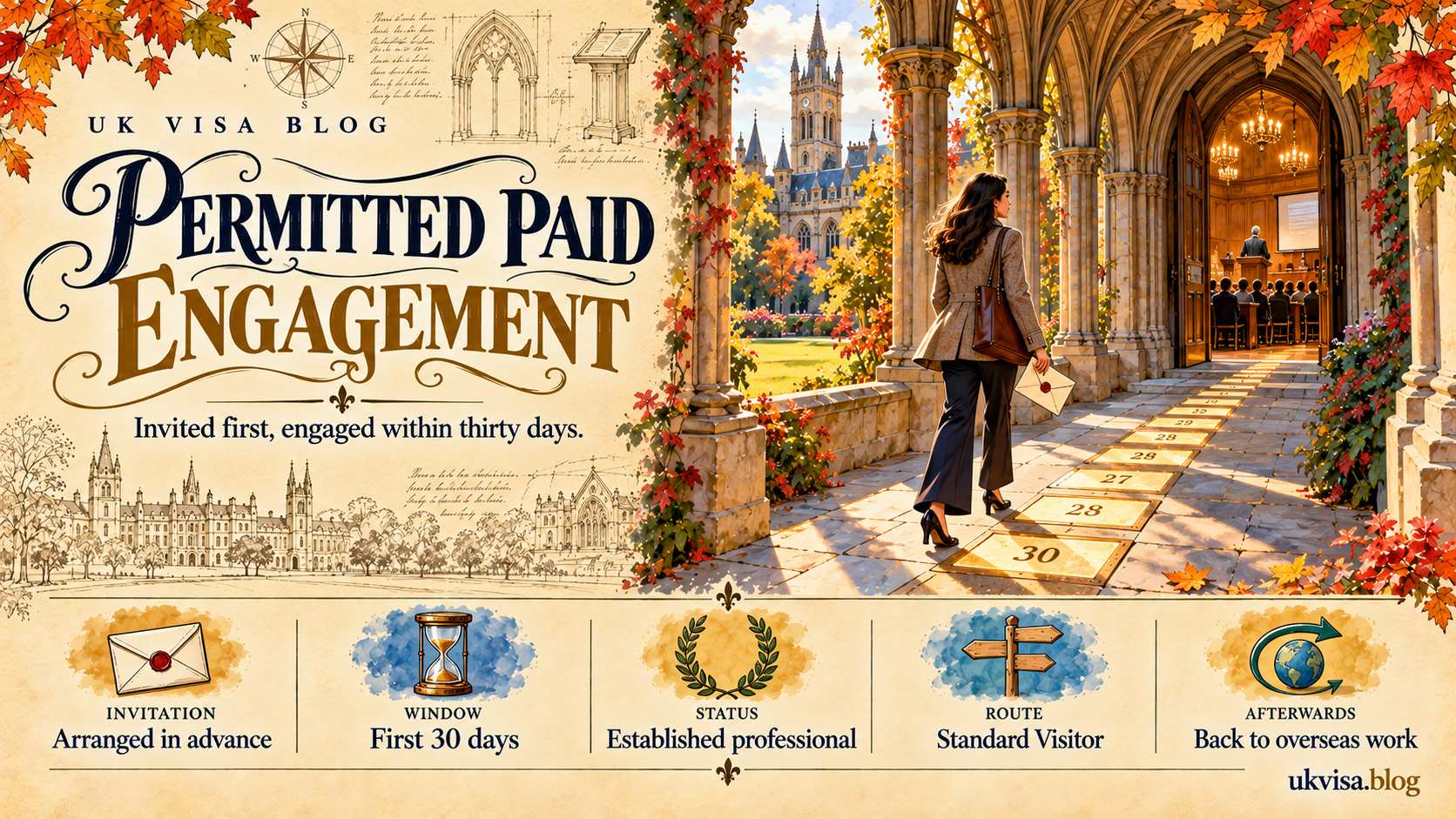
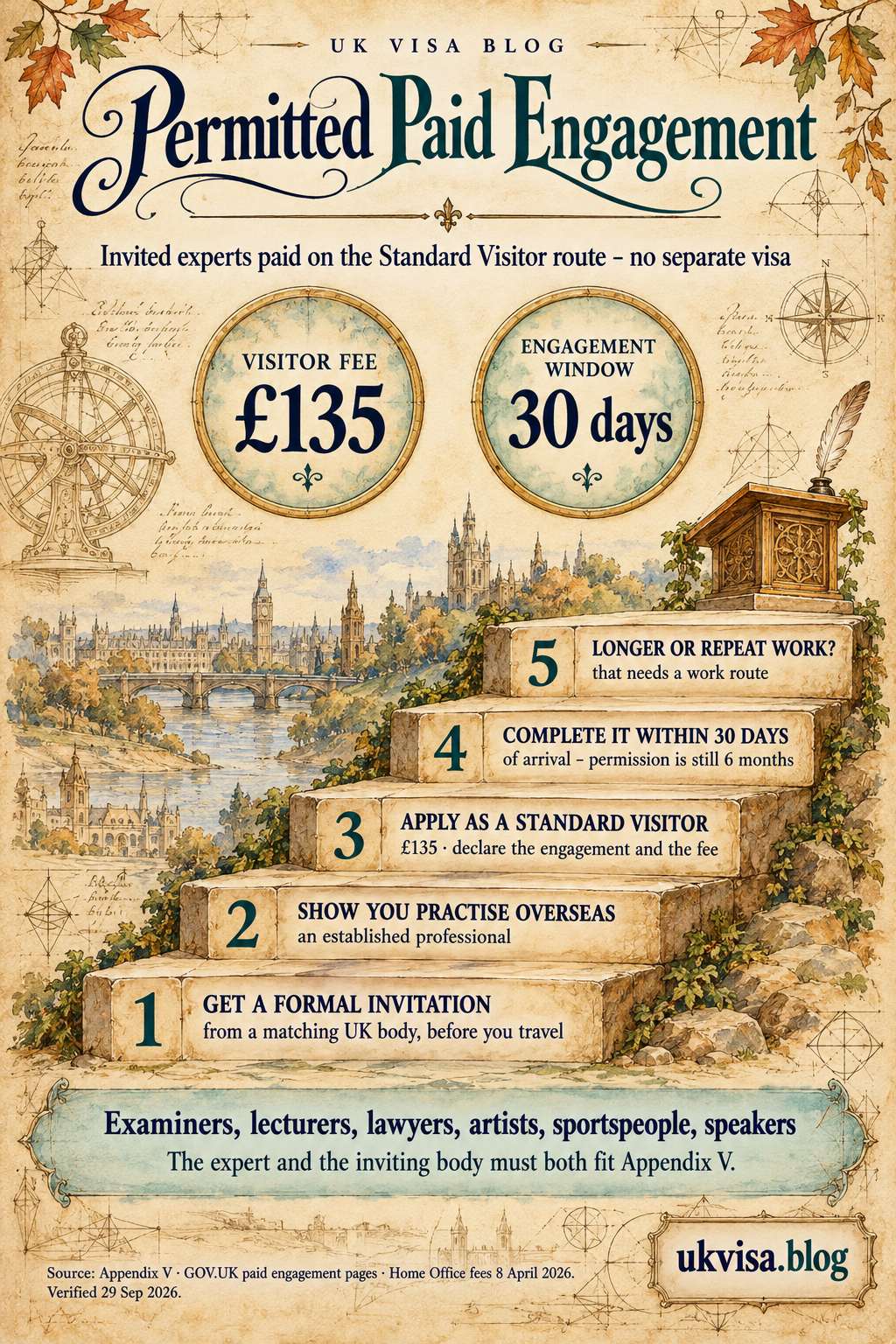
There is no longer a separate Permitted Paid Engagement visa. PPE is now an activity within the Standard Visitor route: you apply for a standard visit at £135, and the engagement must be formally arranged before you travel and carried out within the first 30 days of arrival.
Paid Engagements
Permitted Paid Engagements on the Standard Visitor Route
Which Activities Qualify
Visitors must not be paid from a UK source. Permitted paid engagements are one of the narrow exceptions, listed in Appendix V at paragraph V 13.3 and in the permitted activities appendix. Each entry pairs a type of expert with the kind of UK organisation that may invite them — both halves have to match.
Apply for a Standard Visitor visa at £135 for up to six months. The engagement must be pre-arranged with a formal invitation before you travel, declared in the application, and undertaken within the first 30 days of arrival. You must be an established professional in the field, employed or practising overseas, and returning to that work afterwards.
- Academic examiners and assessors: invited by a UK higher education institution or a UK-based research or arts organisation, to examine students or sit on selection panels.
- Visiting lecturers: invited by the same bodies to give lectures, without replacing the course teacher’s formal role.
- Designated air pilot examiners: invited by a UK training organisation regulated by the Civil Aviation Authority.
- Qualified lawyers: invited by a client for advocacy and dispute resolution work.
- Artists, entertainers and musicians: invited by a UK creative organisation, agent or broadcaster.
- Professional sportspeople: invited by a UK sports organisation, agent or broadcaster.
- Conference speakers: invited by an organiser for a one-off talk or a short series.
The Full-Time Profession Test
The engagement must relate to your expertise and your occupation abroad. A fully retired academic doing one-off examination work does not qualify and must be refused; someone semi-retired who carries out regular examination work and earns income from it does. The same distinction applies to lecturers.
For artists and sportspeople, caseworkers assess standing, reputation, earnings — recognising that artists in some countries earn less — and existing work commitments outside the UK. Arts professionals span the performing and creative fields: poets, make-up artists, stylists, set designers, photographers and traditional artists among them. Fashion models may use the route for a specific engagement, provided they do not intend to make the UK their home.
Where Each Category Has a Hard Edge
- Further education examining: must be refused; that requires a work route.
- Replacing a course teacher: falls under the points-based system, not this provision.
- Pilot examiners: must be employed by their own country’s national aviation authority.
- Lawyers on long cases: where the hearing will run beyond a month and your involvement is required throughout, the application must be refused.
- Trade fair speakers: must not be directly selling to the public.
Recognised inviting bodies extend beyond universities to publicly funded research institutions: independent and research council funded institutes, museums where that is the venue’s primary purpose, art galleries whose primary purpose is exhibiting rather than selling, and arts centres, festivals, theatres and other arts venues. Embassies staging cultural events for their own country are in scope.
The Invitation Letter
Here the letter is not optional in practice. Guidance states that all permitted paid engagements must be pre-arranged with a formal invitation prior to travelling to the UK. Without one, the activity is simply paid work by a visitor, which is prohibited.
What the Letter Must Establish
- Why you: the skills or expertise that led to the invitation.
- The link to the venue: how the engagement connects to the inviting organisation.
- How long it lasts: with dates falling inside the first 30 days of your arrival.
- What is being paid: the fee or the expenses arrangement.
- Verifiable sender details: letterhead, registered number, a direct line and a company email.
[Inviting organisation, registered address]
[Company or charity number]
[Date]
To the Entry Clearance Officer
Re: Permitted paid engagement for [Applicant name], passport number [number]
[Organisation] is [describe: a UK higher education institution / a creative organisation / a sports organisation / the organiser of the named conference]. We invite [Applicant] to undertake [the engagement: to examine doctoral candidates / to deliver a named lecture / to perform at a named event] on [date or dates].
[Applicant] has been chosen because of [the specific expertise: publications, standing in the field, previous work], which relates directly to [his/her] profession as [role] at [overseas employer or practice].
The engagement will take place at [venue and address] and will last [duration]. It falls within 30 days of [Applicant]’s planned arrival on [date].
We will pay a fee of [amount] for the engagement, together with [travel and accommodation arrangements].
Please contact me on [direct telephone] or [organisation email] if confirmation is required.
Yours faithfully,
[Signature]
[Name, job title]
Requirements and Evidence
You meet the ordinary visitor requirements — a genuine visit, an intention to leave, sufficient funds, no prohibited activity — and then the additional engagement requirements. The engagement must be arranged before you travel and declared as part of the entry clearance application.
The engagement must be undertaken within the first 30 days of arrival as a visitor. That is not the length of your permission — a standard visit still runs up to six months — but the activity itself has to fall inside that window. An engagement scheduled for week seven of a stay does not qualify.
Documents by Category
- Academics and lecturers: publications, an employer’s letter confirming role and field, evidence of previous lectures.
- Lawyers: confirmation of a right of audience or temporary call where required, and a practising certificate or certificate of good standing.
- Artists and entertainers: publications, publicity material, awards, media coverage, proof of recent performances.
- Sportspeople: evidence of standing, earnings and existing commitments abroad.
- All applicants: the formal invitation, and evidence of the overseas employment you are returning to.
Rights of audience are not required for arbitration, other alternative dispute resolution hearings, or certain tribunal hearings. Lawyers may also take an active role in preparing a hearing, which can involve one or more preparatory visits. Our supporting documents guide covers evidential standards.
Artists at Permit Free Festivals Are Separate
There is a second exception to the payment bar. Artists, entertainers and musicians may be paid for performances at one or more festivals on the permit free festival list, and that sits outside the permitted paid engagement provisions. They will usually hold an invitation letter from the festival organisers, though guidance confirms this is not a mandatory requirement.
Check which provision your booking falls under before applying, because the conditions differ. A listed festival performance is not bound by the 30-day arrival window that governs permitted paid engagements, while a paid engagement at a venue not on that list is.
Working Offshore
One reporting duty catches people out. Where a visitor arrives directly into UK waters to carry out permitted activities there, without first entering the UK landmass, they are classified as an offshore worker. Unless they have a sponsor, they must notify the Home Office each time they arrive in and leave UK waters, no later than ten working days after each event, giving their name, date of birth, nationality, the dates, the activity, the route they are on and the vessel name.
Applying
Apply on the Standard Visitor route, selecting the paid engagement purpose, and attend a visa application centre for biometrics. Our application form walkthrough covers the free-text fields, which should name the inviting organisation, the engagement and the dates.
Declare the engagement and the fee. This is the one context where payment from a UK source is expected, so concealing it helps nobody and undeclared payment turns a permitted activity into prohibited work. Where an organisation is also covering travel or accommodation, say so — our page on third-party support explains how that is assessed.
Cost and Processing
Costs from 8 April 2026
| Item | Fee | Notes |
|---|---|---|
| Standard Visitor, up to 6 months | £135 | Covers permitted paid engagements |
| 2-year visit visa | £506 | For repeat engagements |
| 5-year visit visa | £903 | For regular UK work in your field |
| 10-year visit visa | £1,128 | Tied to passport validity |
| Priority service | £500 extra | Five working day target |
| Super priority service | £1,000 extra | Next working day target |
Source: Home Office visa fees table, checked 22 August 2026.
Decisions usually take around three weeks from biometrics. Where an engagement date is fixed, apply early rather than paying to compress the timeline — see our pages on priority services, processing after biometrics and delays. Full costs sit on our visitor visa fees.
If You Do Not Need a Visa
Nationals of Australia, Canada, Japan, New Zealand, Singapore, South Korea, the United States, EEA states and Switzerland can use the ePassport gates and automatically receive six months as a Standard Visitor, with no endorsement in the passport. Many will also hold an Electronic Travel Authorisation.
The permitted activity rules apply identically. Carry the formal invitation and evidence of your overseas profession, because with no visa vignette the invitation is the only document showing the engagement was arranged before travel. Keep it accessible rather than in the hold.
Where the Route Runs Out
The provision covers discrete engagements, not a working pattern. A recurring UK commitment, a residency, or an engagement running past 30 days needs a work route. Extension is not the answer either: our page on visitor visa extensions shows how narrow the categories are, and none covers paid engagements.
Sources: the GOV UK paid engagement pages, Appendix V of the Immigration Rules, and the Home Office visit caseworker guidance version 17.0 published 25 February 2026. Figures verified 22 August 2026.
Frequently Asked
Permitted Paid Engagement Questions
Is there still a Permitted Paid Engagement visa?
No. It is now an activity within the Standard Visitor route. You apply for a standard visit and declare the engagement.
How much does it cost?
£135 for a Standard Visitor visa of up to six months from 8 April 2026. There is no separate engagement fee.
What is the 30-day rule?
The engagement must be undertaken within the first 30 days of your arrival as a visitor. Your permission can still run to six months, but the activity must fall inside that window.
Do I have to arrange the engagement before travelling?
Yes. All permitted paid engagements must be pre-arranged with a formal invitation before you travel, and declared in the application.
Can a retired academic examine students under this provision?
A fully retired academic doing one-off examination work does not qualify and must be refused. Someone semi-retired doing regular, paid examination work does.
Can I lecture at a further education college?
Examining at a further education establishment must be refused under this provision — that requires a work route. Lecturing at a higher education institution is permitted, provided you are not replacing the course teacher’s formal role.
I am a lawyer on a case likely to last two months. Can I use this route?
If your involvement is required for the whole hearing, the application must be refused as an engagement lasting longer than 30 days. Preparatory visits are permitted separately.
Can a fashion model use this route?
Yes, for a specific engagement, provided the model does not intend to make the UK their home and can show this is their profession.
Do US, EU, Australian and Canadian citizens need a visa for this?
No. Those nationals enter as Standard Visitors, usually through the ePassport gates. The activity rules are identical, and you should carry the formal invitation.
Can I be paid for speaking at a conference without this provision?
No. Visitors must not receive payment from a UK source except in defined cases. Speaking for reasonable expenses only is fine; a fee needs the engagement provision or a work route — see our page on refusal grounds.