
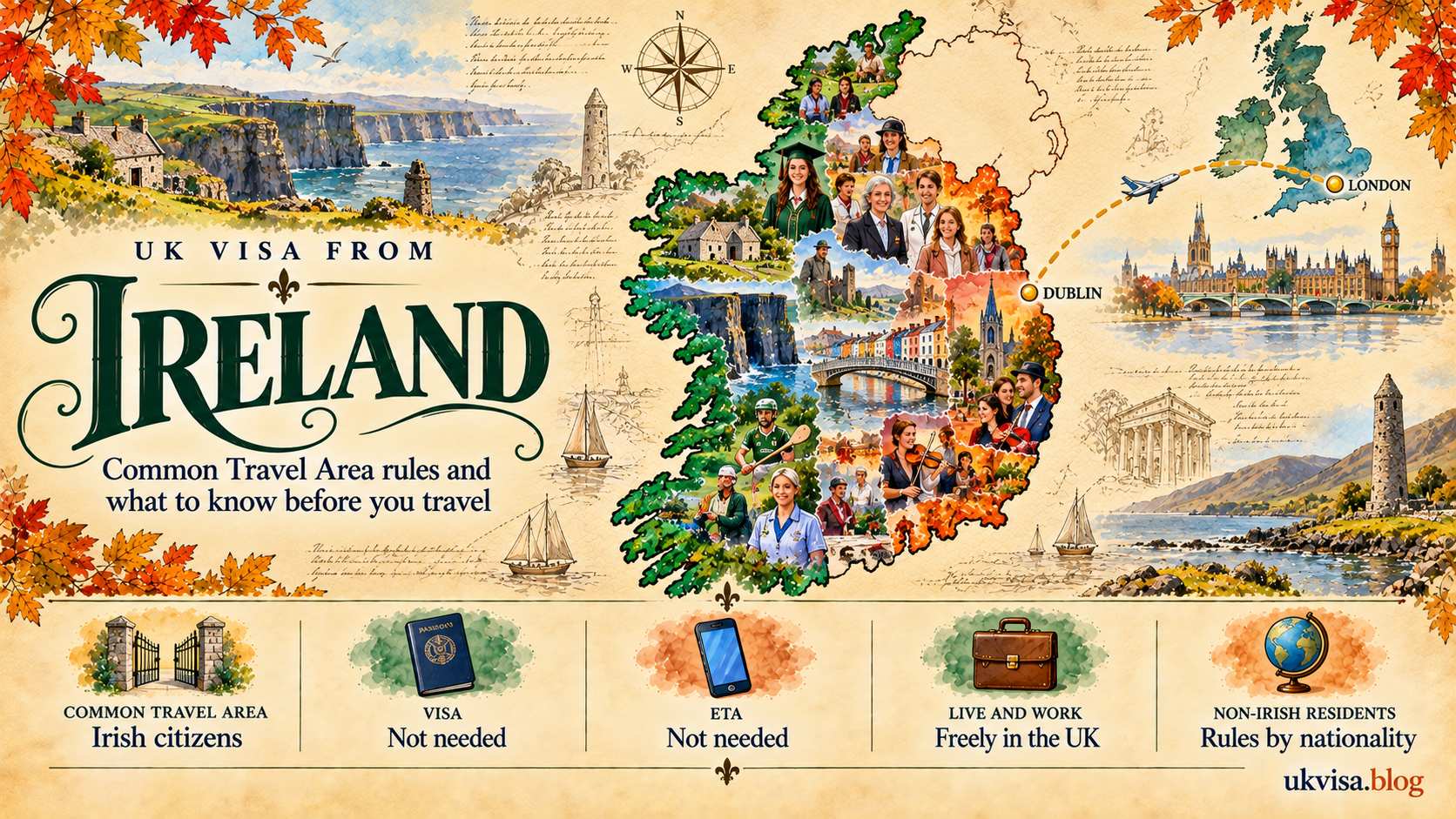
This guide covers the UK visa from Ireland in 2026, and the headline is reassuring: Irish citizens need neither a visa nor an ETA to enter the UK. The Common Travel Area, in place since 1922, gives Irish and British citizens near-identical rights to live, work, and travel between the two countries. The rules only get complicated for non-Irish nationals living in Ireland — and that is where this guide focuses.
UK Visas from Ireland
UK Visa from Ireland 2026: Common Travel Area Rules & Requirements
The Common Travel Area in 2026
Irish citizens need neither a visa nor an ETA to enter the UK — the Common Travel Area gives them the right to travel, live, and work freely. Non-Irish residents of Ireland are treated by nationality: visa-exempt nationals need an ETA (£20), while visa nationals need a Standard Visitor visa (€164). An Irish residence permit does not by itself grant UK entry.
Ireland and the UK share the oldest free-movement arrangement in Europe. The Common Travel Area predates both countries’ EU membership and survived Brexit intact, protected by a 2019 bilateral agreement. It is not part of EU law — which is why Brexit left it unchanged. According to the official gov.uk Common Travel Area guidance, Irish citizens can enter and live in the UK without any form of permission, and vice versa for British citizens in Ireland.
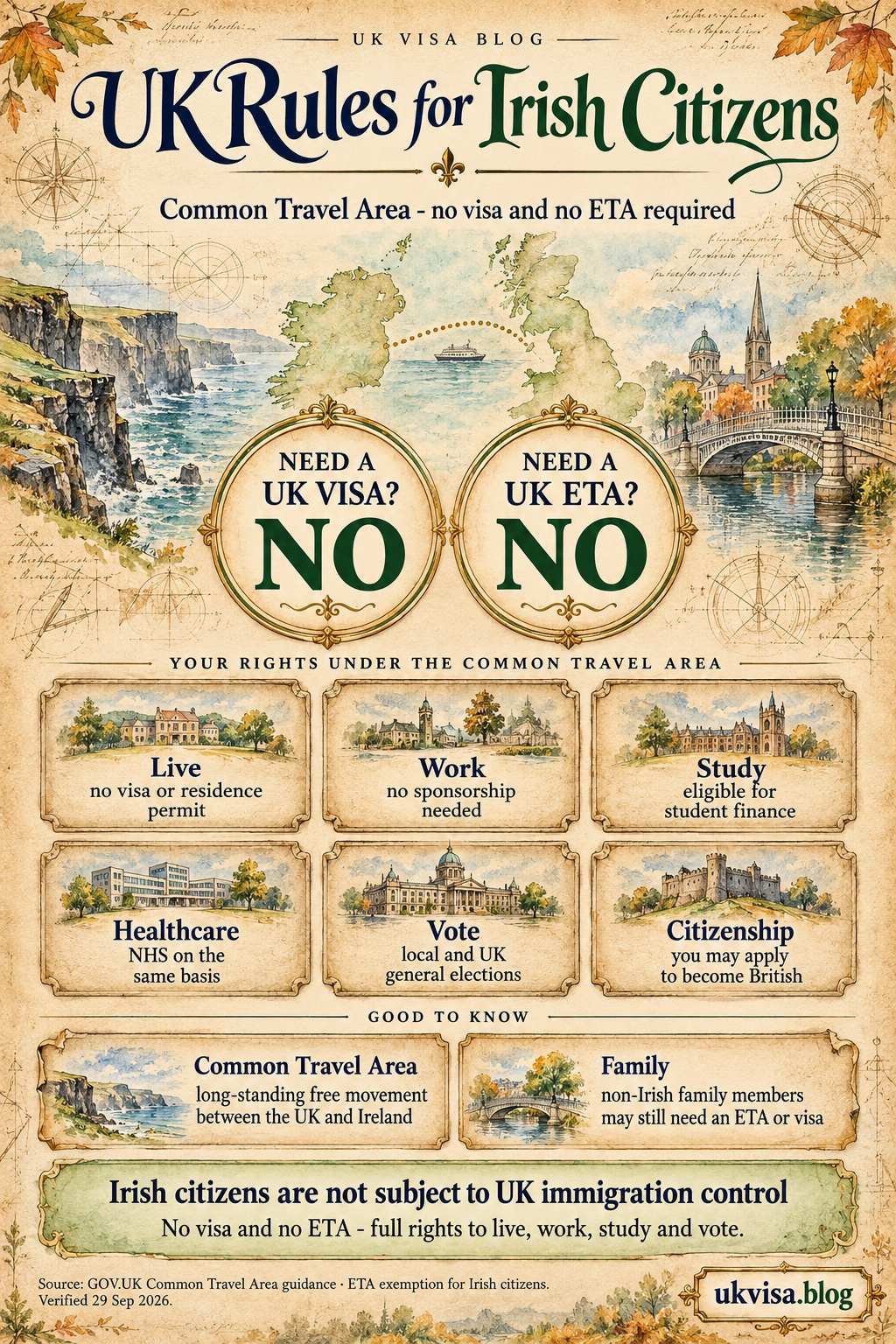
Because of the CTA, Irish citizens were never brought into the ETA scheme that now applies to other European nationals. Where travellers from France and other EU states need an ETA before boarding, Irish citizens simply travel — there is nothing to apply for.
What CTA Rights Cover in Practice
The arrangement goes well beyond entry. Under the CTA, Irish citizens in the UK can live and work without permission, study without a student route, access the NHS and public services on the same basis as residents, and vote in the elections open to them — a package of rights no visa category replicates. British citizens hold the mirror-image rights in Ireland.
Do Irish Citizens Need a Visa or ETA?
No — for any length or purpose of stay. Irish citizens travelling to the UK do not pass through a visa or ETA process at all. They can take up employment without a sponsor, enrol in study without a Student visa, and remain indefinitely without applying for settlement, and they are not subject to the six-month visitor limit that applies to other nationals. In practice their position mirrors that of British citizens far more closely than that of other EU nationals.
Because Irish citizens can live in the UK under the Common Travel Area, they do not need to apply for status. They can, if they wish, apply for British citizenship by naturalisation after meeting residence requirements, as set out in the gov.uk guidance on the rights of Irish citizens, but there is no obligation to regularise their stay first — their CTA rights are sufficient on their own.
Non-Irish Residents of Ireland
Ireland is home to large communities from outside the EU, many of whom travel to the UK for work or family. Their requirement depends entirely on passport nationality, not on their Irish residence. A US or German national resident in Ireland needs an ETA; an Indian or Nigerian national needs a Standard Visitor visa. The Irish Residence Permit (IRP) card proves status in Ireland but carries no UK travel rights of its own.
What UK permission you need from Ireland, by status (2026)
| Your Status | What You Need for the UK | Cost |
|---|---|---|
| Irish citizen | Nothing — CTA applies | Free |
| EU/US/Australian national in Ireland | ETA (UK ETA App) | £20 |
| Indian passport holder in Ireland | Standard Visitor visa | €164 |
| Nigerian passport holder in Ireland | Standard Visitor visa | €164 |
| Other visa-national in Ireland | Standard Visitor visa | €164 |
Source: GOV.UK ETA and Standard Visitor guidance; Home Office fees, 8 April 2026 schedule.
One important practical point: travel within the CTA does not normally involve routine passport checks, but non-Irish nationals must still hold the correct UK permission before crossing — carriers and Border Force can require it. For the full list of who needs an ETA, see our guide to the Electronic Travel Authorisation (ETA). Those holding visa nationalities should prepare with our supporting documents checklist.
UK Visa Fees from Ireland 2026
Irish citizens pay nothing — no visa, no ETA. The fees below apply only to non-Irish nationals who need UK permission, by nationality rather than residence. They are the official Home Office fees current in 2026, shown in euros for applicants in Ireland.
UK visa fees for non-Irish residents of Ireland (2026)
| Visa Type | Fee (EUR) |
|---|---|
| ETA (visa-exempt nationals) | £20 |
| Standard Visitor (6 months) | €164 |
| Long-term Visitor (2 years) | €615 |
| Long-term Visitor (5 / 10 years) | €1,097 / €1,371 |
| Student | €678 |
| Skilled Worker (up to / over 3 years) | €995 / €1,966 |
| Health and Care Worker (up to 3 years) | €394 |
| Partner / Family visa | €2,508 |
| Priority / Super Priority | +€608 / +€1,215 |
Source: Home Office immigration and nationality fees, 8 April 2026 schedule, as displayed in euros; ETA per GOV.UK.
The Immigration Health Surcharge
Any visa over six months also carries the Immigration Health Surcharge, charged in pounds at £1,035 a year — students and Youth Mobility participants pay £776. It is paid on top of the visa fee and is not converted to euros. Health and Care Worker visa holders are exempt, and it does not apply to Irish citizens at all.
Working and Studying in the UK
For Irish citizens the work and study routes simply do not apply — they are free to take employment or enrol in study without any immigration permission, with no sponsor and no salary threshold. The position is unique among European nationals and, again, stems from the Common Travel Area rather than EU rules.
For Non-Irish Residents
A non-Irish national living in Ireland who wants to work in the UK uses the same routes as anyone else. The Skilled Worker route needs a job offer from a licensed sponsor and a salary meeting the £41,700 general threshold, leading to indefinite leave to remain after five years. For study over six months, the Student visa applies; shorter courses need only an ETA where the nationality is visa-exempt. Family routes follow the standard partner visa rules.
How to Apply for a UK Visa from Ireland
Irish citizens have nothing to apply for. Non-Irish residents follow the route their nationality requires — an ETA in the app, or a visa with biometrics.
- Visa-exempt nationals: apply for an ETA in the UK ETA App — minutes, no appointment.
- Visa nationals: complete the online application and pay the fee at gov.uk.
- EU/EEA/Swiss nationals: give biometrics via the UK Immigration: ID Check App.
- Other visa nationals: book biometrics at the Dublin visa centre.
- Upload supporting documents and await the decision.
- Receive your eVisa or a vignette in your passport.
Which App Does What
Two apps matter for non-Irish residents. The UK ETA App handles the £20 travel authorisation for visa-exempt nationals — scan the passport, take a photo, pay, and most decisions arrive within minutes. The UK Immigration: ID Check App handles identity checks for actual visa applications by EU, EEA, and Swiss nationals, replacing the visa-centre appointment entirely. Visa nationals from outside Europe still attend the Dublin centre in person.
Processing Times and Delays
If a visa decision runs late, our guide on UKVI delays explains how to chase it, priority and super-priority services can speed things up where available, and you can track timelines with our guide to post-biometrics waiting times. If a visit was refused before, our guide on the odds of success when reapplying sets out the options.
For official confirmation, use the gov.uk visa checker. Neighbouring guides cover Germany’s UK entry rules, the Netherlands, the Belgium ETA guide, Austria, and Swiss citizens and the UK. Sources: GOV.UK Common Travel Area guidance; Home Office immigration and nationality fees, 8 April 2026 schedule. Figures verified August 2026 against the 8 April 2026 fee schedule.
Frequently Asked
Questions about UK Visas from Ireland
No. Irish citizens are exempt from the UK’s Electronic Travel Authorisation scheme. Unlike other European nationals, who have needed an ETA since 2025, Irish citizens travel under the Common Travel Area and apply for nothing. This applies regardless of how they travel or how long they intend to stay.
No. Irish citizens need no visa for any purpose — visiting, working, studying, or settling. The Common Travel Area, in place since 1922 and reaffirmed in 2019, gives them rights close to those of British citizens. Brexit did not change this, because the CTA is a bilateral arrangement separate from EU law.
Yes. Irish citizens can take employment in the UK without a visa, a sponsor, or a salary threshold, and without the Skilled Worker route that other nationals must use. They can also study without a Student visa and remain indefinitely without applying for settlement, all under the Common Travel Area.
It depends on your nationality, not your Irish residence. If you hold a visa-exempt passport such as an EU state, the US, or Australia, you need an ETA (£20). If you hold a visa nationality, you need a Standard Visitor visa (€164). An Irish Residence Permit does not grant UK entry on its own.
No. The Irish Residence Permit proves your immigration status in Ireland but carries no UK travel rights. You still need the UK permission that matches your nationality — an ETA if visa-exempt, or a visa if you are a visa national. Only Irish citizenship removes the need for UK entry permission.
Indefinitely. Irish citizens are not subject to the six-month visitor limit that applies to other nationals, because they enter under the Common Travel Area rather than as visitors. They can live in the UK for as long as they wish and are free to work and study throughout.
Visa nationals resident in Ireland apply online at gov.uk and give biometrics at the Dublin visa centre. EU, EEA, and Swiss nationals can instead verify identity through the UK Immigration: ID Check App from home. Visa-exempt nationals skip all of this and apply for an ETA in the app.
Yes. Under the Common Travel Area, Irish citizens living in the UK access the NHS and public services on the same basis as residents, and they can vote in the elections open to them. None of this requires a visa, settled status, or the Immigration Health Surcharge — the rights come with Irish citizenship itself, not with any immigration application.
Not for immigration purposes — the Common Travel Area means Irish citizens are not subject to routine immigration control when arriving from Ireland. In practice, though, airlines and ferry operators usually require photo identification, and a passport is the identity document most reliably accepted, so carrying one is strongly advised even on Dublin–London routes.
Travel within the Common Travel Area does not normally involve routine immigration control, though airlines may still ask for photo ID and officials can carry out checks. That does not remove the underlying rules: non-Irish nationals must already hold the correct UK permission — an ETA or visa by nationality — before crossing, and can be asked to show it.