
This guide covers the UK visa from the Netherlands in 2026: the ETA Dutch passport holders now need, current fees in euros, and the visa routes for work, study, and non-EU residents — including the large Indian community. Around 100,000 Dutch nationals live in the UK, some 50,000 Britons live in the Netherlands, and the Amsterdam–London Eurostar puts the two capitals four hours apart. Since Brexit, Dutch travellers need a €24 ETA before boarding.
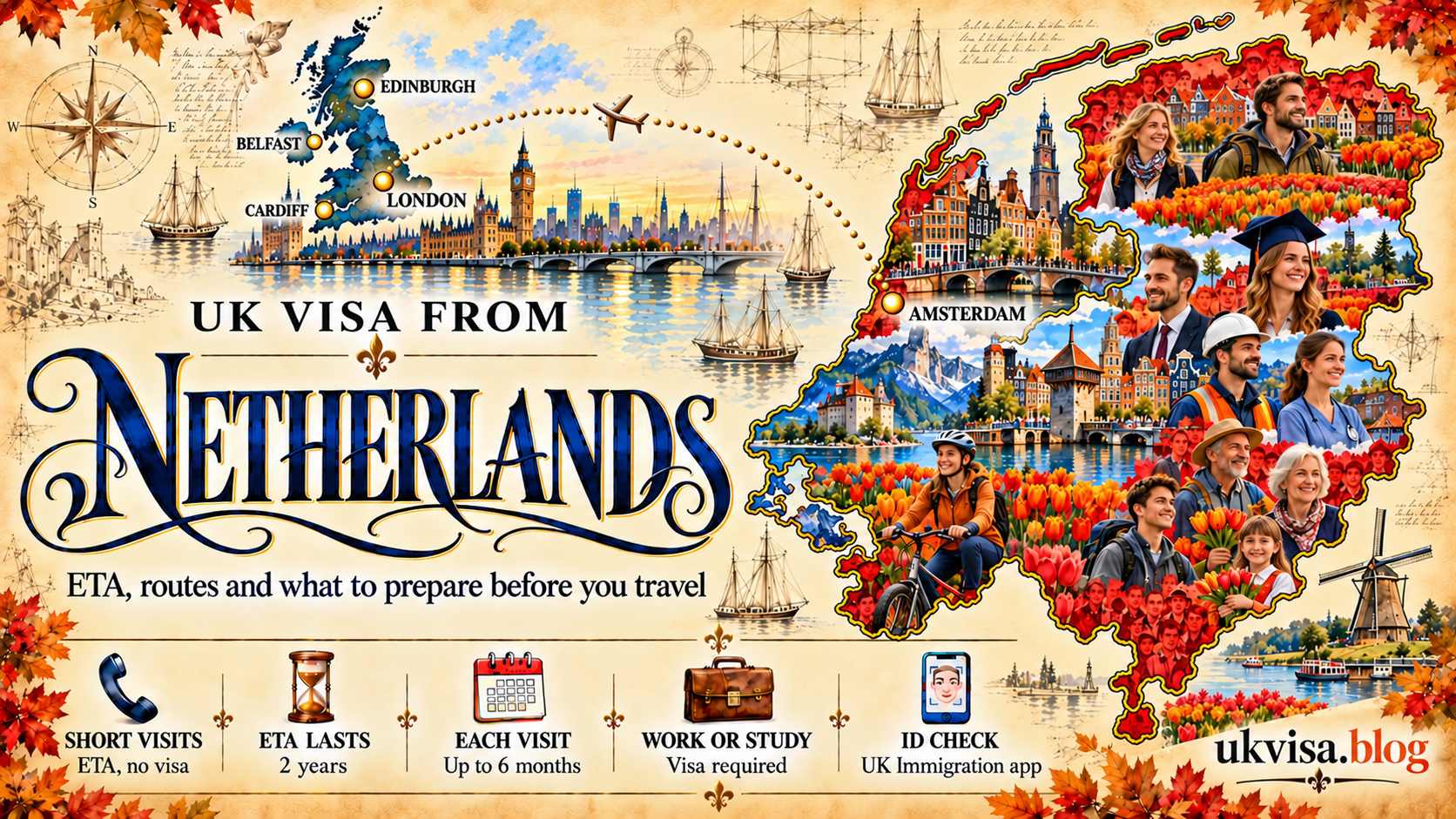
UK Visas from the Netherlands
UK Visa from the Netherlands 2026: ETA Requirements, Fees & Dutch Passport Entry
UK Entry Requirements for Dutch Citizens
Dutch citizens do not need a visa for visits of up to six months, but they do need an ETA (€24, valid two years) obtained through the UK ETA App. Non-EU residents of the Netherlands need a Standard Visitor visa (€164) instead, with biometrics at the Amsterdam visa centre. For work, study, or family stays, Dutch nationals apply for the relevant visa and verify their identity through the UK Immigration: ID Check App.
The Anglo-Dutch connection runs deep — four centuries of trade and rivalry, and William III of Orange took the English throne itself in 1689. Today the traffic is constant in both directions, but since Brexit, Dutch travellers face the same ETA system as other visa-exempt nationals. It must be approved before departure, as carriers check it at check-in, and Dutch nationals now pass through the same border control as other non-EU visitors.
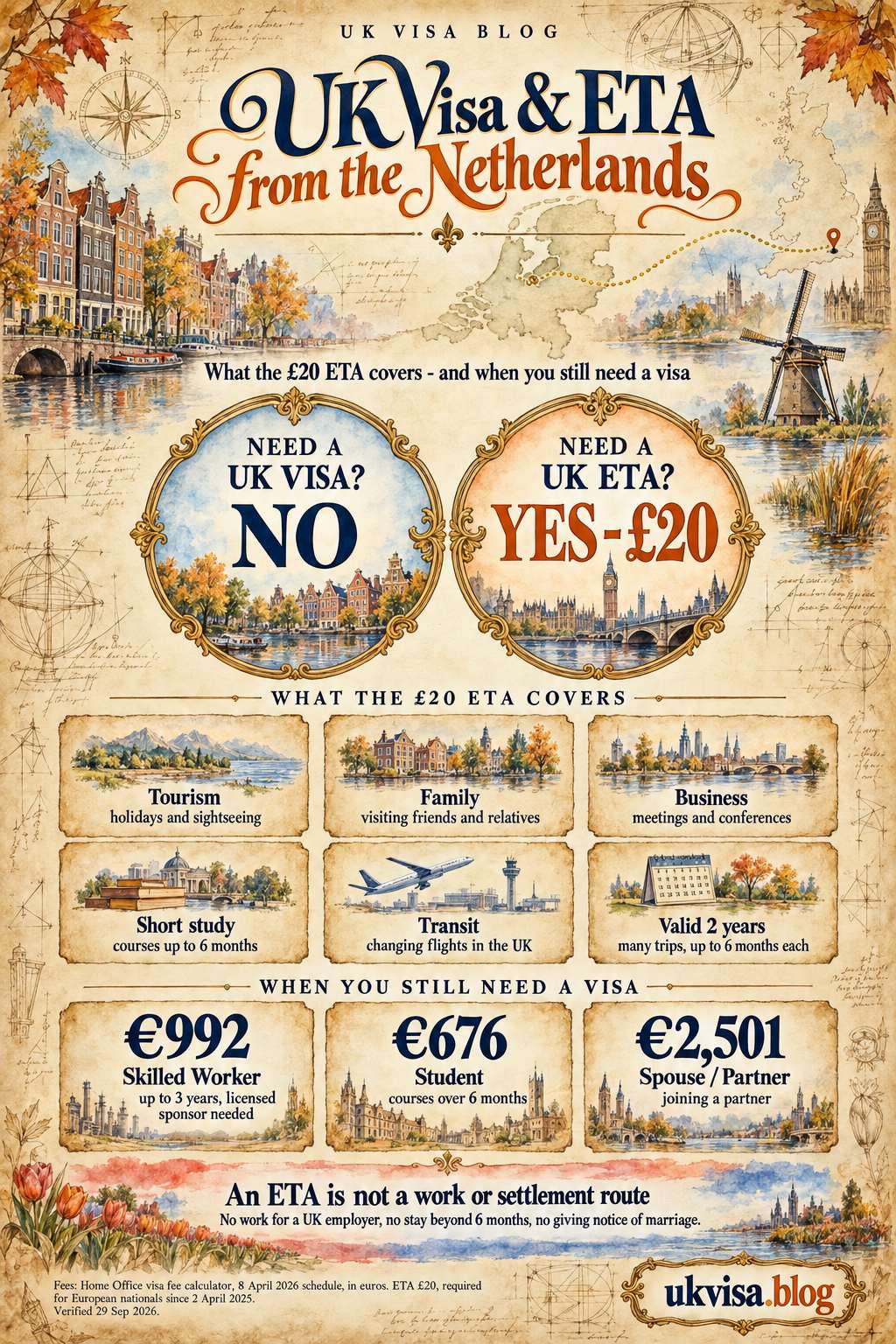
- A valid passport: covering the duration of the stay — a Dutch ID card is not accepted.
- An approved ETA: €24, valid two years, via the UK ETA App.
- Evidence of return or onward travel.
- Accommodation details: a booking or a host’s address.
- Enough funds: to support the visit without working.
- Genuine intention to leave within six months.
At the border, officers may ask about your plans, accommodation, and funds, though detailed questioning is rare for Dutch visitors. Keeping your booking and return ticket on your phone speeds things up. Travellers from elsewhere in the region face the same system, including those covered by our France ETA guidance.
Do I Need a Visa for the UK from the Netherlands?
It depends on your nationality, not your residence. Free movement between the EU and UK ended on 31 December 2020, so Dutch citizens are now visa-exempt nationals for short visits — they can visit without a visa but cannot work, study courses over six months, or access public funds. According to the official gov.uk ETA guidance, Dutch citizens have needed an ETA since 2 April 2025, with a 99.6% issue rate — approval is effectively automatic. Those settled before Brexit may hold status under the EU Settlement Scheme and need neither an ETA nor a visa.
The full rules, exemptions, and how the scheme works across nationalities are covered in our guide to the UK Electronic Travel Authorisation scheme. The same ETA route applies to German citizens travelling to the UK.
UK Tourist Visa from the Netherlands
“UK tourist visa from the Netherlands” means different things by nationality. A Dutch passport holder visiting as a tourist only needs the €24 ETA — covering tourism, family visits, business meetings and negotiations (never paid work), short courses up to 30 days, private medical treatment, and transit. A non-EU national living in the Netherlands must apply for a Standard Visitor visa, regardless of how long they have lived there.
Is There a UK Business Visa from the Netherlands?
Not as a separate product. Business meetings, conferences, negotiations, and site visits all fall within the visitor rules, so a Dutch national travelling for business simply uses the same €24 ETA and a non-EU resident uses the same Standard Visitor visa. What no visitor status allows is paid work for a UK employer — that needs a work visa.
For repeat trips, the long-term visitor visa allows unlimited entries over two, five, or ten years while still capping each stay at six months — it spreads the cost for frequent travellers. Cross-border commuters can compare arrangements in our Belgium fees guide.
UK Visa Fees from the Netherlands 2026 (in Euros)
Home Office fees are set in pounds and shown in euros for applicants in the Netherlands and the eurozone. The figures below are pulled from the official fee calculator, apply identically across euro-currency countries, and are non-refundable.
UK visitor and short-stay fees from the Netherlands (2026)
| Visa Type | Fee (EUR) | Max Stay Per Visit |
|---|---|---|
| ETA (Dutch citizens) | €24 | 6 months |
| Standard Visitor (6 months) | €164 | 6 months |
| Long-term Visitor (2 years) | €615 | 6 months |
| Long-term Visitor (5 years) | €1,097 | 6 months |
| Long-term Visitor (10 years) | €1,371 | 6 months |
| Marriage Visitor | €164 | 6 months |
| Direct Airside Transit (DATV) | €50 | Airside only |
| Visitor in Transit | €91 | 48 hours |
Source: Home Office immigration and nationality fees, 8 April 2026 schedule, as displayed in euros; ETA per GOV.UK.
UK work, study and family visa fees from the Netherlands (2026)
| Visa Category | Fee (EUR) |
|---|---|
| Student | €678 |
| Skilled Worker (up to 3 years) | €995 |
| Skilled Worker (over 3 years) | €1,966 |
| Health and Care Worker (up to 3 years) | €394 |
| Youth Mobility Scheme | €413 |
| Partner / Family visa | €2,508 |
| Adult Dependent Relative | €4,417 |
| Priority service | +€608 |
| Super Priority service | +€1,215 |
Source: Home Office immigration and nationality fees, 8 April 2026 schedule, as displayed in euros.
The Immigration Health Surcharge
Any visa over six months also carries the Immigration Health Surcharge, charged in pounds at £1,035 a year — students and Youth Mobility participants pay £776. It is paid on top of the visa fee and is not converted to euros. Health and Care Worker visa holders are exempt.
UK Visa from the Netherlands for Indians
The Netherlands is home to a large Indian community, many working in Amsterdam’s tech sector, Rotterdam’s port industries, and the Eindhoven high-tech region. Indian nationals in the Netherlands pay €164 for a six-month Standard Visitor visa in 2026. A Dutch residence permit does not grant visa-free UK travel — only your passport nationality decides the requirement — so the process mirrors applying from India, with the advantage of established residence in Europe. Applications go through the visa centre in Amsterdam, the only UK visa application centre in the country, with processing of about three weeks.
- Valid Indian passport with adequate remaining validity.
- Dutch residence permit (verblijfsvergunning) proving legal stay.
- Employment contract or study enrolment in the Netherlands.
- Bank statements: showing funds for the trip.
- Travel plan and accommodation for the UK visit.
- Ties to the Netherlands: tenancy, family, or ongoing work.
Dutch Residence Strengthens Your Application
Legal residence in the Netherlands — especially permanent residence — helps a UK visitor application by showing strong ties and a clear reason to return. Build the file using our UK visa supporting documents checklist, and if a relative is hosting you, our guide to the sponsor’s invitation letter shows what to include. If a visit was refused before, see why UK visas are refused and the odds when reapplying.
Working and Studying in the UK
A Dutch passport no longer confers UK work rights — free movement ended on 31 December 2020, so Dutch nationals now need permission to work or study long-term. The upside is convenience: as an EU national, you verify your identity through the UK Immigration: ID Check App rather than attending a visa centre, and UK visa grant rates for Dutch applicants are high across all routes.
Skilled Worker, Youth Mobility and Student Routes
The Skilled Worker route needs a job offer from a licensed sponsor and a salary meeting the £41,700 general threshold; the fee is €995 for up to three years or €1,966 beyond, leading to indefinite leave to remain after five years. Dutch citizens aged 18 to 35 can use the Youth Mobility Scheme (€413, two years). For courses over six months, the Student visa costs €678; after a degree the Graduate route gives two years’ post-study work. A partner visa (€2,508) carries a £29,000 income requirement.
How to Apply for a UK Visa from the Netherlands
Dutch citizens do almost everything by app: the ETA App for short visits, and the ID Check App for full visa applications — no visa centre visit needed. Non-EU residents use the Amsterdam visa centre for biometrics. For an ETA there is no form beyond the app itself — download it, scan your passport, take a photo, and pay.
- Complete the online application and pay the fee in euros at gov.uk.
- Dutch citizens: give biometrics via the UK Immigration: ID Check App from home.
- Non-EU residents: book biometrics at the Amsterdam visa centre.
- Upload your supporting documents.
- Wait for the decision — about 3 weeks standard, 5 days on priority.
- Receive your eVisa or a vignette in your passport.
Processing Times and Delays
Standard processing is about three weeks for non-settlement visas and up to twelve weeks for settlement routes; ETAs are usually decided within minutes. If a decision runs late, our guide on UK visa delays explains how to chase it, priority and super-priority services can speed things up where available, and you can track timelines with our guide to processing after biometrics.
For official confirmation, use the gov.uk visa checker and the Standard Visitor visa guidance. Neighbouring guides cover the Austria fees guide, travellers from Ireland, and the UK visa from Switzerland. Sources: Home Office immigration and nationality fees, 8 April 2026 schedule; GOV.UK ETA guidance. Figures verified August 2026 against the 8 April 2026 fee schedule.
Frequently Asked
Questions about UK Visas from the Netherlands
No visa is needed for visits up to six months, but Dutch citizens must hold an ETA before travelling. It costs €24, lasts two years, and is obtained through the UK ETA App. The requirement has applied since 2 April 2025 and is enforced at boarding — without an approved ETA, carriers will not let Dutch travellers board transport to the UK. For work or study, the appropriate visa is required.
For Dutch citizens the cost of a UK visit is simply the €24 ETA — there is no visit visa to buy. Non-EU residents of the Netherlands pay €164 for the six-month Standard Visitor visa, with longer options at €615 for two years, €1,097 for five, and €1,371 for ten. Those applications run through the Amsterdam centre and take about three weeks.
No. Since 1 October 2021, EU identity cards are no longer accepted at the UK border for most travellers, so Dutch visitors need a full passport plus the ETA. The main exceptions are those with EU Settlement Scheme status, who can still use a national ID card. If your passport has expired, renew it before booking — the ETA links to the passport you apply with.
There is no separate business visa. Meetings, conferences, negotiations, and site visits all count as permitted visitor activities, so Dutch nationals travel on the €24 ETA and non-EU residents on the €164 Standard Visitor visa. Paid work for a UK employer is never allowed as a visitor — that requires a work route such as the Skilled Worker visa.
Not without a work visa. The main route is the Skilled Worker visa (€995–€1,966), needing sponsorship from a licensed UK employer and a salary at or above the £41,700 general threshold. Dutch nationals aged 18–35 may also use the Youth Mobility Scheme (€413). Business meetings are allowed on an ETA, but paid work is not.
No. A verblijfsvergunning proves your status in the Netherlands but carries no UK travel rights. Visa-national passport holders — Indian, Pakistani, Nigerian, and others — still need a Standard Visitor visa (€164) for any UK trip, while visa-exempt nationals need an ETA. Only your passport nationality decides the requirement, however long you have lived in the Netherlands.
Standard processing is about three weeks for visitor and other non-settlement visas, and up to twelve weeks for settlement visas such as partner routes. Priority service (€608) targets five working days for visitor visas, and super priority (€1,215) aims for the next working day where available. ETAs are usually decided within minutes, up to three working days.
The UK ETA App is for applying for an Electronic Travel Authorisation, which Dutch citizens use for short visits up to six months. The UK Immigration: ID Check App is for giving biometrics when applying for an actual visa — work, study, or family. In short, the ETA app is for visiting and the ID Check app is for longer stays that need a visa.
Nee — voor bezoeken tot zes maanden volstaat de ETA, die €24 (£20) kost, twee jaar geldig is en via de UK ETA App wordt aangevraagd. De verplichting geldt sinds 2 april 2025 en wordt bij het instappen gecontroleerd. Voor werk, studie langer dan zes maanden of gezinshereniging is het bijbehorende visum nodig; wie status heeft onder het EU Settlement Scheme heeft geen ETA of visum nodig.
De ETA voor bezoeken kost €24. De volledige visa: Standard Visitor €164 (zes maanden), studentenvisum €678, Skilled Worker €995 (tot 3 jaar), Youth Mobility €413 en partnervisum €2,508. De kosten betaalt u online bij de aanvraag, en Nederlanders verifiëren hun identiteit via de UK Immigration: ID Check App — zonder bezoek aan een visumkantoor. Niet-EU-inwoners geven biometrie af bij het visumcentrum in Amsterdam.