
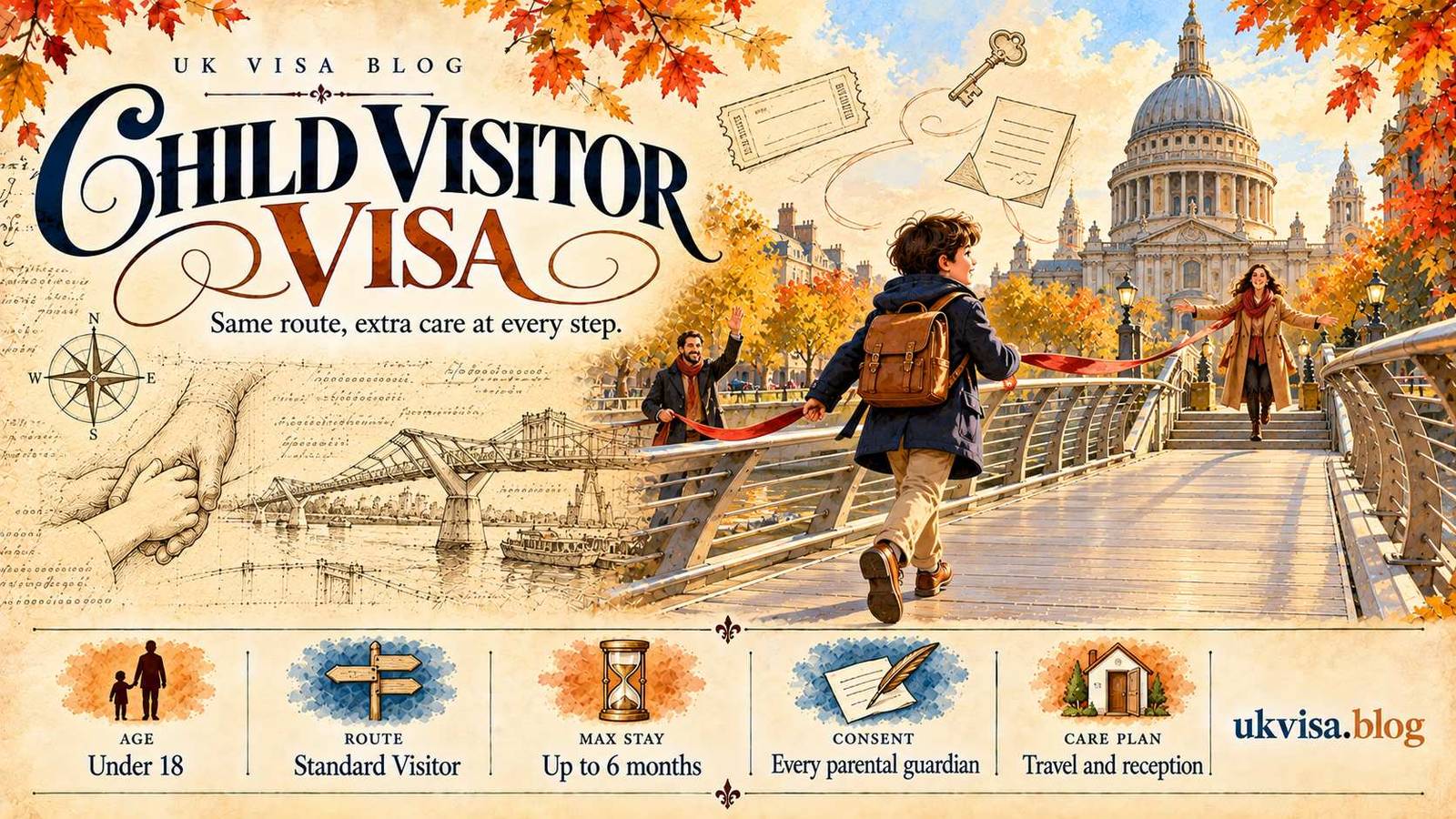
A child visitor applies on the Standard Visitor route — £135, six months, no discount for infants. What makes these applications different is safeguarding: consent from everyone with parental responsibility, documented care arrangements, and an accompanying adult named on the child’s own permission.
UK Short Stay Visas
Understanding the UK Child Visitor Visa in 2026
Child Visitor Requirements 2026
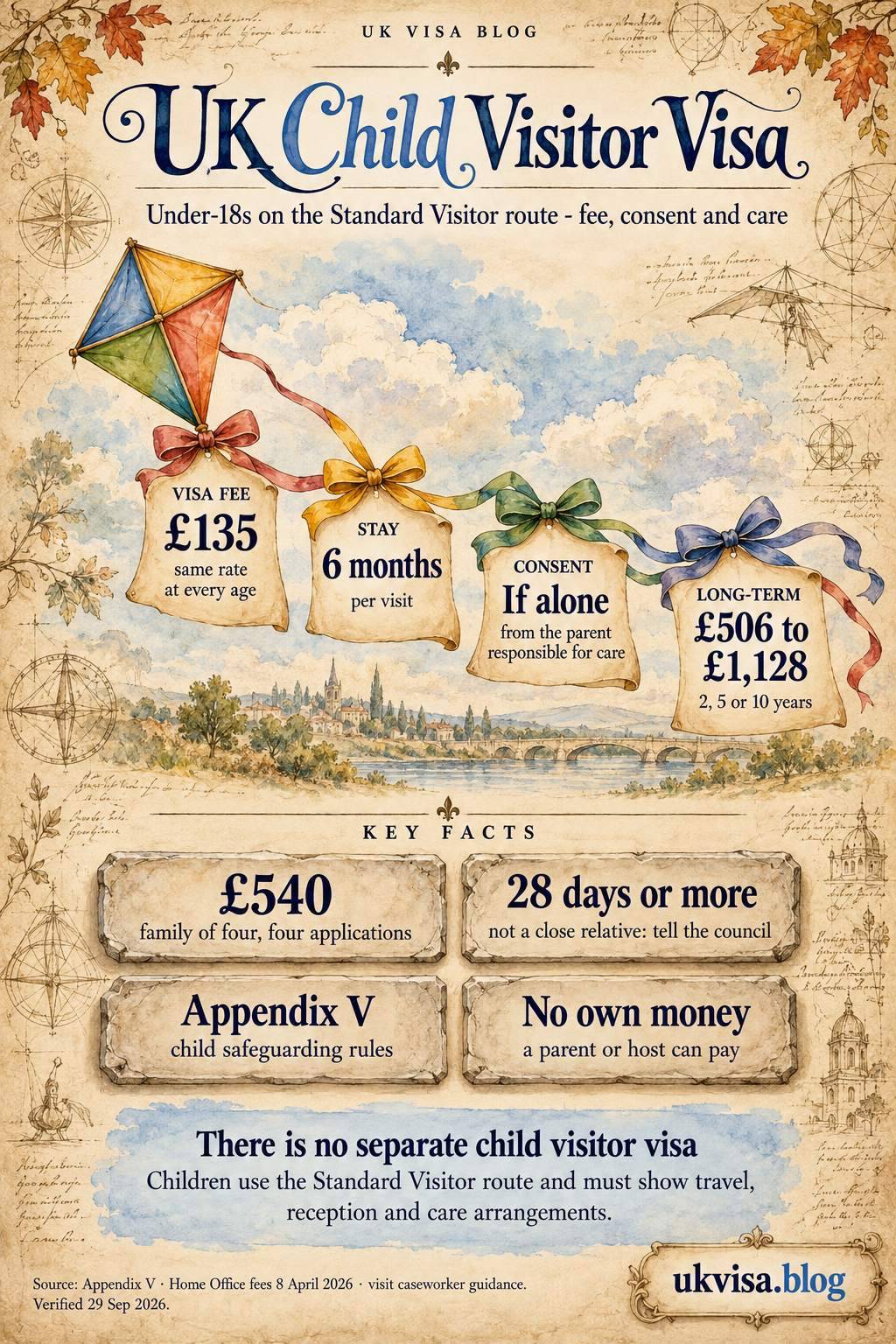
An applicant under 18 applies on the Standard Visitor route for up to six months. They must be a genuine visitor, have adequate travel, reception and care arrangements, and hold written consent from everyone with parental responsibility where they are not travelling with a parent or guardian. The fee is £135 at every age.
There is no separate child visitor visa in the current rules — children apply on the same route as adults, with additional safeguarding requirements at paragraphs V 5.1 and V 5.2 of Appendix V. The Home Office also owes a statutory duty under section 55 of the Borders, Citizenship and Immigration Act 2009 to safeguard the welfare of children.
Children Are Not Expected to Have Their Own Money
The visit guidance says so directly: a child applying as a visitor is not expected to hold funds in their own name, and may meet the maintenance requirement through access to funds from a parent or a third party. Our visitor visa sponsor guide covers what the funder must show.
What a Child Can and Cannot Do
A child visitor may study for up to six months at an accredited institution — but not at an academy or a state-funded school, which the rules exclude. Recreational courses are capped at 30 days, a separate and much shorter allowance. Regular schooling is outside the route entirely.
Fees from 8 April 2026
Children pay the adult rate. There is no reduced fee for infants, under-fives or students, and each child needs their own application — so a family of four pays £540 before anything else. Full rates sit in our visitor visa fees guide.
Child Visit Fees, Before and After 8 April 2026
| Validity | Previous fee | From 8 April 2026 |
|---|---|---|
| 6 months | £127 | £135 |
| 2 years | £475 | £506 |
| 5 years | £848 | £903 |
| 10 years | £1,059 | £1,128 |
Source: Home Office immigration and nationality fees, 8 April 2026.
One trap on the long-term products: an applicant under 18 receives validity running only until six months after their eighteenth birthday, whatever they paid for. A fifteen-year-old buying a ten-year visa is buying about three and a half years — see our long-term visitor visa and multiple entry guides.
The Accompanied Child Endorsement
Where a visa national child travels with an adult, that adult is written into the child’s permission — not merely mentioned in the application. The guidance requires the adult’s passport number, initial and surname to be entered on the child’s visitor permission.
If the child does not travel with the adult identified on the visa, they may be refused entry under paragraph V 1.5 unless the reception, care and consent requirements are separately satisfied. Where two adults will accompany the child at different times — arriving with one parent, taking a day trip with the other — both passport numbers must be entered, and the permission reads “only valid if acc. by” the first or the second.
The practical consequence is that a change of plan after the visa is issued is not a private matter. If the accompanying adult changes, the arrangements have to satisfy an officer at the port instead, and that is a much harder conversation than getting the endorsement right first time.
When Parental Consent Is Required
Whenever the child is not travelling with a parent or guardian responsible for their care. Where a parent or guardian makes the application on the child’s behalf, that will usually satisfy the requirement by itself.
- Divorced or separated parents: the parent or parents holding legal custody or joint responsibility.
- Travelling with a parent who lacks custody: consent from both parents, where the accompanying parent is not the one with legal custody.
- Any flagged risk: both parents, where legal authorities in the child’s country have indicated a risk of removal without consent, or where the caseworker has welfare concerns.
- Applications made by someone else: enquiries into the identity of accompanying adults and of the person giving consent, unless the applicant is a social worker holding parental rights.
The consequence of getting this wrong is absolute rather than discretionary. Where there is no consent from a parent or guardian and no reasonable explanation for its absence, the guidance says the application must be refused.
What the Consent Letter Must Say
There is no prescribed form. Where the child is not travelling with a parent or guardian and nothing else gives cause for concern, a letter confirming the relationship and consenting to the application is sufficient — though a caseworker may still ask for more.
- The child: full name, date of birth, nationality and passport number.
- The parent or guardian: full name, address, contact details and relationship to the child.
- Express consent: a clear statement consenting to the travel and to the application.
- Who is travelling with them: the accompanying adult’s name and, for an adult, their passport number.
- Who will look after them in the UK: the carer’s name, address and relationship to the child.
- How they will travel: the arrangements for the journey itself.
- Signature and date: from everyone whose consent is required.
Where the parent or guardian has no passport, supply another official document carrying their signature. Attach a birth or adoption certificate showing the relationship, and a copy of the photo page of at least one parent’s passport where they are not applying too.
Sample Consent Letter
Adapt the wording below to your own circumstances. Where both parents hold parental responsibility, both should sign, or the letter should explain why only one has. Attach the birth certificate and a copy of each signing parent’s passport biodata page.
[Parent full name]
[Address]
[Telephone] · [Email]
[Date]
To the Entry Clearance Officer
Re: Visit visa application by [Child full name], date of birth [DOB], passport number [number]
I am the [mother / father / legal guardian] of [Child full name], born [DOB] in [country], a national of [country]. I hold parental responsibility for [him/her]. A copy of [his/her] birth certificate and of my passport are enclosed.
I consent to [Child] applying for a visit visa and travelling to the United Kingdom from [arrival date] to [departure date] for the purpose of [specific reason].
[Child] will travel [with me / with [Adult full name], passport number [number], who is [his/her] [relationship] / unaccompanied, meeting [Adult full name] on arrival]. Flight details are [flight numbers and times] where known.
During the visit [Child] will stay at [full UK address] in the care of [Carer full name], who is [his/her] [relationship]. [Carer] can be contacted on [telephone] and [email], and has confirmed [his/her] agreement to this arrangement in the enclosed letter.
All costs of the visit, including travel, accommodation and living costs, will be met by [name and relationship], as evidenced by the enclosed [payslips and bank statements].
[Child] will return to [country] on [date] to resume [his/her] studies at [school name], which has confirmed [his/her] enrolment in the enclosed letter.
I can be contacted at any time on the details above.
Yours faithfully,
[Signature]
[Parent full name]
[Second parent signature and name, where applicable]
Keep the letter consistent with the rest of the bundle. If the letter names a carer, the carer’s own letter and address must match it; if it gives return dates, the school letter and the tickets should reflect the same dates. Contradictions between the consent letter and the supporting documents are a common reason a child’s application is questioned.
Where Consent Letters Fail
Details that contradict the application form. A missing signature from a second person with parental responsibility. Vague care arrangements that name nobody. And a letter so obviously templated that it says nothing specific about this child or this trip — the commonest of the four, and the easiest to avoid.
Children Travelling Alone or Staying with Hosts
Where a child is not travelling or residing with a parent or guardian, the caseworker must be satisfied that travel, reception and care arrangements are adequate. If details are missing or unclear, they must make further enquiries; if not satisfied, they may refuse.
Host Families
The identity and address of the host must be established, and in routine cases a letter from the host family will do. At the border, a child arriving with no documentary evidence of the care arrangements can expect enquiries until the officer is satisfied they are not at risk.
Private Fostering and the 28-Day Line
A child is privately fostered when they are under 16 — or under 18 with a disability — cared for full-time for more than 28 days by someone who is not a parent, legal guardian or close relative. That triggers a duty to notify the local authority. A school group travelling and staying together with an adult is outside the definition.
- Consent: a written statement from the parent or guardian.
- The carer: their name, date of birth, address and relationship to the child.
- Authority: the parents’ authorisation for that carer to look after the child during the stay.
- Educational exchanges over 28 days: a letter from the school detailing the fostering arrangements.
- Notification: confirmation the parents have notified, or will notify, the relevant local authority — with the reply if there is one.
Guidance on the council’s side sits at looking after someone else’s child on GOV.UK.
Charity-Organised Visits Have Their Own Regime
A charity arranging a child’s visit must register with UKVI and supply full details of the allocated hosts and of the checks carried out on them, in line with its own child protection policy. Any Disclosure and Barring Service check must be no more than three years old at the date of application, and charities are expected to re-register annually.
Host families named on the application may only be changed in exceptional circumstances, with full details and checks for the new family. Where Border Force finds a child accompanied by an adult not recorded on the visa, they will check whether the change was notified — and refuse if adequate arrangements cannot be confirmed.
Bringing Your Parents to Visit
Parents apply for a Standard Visitor visa from their country of residence — £135 for six months. You can help with the application form and provide an invitation and financial evidence, but they must attend the biometrics appointment themselves.
- Passport valid for the stay.
- Finances: their own bank or pension statements, or yours if you are funding the trip.
- Your invitation: the purpose, the dates, the relationship and where they will stay.
- Relationship evidence: birth certificates or equivalent documents.
- Ties at home: property, pension arrangements, family remaining there.
- Travel history: previous passports showing compliance with earlier visas.
There Is No Six-Months-in-Twelve Rule for Parents Either
The visit guidance states there is no specified maximum period a person may spend in the UK in any period. What is assessed is whether the pattern amounts to living here — time in the UK against time at home, gaps between visits, GP registration, and long-term commitments abroad. Retired parents visiting for long spells should evidence the life they return to.
When a Visit Is the Wrong Route
The route bars regular schooling and lasts six months. Where either is a problem, a different application is needed — and the fee for the wrong one is not refunded.
Other Routes for Children and Their Parents
| Route | For | Leads to settlement |
|---|---|---|
| Child visitor | Up to six months — tourism, family, short courses | No |
| Parent of a Child Student | A parent accompanying a child aged 4 to 11 at an independent school | No |
| Parent of a British child | A parent of a British or settled child | Yes, in five years |
| Adopted child settlement | A child adopted overseas joining settled parents | Yes, on arrival |
| Marriage visitor | Attending a family wedding or civil partnership | No |
| Short-term Study visa | English language courses beyond six months | No |
Source: Appendix V of the Immigration Rules; visit caseworker guidance version 17.0.
Sources: Appendix V of the Immigration Rules, paragraphs V 1.5, V 5.1 and V 5.2; Home Office visit caseworker guidance, version 17.0 of 25 February 2026; and Visiting the UK: guide to supporting documents, updated 25 February 2026.
Related guides: supporting documents, processing times, delays, extending a visit, cancellation and refusal reasons. Figures verified 22 August 2026.
Frequently Asked
Questions about Child Visitor Visas
£135 for six months from 8 April 2026 — the same as the adult rate, with no discount for infants or under-fives. Long-term versions cost £506, £903 and £1,128. Each child needs their own application and fee, so a family of four pays £540 for six-month visas before any other cost.
Not to regular school. A child visitor may study for up to six months at an accredited institution, but the rules exclude academies and state-funded schools. Recreational courses are separately capped at 30 days. For schooling, the Child Student route applies, with the Parent of a Child Student route for a parent of a child aged 4 to 11.
Whenever the child is not travelling with a parent or guardian responsible for their care. Where parents are separated, consent comes from whoever holds legal custody or joint responsibility — and from both parents where the accompanying parent is not the one with custody, or where any risk has been flagged. No consent and no reasonable explanation means the application must be refused.
Entry may be refused. The accompanying adult’s passport number, initial and surname are written into the child’s permission, and arriving with someone else engages paragraph V 1.5 unless the reception, care and consent requirements are separately met. Where two adults will accompany the child at different times, both passport numbers should be entered before the visa is issued.
Yes, with adequate travel, reception and care arrangements documented and consent from everyone with parental responsibility. Where the child will be cared for by a non-relative for more than 28 days, private fostering rules apply and the local authority must be notified. Airlines apply their own unaccompanied minor policies on top of the immigration requirements.
They apply where a child under 16 — or under 18 with a disability — is cared for full-time for more than 28 days by someone who is not a parent, legal guardian or close relative. The parents must notify the local authority, and the application must show consent, the carer’s details and their authority to care for the child. A school group travelling together is exempt.
No. The guidance states a child applying as a visitor is not expected to have funds in their own name, and may rely on access to a parent’s or a third party’s funds instead. Where a child travels unaccompanied, Border Force may still ask at the port how the visit is being funded.
Yes. They apply for a Standard Visitor visa from their country of residence at £135 for six months, with your invitation letter, evidence of finances — theirs or yours — proof of ties at home and their travel history. You can help with the form and supply documents, but they must attend the biometrics appointment themselves.
No annual limit exists. The visit guidance states there is no specified maximum period a person can spend in the UK in any period, such as six months in twelve. What matters is whether the pattern of visits amounts to living here — assessed on frequency, length, time at home, and markers such as GP registration or long-term commitments abroad.