The UK C Visit Visa is the standard entry clearance for tourists, business travellers, and family visitors — the term "C-Visit" appears on your visa vignette next to "DURATION OF STAY 180 DAYS" and "NUMBER OF ENTRIES MULT". This guide decodes what the C-Visit endorsement means, why most UK visit visas are multiple entry by default, how the 180-day rule actually works at each crossing, when single-entry visas get issued instead, and what happens at the border if your visit pattern starts to look like residence. Covers the 8 April 2026 fee position and the legal framework under Appendix V of the Immigration Rules.
The letter C is a Home Office category code distinguishing visitors from work routes (Skilled Worker, Health and Care), study routes (Student, Child Student), and settlement routes. It has nothing to do with the Schengen Type C visa — the UK is not in the Schengen Area and uses its own classification system. Anyone visiting under Appendix V of the Immigration Rules — for tourism, family, business, marriage, or transit — receives a C-Visit endorsement.
- What Is a C Visit Visa? The "C" Classification Decoded
- MULT on a UK Visa: What Multiple Entry Actually Means
- UK Visitor Visa 180 Days Rule Explained
- Single Entry vs Multiple Entry C Visit Visa
- UK C Visit vs Schengen Type C: Separate Systems
- C Visit Sub-Routes and Per-Visit Stay Limits
- How to Apply and What Your Vignette Will Show
- Border Refusals, Overstaying, and Re-Entry Bans
- Frequently Asked Questions
UK C Visit Visa: Type C Standard Visitor Endorsement
When your UK visit visa application is approved, you receive a vignette — the sticker affixed to a page of your passport — that contains the legal authority for you to enter the UK. On that vignette you'll see "Type: C — VISIT", or simply "C-VISIT" in some layouts. This is the entire reason behind the search term "C Visit Visa": applicants see the term on their own passport sticker and search for what it means. The C is a category code, the VISIT designation is the route, and the combination tells immigration officers at the border that you are entering the UK as a visitor under Appendix V of the Immigration Rules.
The UK Home Office uses a letter-coded classification system to group visa types by purpose. Work routes use D codes, settlement routes use longer category designations, and visitor routes all share the C prefix. Within the C-Visit umbrella, sub-routes exist — Standard Visitor, Marriage Visitor, Transit Visitor, Permitted Paid Engagement Visitor, and so on — but the C-Visit endorsement on the vignette is common to all of them. The specific sub-route is recorded internally and reflected in your conditions of stay rather than printed differently on the vignette.
What Is a C Visit Visa? The "C" Classification Decoded
The C Visit Visa is the Home Office category code printed on UK visitor visa vignettes. The letter C designates the visitor route family (covering tourism, family, business, marriage, and transit visitors), distinguishing it from work, study, and settlement visa classes. The C is not related to the Schengen Type C visa — UK and Schengen visa classifications are entirely separate systems.
A C Visit Visa is functionally identical to a UK Standard Visitor Visa — the names refer to the same legal permission, just described from different angles. "Standard Visitor Visa" is the route name used in policy and application forms. "C-Visit" is the category code printed on the vignette. Applicants who hold the visa often refer to it by whichever term they encountered first. For the application route detail see our Appendix V general visit route policy guide.
Why the "C" Causes Confusion
Two factors drive the search volume around "C Visit Visa": first, applicants see the term unexpectedly on their own visa sticker without anyone having explained it in advance; second, travellers familiar with the Schengen visa system recognise "Type C" as a Schengen short-stay category and assume the UK system uses the same designations. It doesn't. The UK left the European Union in January 2020 and was never part of the Schengen Area — UK visas operate under a completely separate legal framework with their own category codes. The shared use of the letter C across both systems is coincidental, not a sign of any reciprocal recognition or unified standard.
MULT on a UK Visa: What Multiple Entry Actually Means
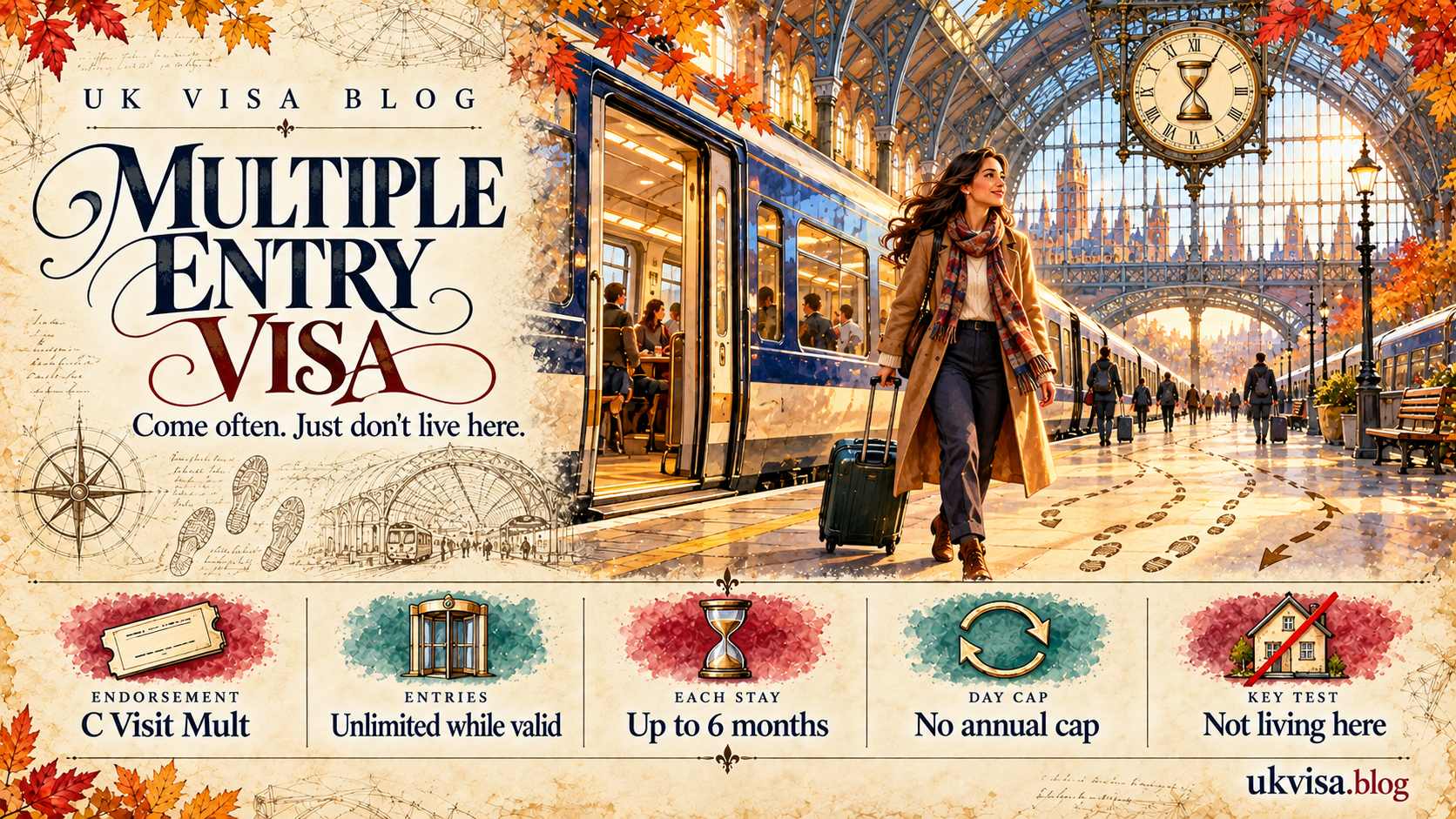
"MULT" stands for multiple entries — printed in the NUMBER OF ENTRIES field of your visa vignette. It means you can enter and leave the UK an unlimited number of times during the visa's validity period, with each separate entry permitting a stay up to the duration shown on the vignette (180 days for Standard Visitors). The vignette will show MULT for most visit visas; some single-entry and limited-entry visas show a digit (1 or 2) instead.
The MULT abbreviation throws first-time applicants because Home Office vignette fields use compressed text to fit the visa sticker. What MULT replaces is the longer phrase "Multiple". So a vignette reading "NUMBER OF ENTRIES: MULT" simply means you have multiple entries; "NUMBER OF ENTRIES: 1" means a single entry; "NUMBER OF ENTRIES: 2" means a dual entry. Most modern UK visitor visas are issued as MULT by default — single and dual-entry visas are now relatively rare, reserved for specific limited circumstances covered later in this guide.
What "Unlimited Entries" Does and Doesn't Mean
MULT means unlimited crossings during the visa validity window — not unlimited time in the UK. Two separate constraints operate independently:
- Per-entry duration: each crossing grants a leave-to-enter period of up to 180 days (printed as "DURATION OF STAY 180 DAYS" on the vignette). You leave before this expires.
- Pattern of residence: Appendix V 4.2(a) prohibits visitors from "living in the UK for extended periods through frequent or successive visits" — even with MULT and 180 days per entry, the cumulative pattern is assessed by Border Force.
In practice: you cannot enter on day 180, leave on day 180, and return on day 181 expecting another full 180 days — Border Force will question whether the UK has become your effective residence. The MULT designation grants the technical ability to cross the border repeatedly; it does not exempt holders from the genuine visitor test, which is applied at every single entry. The Visit caseworker guidance instructs decision-makers to factor in previous duration of visits when assessing genuineness on subsequent applications and at the border.
UK Visitor Visa 180 Days Rule Explained
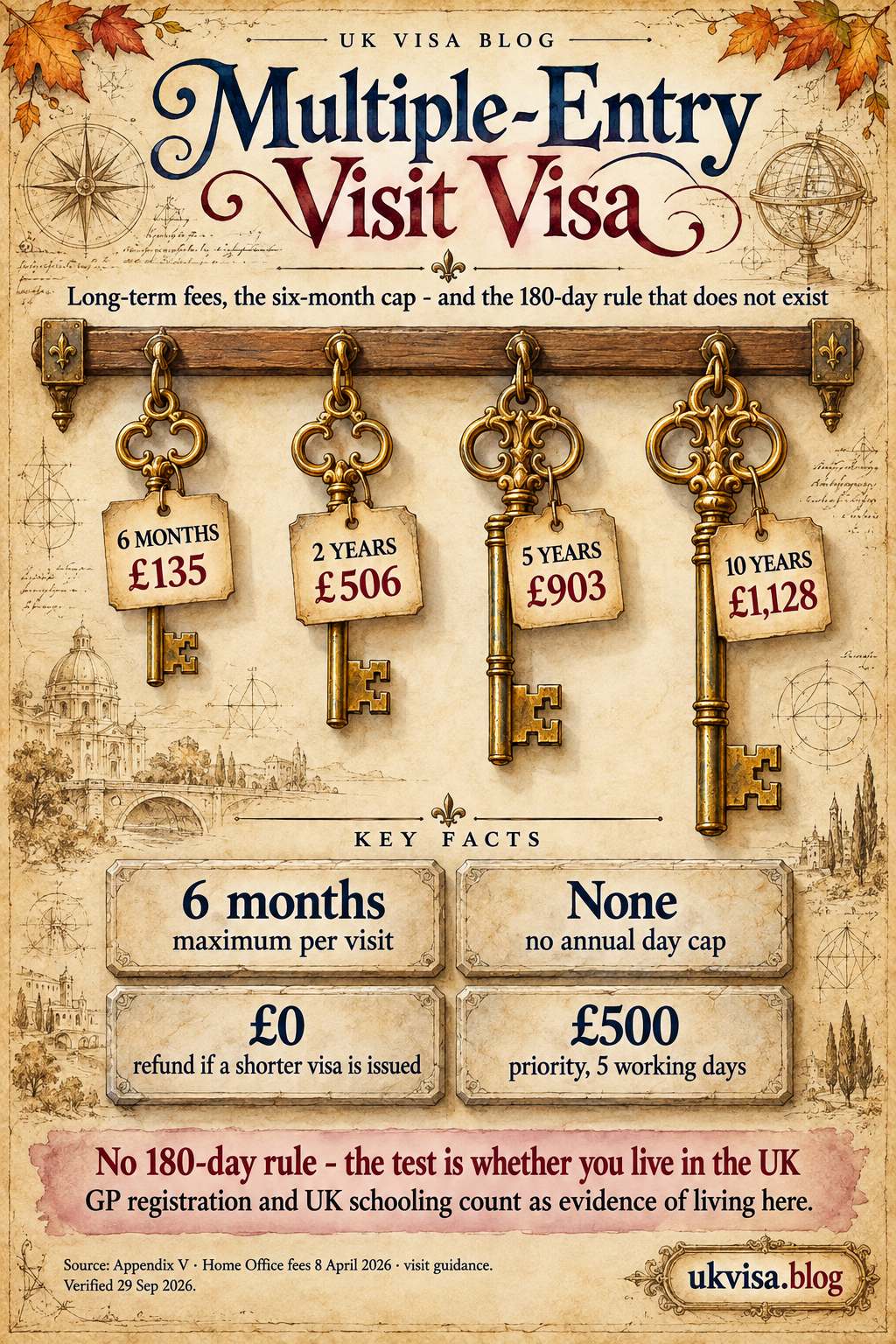
The 180 days rule sets the maximum length of any single visit to the UK on a Standard Visitor Visa. It is a per-entry cap, not an annual quota. Each time you cross the UK border on a multiple entry visa, the clock resets at zero — you may stay up to 180 days from that entry date. Exceeding 180 days in one visit is overstaying. Spending close to 180 days repeatedly, in successive entries, triggers Appendix V 4.2(a) scrutiny separately from the per-entry rule.
Two different "180 days" concepts circulate among visa applicants, and conflating them causes problems. The first is the per-entry leave-to-enter period of up to 180 days — codified in legislation and printed on your vignette. The second is an informal "180 days in any 12-month period" guideline that is sometimes quoted but is not a hard legal cap under UK rules in the same way it exists for Schengen visits. The UK rule is the per-entry cap plus the prohibition on de-facto residence; there is no precise calendar quota above which a visitor automatically breaches the rules.
How the Per-Entry Clock Works at the Border
On arrival at a UK port of entry, Border Force grants you "leave to enter" — formal permission to be in the UK. For Standard Visitors holding a C-Visit visa, this leave is up to 180 days from the day of entry. You must depart before the leave expires. The clock starts the day you arrive; if you arrive 1 March, your leave runs until 28 August at the latest. The validity window of the visa itself is separate — your visa might be valid for 6 months, 2 years, 5 years, or 10 years, but your per-entry leave is still 180 days.
| Visiting Pattern | Border Force Reaction | Likely Outcome |
|---|---|---|
| Two to four weeks, occasional trips per year | Normal visitor pattern | Entry granted without scrutiny |
| 1–2 months for family events or business cycles | Routine entry, brief questioning possible | Entry granted with credible explanation |
| Stays approaching 180 days back-to-back | Pattern flagged; questioning at next entry | Entry sometimes refused; visa may be curtailed |
| More UK time than home-country time over 12 months | Genuine visitor test likely failed | Entry refusal and visa cancellation common |
What Happens If Your Visa Expires Mid-Stay
If your underlying visa validity expires while you are inside the UK on a current period of leave, that leave remains valid until its own end date — typically 180 days from your entry. Example: visa valid until 30 April, you enter on 1 March, your leave-to-enter runs to 28 August even though the visa itself expired in late April. The key constraint is that once you leave, you cannot re-enter on the expired visa. Genuine emergencies preventing departure can be addressed via an in-country leave extension — the £1,172 extension fee and the very narrow grounds for approval are covered separately.
Single Entry vs Multiple Entry C Visit Visa
The vast majority of UK visit visas are issued as multiple entry by default — the MULT designation appears in NUMBER OF ENTRIES. Single-entry visas (showing "1" in that field) are now uncommon, reserved for specific situations such as one-off court appearances, BRP replacement visas, and cases where the Entry Clearance Officer has residual doubts but still grants the visa. A single-entry visa becomes invalid the moment you leave the UK, regardless of unused validity or unused 180-day allowance.
Entry Clearance Officers can exercise discretion on the entries field of a visa even when the applicant requested multiple entries. A single-entry grant is sometimes used as a controlled compromise — the visa is approved (so the applicant can travel) but limited (so the officer can revisit the case if compliance is good on the first trip). Receiving a single-entry visa when you applied for multiple entries is not a refusal; it is a permitted but restrictive grant.
When Single-Entry Visas Are Issued
- Court appearances: witnesses required for criminal, family, or civil proceedings where a single visit suffices
- Police investigations: assisting UK authorities at official request, again as a one-off appointment
- Family emergencies: funerals or visits to seriously ill relatives where the visit is genuinely a single event
- Specific conferences or events: tied to a fixed date with no need for multiple crossings
- Charity-sponsored visits: often used for children's organised group trips
- Residual doubts: ECO grants the visa but has concerns about future compliance — single entry serves as a soft control
- BRP replacement entry visa: the £154 single-entry visa designed solely to let someone replace a lost Biometric Residence Permit on arrival
If you received a single-entry visa when you expected multiple entries, the next application will need to address the underlying concern directly. Strengthen the evidence of ties to your home country, document the compliant use of the single-entry visa, and explain clearly why future visits will need multiple entries. The visit visa approval statistics by country can help calibrate how much extra evidence is typical for your nationality.
UK C Visit vs Schengen Type C: Separate Systems
The UK C Visit Visa and the Schengen Type C short-stay visa are completely unrelated systems that share a coincidental letter. The UK uses C-Visit for any visitor route under Appendix V; Schengen uses Type C for short stays up to 90 days in any 180-day rolling period across the Schengen Area. A UK C-Visit visa does not permit entry to Schengen countries, and a Schengen Type C visa does not permit entry to the UK. The two visas are applied for separately, cost different amounts, and follow different rules.
Confusion between the two systems is common because the UK was historically the most popular non-Schengen Western European destination and many applicants apply for both visas in the same year. Each system uses the letter C for unrelated reasons — UK classification categorises by route, Schengen Type C distinguishes short-stay from long-stay (Type D) and airport transit (Type A) visas. The vignettes look different, the issuing authority differs (UK Home Office vs Schengen member state consulates), and the legal frameworks share no cross-recognition mechanism.
C Visit Sub-Routes and Per-Visit Stay Limits
Most C-Visit visa holders fall under the Standard Visitor sub-route with a 180-day per-entry cap. Specialised sub-routes have shorter or longer per-visit limits: Permitted Paid Engagement Visitors and ADS group visitors are capped at 30 days; Transit Visitors at 48 hours (Direct Airside Transit) or up to 24 hours landside; Private Medical Treatment Visitors can apply for up to 11 months; and Visiting Academics qualify for up to 12 months. All sub-routes are still C-Visit endorsed on the vignette, but conditions differ.
The C-Visit category is umbrella terminology covering several distinct sub-routes under Appendix Visitor: Permitted Activities. Each sub-route shares the C category code but carries different per-visit duration limits and permitted activity scope. Knowing which sub-route applies matters because the vignette duration field will reflect the sub-route limit, not the generic 180-day Standard Visitor cap.
| C-Visit Sub-Route | Per-Visit Maximum | Notes |
|---|---|---|
| Standard Visitor | 180 days | Tourism, family, business meetings, private medical (≤6mo) |
| Marriage / Civil Partnership Visitor | 180 days | Must complete ceremony and depart — see M-Visit (Marriage/Civil Partnership) endorsement |
| Permitted Paid Engagement | 30 days | Invited experts undertaking specific paid activities |
| ADS (Chinese tour group) | 30 days | Approved Destination Status scheme for organised tours |
| Private Medical Treatment | 11 months | Long medical visits — see 11-month private medical treatment route |
| Visiting Academic | 12 months | Research, teaching, or clinical practice activities |
| Direct Airside Transit | 24 hours (airside only) | Through international transit lounge, no UK entry |
| Visitor in Transit (landside) | 48 hours | Onward travel to a destination outside the Common Travel Area |
How to Apply and What Your Vignette Will Show
Apply online via GOV.UK, pay the fee, complete biometrics at a Visa Application Centre, submit supporting documents, and wait approximately 3 weeks for a decision. If approved, you receive a vignette in your passport showing TYPE: C — VISIT, your duration of stay (typically 180 days), the number of entries (typically MULT), and the validity dates. The application route is identical regardless of whether you want a 6-month or longer-validity visa — only the fee differs.
The application is submitted via the online application walkthrough, which routes Standard Visitor applicants and other C-Visit sub-routes through the same digital pathway. At the start of the form, you select the visit purpose and the requested validity period (6 months, 2 years, 5 years, or 10 years). The vignette you receive will reflect the validity granted, not necessarily the validity you requested — Entry Clearance Officers can grant shorter durations than requested without it being a refusal.
- Valid passport with sufficient blank pages for the vignette
- Online application reference and confirmation of fee payment
- Bank statements covering the last 6 months
- Employment letter, business documents, or pension evidence
- Travel itinerary or flight reservation (refundable until decision)
- Accommodation booking or sponsor invitation letter
- Evidence of ties to your home country: property, family, employment
- Previous passports showing UK and international travel history
- TB certificate (if applying from a listed country)
Comprehensive document preparation is covered in our evidence package required for visit visas guide. Where someone in the UK is hosting your visit, they assemble a sponsor package as set out in our sponsor evidence and invitation letter pack guide. The base fee for a 6-month visit visa is £135 from 8 April 2026; see visit visa cost breakdown (6mo / 2yr / 5yr / 10yr) for the four-tier fee structure. If you anticipate visiting frequently and want longer validity, the longer validity tiers (2, 5, or 10 years) guide covers the decision matrix for choosing between them.
Processing Time and Priority Options
Standard decision timelines after biometric submission are approximately 3 weeks (15 working days) for visit visas. If your application runs beyond the standard window, an NSF email from UKVI typically indicates additional checks are underway. 5-working-day and next-day decision services are available at £500 and £1,000 respectively above the standard fee — note these accelerate the decision, not the number of entries on the visa granted.
Border Refusals, Overstaying, and Re-Entry Bans
Overstaying a C-Visit visa carries escalating consequences: up to 30 days of overstay typically incurs no automatic ban but is recorded; 30 days to 12 months of overstay triggers a 12-month re-entry ban; over 12 months triggers a 10-year ban; deportation adds a 10-year ban plus potential criminal record. Border Force can also cancel a valid visa on arrival if your pattern of entries suggests de-facto residence, even without an overstay.
Two separate enforcement mechanisms apply to C-Visit holders. First, the immigration enforcement bans codified in Appendix V apply when leave is exceeded — these are time-based bands. Second, the genuine visitor test under V 4.2 applies at every entry; failing this test results in entry refusal at the border and possible cancellation of the visa.
- Overstay up to 30 days: no automatic ban, but the overstay is recorded permanently and must be disclosed on all future visa applications worldwide
- Overstay 30 days to 12 months: 12-month re-entry ban from the date of departure
- Overstay over 12 months: 10-year re-entry ban from the date of departure
- Removed or deported: 10-year ban applied automatically; potential criminal record depending on circumstances
- Border refusal (no overstay): visa cancelled, return travel arranged at the visitor's expense, record of refusal kept against the visitor's name
A border refusal does not automatically generate a re-entry ban, but it does create a future visa application hurdle — refusals must be disclosed on every subsequent application. For analysis of the specific factors that lead to border-stage decisions going wrong, see why visit visa applications fail. If a refusal has already occurred and you need to know what comes next, the decision notice you receive and how to approach a fresh application guides walk through both the immediate paperwork and the longer-term plan.
Switching From Visit to Other Routes
Most UK immigration categories prohibit switching from C-Visit status to a longer-term route while inside the UK. The visitor must leave and apply for the new visa from their country of residence. Narrow exceptions exist — most commonly switching to a spouse or partner visa if the applicant entered specifically as a fiancé(e) visitor and the conditions in Appendix FM were met. Attempting to switch where it is not permitted results in refusal and damages future applications. For the family scenarios where C-Visit holders sometimes get tripped up, see visiting parents and relatives.
- "C-VISIT" on a vignette is the Home Office category code for visitor routes — covers tourism, family, business, marriage, transit, and other Appendix V sub-routes
- "MULT" in the entries field means multiple entries — unlimited crossings during validity, with each entry granting a separate period of leave up to the duration shown
- The 180-day rule is a per-entry cap, not an annual quota — but the genuine visitor test under Appendix V 4.2(a) catches patterns of de-facto residence
- UK C-Visit and Schengen Type C are entirely separate systems — a UK visa does not work for Schengen and vice versa
- Single-entry visas are uncommon and often signal residual ECO concerns — improve evidence for the next application rather than treating it as a refusal
Frequently Asked Questions
Frequently Asked Questions About UK C Visit Visa
What does "C-Visit" mean on a UK visa vignette?
C-Visit is the Home Office category code for the visitor route, printed on the visa vignette under the TYPE field. The letter C identifies the visa as a visitor visa under Appendix V of the Immigration Rules — distinct from work, study, or settlement classes. It applies to all visitor sub-routes including Standard, Marriage, Transit, Permitted Paid Engagement, and ADS visitors. The C designation has no connection to the Schengen Type C visa, which is a separate system.
What does MULT mean in the NUMBER OF ENTRIES field?
MULT is an abbreviation for "Multiple" — the field is compressed to fit the small vignette layout. It means you can enter and leave the UK an unlimited number of times during the visa's validity period. Each entry grants a separate period of leave up to the duration shown (typically 180 days). If the field shows a digit (1 or 2) instead of MULT, you have a single-entry or dual-entry visa instead.
Can I stay 180 days, leave, and come back for another 180 days?
Technically yes, but in practice Border Force will scrutinise the pattern carefully. Stays approaching 180 days in successive entries with short gaps between them trigger the Appendix V 4.2(a) test on de-facto residence. There is no statutory waiting period between visits, but a pattern of back-to-back near-maximum stays often results in entry refusal on the second or third return. Visitors maintaining genuine ties to their home country — work, family, property — should be able to demonstrate the gaps reflect real life, not visa management.
Is the UK 180-day rule the same as Schengen 90/180?
No. The Schengen 90/180 rule limits non-EU visitors to 90 days within any rolling 180-day period across the entire Schengen Area. The UK rule is a per-entry maximum of 180 days plus the genuine visitor test — there is no rolling-period quota in the UK system. The two systems share a coincidental number but operate on different logic. UK visits do not count against Schengen days and vice versa.
Why did I receive a single-entry visa when I applied for multiple entries?
Entry Clearance Officers can exercise discretion on the entries field. A single-entry grant typically signals one of two things: either the visit purpose was inherently a one-off (court appearance, funeral, specific event) and the ECO matched the visa to the purpose; or the ECO had residual doubts about future compliance but granted the visa with single-entry as a soft control. It is not a refusal. The next application should address the underlying compliance concern with stronger evidence of ties to your home country and a clear case for why future visits need multiple entries.
Can I work on a UK C Visit Visa?
No. C-Visit holders cannot take paid or unpaid employment in the UK. Business activities are limited to meetings, conferences, negotiations, and certain training — you cannot fill a UK position, deliver services to UK customers, or receive payment from a UK source. The only exception is the Permitted Paid Engagement visitor sub-route, which allows specific paid activities for invited experts for up to 30 days. Working outside these limits leads to visa cancellation, removal, and future entry bans.
What happens if I overstay my C Visit Visa?
Overstaying triggers escalating consequences. Up to 30 days carries no automatic ban but is permanently recorded. 30 days to 12 months triggers a 12-month re-entry ban from the date of departure. Over 12 months triggers a 10-year ban. Removal or deportation adds a 10-year ban with possible criminal record. Any overstay, regardless of length, must be disclosed on every future visa application worldwide and damages credibility with immigration authorities.
Can I switch from a C Visit Visa to a work or family visa inside the UK?
Generally no. Most UK immigration categories prohibit switching from visitor status while inside the UK. The visitor must leave and apply for the new visa from their country of residence. Narrow exceptions apply mainly to partner-route switches where the applicant entered as a fiancé(e) visitor with marriage as the declared purpose and the marriage was completed within the visa validity. Attempting to switch where it is not permitted results in refusal and damages future applications.