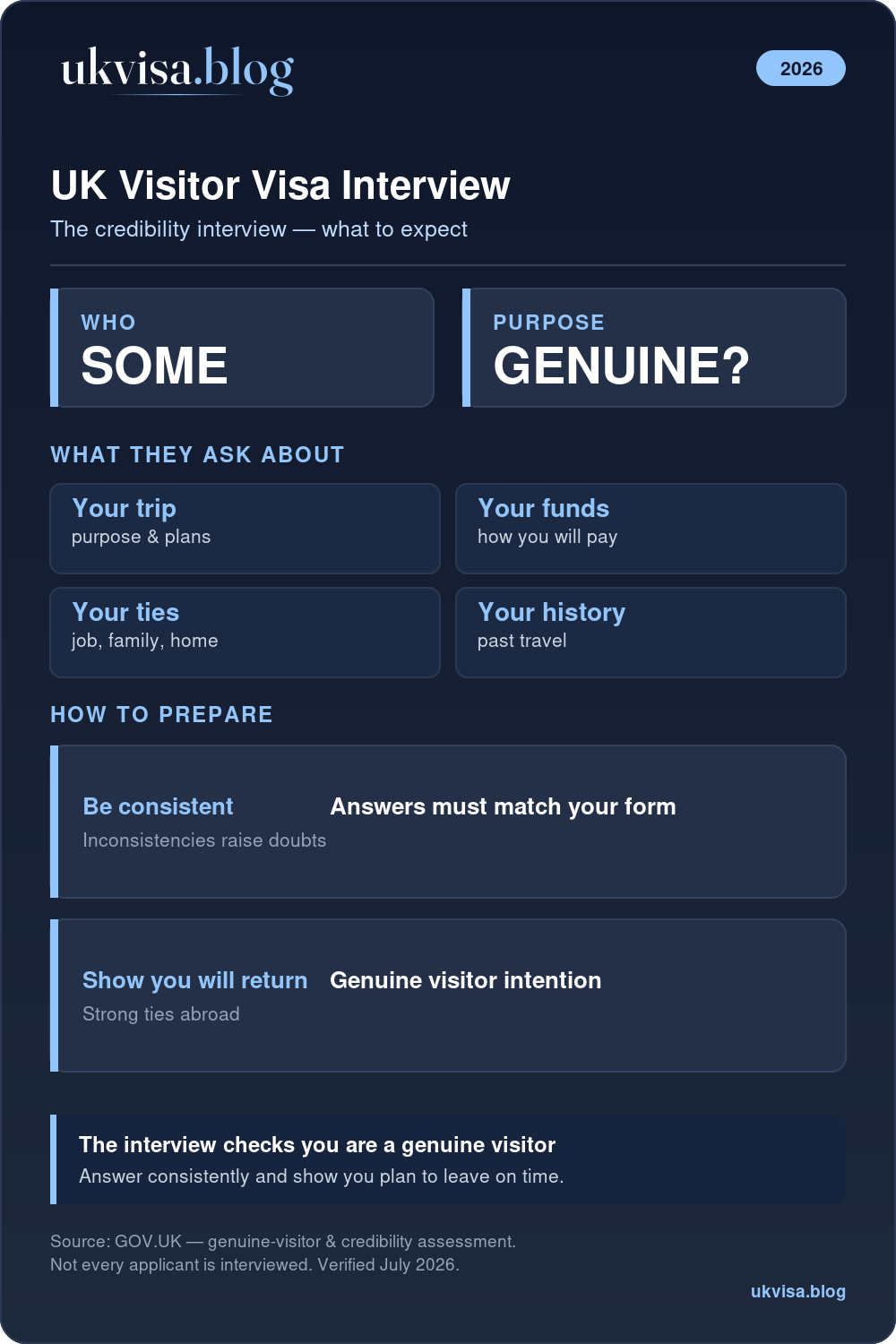
Preparing for a UK visitor visa interview can feel overwhelming, but understanding what questions to expect makes the difference between approval and refusal. UKVI does not interview every applicant — but when an interview is scheduled, your answers carry decisive weight alongside the documents already submitted. This 2026 guide covers the most common questions asked across travel purpose, finances, ties to home country, and travel history, with sample answers, who gets called for an interview, and the documents to bring on the day.
Source: gov.uk + Home Office caseworker guidance (effective 8 April 2026)
1. Most applicants are NOT interviewed — UKVI uses risk-based triggers (limited travel history, financial inconsistencies, previous refusals, high-risk nationality). 2. Honesty beats memorisation — rehearsed answers raise more red flags than authentic ones. UKVI has access to international immigration databases and detects deception easily. 3. Strong ties to home country are decisive — employment, property, family, and ongoing commitments are weighted far more heavily than how polished your answers sound. The interview tests credibility, not perfection.
- What is a UK Visitor Visa Interview?
- Who Gets Called for an Interview?
- Travel Purpose Questions
- Financial Questions
- Ties to Home Country Questions
- Travel History Questions
- Category-Specific Interview Questions
- Essential Documents for Interview Day
- Interview Success Tips
- After Your Interview
- Frequently Asked Questions
Understanding the UK Visitor Visa Interview Process in 2026
A UK visitor visa interview is a credibility assessment conducted by UK Visas and Immigration (UKVI) to verify your travel intentions and ensure you will return home after your visit. Not everyone needs an interview — UKVI typically requests one if you are from a high-risk country, have limited travel history, or if your application raises questions about your intentions or finances. The legal framework for visitor visas is set out in Appendix V: Visitor of the Immigration Rules, which caseworkers apply when deciding applications.
The interview process applies across different visitor visa categories, including the UK Standard Visitor route covering tourism, family visits, business meetings, and short courses. The official gov.uk Standard Visitor guidance covers application steps; this guide focuses specifically on what to expect if you are called for an interview. Each category has specific questions tailored to the applicant's stated visit purpose. Understanding the types of questions asked and preparing thoughtful, honest responses significantly improves your chances of success.
Who Gets Called for a UK Visa Interview?
UKVI selects applicants for interviews based on risk assessment criteria. Common triggers include applying from high-risk countries, having limited travel history, unclear financial documentation, previous visa refusals, or inconsistencies in the application. Most low-risk applicants with complete supporting documents do not receive an interview request.
Not all UK visa applicants receive an interview request. UKVI uses risk assessment tools to identify applications requiring additional scrutiny. Understanding these triggers helps you prepare a stronger application from the outset. If you have previously been refused a visa, reviewing the common UK visa refusal reasons can help you address potential concerns before they trigger an interview request.
Common Interview Triggers
You are more likely to be called for a UK visitor visa interview if you fall into any of these categories:
- High-risk nationality: Applicants from countries with historically higher overstay or refusal rates face increased scrutiny
- First-time applicants: No previous UK or international travel history to demonstrate compliance
- Financial inconsistencies: Large unexplained deposits, insufficient funds, or unclear income sources
- UK-based family ties: Having relatives in the UK may raise questions about return intentions
- Previous refusals: Any prior UK or other country visa refusals require explanation
- Employment gaps: Unclear work history or recent job changes may need clarification
- Long proposed stays: Requests for maximum duration visits without clear justification
- Sponsored applications: Visits funded by a UK-based sponsor may trigger additional verification — see the sponsor documentation guide referenced in the Financial Questions section below
Interviews can be conducted in person at a Visa Application Centre (VAC), via telephone, or through video call. You will receive notification with specific details about the interview format, date, and time. The interview typically lasts between 10 to 30 minutes, depending on the complexity of your application.
Travel Purpose Questions: Why Do You Want to Visit the UK?
Travel purpose questions assess whether your stated reason for visiting aligns with your supporting documents and whether you qualify as a genuine visitor. Answers should be specific, consistent with your application, and demonstrate clear, time-limited plans.
The purpose of your visit is the foundation of your application. UKVI officers use these questions to determine whether you genuinely intend to visit for the stated reason and leave within the permitted timeframe. Your answers must align perfectly with the information in your application form and document checklist.
What is the purpose of your visit to the UK?
Sample Answer: "I'm visiting the UK for a 10-day holiday. I've planned to spend 5 days in London exploring historical sites including the Tower of London, Westminster Abbey, and the British Museum, followed by 5 days in Edinburgh for the castle and Royal Mile. I have confirmed hotel reservations and a detailed daily itinerary."
Why this works: The answer is specific about duration, locations, and activities. It demonstrates genuine planning and aligns with typical tourist behaviour. Vague responses like "I want to see England" raise credibility concerns.
How long do you plan to stay in the UK?
Sample Answer: "I'll be staying for exactly 12 days, arriving on 15th March and departing on 27th March. These dates correspond with my approved annual leave from work, and I have a project deadline on 30th March that requires my return."
Why this works: Specific dates demonstrate planning. Mentioning work obligations establishes a clear reason to return. The dates should match your flight bookings and employment letter.
Where will you stay during your visit?
Sample Answer: "I have confirmed hotel reservations for my entire stay. I'll be at the Holiday Inn Express near Tower Bridge for my London stay, then the Apex Grassmarket Hotel in Edinburgh. I have booking confirmations for both properties in my application."
Why this works: Specific hotel names and locations demonstrate genuine planning. Having confirmations ready shows preparedness. Never suggest you will "figure out accommodation when you arrive."
Do you have friends or family in the UK?
If Yes: "Yes, my cousin lives in Birmingham. However, this is primarily a tourist trip, and I'll be staying in hotels. We plan to meet for dinner during my visit, but the main purpose is sightseeing in London and Scotland."
If No: "No, I don't have any family or close friends in the UK. This is purely a tourist visit to experience British culture and history."
Why this works: Honesty is essential — UKVI may know about UK-based relatives. If you are visiting family specifically, this is a legitimate purpose — see the dedicated Family Visit Interview Questions section below for tailored guidance. Be straightforward rather than hiding the connection.
Why do you want to visit the UK specifically?
Sample Answer: "I've been interested in British history since studying it at university. Visiting the British Museum to see the Rosetta Stone and exploring Tudor history at the Tower of London has been a long-term goal. I'm also keen to experience the Edinburgh Festival, which coincides with my travel dates."
Why this works: Shows genuine interest and knowledge about UK attractions. Personal connection to the visit purpose demonstrates authenticity rather than a generic desire to travel.
Financial Questions: Proving You Can Fund Your UK Visit
Financial questions verify you can cover trip costs without working illegally or accessing public funds. Be prepared to explain your income source, savings, estimated daily budget, and any unusual transactions in your bank statements.
Financial credibility is one of the most critical areas assessed during a UK visitor visa interview. UKVI must be satisfied that you can genuinely afford your trip without needing to work illegally or rely on public funds. Caseworkers assess not just the total amount of funds but also the source, credibility, and consistency over the 6 months of bank statements typically submitted.
How will you fund your trip?
Sample Answer: "I'm funding this trip from my personal savings. Over the past 18 months, I've saved £4,000 specifically for this holiday. My bank statements show regular salary deposits of £2,800 monthly and consistent savings. I estimate spending approximately £150-180 per day, which covers accommodation, meals, transport, and attractions."
Why this works: Demonstrates planned saving rather than sudden deposits. Realistic daily budget shows understanding of UK costs. Connecting savings to regular income establishes credibility.
What is your monthly income?
Sample Answer: "I earn £3,200 per month as a Senior Accountant at [Company Name]. I've been in this role for 4 years. My employment letter confirms my salary, position, and approved leave dates. I've also included my last three payslips showing consistent income."
Why this works: Specific figures that match documentation. Job title and tenure establish stability. Mentioning supporting documents shows thorough preparation.
Can you explain these large deposits in your bank account?
Sample Answer: "Yes, the £6,000 deposit on [specific date] was my annual performance bonus, which is documented in my bonus confirmation letter from HR. The £3,500 deposit on [date] was from selling my motorcycle — I have the sale agreement and vehicle transfer documents as proof."
Why this works: Every unusual transaction has documentation. Dates are specific and verifiable. Pre-empting this question by including explanatory letters with your application is advisable.
Do you have a sponsor for this trip?
If Self-Funded: "No, I'm completely self-funding this trip from my personal savings and income. My bank statements demonstrate I have sufficient funds accumulated over time."
If Sponsored: "Yes, my father is sponsoring my trip. He's a retired civil servant with a pension income and substantial savings. I've included his bank statements, pension documents, and a formal sponsorship letter explaining our relationship and his commitment to fund my visit."
Why this works: Clear statement of funding source. If sponsored, the sponsor's financial documents must be as comprehensive as your own would be — full sponsor documentation requirements are covered in our visitor visa sponsor guide.
Ties to Home Country: Why Will You Return?
Ties to home country questions assess your incentive to return after visiting the UK. Strong ties include stable employment, property ownership, family responsibilities, ongoing education, business interests, or other commitments that demonstrate you have reasons to return.
Demonstrating strong ties to your home country is often the deciding factor in visa decisions. UKVI must be satisfied that you will leave the UK at the end of your visit. Weak ties are a leading cause of UK visitor visa refusals. The more compelling your reasons to return, the stronger your application.
What do you do for work?
Sample Answer: "I work as a Project Manager at [Company Name], a position I've held for 5 years. I lead a team of 8 engineers and currently manage three major infrastructure projects worth £2 million combined. My employer has approved leave from [date] to [date], but I have a critical project milestone on [return date] that I must be present for."
Why this works: Emphasises responsibility and seniority. Specific obligations create compelling return reasons. Long tenure demonstrates stability.
Why will you come back after your UK visit?
Sample Answer: "I have multiple strong ties to my home country. Professionally, I have a secure job with upcoming promotion opportunities. Personally, I own my apartment and have a mortgage commitment. My elderly mother lives nearby and relies on me for support. I'm also enrolled in a professional certification programme with exams scheduled for next month."
Why this works: Multiple categories of ties (employment, property, family, education). Each reason is specific and verifiable. Combination approach is stronger than single reason.
Are you married? Do you have children?
If Married with Children: "Yes, I'm married with two children aged 7 and 11. They'll remain home with my spouse during my trip as they have school commitments. We own our family home, and I have significant family responsibilities that require my presence."
If Single: "I'm single, but I have strong ties through my established career, property ownership, and family responsibilities. I'm the primary caregiver for my widowed father and manage our family's rental property business."
Why this works: Addresses the question directly. Single applicants proactively mention alternative ties to counter potential concerns about settlement risk.
Do you own property in your home country?
If Yes: "Yes, I own a two-bedroom apartment that I purchased in 2019. The property deed is included with my application. I also own a car and have various financial investments in local businesses."
If No: "I currently rent an apartment with a two-year lease agreement that extends beyond my travel dates. I've included the lease as evidence of my ongoing housing commitment. I also have significant ties through my career, family, and financial investments."
Travel History Questions: Your Previous International Experience
Travel history questions assess your compliance record with immigration rules. Previous travel to countries with similar immigration standards demonstrates trustworthiness. First-time travellers should emphasise their thorough preparation and understanding of visa conditions.
Your travel history provides evidence of how you have complied with immigration rules in the past. A clean record of entering and leaving countries as permitted strengthens your credibility. However, limited travel history is not automatically negative — it simply means other aspects of your application must be stronger.
Have you travelled internationally before?
If Yes: "Yes, I've travelled to several countries. In 2024, I visited the Schengen area (France and Germany) for two weeks. In 2025, I travelled to Australia for business meetings. I returned on time from each trip and complied fully with visa conditions. My passport stamps confirm this travel history."
If No: "This will be my first international trip. I've spent the past few years focusing on my career and building savings. Now that I'm financially stable, I'm ready to travel. I've thoroughly researched UK visa requirements and understand all the conditions I must comply with."
Have you been to the UK before?
If Yes: "Yes, I visited the UK in 2023 on a Standard Visitor visa for a two-week holiday. I departed three days before my visa expired and complied with all conditions. That positive experience inspired me to return and explore different regions."
If No: "No, this will be my first visit to the UK. I've been planning this trip for over a year and have thoroughly researched everything from visa requirements to my travel itinerary."
Have you ever been refused a visa?
If Yes: "Yes, I was refused a US visitor visa in 2021 due to insufficient evidence of employment at that time. Since then, I've been promoted to Senior Manager, significantly increased my savings, and successfully travelled to three Schengen countries and Australia. My circumstances have substantially improved."
If No: "No, I have never been refused a visa for any country."
Have you ever overstayed a visa?
Sample Answer: "No, I have never overstayed any visa. I understand the importance of complying with immigration laws and always ensure I depart before my permitted stay expires. I keep careful records of visa validity dates whenever I travel."
Why haven't you travelled much internationally?
Sample Answer: "I focused on completing my education and establishing my career during my twenties. I also prioritised saving for property, which I purchased three years ago. Now that I have financial stability and a secure position, I'm beginning to travel internationally. The UK has been my preferred destination for years due to my interest in British history."
Category-Specific Interview Questions
Beyond the core categories of travel purpose, finances, ties, and travel history, UKVI officers may ask specific questions tailored to your visit type — business meetings, family visits, medical treatment, marriage, or accompanying a child applicant. The questions test whether your stated purpose matches Appendix V permitted activities.
If your visit falls under a specific sub-category, prepare for questions tailored to that purpose. The UK's visitor visa framework permits many activities under one Standard Visitor framework, but each visit type triggers different lines of questioning.
Business Visitor Interview Questions
If you're visiting for business meetings, conferences, or training, expect questions about the inviting UK company, the nature of meetings, and confirmation that you will not undertake productive work. Detailed coverage of business visit requirements is in our UK business visitor visa guide. Typical questions: "Who is inviting you?" "What meetings will you attend?" "Are you being paid by a UK source?" "Have you visited this UK company before?"
Family Visit Interview Questions
If you're visiting UK-based family — parents, siblings, adult children, or other relatives — expect questions about the relationship, the host's UK immigration status, and accommodation arrangements. Full guidance is in our UK Family Visitor Visa guide. Typical questions: "What is your relationship to the host?" "When did you last see them?" "Is the host paying for your trip?" "Where will you stay?"
Child Applicant Interview Questions
When the applicant is a child (under 18) travelling for tourism or family visits, the accompanying parent or legal guardian typically answers the questions. The interview focuses on parental consent, care arrangements, and the C-Visit accompanied/unaccompanied endorsement. Full requirements are in our child visitor visa guide. Typical questions: "Who will care for the child in the UK?" "Are both parents giving consent?" "What is the child's school situation?"
Marriage Visitor Interview Questions
If you're visiting to marry or form a civil partnership in the UK, expect detailed questions about your relationship history, the marriage venue, your intentions after the ceremony, and your plan to leave the UK. Full requirements are in our Marriage Visitor Visa guide. Typical questions: "Where and when did you meet your partner?" "Where will the ceremony take place?" "What are your plans after the wedding?" "Do you intend to live together in the UK after marrying?"
Student CAS Interview (Separate Process)
If you are applying for a Student Visa rather than a visitor visa, UKVI uses a different process called a Credibility Interview (sometimes called a CAS or pre-CAS interview). This is a structured assessment of your academic intentions and ability to study at the proposed UK institution — separate from visitor visa interviews covered in this guide. For Student Visa requirements, see our UK Student Visa requirements guide.
Additional UK Visa Interview Questions
Beyond the core categories, UKVI officers may ask additional questions to verify specific aspects of your application or clarify any concerns.
Do you have a return ticket?
Sample Answer: "Yes, I have confirmed return flights booked with British Airways, departing London Heathrow on [date]. The booking reference and e-ticket are included in my application. I chose a non-flexible fare, which demonstrates my firm commitment to these travel dates."
What if you fall ill during your UK visit?
Sample Answer: "I've purchased comprehensive travel insurance that covers medical emergencies up to £500,000, including emergency repatriation. The policy documents are included with my application. I also maintain access to emergency funds through my international debit card."
Do you intend to work in the UK?
Sample Answer: "Absolutely not. I understand that the Standard Visitor visa does not permit any form of employment. I have a stable, well-paying job at home that I'm returning to, and I have sufficient savings to cover all trip expenses without needing to work."
Essential Documents for Your UK Visitor Visa Interview
Bring original documents and copies of everything submitted with your visa application, including passport, financial evidence, employment letter, accommodation bookings, travel insurance, and any additional supporting documents. Organisation demonstrates preparedness.
Even though you have submitted documents with your application, having organised copies at your interview allows you to reference specific information when answering questions. This preparation demonstrates thoroughness and helps you provide precise answers.
- Current passport plus any previous passports showing travel history
- Bank statements (6 months) with explanatory letters for large transactions
- Employment letter confirming position, salary, leave dates, and return date
- Payslips (last 3 months) and tax documents
- Hotel booking confirmations or host invitation with host's documents
- Flight booking confirmations (outbound and return)
- Travel insurance policy covering entire stay
- Property documents (if applicable)
- Marriage certificate and children's birth certificates (if applicable)
- Sponsor's financial documents (if sponsored)
UK Visitor Visa Interview Success Tips
Success requires preparation, consistency, and confidence. Review your application thoroughly, answer questions directly without over-explaining, maintain consistency with submitted documents, and present yourself professionally. The interview assesses credibility, not perfection.
Before the Interview
Preparation is your greatest advantage. In the days before your UK visitor visa interview, review every detail of your application — dates, figures, and stated plans. Ensure you can explain any document you submitted. Organise your papers in clearly labelled folders for quick reference. Plan to arrive at least 15 minutes early, and dress professionally (business casual is appropriate).
During the Interview
Maintain calm confidence throughout the interview. Make appropriate eye contact and speak clearly at a moderate pace. Answer questions directly — provide the information requested without volunteering unnecessary details. If you do not understand a question, politely ask for clarification rather than guessing. Stay consistent with your written application; contradictions raise credibility concerns.
What to Avoid During Your Interview
- Vague answers: "I want to see the UK" raises concerns — be specific about locations, dates, and activities
- Inconsistency: Contradicting your application suggests dishonesty or poor preparation
- Over-explaining: Answer what is asked; volunteering extra information can create new concerns
- Memorised scripts: Natural responses sound authentic; rehearsed answers sound suspicious
- Excessive nervousness: Some nervousness is normal; extreme anxiety may suggest something to hide
- Arguing with the officer: If corrected, accept it politely; confrontation never helps your case
- Informal language: Maintain professional communication throughout
After Your UK Visitor Visa Interview: What Happens Next
After the interview, your application returns to the decision queue. Standard processing takes 3-6 weeks; priority services (where available) reduce this to 5-10 working days. You will receive email notification when a decision is made, then instructions to collect your passport.
The interview officer will not provide an immediate decision. Your application is assessed alongside the interview notes and all submitted evidence. Check current UK visa processing times for the most accurate timeframe estimates. If your application is taking longer than expected, see our UK visa delay guide for what an NSF email from UKVI means and how to escalate. For country-specific approval probability data, the UK visa success rate guide breaks down outcomes by nationality.
| Service Type | Processing Time | Availability |
|---|---|---|
| Standard Service | 3-6 weeks from interview | All locations |
| Priority Service | 5-10 working days | Selected locations (additional fee) |
| Super Priority | 24-hour turnaround | Very limited locations |
If Your Visa is Approved
Upon receiving your visa, carefully verify all details including validity dates, entry conditions, and whether it permits single or multiple entries. Most Standard Visitor visas allow stays of up to 6 months per visit and are valid for multiple entries over their duration (6 months, 2, 5, or 10 years).
If Your Visa is Refused
A refusal letter will explain the specific reasons for the decision. Common post-interview refusal reasons include insufficient ties to home country, unconvincing travel purpose, inadequate financial evidence, or credibility concerns raised during the interview. You can typically reapply immediately, but should address all stated concerns with stronger evidence. For analysis of reapplication probability and how to rebuild a stronger application, see our chances of getting a UK visa after refusal guide.
- Thorough preparation is the single most important factor for UK visitor visa interview success
- Every answer must be consistent with your written application and documents
- Demonstrate strong ties to your home country through multiple categories of evidence
- Be honest — UKVI has access to international immigration databases
- Answer directly without over-explaining or volunteering unnecessary information
- Interview length is typically 10-30 minutes, conducted in person, by phone, or via video
- Most visitor visa applicants are NOT interviewed — only risk-flagged applications
Frequently Asked Questions
Do all UK visitor visa applicants need to attend an interview?
No, UKVI only calls selected applicants for interviews based on risk assessment criteria. Most straightforward applications from low-risk countries with strong supporting documents do not require interviews. Interviews are typically requested when additional verification is needed — for example, applicants from high-risk countries, those with limited travel history, or applications with financial inconsistencies.
How long does a UK visitor visa interview typically last?
Most UK visitor visa interviews last between 10 to 20 minutes. Complex cases or applications requiring more detailed questioning may extend to 30 minutes. The duration depends on the interviewing officer's assessment of which questions need clarification, and how complete and consistent your initial application was.
What are the most common UK visitor visa interview questions?
The most common UK visitor visa interview questions fall into four core categories: travel purpose ("Why do you want to visit the UK?", "How long will you stay?", "Where will you stay?"), finances ("How will you fund your trip?", "What is your monthly income?"), ties to home country ("Why will you return?", "What do you do for work?"), and travel history ("Have you been refused a visa before?", "Have you travelled internationally?"). Category-specific questions also apply for business, family, marriage, or child applications.
Can I bring an interpreter to my UK visa interview?
Yes, if you are not comfortable conducting the interview in English, you can request an interpreter. However, the interpreter must be a professional — family members are not permitted. Arrange this in advance by contacting the Visa Application Centre when scheduling your interview.
What should I wear to my UK visitor visa interview?
Dress professionally in business casual attire. Avoid overly casual clothing such as shorts, flip-flops, or distressed jeans. First impressions matter, and professional appearance demonstrates you take the immigration process seriously and approach it respectfully.
Should I memorise answers for UK visa interview questions?
No, avoid memorising scripted answers. Rehearsed responses sound unnatural and may raise suspicion. Instead, thoroughly understand your application details and practise explaining your plans naturally. Authenticity is more convincing than perfectly polished but robotic answers. UKVI officers are trained to detect coached responses.
How soon after the interview will I get my UK visa decision?
Standard processing after a UK visitor visa interview typically takes 3-6 weeks. Priority services, where available for an additional fee, can reduce this to 5-10 working days. Super Priority service (24 hours) is only available at very limited locations. Processing times vary by location and season, with delays common during peak travel periods.
Can I reschedule my UK visa interview?
Yes, but only for valid reasons such as medical emergencies or unavoidable circumstances. Contact the Visa Application Centre immediately to request rescheduling. Be aware that multiple rescheduling requests may delay your application and could raise questions about your commitment to the visit.
What happens if I'm too nervous during my UK visa interview?
Some nervousness is completely normal and expected by interview officers. Take deep breaths, request a moment to compose yourself if needed, and ask for clarification if you do not understand a question. Focus on answering honestly — genuine responses are more important than perfect delivery. Officers distinguish between normal nervousness and the kind of evasiveness that suggests dishonesty.
What's the best answer to "Why do you want to visit the UK?"
The best answer is specific, personal, and tied to verifiable activities. Mention specific destinations, attractions, events, or family members you plan to visit. Connect the visit to a personal interest or milestone (history, culture, sport, family event, business meeting). Avoid generic responses like "I just want to travel" or "to see England" — these raise credibility concerns. Your answer should align exactly with your stated itinerary and supporting documents.