
Administrative review is a check for case working error, not a second assessment of your case. Appendix AR defines the test narrowly: did the decision maker fail to apply, or incorrectly apply, the Immigration Rules or published guidance. New evidence is generally not considered, which is why it succeeds far less often than an appeal.
Administrative Review
UK Visa Administrative Review Under Appendix AR
What Administrative Review Is
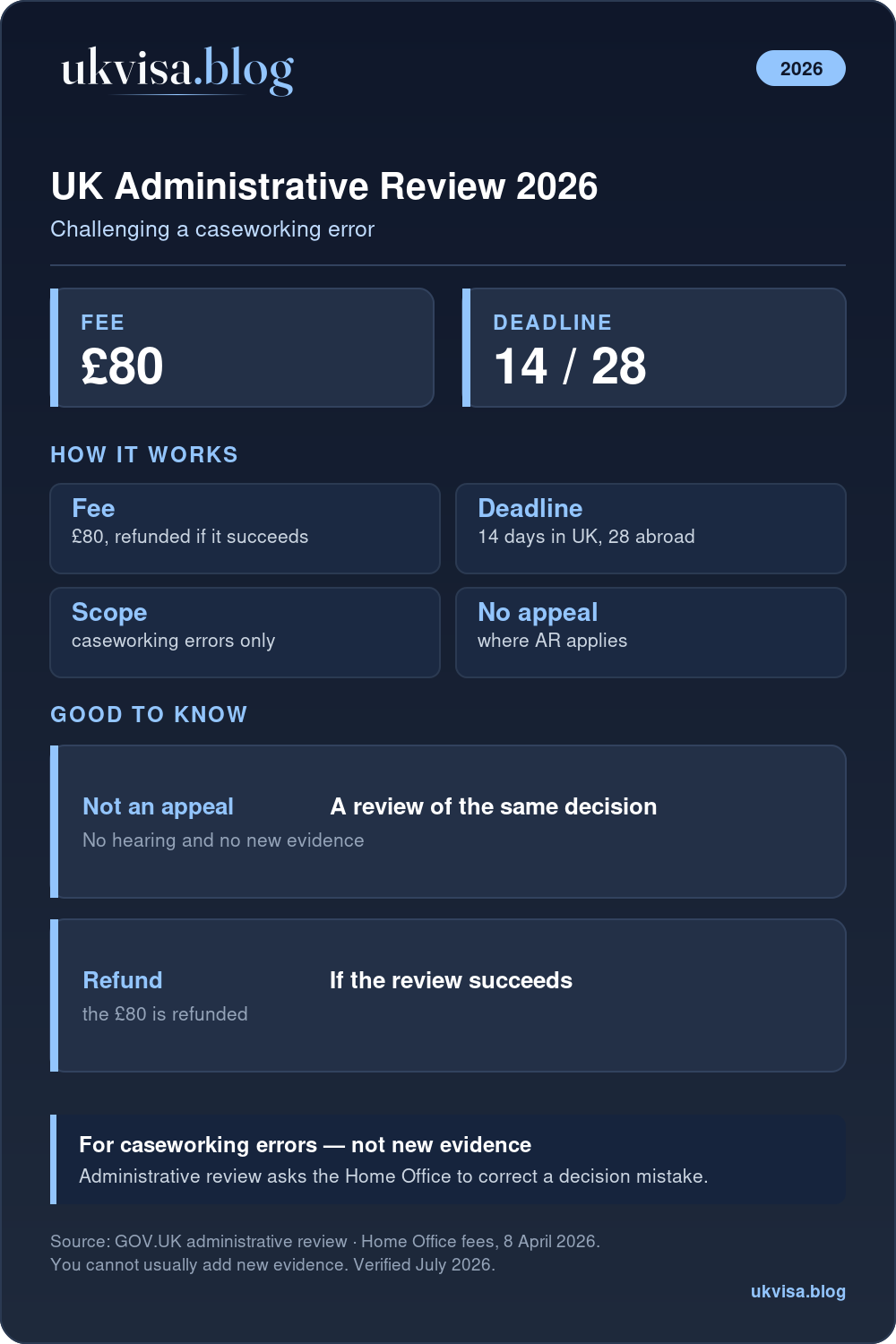
A different Home Office caseworker rechecks the decision for a case working error. It is internal, it costs £80, and it is bounded: the reviewer asks whether the original decision was made correctly on the material that was before the decision maker, not whether a better application could have been made.
Apply within 14 calendar days of receiving the decision if you are in the UK, 7 days if you are in detention, and 28 days if you are outside the UK. The fee is £80. New evidence is generally not considered. GOV.UK currently warns that a result can take 12 months or more, with a Home Office update if nothing is decided within six months.
Why It Exists
It replaced rights of appeal on most work and study routes. The policy trade was speed and cost against scope: a cheap internal check instead of a tribunal, with the scope narrowed to errors rather than merits. Understanding that trade explains both the low fee and the low success rate.
Which Decisions Are Eligible
- Points-based work routes: including Skilled Worker.
- Study routes: including the student route.
- Many in-country decisions: including some settlement applications — see our page on settlement.
- Decisions to cancel permission at the border: in defined circumstances.
- Not visit refusals: there is no administrative review and no general appeal — see our page on the standard visitor route.
- Not human rights refusals: where an appeal right exists instead — see our spouse route page.
The refusal notice states whether review is available and by when. If it does not offer one, it is because none exists for that decision — check the notice rather than assuming.
Why Review Succeeds Less Often Than an Appeal
Three structural reasons, none of them about the strength of your case. The test is error rather than merits. New evidence is generally excluded. And the reviewer works from the same file, so a decision that was reasonable on thin evidence stays reasonable on review.
Tribunal appeals sit differently. A judge hears evidence, including evidence that did not exist when the decision was made, and around 39% of immigration appeals were allowed in early 2026. That is not a comparison of case quality; it is a comparison of what each process is permitted to look at. Our page on success rates sets out the data.
Applying
- Establish the date you received the decision: the deadline runs from it.
- Identify the paragraph and the finding: from the refusal notice.
- Locate the error: a rule or guidance provision misapplied, or evidence overlooked.
- Apply online and pay £80: within the deadline for your situation.
- State the error precisely: with the page or document reference that proves it.
- Do not restate the application: the reviewer is not reassessing the merits.
What You Can and Cannot Send
Generally you cannot submit new evidence. Appendix AR allows limited exceptions, principally where the original decision involved false representations or deception, previous breaches of immigration law, a failure to request specified documents, or non-compliance with the evidential flexibility policy. Outside those, new material is not considered.
Attaching the bank statement you forgot does not turn a review into a fresh assessment. Unless one of the narrow exceptions applies, the reviewer disregards it and confirms the decision — and you have spent £80 and the deadline for anything else has moved on. Where evidence was missing, a fresh application is the remedy.
Deadlines
Time Limits Under Appendix AR
| Situation | Deadline from receiving notice |
|---|---|
| Applicant in the UK, not detained | 14 calendar days |
| Applicant in immigration detention | 7 calendar days |
| Applicant outside the UK | 28 calendar days |
Source: Immigration Rules, Appendix AR. Checked 22 August 2026.
Calendar days, not working days. And the clock runs from receipt of the notice, which is governed by the deemed service rules — the second day after recorded post within the UK, the 28th day after posting abroad, the day of sending for email. Our page on reading the refusal letter covers establishing that date.
Section 3C While a Review Is Pending
Where an in-country application was made in time and is refused, section 3C leave can continue during an in-time administrative review. That is frequently the decisive reason to use the review rather than leave and reapply, even where the prospects are modest. See our page on section 3C leave.
Evidential Flexibility, and Why It Matters Here
One of the narrow exceptions is worth understanding, because it is where reviews are most often won. Home Office policy requires caseworkers, in defined circumstances, to write and ask for a missing or incorrect specified document before refusing. Where that step was skipped, the failure to take it is itself the case working error.
The same applies to a decision that refuses for want of a specified document the applicant was never asked for. Check the file: if a document was missing and no request was made, the ground is the omission of the request rather than the absence of the document. That framing is what makes the point reviewable at all.
How Long It Takes
GOV.UK currently warns that a result can take 12 months or more, and that the Home Office will contact you with an update if there is no decision within six months. That is a material change from how the remedy was originally presented, and it should shape the decision to use it.
Weigh it against the alternative. A fresh application on most routes is decided in three weeks from abroad or eight weeks in country. Where the missing element is evidence rather than a legal error, waiting a year for a review that cannot look at that evidence makes no sense.
What Counts as a Case Working Error
- Failure to apply the relevant Immigration Rules: or applying them incorrectly.
- Failure to apply published guidance: or applying it incorrectly.
- Evidence overlooked: a document that was submitted but not considered.
- A factual mistake: a date or figure misread from the material provided.
- The wrong version of the rules: applied to an application made before a change.
What is not an error: disagreement with the weight given to evidence, dissatisfaction with the outcome, or a claim that the decision was harsh. Those are merits arguments, and administrative review is not a merits process. Our page on refusal grounds helps separate the two.
If the Review Succeeds
The decision is withdrawn and remade. In most cases that means the application is granted, but not always — the reviewer may identify the error and the decision may be remade correctly on another ground. The £80 is generally refunded where a case working error is found.
Where the decision is remade in your favour, permission is granted from that point and your status flows from it. Where an in-country application was involved, check what happens to any section 3C leave and to the dates on your new grant.
The Outcome Is Not Always a Grant
A review can find an error and still leave you refused. Where the reviewer accepts that a rule was misapplied but concludes the application fails on a different requirement, the decision is remade with new reasons rather than reversed. That outcome is common enough to plan for, and it restarts the question of what to do next.
If the Review Fails
The original decision stands and there is normally only one review per decision. The remaining options are a fresh application, a reconsideration request, or judicial review where the review itself was unlawful.
For an in-country applicant, an unsuccessful review usually ends section 3C leave, and overstaying from that point carries the consequences set out on our pages on general grounds for refusal and re-entry bans. Take advice before the review is decided, not after.
Drafting the Grounds
The application asks you to identify the error. Precision wins here: name the paragraph, quote the finding, point to the document, and say what the correct outcome would have been. Length is not the point — one clearly evidenced error beats five general complaints.
Applicant: [Name], date of birth [DOB]
Application reference: [GWF or UAN]
Decision date: [Date]
Date notice received: [Date]
Ground: case working error — failure to apply, or incorrect application of, [the rule or guidance provision].
The decision states at [page or paragraph]: "[quote the finding]".
That finding is incorrect because [the document submitted on DD Month YYYY, at page X of the bundle, shows Y]. The document was submitted with the application and appears in the document list at [reference].
The correct application of [rule or guidance reference] to that evidence is [state it]. Had it been applied, the requirement at [paragraph] would have been met.
I ask that the decision be withdrawn and the application granted.
The Alternatives
- Evidence was missing or unclear: a fresh application, not a review.
- A document was submitted but ignored: administrative review, at £80.
- A human rights claim was refused: an appeal, where the right exists — see our page on human rights grounds.
- An obvious factual error: a reconsideration request alongside the formal remedy.
- The decision was unlawful: a pre-action letter and judicial review.
Fees for each are on our page on visa fees, and our page on what to do after a refusal compares the routes. Where the refusal turned on documents or English, see our supporting documents guide.
Sources: Appendix AR of the Immigration Rules on GOV UK and the GOV UK administrative review pages. Figures verified 22 August 2026.
Frequently Asked
Administrative Review Questions
How long do I have to apply?
14 calendar days from receiving the decision if you are in the UK, 7 days if in detention, and 28 days if outside the UK.
How much does it cost?
£80. It is generally refunded where a case working error is found.
Can I send new evidence?
Generally no. Appendix AR allows narrow exceptions, including where the decision involved deception allegations, previous breaches, a failure to request specified documents, or evidential flexibility.
How long does a decision take?
GOV.UK warns it can take 12 months or more, with an update from the Home Office if nothing is decided within six months.
Is review available for a visit refusal?
No. Visit refusals carry no administrative review and no general right of appeal. A fresh application is the route.
What counts as a case working error?
A failure to apply, or incorrect application of, the Immigration Rules or published guidance — including evidence submitted but not considered. Disagreement about weight is not an error.
Does review protect my status while it runs?
Where an in-country application was made in time, section 3C leave can continue during an in-time review. That is often the main reason to use it.
Can I ask for a second review?
Normally there is only one review per decision. After that the options are a fresh application, reconsideration, or judicial review.
Should I use a lawyer?
For a clear, single error you can point to in your own bundle, often not. Where the refusal cites deception or criminality, or where section 3C is in play, take advice.
Is a fresh application better?
Usually, where evidence was missing. It is decided in weeks rather than months and can include the material a review cannot look at.