
Settlement is one of the slower decisions the Home Office makes, and it is not covered by the published in-country waiting times that govern the temporary routes. What is available is the faster-decision route: priority at £500 and, on most settlement categories, super priority at £1,000 for a next working day target.
Settlement Timing
How Long Indefinite Leave to Remain Takes
What Is Actually Published
GOV.UK publishes waiting times for in-country applications on the temporary routes — eight weeks for most, three for Health and Care Worker and Start-up, twelve months for some family categories. Settlement applications are handled separately and are not in that table, which is why applicants find no figure to plan around.
There is no published in-country waiting time for settlement in the table that covers the temporary routes. Faster decisions are available: priority at £500 and super priority at £1,000 for a next working day target, across a broad list of settlement categories including long residence, partner and parent routes, work and business categories, UK Ancestry, HM Forces, children under 18 and BN(O). Some carry channel restrictions.
ILR Processing Times in 2026
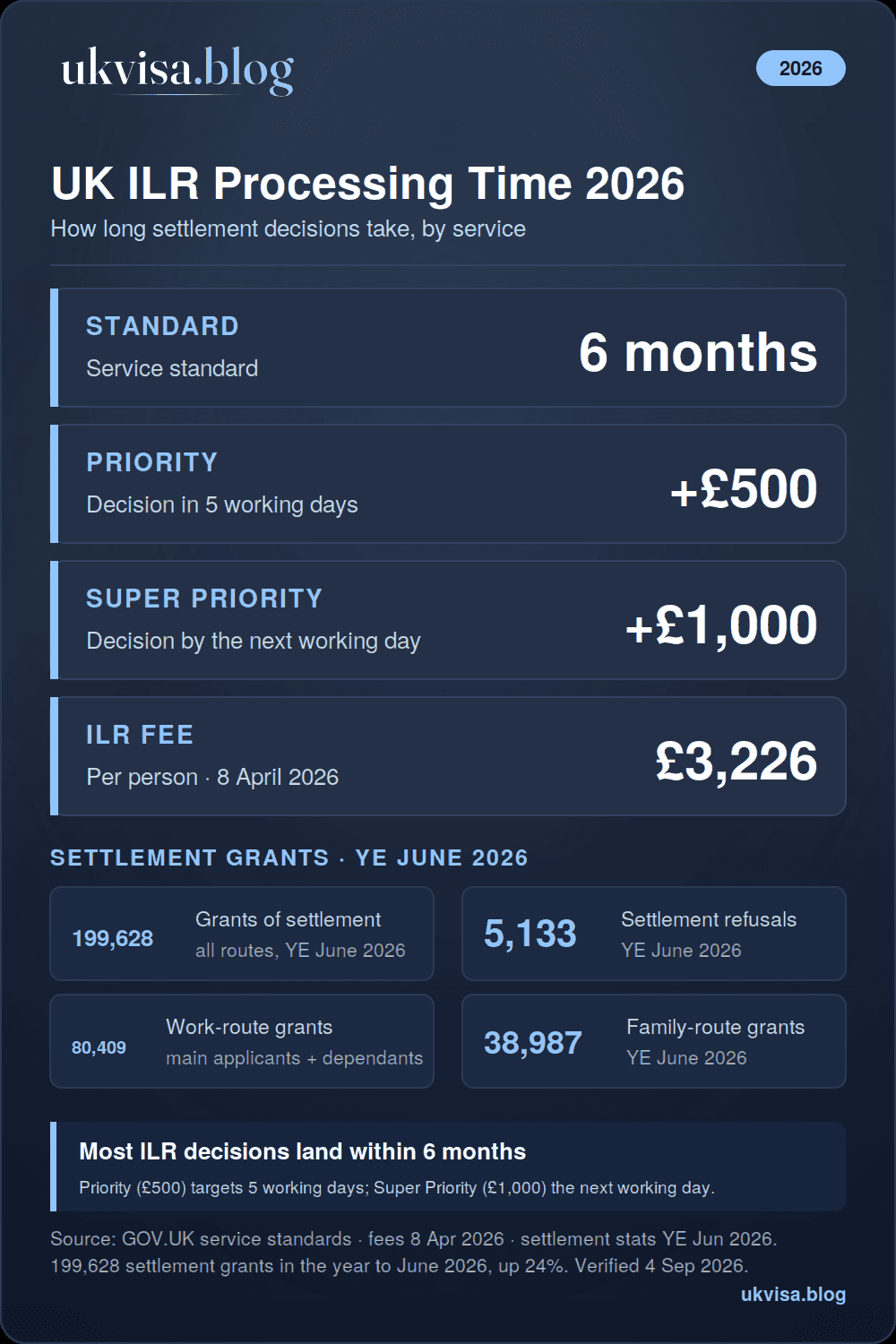
Searches for a single "ILR processing time 2026" figure surface everything from weeks to a year, because no routine service standard is published for settlement. What is fixed for 2026: super priority buys a next-working-day decision where it is offered at checkout, the priority service targets 5 working days for most settlement applications, and a standard application moves at whatever speed the caseload allows.
Section 3C Protects You Meanwhile
Where you applied before your existing permission expired, section 3C of the Immigration Act 1971 continues it on the same conditions while the decision is pending. That is what makes a long settlement wait survivable — you remain lawfully here, with the same work rights, until the decision is made. See our page on section 3C leave.
Timing by Category
The practical experience differs by route, and the difference is driven by how much verification each involves rather than by any published target. A work settlement application resting on employment records moves faster than a long residence application spanning ten years of permissions.
- A long qualifying period: ten years generates more to check than five.
- Multiple previous permissions: each one verified against the record.
- Absences near the limit: which have to be counted rather than accepted.
- An exception being relied on: discretion takes longer than arithmetic.
- Dependants applying together: linked cases move at the pace of the slowest.
- Anything engaging suitability: convictions, breaches or unpaid debts to public bodies.
Priority and Super Priority
Faster Decision Options
| Service | Fee, per applicant | Target |
|---|---|---|
| Standard | Included | No published in-country settlement figure |
| Priority | £500 | Five working days on most visa and settlement applications |
| Super priority | £1,000 | End of the next working day |
| Super priority, weekend or bank holiday | £1,000 | Two working days |
Source: GOV.UK faster decision guidance and the Home Office fee table, 8 April 2026. Checked 22 August 2026.
Both are charged per applicant, so a family of four paying for super priority adds £4,000 to a bill already running to £12,904 in settlement fees. And both buy queue position rather than a better decision — see our page on priority services.
GOV.UK states that where more information is needed or details must be verified with another department, the decision may take longer and you will not usually get your money back. Settlement applications carry more verification than most, which makes the fee genuinely at risk where absences, employment history or suitability are in question.
Settlement on the Partner Route
Partner settlement is eligible for the faster services, and family applications in country can access the next working day service through a service point appointment. The evidence involved is relationship, financial and accommodation material rather than employment records, which is a different kind of check.
One point specific to this route: Appendix Continuous Residence does not list Appendix FM, so the 180-day absence cap does not govern the five-year partner or parent routes. See our pages on the spouse route and the continuous residence requirement.
Settlement on Work Routes
Work settlement is generally the most predictable, because the qualifying period is documented by sponsorship records the Home Office already holds. The requirements that most often delay it are absences and the continuing employment condition at the date of application.
Several work routes are exempt from proving English again at settlement, having proved it at entry — Skilled Worker among them. That removes one document and one potential delay. See our page on the Skilled Worker route.
Long Residence
Ten years of permissions is ten years of records to reconcile, and this is reliably the slowest settlement route. The two things that delay it most are a gap between one permission ending and the next beginning, and an absence total nobody counted at the time.
Both are addressable before applying, and both are far cheaper to fix then. Reconstruct the permission history and the absence record from your own documents before the £3,226 is spent — see our page on the continuous residence requirement.
BN(O) Settlement
The BN(O) route qualifies for settlement after five years and is on the eligible list for faster decisions. In-country BN(O) applications on the temporary route are published at twelve weeks, which is longer than the eight-week standard for most other categories — see our page on the BN(O) route.
Private Life and Family Life Routes
These are the slowest family applications by a wide margin. Partner applications made on a private life basis, and parent applications in country, are published at twelve months on the temporary route — an order of magnitude beyond the eight-week standard.
Settlement on those routes follows the same pattern, because the underlying assessment is evaluative rather than documentary. Our pages on the private life route and human rights applications cover what is being weighed.
Where the Faster Services Are Not Offered
Availability is not uniform across settlement categories. Some allow the next working day service only through a service point appointment rather than any other channel, at least one route is excluded from service point appointments altogether, and a legacy category permits only the five working day option through that channel.
Check the current eligibility list for your own route before building a timetable around a purchased target. The services are also withdrawn from time to time during periods of high demand, and there is no entitlement to them.
Planning Around a Long Wait
Because section 3C holds your status, the practical problems of a long settlement wait are administrative rather than legal: an employer's right to work re-check, a landlord's right to rent check, a mortgage application, a passport that expires while the case runs. Each is solvable, and each is easier solved before it becomes urgent.
Keep the submission confirmation, the payment receipt and a current share code together, and tell anyone who will need to verify your position that a decision is pending. The verification services exist for exactly this situation, and most refusals of service come from unfamiliarity rather than from any actual gap in your status.
What Causes Delay
- A request for further evidence: which stops the clock until answered.
- Absence figures that do not reconcile: with the Home Office record.
- A gap in permission: discovered during the check rather than declared.
- Suitability questions: convictions, immigration breaches, unpaid tax or NHS debt.
- An unverifiable Life in the UK pass: or an English certificate from an unapproved provider.
- Demand: which GOV.UK names as a general reason applications take longer.
Almost all of these are addressed at submission rather than afterwards. Our page on visa delays covers what the notification messages mean and when contacting the Home Office is worthwhile.
Answering a Request for Evidence
Send exactly what was asked for, by the deadline, quoting the application reference. Rebuilding the whole bundle invites fresh questions and lengthens the check, while missing the deadline converts a solvable gap into a refusal of an application that cost £3,226.
Tracking the Application
Your online account shows status changes and the registered email receives any request or notification. Keep both working: a request for documents that goes unanswered becomes a refusal, and a notice sent electronically is treated as served on the day it was sent.
Chasing before a decision is genuinely overdue achieves nothing. Where circumstances change materially — a passport expiring, a serious illness, a fixed date you now cannot meet — that is a different and legitimate enquiry.
The Cost
£3,226 per applicant from 8 April 2026, up from £3,029, with no health surcharge on a settlement application. The Life in the UK test is £50 per attempt. Priority adds £500 and super priority £1,000, per person. Our in-country fee page sets out the full picture.
None of the fee is refunded on refusal, though the surcharge would be if one were payable. That asymmetry is the argument for spending time on the absence record and the form choice rather than on speed — see our pages on settlement and the Life in the UK test.
Changes on the Horizon
The government consulted on an earned settlement model, and the consultation closed on 12 February 2026. Nothing has been laid in the Immigration Rules, so current qualifying periods and processes apply until a statement of changes appears.
Where a refusal does arrive, the options are administrative review where available, a fresh application, or judicial review for unlawfulness. See our pages on administrative review and what to do after a refusal.
Sources: GOV UK waiting times for applications inside the UK, the GOV.UK faster decision guidance and eligibility list, the Home Office fee table effective 8 April 2026, and the statements of changes collection. Figures verified 22 August 2026.
Frequently Asked
Settlement Timing Questions
Is there a published waiting time for settlement?
Not in the table covering in-country temporary routes. Settlement is handled separately, which is why applicants find no figure to plan around.
Can I pay for a faster settlement decision?
Yes. Priority at £500 targets five working days and super priority at £1,000 targets the end of the next working day, across a broad list of settlement categories.
Am I lawfully here while I wait?
Yes, where you applied before your existing permission expired. Section 3C continues it on the same conditions until the decision.
Can I travel while it is pending?
No. Section 3C leave lapses if you leave the UK and the application is generally treated as withdrawn. It does not revive on return.
Which route takes longest?
Long residence, because ten years of permissions and absences have to be reconciled. Private life and parent applications are the slowest of the family categories.
Will I get the priority fee back if it takes longer?
Usually not. Where more information is needed or details must be verified with another department, the decision may take longer and the fee is not returned.
Do dependants get decided at the same time?
Usually, where applications are linked and submitted together. That means the family moves at the pace of whichever case needs the most checking.
How much does settlement cost?
£3,226 per applicant, with no health surcharge. The Life in the UK test is £50 per attempt, and priority services are charged per person on top.
My passport expires while the application is pending. What do I do?
Raise it early rather than at expiry. A document expiring while the case runs creates a problem for the decision itself, and it is far easier to address before it happens.
Can I start a second application to speed things up?
No. Section 3C prevents making an application to vary leave while it is extended, and a second application would complicate both files without overtaking the first.
What is the single best way to avoid delay?
Reconstruct and evidence the absence record before applying, and check you are using the correct form. Those two account for most avoidable settlement delays and refusals.
Will the earned settlement proposals change this?
Nothing has been laid in the Rules. The consultation closed on 12 February 2026 and current periods and processes apply until a statement of changes appears.