
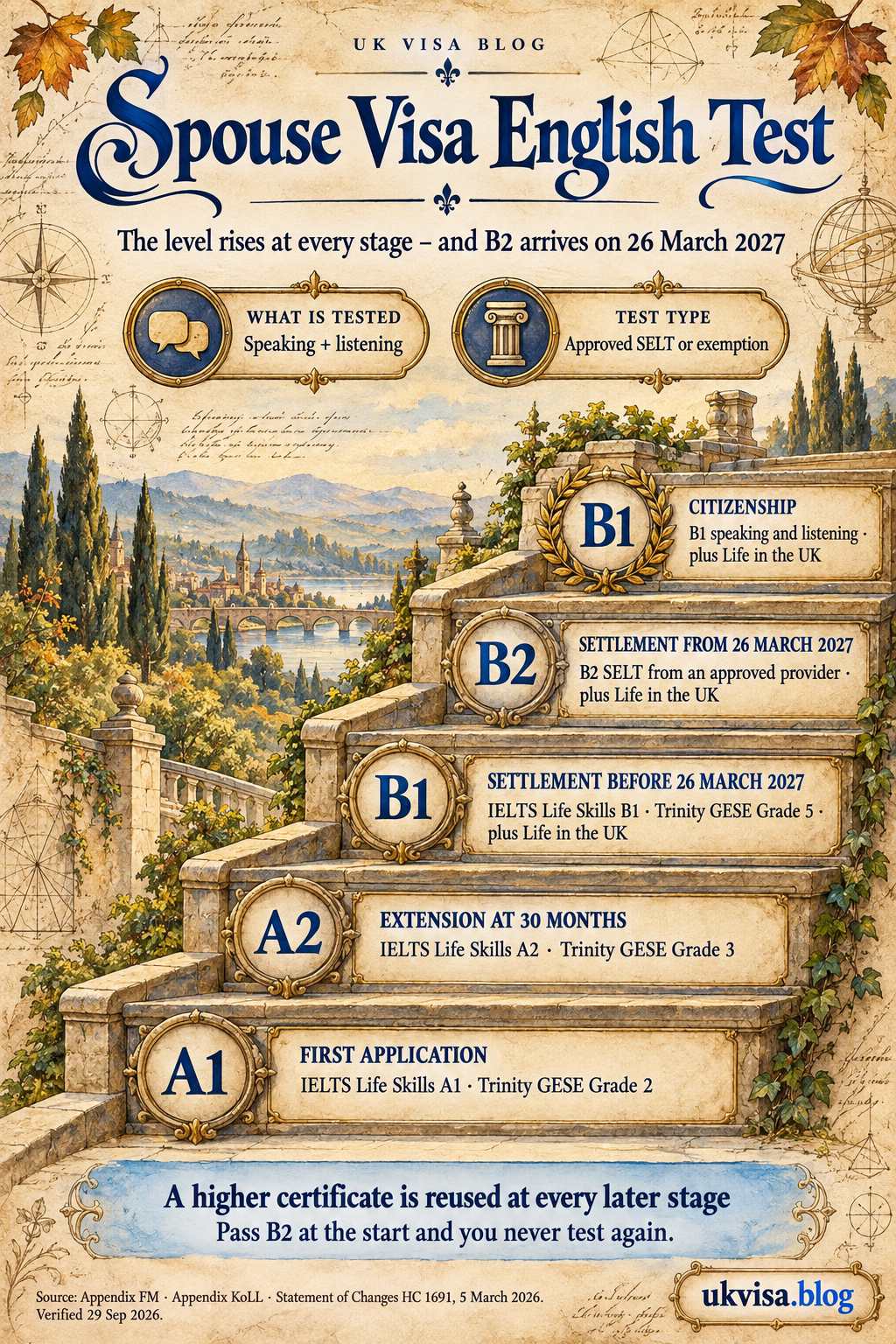
The spouse visa English requirement rises at every stage: A1 to enter, A2 to extend, B1 to settle — and B2 for settlement applications made on or after 26 March 2027. Only speaking and listening are tested, only approved providers count, and passing high once can cover the whole five years.
UK Family Visas
English Language Requirement for UK Spouse Visa 2026
What English Test Is Required for a UK Spouse Visa?
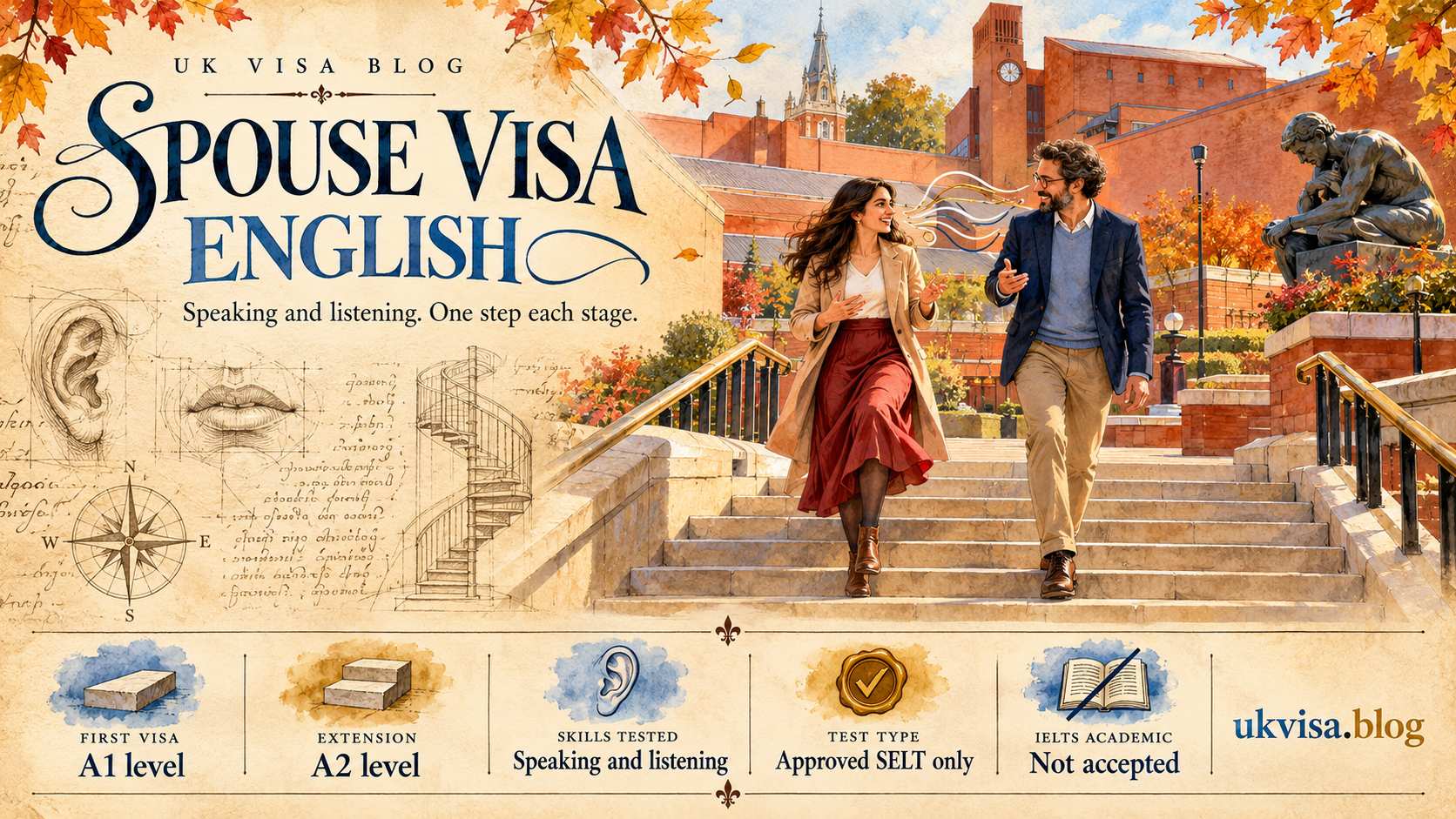
A Secure English Language Test in speaking and listening from a UKVI-approved provider. The level depends on the stage: A1 for the first application, A2 at extension, B1 at settlement before 26 March 2027 and B2 from that date. Reading and writing are not tested. A standard IELTS Academic or General result is not accepted, whatever the score.
The requirement runs through the whole spouse visa route and applies identically to spouses, civil partners and unmarried partners — see our guide to all partner relationship categories. The same A1 standard applies at entry on the fiancé visa route, which feeds into the partner route after the marriage.
English Level Required at Each Stage
| Stage | CEFR level | Typical tests |
|---|---|---|
| First application | A1 speaking and listening | IELTS Life Skills A1, Trinity GESE Grade 2 |
| Extension after 30 months | A2 speaking and listening | IELTS Life Skills A2, Trinity GESE Grade 3 |
| Settlement before 26 March 2027 | B1 speaking and listening | IELTS Life Skills B1, Trinity GESE Grade 5 |
| Settlement from 26 March 2027 | B2 speaking and listening | A B2 SELT from an approved provider |
Source: Appendix FM; Appendix KoLL paragraph 2.2; HC 1691 of 5 March 2026.
Pass High Once and Reuse It
A certificate at a level above what the stage demands can be used again at every later stage, even after its two-year validity has run out, provided the provider has not withdrawn it. Someone who takes B1 for their first application never needs another test before settlement — and someone settling after March 2027 should be thinking about B2 now.
A1 English Test for the First Application
A1 is the entry level of the CEFR scale — enough to introduce yourself, answer simple questions about where you live and who you know, and hold a basic exchange with someone speaking slowly. It is a pass or fail assessment with no score or grade attached.
What the Test Involves
A Life Skills test is taken face to face with an examiner and one other candidate. You listen to short recordings on everyday subjects and answer questions, respond to the examiner about your own life, then hold a short conversation with the other candidate. Reading and writing are not assessed at any stage of the family route.
Language level also matters beyond the certificate. Where a case is referred for a credibility interview, comprehension becomes part of the picture — our spouse visa interview preparation guide covers how that plays out.
A2 English Test for the Extension
A2 is required when you apply to extend on form FLR(M) after the first grant expires — see our guide to the FLR application forms. The level assumes your English has moved on during two and a half years in the UK: understanding sentences and common expressions about everyday life, and handling routine exchanges.
Check What You Passed Last Time
If your first application was carried by an A1 certificate, you need a fresh test at A2. If it was carried by A2 or higher, the same certificate does the job again — expired or not — provided it has not been withdrawn. Look at the level on the certificate before booking anything.
If You Were Exempt Last Time
An exemption granted at entry clearance does not travel with you. The family English guidance is explicit that an applicant exempt at the first stage must meet the level at the extension unless the exemption still applies — a medical condition that has resolved, or exceptional circumstances that have passed, put the requirement back in place.
B1 English Test for Settlement
B1 is the threshold level: following the main points of clear standard speech on familiar subjects and coping with most situations that come up while travelling. It applies to settlement applications submitted before 26 March 2027, alongside the citizenship test at £50.
Two Requirements, Not One
Settlement under Appendix KoLL needs both the language test and the Life in the UK test, which is 24 questions with a 75 per cent pass mark. Missing either one blocks the application, and neither can be substituted for the other. Our ILR through the spouse visa route guide sets the stage out in full.
You Do Not Have to Test in the UK
A widely repeated claim says settlement tests must be taken at UK centres. GOV.UK’s own SELT guidance says otherwise: tests for settlement may be taken in the UK or overseas. What does matter is the provider — Trinity College London and Pearson’s PTE Home operate through UK centres, while PSI’s Skills for English UKVI runs outside the UK.
B2 English from 26 March 2027
Statement of Changes HC 1691, laid on 5 March 2026, rewrites Appendix KoLL paragraph 2.2. Applications for indefinite leave made before 26 March 2027 are assessed at B1; applications made on or after that date need B2 in speaking and listening. The change reaches most settlement routes, the family route among them.
What B2 Actually Asks For
B2 is upper intermediate. You are expected to follow the main ideas of complex material on concrete and abstract topics, and to interact with enough fluency that a conversation with a native speaker is comfortable for both sides. It is a real step up from B1, not a formality, and it takes most learners months rather than weeks.
The level is fixed by when the settlement application is submitted and paid for, not by when your five years complete. If your qualifying period ends near March 2027 and you hold B1, applying as soon as you are eligible keeps you on the lower standard. If you need longer to reach B2, the calculation runs the other way — plan it deliberately rather than by accident.
Who Is Unaffected
Anyone already holding a B2 or higher certificate can rely on it under the ordinary reuse rules. The exemptions survive the change untouched: an English-taught degree, nationality of a majority English-speaking country, age 65 or over, and the medical and exceptional circumstances routes all continue to apply after March 2027.
Approved SELT Providers
Only tests from providers on the UKVI approved list count. A standard IELTS Academic or General certificate is rejected however high the band, because the test is not a SELT. Booking the wrong product is one of the cheapest mistakes to avoid and one of the most common to make.
Where Each Provider Operates
| Provider | Test | Available |
|---|---|---|
| IELTS SELT Consortium | IELTS for UKVI, IELTS Life Skills | UK and overseas |
| Trinity College London | GESE, ISE | UK |
| LanguageCert | Academic, General and International ESOL SELT | UK and overseas |
| Pearson | PTE Academic UKVI, PTE Home | UK and overseas |
| PSI Services | Skills for English UKVI | Overseas |
Results are valid for two years from the date of award. Fees vary by provider, level and country and change without much notice, so take the figure from the provider’s own booking page rather than any third-party list. Test costs sit alongside the fees in our Home Office settlement costs guide.
Booking for B2
Not every SELT is offered at every level, and the speaking-and-listening products are narrower than the four-skills ones. Before booking for a settlement application after March 2027, confirm on the provider’s site that the specific test you are buying is awarded at B2 — a four-skills test may be the only option with some providers.
Exemptions from the English Requirement
Four exemptions exist, and two of them are decided rather than automatic. Nationality and qualifications are checked against a list; the medical and exceptional circumstances routes both require a senior caseworker or entry clearance manager to agree before they are granted.
- Nationals of majority English-speaking countries: Antigua and Barbuda, Australia, the Bahamas, Barbados, Belize, Canada, Dominica, Grenada, Guyana, Ireland, Jamaica, Malta, New Zealand, St Kitts and Nevis, St Lucia, St Vincent and the Grenadines, Trinidad and Tobago, and the United States. A passport is the evidence; dual nationals may rely on either nationality.
- Age 65 or over at the date of application, evidenced by the passport.
- Degree taught or researched in English at UK bachelor’s level or above, with an Ecctis statement for overseas qualifications.
- Physical or mental condition preventing the applicant from learning English or sitting the test, with medical evidence from a qualified practitioner.
- Exceptional circumstances preventing compliance — armed conflict, prolonged hospitalisation, full-time care of a disabled child, or no accessible test provision in the country of residence.
Canada Is the Trap in the Degree Exemption
Degrees from a listed set of countries are presumed to have been taught in English, which removes the need to prove it. Canada is not on that list, even though Canadians are exempt by nationality. A Canadian-educated applicant of another nationality therefore needs an Ecctis statement confirming the teaching language — a step that routinely gets missed.
What Will Not Count as Exceptional
The guidance is blunt: limited literacy or education is not in itself an exceptional circumstance. Nor is reluctance to travel to a test centre abroad — the threshold is more than inconvenience, and it has to be evidenced. Illiteracy in a first language does not remove the requirement, though it may support a medical assessment.
If the Level Has Moved Under You
Where an application arrives with a certificate at a lower level than the stage now requires, caseworkers may hold the case and give one month to supply evidence at the higher level rather than refusing outright. It is a discretion, not an entitlement, and it depends on the rest of the application being in order.
English sits alongside the £29,000 financial threshold and the spouse visa accommodation rules as the three core eligibility tests, and the certificate belongs in the bundle described in our spouse visa supporting documents guide. The A2 stage arrives with the extension, and the B1 or B2 stage with UK long-term settlement and later naturalisation.
Sources: the knowledge of English pages on GOV.UK; Appendix KoLL paragraph 2.2 of the Immigration Rules; Statement of Changes HC 1691 of 5 March 2026; and Home Office guidance, English language requirement for family members, version 8.0. Figures verified 22 August 2026.
Frequently Asked
Questions about the Spouse Visa English Requirement
A Secure English Language Test in speaking and listening at CEFR A1 for the first application, from a UKVI-approved provider. IELTS Life Skills A1 and Trinity GESE Grade 2 are the usual choices. Standard IELTS Academic and General certificates are not accepted at any band, because they are not secure tests for immigration purposes.
A2 speaking and listening, taken when you apply on form FLR(M) after the first grant expires. If your original application was carried by a certificate at A2 or above, you can use that same certificate again even though it has expired, provided the provider has not withdrawn it. Check the level on the certificate before booking a new test.
26 March 2027. Statement of Changes HC 1691, laid on 5 March 2026, amends Appendix KoLL so that settlement applications made on or after that date need B2 speaking and listening instead of B1. What fixes the level is the date the application is submitted, not the date the qualifying residence completes.
No. GOV.UK’s guidance on secure English language tests states that tests for settlement may be taken in the UK or overseas. What varies is the provider: Trinity College London and Pearson’s PTE Home operate through UK centres, while PSI’s Skills for English UKVI is offered outside the UK. Check the provider covers your location before booking.
Two years from the date the result is awarded. That limit matters only for a first use, though — a certificate relied on in an earlier successful application can be used again at later stages even after it expires, as long as the level meets the current requirement and the provider has not withdrawn the award.
Nationals of Antigua and Barbuda, Australia, the Bahamas, Barbados, Belize, Canada, Dominica, Grenada, Guyana, Ireland, Jamaica, Malta, New Zealand, St Kitts and Nevis, St Lucia, St Vincent and the Grenadines, Trinidad and Tobago and the United States. A passport is the evidence, and a dual national may rely on whichever nationality helps.
Yes, where the qualification is at UK bachelor’s level or above and was taught or researched in English. A UK degree needs only the certificate. An overseas degree needs an Ecctis statement confirming both the academic level and, unless the country is on the presumed list, that the teaching was in English. Canada is not on that presumed list.
Applicants aged 65 or over at the date of application are exempt outright. A physical or mental condition that prevents someone learning English or sitting the test also exempts them, but it needs medical evidence from a qualified practitioner and sign-off by a senior caseworker or entry clearance manager. It is assessed case by case, not granted on a diagnosis alone.
Long-term residence somewhere affected by armed conflict or humanitarian disaster, months of hospitalisation immediately before applying, full-time care of a disabled child, or living in a country with no accessible test provision where travelling abroad is genuinely impracticable. Limited literacy or education does not qualify on its own, and reluctance to travel is not enough.