
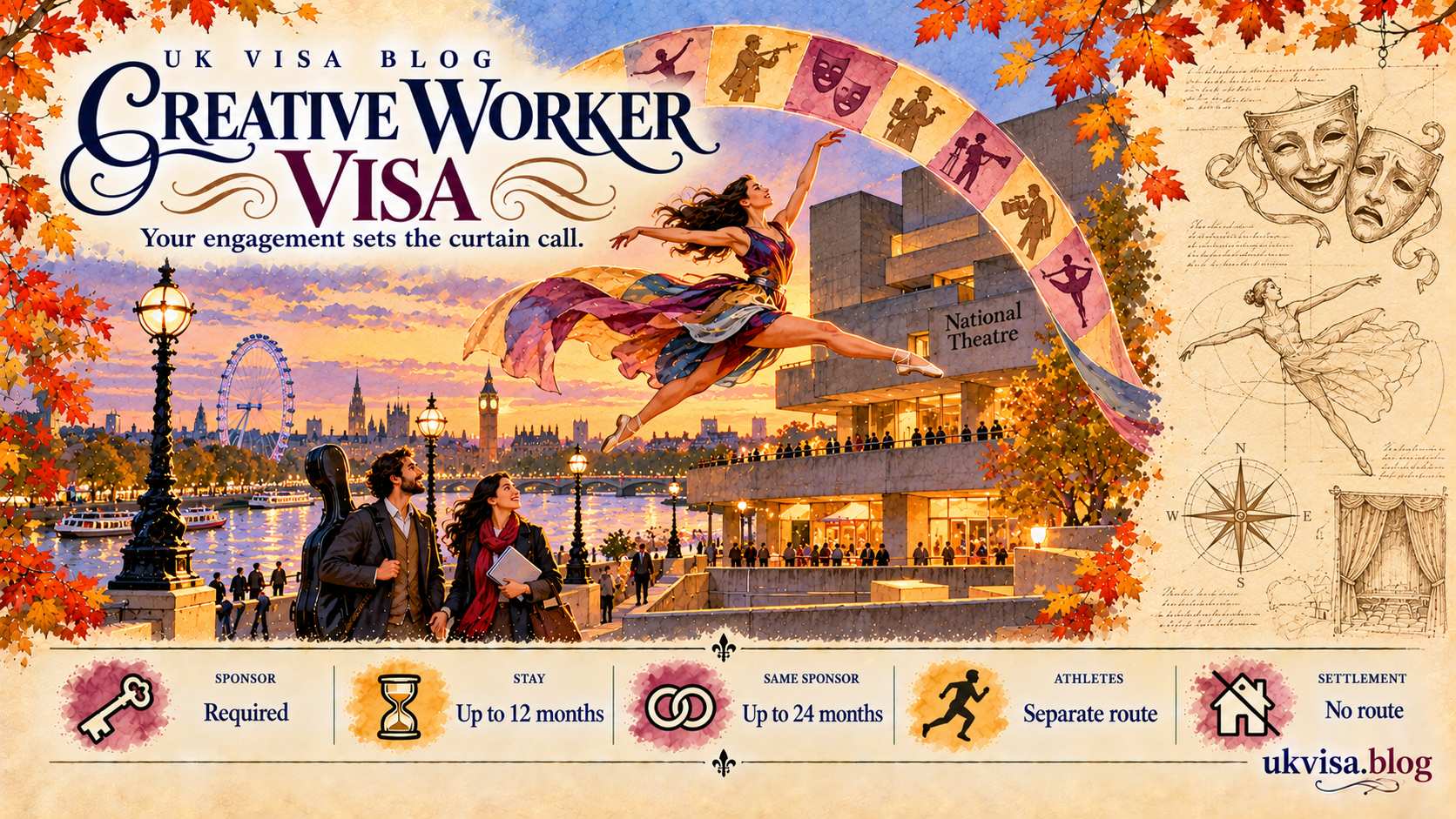
The Creative Worker visa covers actors, dancers, musicians, models and film crew working in the UK on a sponsored engagement. It costs £340, runs up to 12 months at a time, and has one feature no other work route offers: some performers can skip the visa entirely and be admitted at the border for three months or less.
UK Work Visas
Creative Worker Visa UK 2026: Sponsorship, the Concession and Duration
What the Creative Worker Visa Is
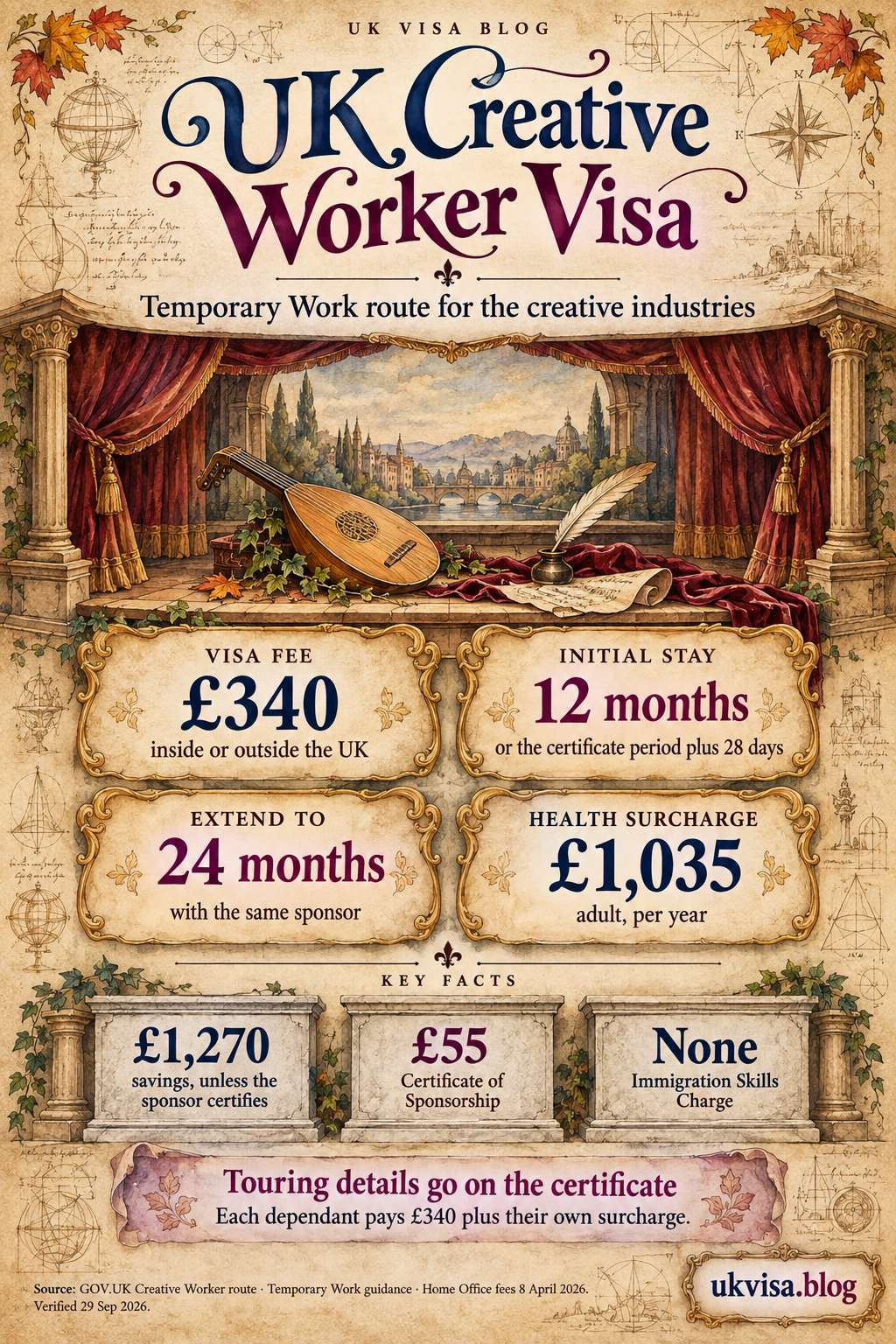
A sponsored route in the Temporary Work family for people working in the creative industries. The fee is £340, the same inside or outside the UK, plus the health surcharge and £1,270 in savings unless your sponsor certifies maintenance. Permission runs to 12 months or the certificate period plus 28 days, whichever is shorter, and can be extended — with the same sponsor, up to 24 months in total.
This route replaced the old Creative and Sporting category. The sporting half moved out: athletes and coaches now use the International Sportsperson visa. Guides still describing a combined creative and sporting route are out of date, and the two now differ in fee, duration and endorsement requirements.
Who Qualifies
A creative worker is someone working in the creative industries — GOV.UK gives actors, dancers, musicians and film crew as examples, and the route extends across production and technical roles as well as performers. What matters is not the job title but the relationship to the sponsor: the work you do in the UK must relate to the work of your sponsoring organisation.
That test rules out using a friendly sponsor as a vehicle for unrelated work. A production company sponsoring crew for its own production is straightforward; the same company sponsoring someone for work it has nothing to do with is not.
Eligibility
- Certificate of sponsorship: from a licensed sponsor, for work relating to the sponsor’s own work.
- Money: £1,270 held for 28 consecutive days, unless your sponsor certifies maintenance on the certificate.
- Timing: apply up to three months before the start date; your stay must begin no more than 14 days before it.
- Lawful employment: the engagement must comply with the minimum wage and working time rules.
- Certificates: a tuberculosis test if you are applying from a listed country, and certified translations where documents are not in English or Welsh.
- No English test: there is no language requirement on this route.
How Certificates Work on Tours and Productions
The certificate mechanics are built for the sector rather than for single hires. The Temporary Work guidance provides for group certificates of sponsorship, covering a company or ensemble rather than one performer at a time, and for certificates covering multiple engagements or performances instead of a separate certificate for each date.
Expenses handled through the certificate follow their own rules, which is why touring paperwork is worth settling before dates are confirmed rather than after. The underlying sponsor duties — reporting, record-keeping, cooperation with compliance visits — are the ordinary ones in our sponsor licence guide, and a Temporary Worker licence costs £611 with certificates at £55.
The Certificate Itself
A certificate of sponsorship is an electronic record, not a document — you receive a reference number. It can be used once and must be used within three months of assignment, and caseworkers check its current status before deciding. One withdrawn by the sponsor means refusal unless a replacement is assigned, which on a production with fixed dates is a scheduling problem as much as an immigration one.
Fees
£340 per person, identical inside and outside the UK, plus the health surcharge at £1,035 a year for adults and £776 for under-18s. Each dependant pays the same again. There is no Immigration Skills Charge on this route. Cross-route comparisons sit in our fee guide and the levy itself in our health surcharge guide.
Timing Around Production Dates
Two dates govern the schedule. You can apply up to three months before the start date on the certificate, and your stay must not begin more than 14 days before it. Rehearsal periods that start earlier than the contracted engagement therefore need to be reflected on the certificate itself, not absorbed into an early arrival.
How to Apply
Apply online up to three months before the start date on your certificate — the mechanics are in our application form guide. Decisions usually take about three weeks from outside the UK and eight weeks inside it, with paid faster services available. To extend, you must be in the UK and apply before your current permission expires.
The Three-Month Concession
You can enter the UK without applying for a visa in advance if you hold a valid Creative Worker certificate of sponsorship, are coming for three months or less, and do not normally need a visa to enter as a visitor. You must still meet all the eligibility requirements, and you will usually need an electronic travel authorisation to travel. The catch is at the other end: GOV.UK states that you cannot extend your stay if you used the concession to enter. A short engagement that turns into a longer one therefore means leaving and applying properly, not extending from inside the UK.
Partners and children can travel with you under the same logic, provided they too do not normally need a visitor visa — and they will usually need their own travel authorisation.
Travel Authorisation and the Concession
The concession removes the visa, not every formality. Most people using it will need an electronic travel authorisation before boarding, and so will any partner or children travelling with them. Because the authorisation is applied for separately and is tied to the passport, it is worth arranging as soon as the engagement is confirmed rather than in the final week.
How Long You Can Stay
A first grant runs to a maximum of 12 months, or the time on your certificate plus up to 28 days, whichever is shorter. Extensions work differently depending on whether you are staying put, and the difference is worth planning around.
Extension Limits
| Situation | Extension is the shortest of |
|---|---|
| Changing sponsor | The certificate period plus 14 days, or the time needed to reach 12 months in total |
| Staying with the same sponsor | 12 months, the certificate period plus 14 days, or the time needed to reach 24 months in total |
Source: GOV.UK Creative Worker visa — extend your visa. Verified 22 August 2026.
The practical consequence is that staying with one sponsor can take you to two years, while moving between sponsors caps you at one. Performers weighing a change of production mid-run should price that in before signing.
What You Can and Cannot Do
You work for your sponsor in the job on the certificate. You can study, with an Academic Technology Approval Scheme certificate for some courses, and take a second job of up to 20 hours a week either in the same sector at the same level or in a job on the immigration salary list. You cannot claim public funds or start your own business — a real constraint for performers who normally operate through their own company.
Where the work is genuinely self-directed rather than sponsored, other routes fit better: Global Talent visa for endorsed arts and culture figures, or Skilled Worker for salaried creative roles that meet the salary thresholds.
Working Through Your Own Company
The prohibition on starting your own business is the constraint most performers hit, because engagements at home are often invoiced through a personal service company. On this route the sponsored work has to be employment by, or engagement with, the sponsor as described on the certificate. Structuring UK fees through a company you own is not what the permission allows.
Partners and Children
A partner and children can apply as dependants if eligible, each paying £340 and their own health surcharge. Their permission does not extend automatically when yours does — they apply either at the same time as you or at any point before their own permission expires. The mechanics are in our dependant visa guide.
Sources: GOV.UK Creative Worker route page on GOV.UK; Appendix Temporary Work — Creative Worker; and the Home Office Temporary Work caseworker guidance version 38.0. Figures verified 22 August 2026.
Frequently Asked
Questions about the Creative Worker Visa
No. The route now covers creative work only. Sportspeople and coaches use the International Sportsperson visa instead, which requires a governing body endorsement, costs £340 for twelve months or less and £819 or £943 for longer, and can lead to settlement. The creative route does neither.
Only under the concession: a valid Creative Worker certificate of sponsorship, an engagement of three months or less, and a nationality that does not normally need a visa to visit. You must still meet all the eligibility requirements, and you will usually need an electronic travel authorisation. Entering this way means you cannot extend your stay afterwards.
A first grant is up to 12 months, or the certificate period plus 28 days, whichever is shorter. Extending with the same sponsor can take you to 24 months in total. Changing sponsor caps the total at 12 months. You must be in the UK to extend, and must apply before your current permission expires.
£340 per person, the same inside or outside the UK, plus the health surcharge at £1,035 a year for adults and £776 for children. Each dependant pays the same again. You also need £1,270 in savings held for 28 consecutive days unless your sponsor certifies maintenance on the certificate of sponsorship.
Yes. The guidance provides for group certificates of sponsorship covering a company or ensemble, and for certificates covering multiple engagements or performances rather than one per date. Expenses handled through the certificate follow their own rules, so the arrangements are worth settling with the sponsor before dates are locked in.
Up to 20 hours a week, either in the same sector at the same level as your sponsored work or in a job on the immigration salary list. You can also study, with an Academic Technology Approval Scheme certificate for some subjects. What you cannot do is start your own business or claim public funds.
No. There is no English language requirement on any of the Temporary Work routes, including this one. Documents you submit still need to be in English or Welsh or accompanied by a certified translation, and a caseworker can still interview you where the genuineness of the engagement is in doubt.
No. Time on the Creative Worker route does not count towards indefinite leave to remain, and switching into another route from inside the UK is generally not possible. Performers building a long-term UK career usually move to Global Talent through an arts and culture endorsement, or to Skilled Worker where the role is a salaried one.