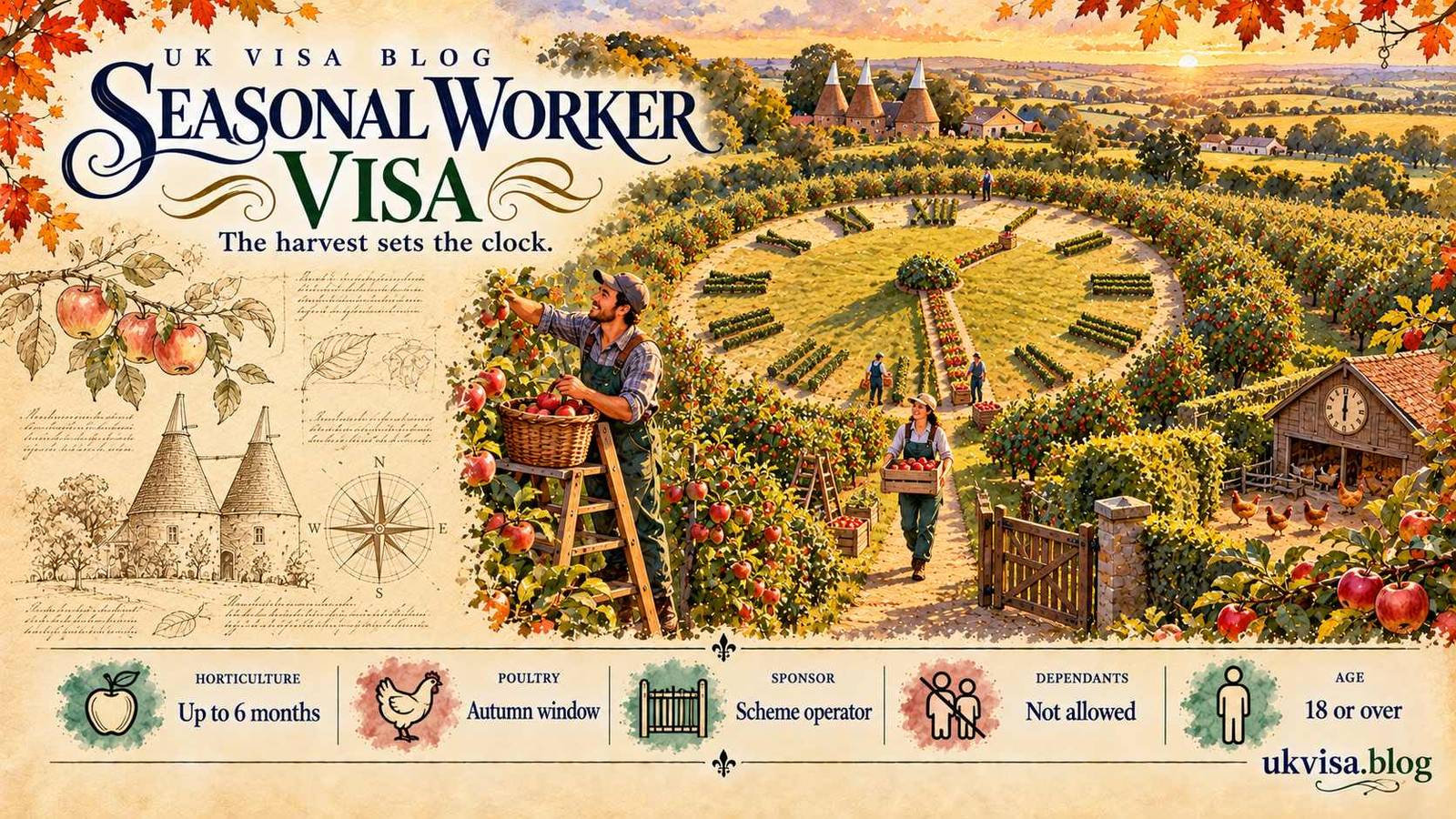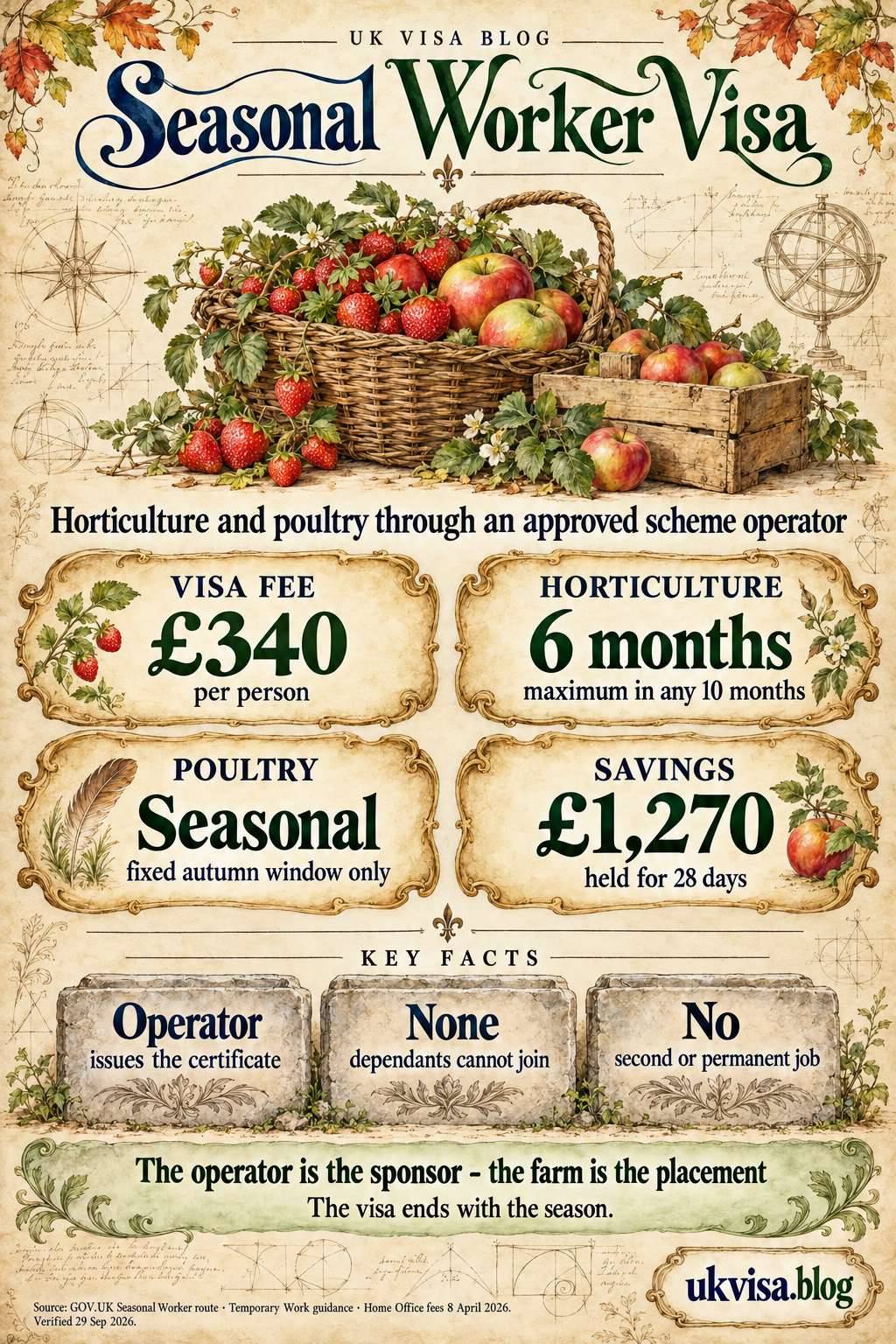
The Seasonal Worker visa is the UK's dedicated temporary work route for the horticulture and poultry production sectors — administered under Appendix Temporary Work: Seasonal Worker of the Immigration Rules. The 2026 allocation confirmed by DEFRA totals 42,900 places: 41,000 for horticulture and 1,900 for poultry (down from 43,000 + 2,000 in 2025). From 8 April 2026 the application fee is £340 (up from £319), with no Immigration Health Surcharge required because grants do not exceed 6 months. From 11 November 2025, horticulture workers can spend up to 6 months in any rolling 10-month period (relaxed from the previous 12-month rolling rule), subject to a 4-month "cooling off" period since their last Seasonal Worker stay. Poultry grants run strictly from 2 October to 31 December each year, with applications due by 15 November.
The cheapest UK sponsored work visa — £340 with no IHS — and the only route that gives Central Asian, Eastern European and other overseas nationals direct access to UK horticulture and poultry sponsorship without a degree, English test or salary threshold beyond the National Living Wage. The catch: strict 6-months-in-10 limit, no settlement pathway, no dependants, no switching from inside the UK, and recruitment runs only through 7 approved scheme operators (5 horticulture + 2 poultry — overlapping). Time on this route does not count toward Indefinite Leave to Remain.
- What is the Seasonal Worker Visa?
- Horticulture and Poultry Roles Covered
- 2026 Quota and DEFRA Allocation
- Approved Scheme Operators (Sponsorship Companies)
- Eligibility Requirements
- Duration, Rolling 10 Rule and Cooling Off
- Pay, Hours and Worker Protections
- How to Apply
- Seasonal Worker Visa Cost from 8 April 2026
- Refusal and Administrative Review
- Frequently Asked Questions
Seasonal Worker Visa UK 2026: Horticulture, Poultry and Approved Scheme Operators
The Seasonal Worker route replaced the former Tier 5 (Temporary Worker) Seasonal Worker visa under the points-based system rebranding in December 2020. It is now governed by Appendix Temporary Work: Seasonal Worker and operates through a tightly controlled list of approved scheme operators rather than direct employer sponsorship — making it structurally different from every other UK work visa.
Before Brexit, the UK relied heavily on EU free movement for seasonal agricultural labour — particularly from Poland, Romania and Bulgaria. The Seasonal Worker Scheme was piloted in 2019 to bridge the post-Brexit gap, scaled rapidly through 2021–2023, and is now confirmed through 2029 following NFU lobbying. Recruitment patterns have shifted markedly: Central Asian nationals (Kyrgyzstan, Tajikistan, Uzbekistan and Kazakhstan) now account for over 78% of Seasonal Worker grants, alongside Ukrainian, Nepalese and other source-country workers contracted directly by the approved scheme operators.
What is the Seasonal Worker Visa?
The Seasonal Worker visa is a UK short-term work visa for horticulture (year-round, up to 6 months in a 10-month rolling period) or poultry production (strictly 2 October – 31 December). From 8 April 2026 the application fee is £340. No Immigration Health Surcharge applies because grants do not exceed 6 months. Sponsorship runs through one of 7 approved scheme operators — individual farms cannot sponsor workers directly. The 2026 allocation is 42,900 places (41,000 horticulture + 1,900 poultry).
Horticulture and Poultry Roles Covered
Horticulture Sector — Year-Round Window
Horticulture work is the dominant strand of the scheme, covering edible and ornamental crops grown in fields, glasshouses, polytunnels and orchards. Applications can be made at any time of year, and the rolling 10-month grant pattern allows workers to span the spring asparagus and daffodil season, summer soft fruit, autumn apples and pears, and continuing winter glasshouse operations.
- Soft fruit: Strawberries, raspberries, blackcurrants, blueberries, gooseberries, and other berries.
- Top fruit (orchard): Apples, plums, cherries, apricots, pears.
- Field vegetables: Potatoes, carrots, herbs, leafy salads, broccoli, cauliflower and outdoor brassicas.
- Protected vegetables: Tomatoes, cucumbers, peppers and leafy greens grown in glasshouses or polytunnels.
- Vine and bines: Grapes (English wine production) and hops (brewing).
- Ornamental plants: Flowers, bulbs, and decorative plants in cut-flower or container production.
Poultry Production — Strict 2 October to 31 December Window
Poultry work is significantly more restricted than horticulture. The 2 October – 31 December window aligns with peak Christmas demand for turkey, goose and other poultry products. Applications must be submitted by 15 November each year — missing this deadline means waiting until the following season. Eligible roles cover poultry catching, processing, packing, hanging, butchery and dressing — but pork butchery is no longer included in the scheme.
Poultry Seasonal Worker visa applications must be submitted by 15 November each year — this is a hard deadline. Work is only permitted from 2 October to 31 December within the same calendar year, meaning late November applications generally cannot be processed and granted in time to start work before the season ends. Plan poultry recruitment in late summer / early autumn to ensure visas are issued by early October.
2026 Quota and DEFRA Allocation
DEFRA confirmed in November 2025 that the 2026 Seasonal Worker Scheme allocation is 42,900 visas: 41,000 horticulture (down from 43,000 in 2025) and 1,900 poultry (down from 2,000). The modest reduction continues the government's gradual tapering of overseas labour quotas to encourage automation investment and domestic workforce development, while preserving sufficient labour for current harvest demand. Detailed multi-year quotas for 2027–2029 are expected from DEFRA later in 2026.
| Year | Horticulture | Poultry | Total | Change vs Previous Year |
|---|---|---|---|---|
| 2026 | 41,000 | 1,900 | 42,900 | −2,100 (−4.7%) |
| 2025 | 43,000 | 2,000 | 45,000 | Unchanged from 2024 |
| 2024 | 43,000 | 2,000 | 45,000 | +5,000 vs 2023 |
| 2023 | 40,000 (incl. 5,000 reserve) | 2,000 | 42,000 | — |
Source: DEFRA Seasonal Worker Scheme allocation announcements; gov.uk policy publications 2023–2026.
The 2026 reduction follows the government's commitment under the post-2024 Labour administration to gradually reduce overseas seasonal labour while pushing automation investment and domestic workforce development. NFU President Tom Bradshaw confirmed the 2026 announcement as "a small reduction" the industry could absorb. Allocations are distributed across the approved scheme operators based on demonstrated farm demand and operational capacity.
Approved Scheme Operators (Sponsorship Companies)
UK farms cannot sponsor Seasonal Workers directly. All sponsorship runs through 7 approved scheme operators licensed by the Home Office, endorsed by DEFRA, and holding a Gangmasters and Labour Abuse Authority (GLAA) licence. Five operators handle horticulture (Agri-HR, Concordia, Fruitful Jobs, HOPS Labour Solutions, Pro-Force) and two handle poultry (AG Recruitment, Fruitful Jobs — overlap). Workers must apply directly to these operators for placement, NOT to individual farms.
Horticulture Scheme Operators (2026)
- Agri-HR — UK-based recruitment specialist for horticultural labour.
- Concordia — Long-standing seasonal workforce operator with extensive farm partnerships.
- Fruitful Jobs — Operator covering both horticulture and poultry (cross-sector).
- HOPS Labour Solutions — One of the largest horticulture scheme operators by placement volume.
- Pro-Force — Major operator serving fruit, vegetable and ornamental sectors.
Poultry Scheme Operators (2026)
- AG Recruitment — Specialist for poultry catching, processing and butchery roles.
- Fruitful Jobs — Operates across both horticulture and poultry sectors.
Several scam networks target prospective Seasonal Worker applicants — particularly in Central Asia, Nepal and Eastern Europe — by promising guaranteed placement for a fee, charging upfront "recruitment fees" or "visa processing fees", or impersonating approved scheme operators on fake websites. Under the Employer Pays Principle (EPP) that governs the scheme since 2023, NO recruitment fees can lawfully be charged to workers. Apply only through the 7 approved scheme operators listed above — verify their identity against the gov.uk approved sponsor list before paying anything.
For end-to-end sponsor licence framework via approved scheme operators background — including how Certificates of Sponsorship are assigned through the Sponsorship Management System and how compliance audits work — the wider sponsorship framework guide covers the underlying mechanics that apply across all UK sponsored work visas.
Eligibility Requirements
Aged 18+ on the date of application; Certificate of Sponsorship from an approved scheme operator assigned within 3 months of the visa application; £1,270 in personal savings held for 28 consecutive days (waived if the sponsor certifies maintenance on the CoS); TB test certificate if applying from a listed country; criminal record certificate may be requested for certain roles; must apply from outside the UK (no switching from inside). There is NO English language requirement and NO degree/qualification requirement.
- Age: 18 or over on the date of application; no upper age limit, but physical fitness for demanding agricultural work is expected by scheme operators.
- Sponsorship: Certificate of Sponsorship from one of the 7 approved scheme operators — issued within 3 months of the visa application.
- Financial maintenance: £1,270 in personal savings held for 28 consecutive days ending within 31 days of the application, OR sponsor certifies maintenance on the CoS.
- No English language requirement: Unlike Skilled Worker and most other routes, no SELT or CEFR test is required for Seasonal Worker.
- No degree or RQF Level 6 requirement: The route is open to applicants of any educational background.
- TB test certificate: Required if applying from a listed country with TB screening obligations.
- Criminal record certificate: Not routinely required, but UKVI may request one depending on the role and country of residence in the past 10 years.
- Outside-UK application only: All applications must be made from outside the UK — no switching from inside the country.
- 4-month cooling off (horticulture): For CoS assigned on or after 11 November 2025, the worker must not have been in the UK as a Seasonal Worker during the 4 months immediately before the CoS start date.
- Suitability: Must not fall for refusal under general grounds of the Immigration Rules.
Duration, Rolling 10 Rule and Cooling Off
From 11 November 2025, horticulture Seasonal Worker grants are limited to 6 months in any rolling 10-month period — a relaxation from the previous 6-in-12 framework, which means workers can return sooner between seasons. A 4-month cooling off period applies: the Certificate of Sponsorship start date must fall at least 4 months after the worker was last in the UK as a Seasonal Worker. Poultry grants run strictly 2 October – 31 December within a single calendar year, with a separate annual cycle rather than a rolling window.
The Rolling 10 Rule Explained
Until November 2025, horticulture Seasonal Workers could spend a maximum of 6 months in the UK during any rolling 12-month period — meaning a worker who left after 6 months had to wait a further 6 months before returning. The Immigration Rules change in force from 11 November 2025 reduced this to 6 months in any rolling 10-month period, cutting the mandatory gap between seasons and giving workers and growers more flexibility across the harvest cycle. The NFU campaigned for this change for several years, framing it as a critical flexibility win for British food production.
The 4-Month Cooling Off Period (Horticulture)
A separate 4-month cooling-off period applies independently of the rolling 10-month window. For any Certificate of Sponsorship assigned on or after 11 November 2025, UKVI expects the worker not to have been in the UK as a Seasonal Worker during the 4 months immediately before the work start date on the CoS. If the start date falls less than 4 months after the worker's last Seasonal Worker stay, the visa application is likely to be refused — and the scheme operator may face compliance action. This rule is independent of the rolling 10-month grant cap; both apply simultaneously.
| Rule Aspect | Horticulture | Poultry |
|---|---|---|
| Maximum stay | 6 months in any rolling 10-month period (from 11 November 2025) | 2 October – 31 December only (single calendar year) |
| Cooling off period | 4 months before return (from 11 November 2025) | Annual season-based (no separate cooling off) |
| Application window | Year-round — apply up to 3 months before CoS start date | By 15 November each year |
| 2026 quota | 41,000 visas | 1,900 visas |
| Visa entry window | Up to 14 days before CoS start date | Up to 14 days before CoS start date |
Pay, Hours and Worker Protections
From 1 April 2026, Seasonal Workers must be paid at least the National Living Wage of £12.71/hour (up from £12.21 from April 2025) for horticulture and general poultry roles. Specified poultry butchers and dressers under SOC codes 5431 and 5433 must receive £15.88/hour, reflecting the higher-skill rate aligned with Skilled Worker going rates. All workers are guaranteed a minimum 32 hours of paid work per week regardless of actual work availability — zero-hours contracts are prohibited. Recruitment fees cannot be charged to workers under the Employer Pays Principle.
Minimum Pay Rates from 1 April 2026
| Role Type | Minimum Hourly Rate (from 1 April 2026) | Guaranteed Hours |
|---|---|---|
| Horticulture (all roles) | £12.71 / hour (National Living Wage) | 32 hours / week minimum |
| Poultry — general roles | £12.71 / hour (National Living Wage) | 32 hours / week minimum |
| Poultry butchers and dressers (SOC 5431 / 5433) | £15.88 / hour | 32 hours / week minimum |
| Accommodation offset | Maximum £11.10 / day from 1 April 2026 | Deductible from wages |
Source: National Minimum Wage Regulations 2026 (in force 1 April 2026); Seasonal Worker Scheme Sponsor Guidance.
Worker Rights and Protections
- Employer Pays Principle (EPP): No recruitment fees can be charged to workers — all costs sit with the employer/sponsor.
- 32-hour minimum guarantee: Workers must receive at least 32 paid hours per week regardless of actual work availability; zero-hours contracts are explicitly prohibited.
- Bilingual employment contracts: Contracts must be provided in both English and the worker's first language.
- Accommodation standards: Sponsors must arrange accommodation meeting minimum welfare standards; charges cannot exceed the daily offset (£11.10/day from April 2026).
- Working Time Regulations: 48-hour average weekly limit unless a valid opt-out is signed; statutory rest breaks apply.
- Fair Work Agency (FWA) enforcement: From April 2026, the new Fair Work Agency consolidates NMW/NLW compliance enforcement, with penalties of up to 200% of arrears capped at £20,000 per worker.
- Health and safety: Workers are covered by full UK health and safety legislation; sponsors must provide PPE and adequate training.
How to Apply
All applications are submitted online via the gov.uk Seasonal Worker visa apply portal from outside the UK. The applicant can apply up to 3 months before the role start date listed on the Certificate of Sponsorship. Most successful applications are now granted as eVisas linked to the worker's UKVI account, though physical vignettes are still issued in some Visa Application Centre processes.
- Step 1: Apply directly to one of the 7 approved scheme operators (Agri-HR, Concordia, Fruitful Jobs, HOPS, Pro-Force for horticulture; AG Recruitment, Fruitful Jobs for poultry) for a job placement.
- Step 2: Receive your Certificate of Sponsorship from the scheme operator via the Sponsorship Management System, with role details, start date and location.
- Step 3: Complete the online online visa application portal on gov.uk within 3 months of the CoS start date.
- Step 4: Pay the £340 visa fee — no Immigration Health Surcharge is required for Seasonal Worker.
- Step 5: Verify your identity — either through the UK Immigration: ID Check app (eligible passports) or by booking a biometric appointment at a Visa Application Centre.
- Step 6: Upload supporting document checklist — current passport, CoS reference, financial maintenance evidence (unless sponsor-certified), TB certificate where applicable, criminal record certificate if requested.
- Step 7: Wait for decision — standard service is approximately 3 weeks from biometric enrolment.
- Step 8: Travel to the UK up to 14 days before the CoS start date and begin work with your assigned host farm or processing site.
Processing Times
Standard processing for Seasonal Worker visas takes approximately 3 weeks from biometric enrolment. Some Visa Application Centres offer priority service options for faster decisions at additional cost — though availability varies significantly by source country. For applicants from Central Asia and Eastern Europe, the standard 3-week service typically meets the operational timeline given the year-round horticulture application window.
Seasonal Worker Visa Cost from 8 April 2026
From 8 April 2026 the application fee is £340 (up from £319 — same uplift as the broader Temporary Work visa family under Statement of Changes HC 1691). No Immigration Health Surcharge applies because grants do not exceed 6 months. Optional priority service costs £500 (5 working days) and super-priority costs £1,000 (next working day) where offered. Total Home Office cost for a single applicant is therefore £340 — the cheapest sponsored UK work visa available.
| Fee Component | Amount from 8 April 2026 | Notes |
|---|---|---|
| Visa application fee | £340 per person | Up from £319 before 8 April 2026 |
| Immigration Health Surcharge | £0 (not required) | Exempt because grants are ≤6 months |
| Total Home Office charges | £340 | Cheapest sponsored UK work visa |
| Priority service uplift | +£500 (where available) | Targets decision within 5 working days |
| Super-priority service uplift | +£1,000 (where available) | Targets next working day decision |
| Sponsor cost — CoS | £55 | Paid by the scheme operator, not the worker |
| TB test certificate | Variable (~£65–£100 in most source countries) | Paid at the approved clinic, separately from Home Office fees |
Source: gov.uk Seasonal Worker visa fee schedule (updated April 2026); Statement of Changes HC 1691 (5 March 2026).
The £340 application fee aligns the Seasonal Worker route with the broader Temporary Worker visa family — including Youth Mobility Scheme, India Young Professionals Scheme, T5 Creative Worker, T5 Charity Worker, and the GBM sub-routes (Graduate Trainee, Service Supplier, UK Expansion Worker, Secondment Worker) — which all moved from £319 to £340 on the same 8 April 2026 effective date under Statement of Changes HC 1691. The wider UK work visa fees overview page covers the full fee schedule across all sponsored work routes.
Visa Conditions and Restrictions
The Seasonal Worker route operates with some of the strictest conditions of any UK work visa, reflecting its strictly temporary nature and the role of approved scheme operators in maintaining compliance.
- Sponsored role only: You can only work in the job described on your Certificate of Sponsorship. Switching to a different role within the same sector requires a new CoS from the scheme operator.
- No second jobs: Additional employment outside the sponsored role is not permitted.
- No self-employment: Running your own business is not permitted on this visa.
- No public funds: Most welfare benefits are restricted under "no recourse to public funds".
- No dependants: Partners and children cannot be added to the application; each family member must qualify separately.
- No settlement: Time on this visa does NOT count toward Indefinite Leave to Remain; the route is strictly temporary.
- Cannot switch in-country: You cannot switch to another visa category from inside the UK — you must return home and apply afresh from outside the UK.
- Cannot apply for criminal record certificate requirements: Where applicable, these must be provided in advance, not after arrival.
The Seasonal Worker visa is strictly temporary. Time spent on this visa does NOT count toward the 5-year continuous-residence period required for Indefinite Leave to Remain. If long-term UK settlement is the goal, you would need to leave the UK at the end of the seasonal grant and apply from abroad for a different visa category — typically the Skilled Worker visa with employer sponsorship (which requires a job offer paying £41,700+ from 22 July 2025), the Youth Mobility Scheme as an alternative work route (where the applicant is from an eligible country aged 18–30/35), or family-route visas. Overstaying triggers the re-entry ban consequences for overstayers framework — typically a 1–10 year UK exclusion.
Refusal and Administrative Review
A refused Seasonal Worker visa decision is challengeable only by way of administrative review for caseworking errors under Appendix AR — there is no full right of appeal. The administrative review deadline is typically 28 days from receipt of the refusal. Review is limited to caseworking errors and cannot reconsider the underlying merits with new evidence. The most common refusal reasons for Seasonal Worker applications are: failure of the £1,270 maintenance test where the sponsor has not certified maintenance, missing the 4-month cooling off period for returning workers (CoS assigned on or after 11 November 2025), and missing the 15 November poultry application deadline.
- Application fee £340 from 8 April 2026 (up from £319) — no IHS required because grants do not exceed 6 months.
- 2026 quota 42,900 visas: 41,000 horticulture + 1,900 poultry (down from 43,000 + 2,000 in 2025).
- Horticulture: 6 months in any rolling 10-month period from 11 November 2025 (relaxed from 6-in-12), with 4-month cooling off.
- Poultry: strictly 2 October to 31 December each year; applications by 15 November.
- Sponsorship runs through 7 approved scheme operators (5 horticulture + 2 poultry, with Fruitful Jobs spanning both).
- National Living Wage £12.71/hour from 1 April 2026 (up from £12.21); poultry butchers/dressers £15.88/hour.
- 32 hours/week guaranteed minimum; zero-hours contracts prohibited.
- No English language test, no degree requirement, no salary threshold beyond NLW.
- No dependants, no settlement pathway, no in-country switching, no extensions.
- Employer Pays Principle: no recruitment fees can be charged to workers — beware scams.
For official guidance and to start the application, the authoritative entry point is the gov.uk Seasonal Worker visa overview. The legal framework sits in Appendix Temporary Work: Seasonal Worker. The 2026 fee uplift was set out in Statement of Changes HC 1691 (5 March 2026). The rolling 10-month rule and 4-month cooling off period were introduced via the Statement of Changes HC 1333 (14 October 2025), in force from 11 November 2025. For alternative short-term work routes the wider T5 Creative Worker visa for sporting and creative roles covers the other temporary worker pathways.
From 8 April 2026 the application fee is £340 per person (up from £319 — the same uplift applied across the broader Temporary Worker visa family under Statement of Changes HC 1691). No Immigration Health Surcharge is required because Seasonal Worker grants do not exceed 6 months. Optional priority service adds £500 (5 working days) and super-priority adds £1,000 (next working day) where available. Total cost £340 — the cheapest sponsored UK work visa available.
From 11 November 2025, horticulture workers can stay up to 6 months in any rolling 10-month period — relaxed from the previous 6-in-12 rule. Poultry workers can only work in the UK between 2 October and 31 December each calendar year. The visa cannot be extended; once the grant expires you must leave the UK and apply afresh from abroad if you wish to return for a future season.
For horticulture roles where the Certificate of Sponsorship is assigned on or after 11 November 2025, UKVI expects the worker not to have been in the UK as a Seasonal Worker during the 4 months immediately before the CoS start date. If the start date falls less than 4 months after the worker's last Seasonal Worker stay, the visa application is likely to be refused — and the scheme operator may face compliance action. The cooling off period applies independently of the rolling 10-month grant cap.
For horticulture: Agri-HR, Concordia, Fruitful Jobs, HOPS Labour Solutions, and Pro-Force (5 operators). For poultry: AG Recruitment and Fruitful Jobs (2 operators). Workers must apply directly to these operators for job placement — individual UK farms and poultry processors cannot obtain a Seasonal Worker sponsor licence in their own right. Always verify the operator's identity against the gov.uk approved sponsor list before paying any fees, and report suspicious "recruitment fee" demands as scams.
From 1 April 2026 the National Living Wage rises to £12.71 per hour (up from £12.21 in 2025). Horticulture workers and general poultry workers must be paid at least the NLW for every hour worked. Specified poultry butchers and dressers under SOC codes 5431 and 5433 must receive £15.88 per hour, reflecting the higher-skill Skilled Worker going rate. All Seasonal Workers are guaranteed a minimum of 32 paid hours per week regardless of actual work availability — zero-hours contracts are prohibited under the scheme.
No. The Seasonal Worker visa does not permit dependants. Partners, children and other family members cannot be added to the application. If a family member is independently eligible for a UK visa (for example, a Skilled Worker visa through their own employer, or a Student visa through a course offer), they would need to apply separately on their own merits. The Seasonal Worker route is strictly for individual workers.
You can only work in the role described on your Certificate of Sponsorship for the host farm or processing site identified by your scheme operator. However, your scheme operator may be able to reassign you to a different host farm within the same sector if circumstances change — for example, if a host site's harvest finishes earlier than expected. Contact your scheme operator promptly if you have any concerns about placement. You cannot independently move to a different scheme operator.
No. The Seasonal Worker visa has no pathway to settlement (Indefinite Leave to Remain). Time spent on this visa does NOT count toward the 5-year continuous-residence period required for ILR. You cannot switch to another visa category from inside the UK — you must leave the country and apply afresh from abroad for a settlement-leading route such as Skilled Worker. The Seasonal Worker route is designed strictly for short-term seasonal labour and is not part of any long-term migration pathway.
DEFRA confirmed in November 2025 that the 2026 Seasonal Worker Scheme allocation is 42,900 visas: 41,000 for horticulture (down from 43,000 in 2025) and 1,900 for poultry (down from 2,000). The modest reduction reflects the government's gradual tapering of overseas seasonal labour quotas to encourage automation investment and domestic workforce development. Detailed multi-year quotas through 2029 are expected to be published later in 2026 following ongoing NFU engagement with DEFRA.
The Seasonal Worker visa itself is a genuine UK government route — but scammers exploit the route by impersonating approved scheme operators, charging upfront "recruitment fees" or "visa processing fees" (illegal under the Employer Pays Principle), and operating fake websites. Under EPP, NO recruitment fees can lawfully be charged to workers. Apply only through the 7 approved scheme operators (Agri-HR, Concordia, Fruitful Jobs, HOPS Labour Solutions, Pro-Force for horticulture; AG Recruitment and Fruitful Jobs for poultry). Verify identity against the gov.uk approved sponsor list before paying anything. The Home Office never collects ballot or recruitment fees by email or via personal bank accounts.