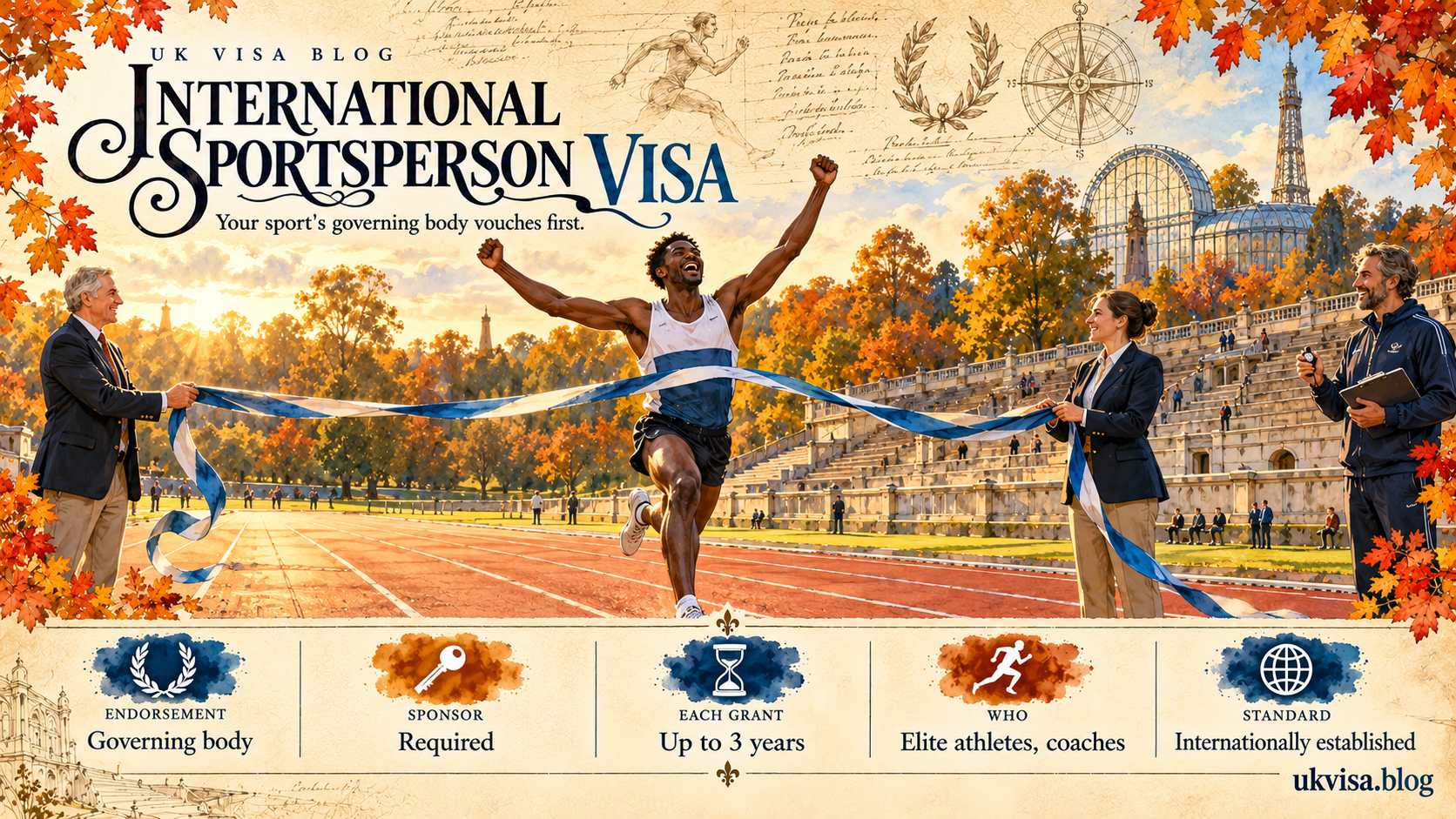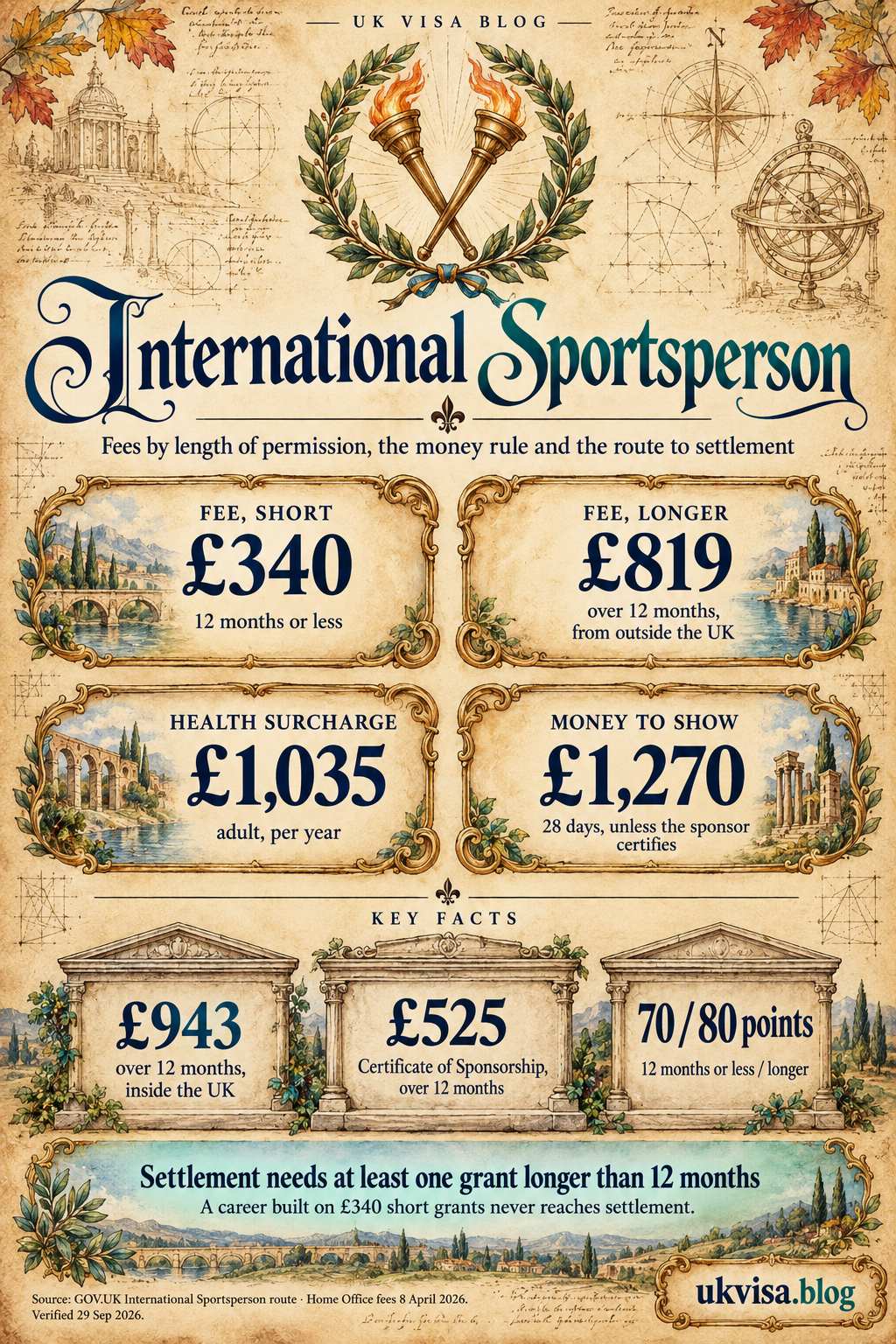
The International Sportsperson visa — the modern replacement for the former Tier 2 Sportsperson and the sporting limb of the Tier 5 Creative and Sporting visa — is the long-term UK work route for elite athletes and qualified coaches. Introduced in October 2021 under Appendix International Sportsperson, it requires a Governing Body Endorsement (GBE) from the relevant UK sports authority and a Certificate of Sponsorship from a licensed UK club or organisation. From 8 April 2026 the application fee is £340 (visas up to 12 months), £819 (over 12 months, outside UK) or £943 (over 12 months, in-UK extension or switch). ILR is available after 5 years' continuous residence — provided at least one grant lasted more than 12 months — with a £35,800 minimum salary threshold lower than Skilled Worker's £41,700.
Since the end of EU free movement in January 2021, every overseas footballer, rugby player, cricketer, tennis player or qualified coach taking up a paid professional role with a UK club needs an International Sportsperson visa — including all EU/EEA nationals. The two-stage gating is unique: governing body endorsement comes first, then the Home Office visa application. The route leads to ILR after 5 years and is the only points-based UK visa that explicitly permits working as a professional sportsperson — most other work visas prohibit this.
- What is the International Sportsperson Visa?
- UK Sports Visa Requirements 2026
- Governing Body Endorsement (GBE)
- Sportsperson Visa Fees from 8 April 2026
- How to Apply
- What You Can and Cannot Do
- Bringing Your Family
- Settlement and ILR for Sportspersons
- Refusal and Administrative Review
- Frequently Asked Questions
International Sportsperson Visa UK 2026: Elite Athletes, Coaches and Brexit-Era Sports Immigration
The International Sportsperson visa was introduced on 11 October 2021 under Appendix International Sportsperson of the Immigration Rules, consolidating the former Tier 2 (Sportsperson) visa and the sporting limb of the T5 Creative Worker visa (former route) into a single streamlined route. The reform reflected the broader points-based system rebranding and removed the legacy "Tier" terminology. The new route preserved the long-term work permission and ILR pathway of T2 Sportsperson while folding in short-term sporting engagements previously handled by T5.
Since 1 January 2021, the end of EU free movement means every European Union, EEA and Swiss national taking up paid professional sport with a UK club requires an International Sportsperson visa — exactly the same as a player arriving from Brazil, Nigeria or Japan. This represents the single biggest shift in UK sports recruitment since the introduction of the Bosman ruling in 1995. Premier League clubs, Championship clubs, the EFL, cricket counties, rugby unions and other governing bodies are now operating in a fully sponsored-visa environment for all non-British recruitment.
What is the International Sportsperson Visa?
The International Sportsperson visa is a sponsored UK work visa for elite athletes and qualified coaches. Eligibility requires a Governing Body Endorsement from the relevant UK sports authority (the Football Association for football, ECB for cricket, RFU for rugby union and similar), a Certificate of Sponsorship from a licensed UK club, £1,270 in personal savings (unless the sponsor certifies maintenance), age 16+, English language at A1 CEFR for long-term visas, and a TB test certificate if applying from a listed country. The visa runs for up to 3 years per grant and leads to settlement after 5 years.
UK Sports Visa Requirements 2026
Aged 16+ on the date of application; Governing Body Endorsement (GBE) from the recognised UK sports authority for the relevant sport; Certificate of Sponsorship from a Home Office licensed sponsor; £1,270 in personal savings held for 28 consecutive days (waived where sponsor certifies on the CoS); English language ability at A1 CEFR speaking and listening for visas over 12 months; TB certificate if applying from a listed country; and must not fall for refusal under general grounds.
Core Eligibility Criteria
- Age 16+: Must be 16 or over on the date of application — younger players sometimes use Child Student or other family routes until eligible.
- Governing Body Endorsement (GBE): Required for every applicant before a Certificate of Sponsorship can be issued. Each sport has its own endorsement criteria — see the dedicated GBE section below.
- Certificate of Sponsorship: Issued by a Home Office licensed Sponsor — must reference the GBE, be issued within 3 months of the visa application, and describe the role, salary and duration.
- Financial maintenance: £1,270 held in personal funds for 28 consecutive days ending within 31 days of the application date — unless the sponsor certifies maintenance on the CoS.
- English language (visas over 12 months only): Meet the A1 CEFR speaking and listening standard under B1 CEFR English standard for ILR — typically by SELT certificate, qualifying UK degree or majority-English-speaking nationality.
- TB test certificate: Required if applying from a listed country with TB screening obligations.
- Suitability: Must not fall for refusal under the general grounds of the Immigration Rules — character, criminality, immigration history.
Short-Term vs Long-Term Sportsperson Visa
| Variant | Maximum Duration | English Language Required | Settlement Possible |
|---|---|---|---|
| Short-term Sportsperson | Up to 12 months | Not required | No — but counts toward 5 years where at least one later visa exceeds 12 months |
| Long-term Sportsperson | Up to 3 years per grant | A1 CEFR speaking and listening | Yes — ILR after 5 years' continuous residence |
The visa duration is set by the date in the Certificate of Sponsorship plus 14 days, capped by the maximum for the variant (12 months or 3 years). For athletes whose required role does not qualify for a GBE, alternative routes include the Skilled Worker visa as an alternative work route (where the role fits a non-sport occupation code and meets the £41,700 salary threshold) and Standard Visitor visa for short amateur or coaching engagements not involving paid employment.
Governing Body Endorsement (GBE)
A Governing Body Endorsement (GBE) is mandatory written confirmation from the relevant UK sports authority that the applicant is internationally established at the highest level and will significantly contribute to UK sport. Each governing body operates its own GBE criteria — most use a points-based system. The Football Association requires 15 points for footballers (with an "Elite Significant Contribution" exception route since June 2023). The GBE must be in place BEFORE the Certificate of Sponsorship is assigned. No GBE means no visa, regardless of contract value or club status.
UK Sports Governing Bodies
| Sport | Governing Body | Endorsement Mechanism |
|---|---|---|
| Football | The Football Association (FA) | 15-point system + Exceptions Panel + ESC route (June 2023) |
| Cricket | England and Wales Cricket Board (ECB) | Points-based assessment + Exceptions Panel |
| Rugby Union | Rugby Football Union (RFU) | Points-based assessment |
| Rugby League | Rugby Football League (RFL) | Points-based assessment |
| Tennis | Lawn Tennis Association (LTA) | ATP/WTA ranking-based criteria |
| Basketball | British Basketball League (BBL) | Performance and experience criteria |
| Other sports | See Appendix Sports Governing Bodies | Body-specific criteria |
Football GBE: 15-Point System Explained
For senior professional footballers, the FA's GBE assessment awards points across four main criteria: international appearances for the player's senior national team (weighted by FIFA ranking), continental competition appearances (Champions League, Europa League, Conference League and equivalents), league quality of the previous club (FIFA-banded league strength), and club performance (league position and continental qualification). A total of 15 points is required for automatic GBE approval.
Players scoring 10–14 points can be referred to the FA's Exceptions Panel, which reviews compelling cases where the player's profile is genuinely exceptional despite falling short of the headline threshold. Decisions are case-by-case and consider factors such as injury record, age, transfer fee, club academy pedigree, and the strategic profile of the move.
Since June 2023, the FA permits English clubs to sign promising young international players who do not meet the headline 15-point GBE threshold under the ESC framework. Premier League and EFL Championship clubs can recruit up to 4 ESC players per season; League One and League Two clubs can sign up to 2 ESC players per season. The ESC criteria focus on "significant potential" — players whose future career trajectory would meaningfully enhance football development in England. This was the FA's response to industry pressure following high-profile cases where talented youth players were blocked under the rigid points framework. ESC is a fixed annual quota and applications are reviewed individually.
Sportsperson Visa Fees from 8 April 2026
From 8 April 2026: short-term visa (up to 12 months) costs £340 per person; long-term visa over 12 months costs £819 per person outside the UK or £943 per person for in-UK extension/switch applications. Each applicant pays the Immigration Health Surcharge of £1,035 per year for adults and £776 per year for under-18s, up front for the full grant period. Priority service adds £500 and super-priority adds £1,000 where available. A 3-year long-term visa for a single adult applicant from outside the UK comes to £3,924 total in Home Office charges.
Applicant Fees from 8 April 2026
| Fee Component | Amount from 8 April 2026 | Notes |
|---|---|---|
| Short-term (up to 12 months) | £340 per person | Same fee inside or outside UK |
| Long-term (over 12 months, outside UK) | £819 per person | Up from £769; matches Skilled Worker outside-UK rate |
| Long-term extension or switch (inside UK) | £943 per person | Up from £885; matches Skilled Worker in-UK rate |
| Immigration Health Surcharge — adult | £1,035 per year | Standard work-visa rate; paid up front for full grant |
| Immigration Health Surcharge — under 18 | £776 per year | Discounted rate for dependent children |
| Priority service uplift | +£500 | Targets decision within 5 working days; availability varies by VAC |
| Super-priority service uplift | +£1,000 | Targets next working day decision; limited availability |
| Biometric enrolment | £19.20 for in-UK applications | Often waived where UK Immigration: ID Check app is used |
Source: gov.uk International Sportsperson visa fee schedule, updated 29 April 2026.
Total Cost Example: 3-Year Long-Term Visa (Adult, Outside UK)
- Visa application fee: £819
- Immigration Health Surcharge (3 years × £1,035): £3,105
- Total Home Office charges per adult applicant: £3,924
- Family of four applying together (3-year visa): approximately £14,094 before TB tests and biometrics
Employer/Sponsor Costs from 8 April 2026
UK clubs and sporting organisations sponsoring international athletes incur their own Home Office costs alongside the applicant's fees. Sponsor licence fees and Certificate of Sponsorship fees increased significantly under Statement of Changes HC 1691 (effective 8 April 2026).
| Sponsor Cost Component | Amount from 8 April 2026 | Notes |
|---|---|---|
| Sponsor licence — large organisation | £1,682 | Up from £1,579; valid 4 years |
| Sponsor licence — small organisation / charity | £611 | Up from £574; valid 4 years |
| Certificate of Sponsorship — long-term (over 12 months) | £525 | Unchanged; per individual CoS assignment |
| Certificate of Sponsorship — short-term (up to 12 months) | £55 | Unchanged; per individual CoS assignment |
Note that International Sportsperson roles are exempt from the Immigration Skills Charge that applies to Skilled Worker sponsorships — clubs do not pay the £1,320/year (large) or £480/year (small) charge that ordinary sponsored work routes carry. The Sportsperson route therefore costs the sponsoring club less per worker than equivalent Skilled Worker sponsorship. See the wider sponsor licence framework for UK employers for comparison with non-sport routes.
How to Apply
All applications are submitted online via the gov.uk International Sportsperson visa overview. The applicant can apply up to 3 months before the role start date listed on the Certificate of Sponsorship. Successful applications are now granted as eVisas linked to the applicant's UKVI account, replacing the older Biometric Residence Permit format (the transition to digital-only eVisas was completed by the end of 2024 for new grants).
- Step 1: Secure Governing Body Endorsement from the relevant UK sports authority — this must happen before any CoS is issued.
- Step 2: Sponsor club assigns the Certificate of Sponsorship through the Sponsorship Management System (SMS), referencing the GBE.
- Step 3: Complete the online visa application on gov.uk — typically takes 30–60 minutes.
- Step 4: Pay the visa fee and full Immigration Health Surcharge by debit or credit card.
- Step 5: Verify identity — either through the UK Immigration: ID Check app for eligible passports, or by booking a biometric appointment at a Visa Application Centre.
- Step 6: Upload supporting documentation — current passport, GBE confirmation, CoS reference, financial maintenance evidence, TB certificate, English language evidence (long-term visas only).
- Step 7: Wait for decision — standard service is 3 weeks (outside UK) or 8 weeks (inside UK).
- Step 8: Create a UKVI account, access the eVisa, and travel to the UK.
Processing Times During Transfer Windows
Processing times can extend during peak demand windows — summer transfer window (June–August for football and cricket) and the January football transfer window are particularly busy. Clubs working to registration deadlines should build a 3–4 week buffer into their recruitment timeline and consider priority visa services for faster decisions where the registration window is tight.
What You Can and Cannot Do on the Sportsperson Visa
The International Sportsperson visa is one of the few UK visa categories that explicitly permits professional sporting employment — most other work routes (Skilled Worker, Global Business Mobility, Senior or Specialist Worker) prohibit working as a professional sportsperson or coach. Within that framework, there are well-defined permitted and restricted activities.
Permitted Activities
- Sponsored employment in the role described on the Certificate of Sponsorship.
- Representing your national team while in the UK — including international friendlies, qualifying matches and tournament participation.
- British Universities and Colleges Sport (BUCS) competitions for student-athletes.
- Sports broadcasting — temporary punditry and commentary engagements.
- Second job: Up to 20 hours per week in the same profession or in an Immigration Salary List shortage occupation — only after starting the sponsored role.
- Voluntary work — unpaid charitable activities are permitted alongside the sponsored role.
- Study — provided it does not interfere with the sponsored employment; no separate Student visa required.
- Travel in and out of the UK freely during the visa period.
- Bring dependants — partner and children under 18 can apply as dependants.
Restricted Activities
- No public funds — most benefits and welfare payments are restricted under "no recourse to public funds".
- No starting or running a business — the route is sponsored employment, not entrepreneurial activity. Endorsement income and personal sponsorship arrangements are permitted but the route does not cover business ownership or self-employment.
- No second job until sponsored role starts — the 20-hour supplementary employment allowance only kicks in once the sponsored role has commenced.
- No work outside permitted parameters — any paid work outside the sponsored role, the 20-hour supplementary allowance, voluntary work or permitted broadcasting requires a new visa.
Breaching International Sportsperson visa conditions can result in re-entry ban consequences after removal ranging from 1 to 10 years, depending on the nature and seriousness of the breach. Dependants are bound by the same condition framework — they can work in most jobs but specifically cannot work as professional sportspersons or coaches themselves. Sponsor compliance failures can also trigger licence revocation, which would end the worker's permission to continue in the role.
Bringing Your Family
The International Sportsperson visa is a settlement-leading route, so dependant entitlements mirror those of Skilled Worker. Eligible dependants are the applicant's partner (spouse, civil partner, or unmarried partner of 2+ years' cohabitation), and children under 18 (or over 18 if already in the UK as a dependant). Each dependant submits a separate dependant partner and children visa application and pays the same fee structure as the main applicant, plus IHS at the relevant adult/child rate.
Dependant Financial Requirements
- Partner: £285 in savings held for 28 consecutive days.
- First child: £315 additional in savings.
- Each additional child: £200 additional in savings.
- Sponsor certification waiver: Applies if the sponsor certifies maintenance for the family on the main applicant's CoS.
Dependants can work in most occupations (with the explicit exception of professional sport and sports coaching), can study, can travel freely, and can apply for ILR in their own right after 5 years' continuous residence. Their visa end-date is aligned to the main applicant's visa unless they qualify for a longer grant on their own merits.
Settlement and ILR for Sportspersons
After 5 years' continuous residence under the International Sportsperson route (or in combination with qualifying routes like Skilled Worker, Global Talent, Innovator Founder and Sole Representative), holders can apply for Indefinite Leave to Remain — provided at least one of their grants exceeded 12 months. ILR requires a minimum salary of £35,800 from the main sponsored job, no more than 180 days outside the UK in any rolling 12-month period, English at B1 CEFR (unless exempt), passing the Life in the UK test, and continuing sponsorship. The ILR fee is £3,226 from 8 April 2026.
ILR Eligibility for Sportspersons
- 5 years' continuous residence: Under International Sportsperson, or in combination with other qualifying sponsored routes — see 180-day absence rule for continuous residence. International commitments related to the role count toward the absence calculation.
- At least one grant over 12 months: The 5-year clock cannot be made up entirely of short-term (under-12-month) grants — at least one long-term visa is required.
- Most recent leave under International Sportsperson: The latest grant must be under Appendix International Sportsperson.
- Minimum salary £35,800/year: From the main sponsored role; endorsement income, appearance fees and performance bonuses do not count toward the threshold.
- Continuing sponsorship: The sponsor must confirm at the ILR stage that the worker's services are still required.
- Knowledge of Language and Life (KoLL): Pass the Life in the UK settlement test and meet B1 CEFR English under Appendix KoL UK (limited-leave standard is A1; ILR standard is B1).
- Apply from inside the UK: ILR applications cannot be made from outside the UK.
- Suitability: Must not fall for refusal under general grounds.
The Sportsperson ILR salary threshold is £35,800 per year — lower than the Skilled Worker baseline of £41,700 from 22 July 2025 — but Sportsperson rules count ONLY the salary from the main sponsored job. Endorsement deals, image rights, appearance fees, win bonuses, and performance-related payments do NOT contribute to the £35,800 figure. The sponsor must confirm the base salary at the ILR stage. Time spent on the old Tier 5 Creative and Sporting visa does NOT count toward the 5-year qualifying period; only time on T2 Sportsperson and the current International Sportsperson route counts.
Onward Path: British Citizenship
Once ILR is granted, the standard 12-month wait applies before naturalisation as a British citizen — see British citizenship 12 months after ILR. The naturalisation fee from 8 April 2026 is £1,709 per applicant. For sportspersons married to British citizens, the wait can be shorter (immediately upon ILR for married applicants meeting other requirements). For the wider settlement comparison across routes, see the ILR settlement framework after 5 years guide.
Immigration Health Surcharge at Settlement
ILR applicants are exempt from the Immigration Health Surcharge for sponsored workers at the settlement stage — IHS only applies to limited leave. The £3,226 ILR application fee is therefore the main Home Office charge at settlement, with the Life in the UK test (£50) and biometric enrolment (£19.20) as ancillary costs.
Refusal and Administrative Review
A refused International Sportsperson visa decision is challengeable only by way of administrative review under Appendix AR — there is no general right of appeal for points-based work refusals. The administrative review deadline is typically 14 days from receipt of the decision (28 days for refusals issued outside the UK). Review is limited to caseworking errors and cannot reconsider the underlying merits with new evidence — fresh evidence requires a fresh application. Section 3C of the Immigration Act 1971 automatically extends existing leave while a pending in-time administrative review is being decided.
High-profile refusals — including the Gaël Ondoua case affecting Servette's UEFA participation against Rangers — demonstrate that visa rules apply equally to elite-level European football fixtures. Documentation compliance and advance planning at the GBE and CoS stages are the single best protection against last-minute refusals at registration deadlines.
- The International Sportsperson visa is the modern replacement for Tier 2 Sportsperson and the sporting limb of Tier 5 Creative and Sporting — introduced October 2021.
- Fees from 8 April 2026: £340 (up to 12 months), £819 (over 12 months outside UK), £943 (over 12 months in-UK extension/switch).
- Immigration Health Surcharge £1,035/year adult, £776/year under-18, paid up front for full grant period.
- Sponsor licence £1,682 (large) / £611 (small) from 8 April 2026; CoS £525 long-term / £55 short-term; no Immigration Skills Charge applies to Sportsperson sponsorship.
- Governing Body Endorsement (GBE) is mandatory — FA uses a 15-point system for football, with the Elite Significant Contribution (ESC) route since June 2023 for promising young players.
- Post-Brexit since January 2021: every EU/EEA/Swiss national needs this visa for professional UK sport — same as non-EU players.
- 5-year ILR pathway with £35,800 minimum salary from main sponsored role; £41,700 Skilled Worker threshold does NOT apply.
- ILR fee £3,226 from 8 April 2026 (up from £3,029); naturalisation £1,709 from 12 months after ILR.
- Family members can join as dependants; they can work in most jobs but not as sportspersons or coaches.
- Standard processing: 3 weeks outside UK / 8 weeks inside UK; priority service £500 (5 working days) and super-priority £1,000 (next working day) available where offered.
For full authoritative guidance the gov.uk International Sportsperson visa overview is the applicant-facing entry point. The legal framework sits at Appendix International Sportsperson and the full list of recognised sports authorities is at Appendix Sports Governing Bodies. The April 2026 fee uplifts were set out in Statement of Changes HC 1691 (5 March 2026), in force from 8 April 2026.
The International Sportsperson visa is a UK long-term work visa under Appendix International Sportsperson for elite athletes and qualified coaches sponsored by a licensed UK club or organisation. It replaced the Tier 2 (Sportsperson) visa and the sporting limb of the Tier 5 (Creative and Sporting) visa in October 2021. Grants run up to 3 years and lead to Indefinite Leave to Remain after 5 years' continuous residence (provided at least one grant lasted longer than 12 months). The route is one of the few UK visa categories that explicitly permits working as a professional sportsperson or coach.
From 8 April 2026, the application fee is £340 for short-term visas (up to 12 months), £819 for long-term visas applied for from outside the UK, or £943 for long-term in-UK extensions or switches. Each applicant pays the Immigration Health Surcharge of £1,035 per year for adults (£776 for under-18s), paid up front for the full grant period. A 3-year visa for a single adult applicant from outside the UK comes to £3,924 in total Home Office charges. Priority service adds £500; super-priority adds £1,000.
You must be aged 16 or over, hold a current Governing Body Endorsement (GBE) from the relevant UK sports authority confirming you're internationally established at the highest level, have a Certificate of Sponsorship from a Home Office licensed sponsor, demonstrate £1,270 in personal savings held for 28 consecutive days (unless the sponsor certifies maintenance), meet the A1 CEFR English language requirement for long-term visas, and pass a TB test if applying from a listed country.
Standard processing is 3 weeks for applications submitted from outside the UK and up to 8 weeks for in-UK applications (extensions or switches). Priority service (£500 uplift) targets a decision within 5 working days; super-priority (£1,000 uplift) targets next working day decisions. Processing times can extend during peak transfer windows (summer June–August and the January football window). Clubs working to registration deadlines should build a 3–4 week buffer into their recruitment timeline.
A Governing Body Endorsement is mandatory written confirmation from the relevant UK sports authority that the applicant is internationally established at the highest level and will significantly contribute to UK sport. For football, the Football Association uses a 15-point system based on international appearances, league quality, club performance and continental competition record. Other sports — cricket (ECB), rugby (RFU/RFL), tennis (LTA), basketball (BBL) — operate their own GBE criteria. The GBE must be issued BEFORE the Certificate of Sponsorship.
Since June 2023, the FA permits English clubs to sign promising young international players who do not meet the headline 15-point GBE threshold under the ESC framework. Premier League and EFL Championship clubs can recruit up to 4 ESC players per season; League One and League Two clubs can sign up to 2 ESC players. The criteria focus on "significant potential" to enhance football development in England — typically players whose future trajectory justifies an exception despite a lower current points score. Each application is reviewed individually within the annual club quota.
Yes — extensions are permitted for up to 3 years at a time, provided you continue to meet the eligibility criteria. You need a renewed Governing Body Endorsement, a new Certificate of Sponsorship from your sponsor, and ongoing compliance with the role and salary requirements. The in-UK extension fee from 8 April 2026 is £943 per applicant for long-term visas plus £1,035 per year IHS. Apply before your current visa expires — section 3C of the Immigration Act 1971 automatically extends your existing leave while an in-time extension is pending.
Yes. Eligible dependants include your partner (spouse, civil partner, or unmarried partner of 2+ years), and children under 18. Each dependant submits a separate application and pays the same fee structure plus IHS at adult or under-18 rates. Dependants must meet financial requirements: £285 in savings for partners, £315 for the first child, £200 for each additional child — unless the sponsor certifies maintenance on the CoS. Dependants can work in most jobs (but not as professional sportspersons or coaches), study, and travel freely.
After 5 years' continuous residence under the International Sportsperson route (or combined with other qualifying sponsored routes), you can apply for Indefinite Leave to Remain provided at least one of your grants lasted longer than 12 months. Requirements include: earning at least £35,800 per year from your main sponsored role (endorsement income and bonuses do not count), no more than 180 days outside the UK in any rolling 12-month period, English at B1 CEFR, passing the Life in the UK test, and continuing sponsorship. The ILR fee from 8 April 2026 is £3,226. After 12 months on ILR you can apply for British citizenship.
The end of EU free movement on 31 December 2020 brought EU, EEA and Swiss nationals fully within the UK's immigration framework. Since 1 January 2021, every European footballer, rugby player, cricketer, coach or other professional athlete taking up paid sporting employment with a UK club requires an International Sportsperson visa — exactly the same as a player from outside Europe. The single visa framework now applies uniformly to all non-British recruitment, with the same GBE, CoS, fee, IHS and processing requirements regardless of nationality.