
The International Agreement visa covers work brought into UK law by treaty: staff of overseas governments and recognised international organisations, and private servants in diplomatic households. It costs £340. The two groups look like one route but behave differently — two years for the first, up to five for the second — and neither is the route for contracting services to a UK company.
UK Work Visas
International Agreement Visa UK 2026: Who It Covers and For How Long
What the Route Is
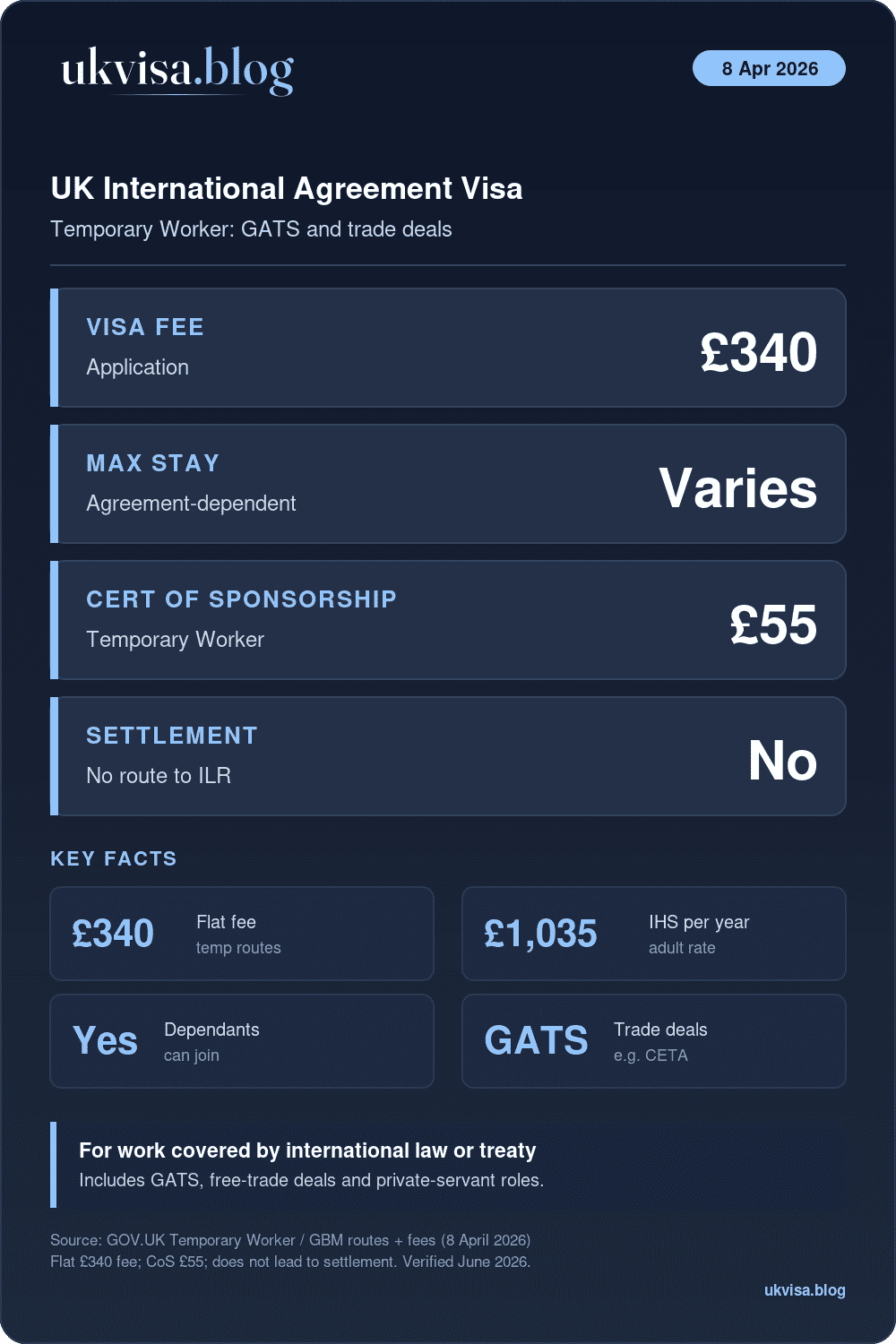
A sponsored route in the Temporary Work family for people contracted to do work covered by international law or treaty while in the UK. It covers work for an overseas government or a recognised international organisation, and work as a private servant in a diplomatic household. The fee is £340, the same inside or outside the UK, plus the health surcharge and £1,270 in savings.
As with the other temporary routes, the work you do in the UK must relate to the work of your sponsor organisation, and you need a certificate of sponsorship from a licensed employer before applying. There is no English language requirement and no salary threshold, but the employment must still comply with the minimum wage and working time rules.
Who the Route Covers
There are two distinct populations here, and the Home Office assesses them separately even though they sit in the same appendix. The first is employees of overseas governments and recognised international organisations — diplomatic and consular support staff, and staff of bodies whose UK presence rests on an international agreement.
The second is private servants in diplomatic households: domestic staff employed by a diplomat rather than by a mission. They have their own conditions, their own maximum stay, and their own protections, and the caseworker guidance deals with them in a separate section from the government and organisation workers.
Private Servants in Diplomatic Households
This is the more sensitive half of the route, because the worker lives and works inside a private household attached to a diplomatic mission. The guidance addresses compliance with UK employment law directly, including specific treatment of the national minimum wage — a recognition that pay and conditions in private households are harder to observe than in an office.
The permission is longer than the rest of the temporary family. A private servant can stay for up to five years in total, applying for up to two years at a time, or the certificate period plus up to 14 days, whichever is shorter. That makes it the only Temporary Work category with a multi-year horizon.
This Is Not the Route for Contracting to a UK Company
GOV.UK is explicit: if you are being contracted to provide services to a UK company, apply for the Service Supplier visa under Global Business Mobility instead. The International Agreement route is for work that international law or treaty brings within UK rules — overseas government employment, recognised international organisations, and diplomatic households. Commercial contracting is a different arrangement with a different appendix, a different sponsor relationship and different periods of permission. Applying under the wrong one costs the fee and the certificate, and the certificate cannot be reused.
Recognised International Organisations
Not every body with an international name qualifies. The organisation has to be one recognised for these purposes, with a UK presence resting on an international agreement, and the sponsorship has to come from it or from the overseas government concerned. Where an organisation is not recognised, the employment is ordinary employment and falls to be sponsored on a normal work route instead.
Eligibility
- Certificate of sponsorship: from a licensed sponsor, for work relating to the sponsor's own work.
- Covered work: employment with an overseas government or recognised international organisation, or as a private servant in a diplomatic household.
- Money: £1,270 held for 28 consecutive days, unless your sponsor certifies maintenance.
- Employment law: pay and hours complying with the minimum wage and working time rules.
- Certificates: a tuberculosis test if applying from a listed country, and certified translations where documents are not in English or Welsh.
- Timing: apply up to three months before the start date on the certificate.
How Long You Can Stay
Maximum Stay by Category
| Category | Grant length | Maximum total |
|---|---|---|
| Overseas government or international organisation worker | Up to 2 years, or the certificate period plus 14 days | 2 years |
| Private servant in a diplomatic household | Up to 2 years at a time, or the certificate period plus 14 days | 5 years |
Source: GOV.UK International Agreement visa (Temporary Work). Verified 22 August 2026.
In both cases the shorter of the two calculations applies, so a certificate issued for eighteen months produces eighteen months plus fourteen days rather than the full two years.
Why the Two Halves Are Assessed Separately
Government and organisation staff are assessed against the institution that employs them: whether it qualifies, and whether the posting is what it says. Private servant applications turn on the household and the contract — who employs the worker, on what terms, and whether those terms comply with UK employment law. Same appendix, same fee, different evidence.
Fees
£340 per person, identical inside and outside the UK, plus the health surcharge at £1,035 a year for adults and £776 for under-18s. Each dependant pays the same again. Your sponsor pays £611 for a Temporary Worker licence and £55 per certificate, and no Immigration Skills Charge applies. Comparisons across routes are in our fee table.
Money and the 28-Day Rule
You need £1,270 held for 28 days in a row, with day 28 within 31 days of applying, unless the sponsor certifies maintenance on the certificate or you have been in the UK on a valid visa for twelve months. Dependants show their own funds separately, on the same 28-day basis.
How to Apply
Apply online up to three months before the start date on your certificate — the process is in our application form guide. Decisions usually take about three weeks from outside the UK and eight weeks inside it, and paid faster services are available. Because private servant applications turn on the employment terms as much as the sponsorship, the contract is worth preparing carefully before submission.
The Certificate and the Three-Month Window
The certificate of sponsorship is an electronic record used once, within three months of assignment, and its status is checked at decision rather than at submission. Missions and households arranging postings months in advance should assign it close to the intended travel date, not at the point the decision to post is taken.
What You Can and Cannot Do
You work for your sponsor in the role on the certificate. As on the rest of the temporary family, public funds are not available, and the permission does not lead to settlement. Second-job and study allowances follow the standard temporary-route pattern, with the sponsored role remaining the primary activity throughout.
Neighbouring routes cover adjacent situations: Government Authorised Exchange for approved training and research schemes, Charity Worker for unpaid charitable work, Religious Worker for supporting religious work, and Creative Worker for performers and crew.
When the Posting Ends Early
Permission on this route is tied to the sponsorship that supports it. A posting that ends early, a mission that closes a position, or a household that no longer employs the worker all remove the basis for the permission, and there is no in-country switch available to absorb the change. Planning for an early end matters more here than on routes where a new sponsor can be found in-country.
Partners and Children
A partner and children can apply as dependants if eligible, each paying £340 and their own health surcharge and showing their own funds. Their permission runs with yours. For private servants on the five-year track this matters more than elsewhere in the temporary family, because the horizon is long enough for children to be in school for the whole period — the mechanics are in our dependant visa guide.
Sources: GOV.UK International Agreement route page on GOV.UK; Appendix Temporary Work — International Agreement; and the Home Office Temporary Work caseworker guidance version 38.0. Figures verified 22 August 2026.
Frequently Asked
Questions about the International Agreement Visa
People contracted to do work covered by international law or treaty while in the UK. In practice that means employees of overseas governments and recognised international organisations, and private servants working in diplomatic households. Both need a certificate of sponsorship from a licensed sponsor, and the work must relate to the sponsor's own work.
Overseas government and international organisation workers can stay up to two years, or the certificate period plus 14 days, whichever is shorter. Private servants in diplomatic households can stay up to five years in total, applying for up to two years at a time on the same shorter-of calculation. Neither leads to settlement.
No. GOV.UK directs anyone contracted to provide services to a UK company to the Service Supplier visa under Global Business Mobility instead. This route is for work brought within UK rules by international agreement, not for commercial contracting. Applying on the wrong one loses both the application fee and the certificate of sponsorship.
£340 per person, the same inside or outside the UK, plus the health surcharge at £1,035 a year for adults and £776 for children. You also need to show £1,270 in savings held for 28 consecutive days unless your sponsor certifies maintenance. Sponsors pay £611 for the licence and £55 per certificate.
The caseworker guidance addresses compliance with UK employment law for private servants in diplomatic households specifically, including the treatment of the national minimum wage. The employment must comply with minimum wage and working time rules like any other, and a job that does not is a ground for refusing the application.
No. None of the Temporary Work routes has one, and this is no exception. Documents submitted with the application still have to be in English or Welsh or come with a certified translation, and a caseworker can interview an applicant where the genuineness of the arrangement is in question.
Yes, if they are eligible. Each dependant pays the £340 fee and their own health surcharge and must show their own funds. Their permission is tied to yours and ends when it does. On the five-year private servant track that is long enough to matter for schooling, which is worth planning around at the first application.
No. Like the rest of the Temporary Work family, this route does not lead to indefinite leave to remain, and switching into another route from inside the UK is generally not possible. Even the five-year private servant track builds no settlement clock, so a longer-term future needs a different route applied for from abroad.