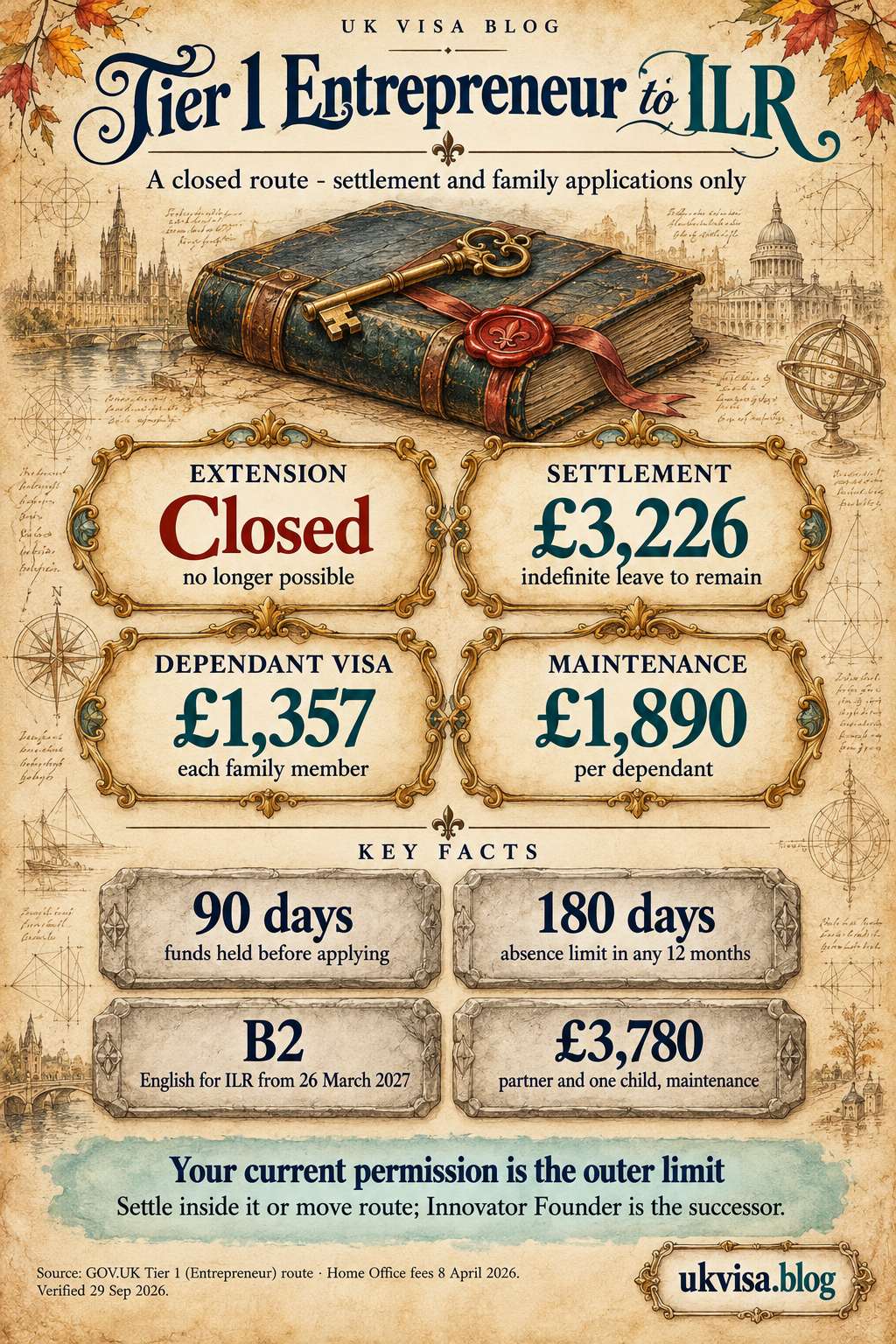
The Tier 1 Entrepreneur visa to ILR route is in its final wind-down phase. The visa category closed to new applicants on 29 March 2019, the standard extension and ILR deadlines have passed (6 April 2023 and 6 April 2025 respectively), and the route survives only for former Tier 1 (Graduate Entrepreneur) holders and certain Start-up visa switchers — who have until 6 July 2027 to make their ILR application. The ILR fee is £3,226 from 8 April 2026. Priority and super-priority processing are NOT available for this route — standard service only.
The standard ILR deadline of 6 April 2025 has passed and no extensions are possible for the general Tier 1 Entrepreneur cohort. Only former Tier 1 (Graduate Entrepreneur) holders and Start-up visa switchers retain access — they must apply for ILR before 6 July 2027. ILR is £3,226 from 8 April 2026, processed in standard service only (up to 6 months). Those who missed the deadline must move to Innovator Founder, Global Talent, Skilled Worker or another category before current leave expires.
- Which Tier 1 Entrepreneur ILR Deadline Applies?
- Who Can Still Apply Under This Route?
- Tier 1 Entrepreneur ILR Requirements
- Accelerated 3-Year ILR Route
- Document Checklist
- Application Process and Fees
- Alternative Routes if You Missed the Deadline
- Refusal and Administrative Review
- Frequently Asked Questions
Tier 1 Entrepreneur Visa to ILR 2026: Wind-Down and Final Deadlines
The Tier 1 (Entrepreneur) route closed to new applicants on 29 March 2019, replaced operationally by the Innovator Founder route under Part 6A of the Immigration Rules. Transitional protection has run on a fixed timeline of extension and settlement deadlines designed to clear the residual caseload — extensions ended on 6 April 2023 (standard) and 6 July 2025 (former Graduate Entrepreneurs), and ILR deadlines run on 6 April 2025 (standard) and 6 July 2027 (former Graduate Entrepreneurs and Start-up switchers).
Which Tier 1 Entrepreneur ILR Deadline Applies?
The deadline depends entirely on immigration history. Standard Tier 1 (Entrepreneur) holders who never held Graduate Entrepreneur or Start-up status had until 6 April 2025 to apply for ILR — that deadline has passed and no further ILR applications under this cohort are accepted. Former Tier 1 (Graduate Entrepreneur) holders, and those who switched from Start-up before entering Tier 1 (Entrepreneur), have until 6 July 2027.
Full Wind-Down Timeline
| Application Type | Deadline | Status (2026) |
|---|---|---|
| New initial Tier 1 (Entrepreneur) applications | 29 March 2019 | CLOSED |
| Extensions (standard) | 6 April 2023 | CLOSED |
| Extensions (Graduate Entrepreneur switchers) | 6 July 2025 | CLOSED |
| ILR (standard cohort) | 6 April 2025 | CLOSED |
| ILR (Graduate Entrepreneur or Start-up switchers) | 6 July 2027 | OPEN |
Source: Paragraphs 245D to 245DF of the Immigration Rules; Home Office published transitional dates.
Tier 1 Entrepreneur ILR applications can only be made under the standard service — priority and super-priority services are NOT available for this route. Standard processing is up to 6 months. Applying close to the 6 July 2027 deadline carries no buffer if the Home Office requests further evidence or interviews. Submit earlier than later — a refused application near the deadline leaves limited time to reapply or switch route. Section 3C protection only operates while a valid in-time application is pending.
Who Can Still Apply Under This Route?
Only two cohorts retain access to Tier 1 Entrepreneur ILR after 6 April 2025. Both groups must apply before 6 July 2027.
- Former Tier 1 (Graduate Entrepreneur) holders: Anyone who at any time held Tier 1 (Graduate Entrepreneur) status before switching into Tier 1 (Entrepreneur). The Graduate Entrepreneur visa was endorsed by a UK Higher Education Institution for graduates with genuine, credible business ideas — switchers from this cohort retain the later ILR deadline.
- Start-up visa switchers: Individuals who held Start-up visa permission before switching into Tier 1 (Entrepreneur). The Start-up route itself was closed and replaced by Innovator Founder, but the transitional provisions still cover those who progressed through the Start-up → Tier 1 (Entrepreneur) path.
Check your immigration history: previous Biometric Residence Permits (BRPs), entry-clearance vignettes in passports, and Home Office decision letters will all show whether Tier 1 (Graduate Entrepreneur) or Start-up status preceded the Tier 1 (Entrepreneur) grant. If documentation is incomplete, request a Subject Access Request (SAR) from UKVI under data protection law — this typically returns the full immigration history within 30 days. Time spent under the Graduate Entrepreneur / Start-up grant does NOT count toward the 5-year continuous-residence period under this route; only Tier 1 (Entrepreneur) leave counts.
Tier 1 Entrepreneur ILR Requirements
To qualify for Tier 1 Entrepreneur ILR, the applicant must score 75 points under paragraph 245DF of the Immigration Rules, meet 5 years' continuous residence (or 3 years accelerated), have invested at least £200,000 (or £50,000 if applicable) in UK businesses, have created at least 2 full-time jobs (10 jobs for accelerated) for settled workers lasting 12+ months, pass the Genuine Entrepreneur Test, meet English language and Life in the UK requirements, and not exceed 180 days' absence from the UK in any rolling 12-month period.
Standard 5-Year ILR Requirements
- 75 attribute points under the settlement points table — covering investment, business registration, and job creation.
- 5 years' continuous residence as a Tier 1 (Entrepreneur) — see 180-day absence rule for continuous residence under Appendix Continuous Residence.
- Investment: At least £200,000 (or £50,000 in defined cases) invested in cash directly into one or more UK businesses.
- Job creation: Created at least 2 full-time jobs for settled workers (British citizens, ILR holders, or EU Settlement Scheme grantees), each lasting 12 consecutive months. A "full-time job" is defined by the Home Office as 30+ hours per week.
- Genuine Entrepreneur Test: Continued evidence of active involvement in running the UK business — contracts, invoices, management decisions, bank statements, HMRC records.
- English language: Meet the B1 CEFR English standard for ILR applications (B1 level under Appendix KoLL).
- Life in the UK test: Pass the Life in the UK settlement test — booking is separate from the ILR application at £50.
- Suitability: Must not fall for refusal under the general grounds of the Immigration Rules.
Settlement Points Breakdown (Paragraph 245DF)
| Attribute | Points | Evidence Test |
|---|---|---|
| Investment | 20 | £200,000 (or £50,000) invested in UK business(es) |
| Business registration | 20 | Registered as director or self-employed within 6 months of initial entry; still actively involved |
| Job creation | 20 | 2 full-time jobs for settled workers, each 12+ months |
| Continuous residence | 15 | 5 years (3 for accelerated) lawfully in UK as Tier 1 (Entrepreneur); ≤180 days' absence in any 12-month period |
| Total required | 75 | All four attribute categories must be met |
Accelerated 3-Year ILR Route
Tier 1 (Entrepreneur) migrants who produced exceptional business outcomes can apply for ILR after 3 years rather than 5. The accelerated route uses the same 75-point framework but raises the job-creation or business-income bar substantially. The 6 July 2027 deadline applies to both standard and accelerated routes for the eligible cohort.
Accelerated Route Eligibility
- 3 years' continuous residence as a Tier 1 (Entrepreneur) — with the same ≤180-day absence rule.
- 10 full-time jobs created for settled workers, each lasting 12+ consecutive months; OR
- £5 million business income generated from business activities over the 3-year period — either a new UK business generating £5m gross income, or a takeover/investment resulting in a net £5m increase in gross income.
- All other standard requirements still apply — Genuine Entrepreneur Test, English at B1, Life in the UK test, suitability.
The £5m income test is assessed on gross business income from trading activity — not assets, capital, or non-trading receipts. Audited business accounts and HMRC corporation tax returns are the central evidence. For the 10-job test, all 10 positions must run for 12 consecutive months (not 12 months in aggregate across multiple part-time roles), each at 30+ hours/week, paid through PAYE with RTI submissions to HMRC. Employment evidence must show each role separately — payslips, employment contracts, RTI submissions, P60s. Job creation cannot be combined across businesses owned partly by other Tier 1 Entrepreneur migrants relying on the same jobs for their own settlement.
Document Checklist
- Personal: Current and all previous passports covering the qualifying period; current BRP or eVisa; Police Registration Certificate where applicable.
- Knowledge requirements: Life in the UK test pass certificate; B1 English language evidence (SELT, qualifying UK degree, majority-English nationality, or exempt status).
- Business registration: Companies House extracts showing director / member appointments and dates; partnership agreements; HMRC self-employment registration where applicable.
- Investment evidence: Business bank statements showing the £200,000 (or £50,000) injection; share certificates; director's loan documentation; bank-to-bank transfer records.
- HMRC records: Corporation Tax filings, VAT registration and returns, National Insurance contributions, PAYE / RTI submissions.
- Company accounts: Audited or chartered-accountant-prepared financial statements covering each year of the qualifying period.
- Job creation evidence: Employment contracts for each settled worker; payslips and P60s; HMRC RTI submissions; settled-worker status evidence (passport, BRP, EUSS grant) — held with employee consent.
- Genuine business activity: Sample client/supplier contracts; invoices issued; correspondence demonstrating day-to-day operational involvement; minutes of board meetings where the applicant was active.
Application Process and Fees
Tier 1 Entrepreneur ILR applications are submitted online using the SET(O) settlement form on gov.uk. The applicant must be physically present in the UK when applying. Identity is verified through the UK Immigration: ID Check app for eligible passports or at a UKVCAS service point. Standard Home Office decision time is up to 6 months — and is the only service level available for this route.
ILR Application Fees from 8 April 2026
| Service / Component | Fee from 8 April 2026 | Notes |
|---|---|---|
| SET(O) ILR application (per person) | £3,226 | Up from £3,029; same fee for dependants |
| Priority service | Not available | Not offered on Tier 1 (Entrepreneur) ILR |
| Super-priority service | Not available | Not offered on Tier 1 (Entrepreneur) ILR |
| Standard decision target | Up to 6 months | Only available service level for this route |
| Life in the UK test (booked separately) | £50 | Required for ILR; book at an approved test centre |
| Biometric enrolment | £19.20 | UKVCAS appointment; waived where ID Check app available |
| Immigration Health Surcharge | Not payable | ILR applicants are exempt from IHS |
Source: Home Office immigration and nationality fees, 8 April 2026.
For a family of four applying together, the Home Office fees alone come to £3,226 × 4 = £12,904 before Life in the UK tests, biometrics, and any English-test costs. There is no fee discount for dependent children.
Alternative Routes if You Missed the Deadline
For Tier 1 (Entrepreneur) holders who do not qualify for the 6 July 2027 extended deadline and whose current leave is running down, switching to an alternative route is the only viable path. Time spent under Tier 1 (Entrepreneur) counts toward continuous residence on most of these routes, meaning settlement on the new route can be relatively quick.
- Innovator Founder visa replacement route: The direct modern replacement for Tier 1 (Entrepreneur). Requires endorsement by an approved body for an innovative, viable and scalable business idea. No minimum investment requirement. ILR available after 3 years where the business meets specified growth criteria.
- Global Talent endorsement pathway: Suitable for established or emerging leaders in science, engineering, humanities, medicine, digital technology, or arts and culture. No job offer required. Accelerated 3-year path to ILR for exceptional talent endorsements.
- Skilled Worker route for sponsored employment: Requires a job offer from a licensed UK sponsor at RQF Level 6 and the Skilled Worker £41,700 salary threshold (or applicable lower threshold). Existing Tier 1 Entrepreneurs with operating UK businesses sometimes pursue self-sponsorship, but this requires the business to obtain its own sponsor licence and meet ongoing compliance duties.
- Scale-up visa for high-growth companies: Initial 6-month sponsorship by an approved Scale-up business, then unsponsored permission. Suits entrepreneurs willing to take a sponsored role at another fast-growth firm.
- HPI route for top-100 university graduates: Available only to recent graduates (within 5 years) of qualifying global universities — narrow but a possibility for younger entrepreneurs.
Refusal and Administrative Review
A Tier 1 Entrepreneur ILR refusal is reviewable by way of challenge a refusal via administrative review under Appendix AR — there is no general right of appeal for ILR refusals on this route. The administrative review challenges caseworking errors in the decision; the typical deadline is 14 days from receipt of the decision (28 days for refusals issued outside the UK). Given the 6 July 2027 ILR deadline, a refused application close to expiry carries very little time to remedy by re-application — making advice from an OISC-regulated or solicitor-led immigration adviser essential at the refusal stage.
If the original ILR application was made in time (before the current leave expired AND before the 6 July 2027 deadline), section 3C of the Immigration Act 1971 extends existing permission automatically while a pending administrative review is being decided. Once the administrative review concludes — whether successful or not — section 3C ends. A successful administrative review reopens the ILR decision; an unsuccessful one leaves the applicant needing to switch route or leave the UK. If the original ILR application was out of time, section 3C does not apply.
- The route closed to new applicants on 29 March 2019 and is in final wind-down phase.
- Standard ILR deadline of 6 April 2025 has passed — no further applications accepted from the standard cohort.
- Former Tier 1 (Graduate Entrepreneur) holders and Start-up visa switchers have until 6 July 2027 to apply for ILR.
- 75 points required under paragraph 245DF — investment £200,000 (or £50,000), 2 full-time jobs for settled workers, business registration within 6 months of entry, 5 years' continuous residence.
- Accelerated 3-year ILR available with 10 full-time jobs OR £5 million gross business income.
- ILR fee is £3,226 from 8 April 2026 (up from £3,029); same fee for dependants; no IHS payable at ILR stage.
- Priority and super-priority services are NOT available for Tier 1 Entrepreneur ILR — standard service only, up to 6 months.
- Full-time job means 30+ hours per week; settled workers means British citizens, ILR holders, or EU Settlement Scheme grantees.
- Missed the deadline? Switch to Innovator Founder, Global Talent, Skilled Worker, Scale-up, or HPI before current leave expires.
For the latest official guidance, the gov.uk SET(O) settlement page and the Home Office Tier 1 (Entrepreneur) policy guidance remain the authoritative sources. The wider settlement framework — and the comparison of Tier 1 (Entrepreneur) ILR with all other settlement routes — sits in the ILR settlement framework across routes guide, and the 12-month wait before British citizenship 12-month wait after ILR follows the standard naturalisation rules.
Only if you previously held leave as a Tier 1 (Graduate Entrepreneur) or switched from the Start-up visa before entering Tier 1 (Entrepreneur). In that case, you have until 6 July 2027 to apply for ILR. If you held only standard Tier 1 (Entrepreneur) leave with no Graduate Entrepreneur or Start-up history, the 6 April 2025 deadline has passed and no further ILR applications under this route are accepted — you must switch to an alternative immigration category before your current leave expires.
Standard processing is up to 6 months from the completion of biometric enrolment. Priority and super-priority services are NOT available for Tier 1 (Entrepreneur) ILR applications — standard service is the only option. This makes timing critical: applications submitted close to the 6 July 2027 deadline carry no fall-back if the Home Office requests further evidence or schedules an interview. Aim to submit at least 9-12 months before the deadline.
The ILR application fee is £3,226 per person from 8 April 2026 (up from £3,029 between 9 April 2025 and 7 April 2026). The same fee applies to dependants — there is no discount for children. ILR applicants are exempt from the Immigration Health Surcharge. The Life in the UK test costs £50 (booked separately) and biometric enrolment is £19.20 where required. For a family of four, the Home Office application fees alone come to £12,904.
You must have created at least 2 full-time jobs (30+ hours per week) for settled workers — British citizens, ILR holders, or EU Settlement Scheme grantees — each lasting at least 12 consecutive months during your last grant of leave. For accelerated ILR after 3 years, the bar rises to 10 full-time jobs OR £5 million gross business income generated over the 3-year period. Each job must be evidenced through payslips, employment contracts, P60s, and HMRC RTI submissions, with proof of the worker's settled status.
Yes. Partners (spouses, civil partners, unmarried partners of 2+ years) and children under 18 holding dependent leave under the Tier 1 (Entrepreneur) route can apply for ILR alongside the main applicant. Each dependant must have completed 5 years' continuous residence in the UK and pays the same £3,226 application fee from 8 April 2026. Adult dependants must pass the Life in the UK test and meet the B1 English standard unless exempt. Children under 18 are not required to take Life in the UK or English tests.
The Home Office issues a decision letter explaining the refusal reasons. An administrative review under Appendix AR may be available to challenge caseworking errors — the deadline is typically 14 days from receipt of the decision (28 days for refusals issued outside the UK). There is no full right of appeal on Tier 1 (Entrepreneur) ILR refusals. If the original application was in time, section 3C extends existing leave while the administrative review is pending. Given the 6 July 2027 ILR deadline, a refusal close to the cut-off leaves very little time to remedy — switching to Innovator Founder or another route may be the practical fallback.
If you missed the 6 April 2025 deadline and never held Graduate Entrepreneur or Start-up leave, ILR under this route is no longer possible. The practical alternatives are: the Innovator Founder visa for entrepreneurs with an innovative business idea and endorsing-body endorsement; the Global Talent visa for leaders in tech, science, academia or the arts; the Skilled Worker visa via a sponsored UK role or self-sponsorship through your own business; or the Scale-up visa where a sponsored role at an approved high-growth business is available. Act before your current Tier 1 (Entrepreneur) permission expires — overstaying creates serious downstream problems.
Check your immigration history — previous Biometric Residence Permits (BRPs), entry-clearance vignettes in your passports, and Home Office decision letters all record the visa category for each grant. The Tier 1 (Graduate Entrepreneur) visa was endorsed by a UK Higher Education Institution and allowed up to 2 years on the route before switching to Tier 1 (Entrepreneur). If documentation is incomplete, submit a Subject Access Request to UKVI under data protection law — the response typically returns the complete immigration history within 30 days.
No. The Tier 1 (Entrepreneur) ILR continuous-residence test counts only leave granted under the Tier 1 (Entrepreneur) category. Time spent under Innovator Founder, Skilled Worker, Global Talent or any other route does not contribute to the 5-year (or 3-year accelerated) qualifying period for ILR under this route. However, time on Tier 1 (Entrepreneur) does generally count toward continuous residence for ILR on other routes if you switch — so a former Tier 1 (Entrepreneur) who switches to Innovator Founder typically does not start the clock over at zero.