
Settlement applications are chosen by route, not by picking a form code from a list. The SET labels still appear in guidance and in refusal notices, but the paper forms behind them are gone — you answer questions about your circumstances and the online service directs you to the right application.

Settlement Applications
Choosing the Right Indefinite Leave to Remain Application
How the Application Is Selected
Start from the route you qualify on. The GOV.UK settlement service asks which visa you hold or which basis you are relying on, and routes you into the right application. There is no menu of form codes to choose from, and no downloadable paper form to complete.
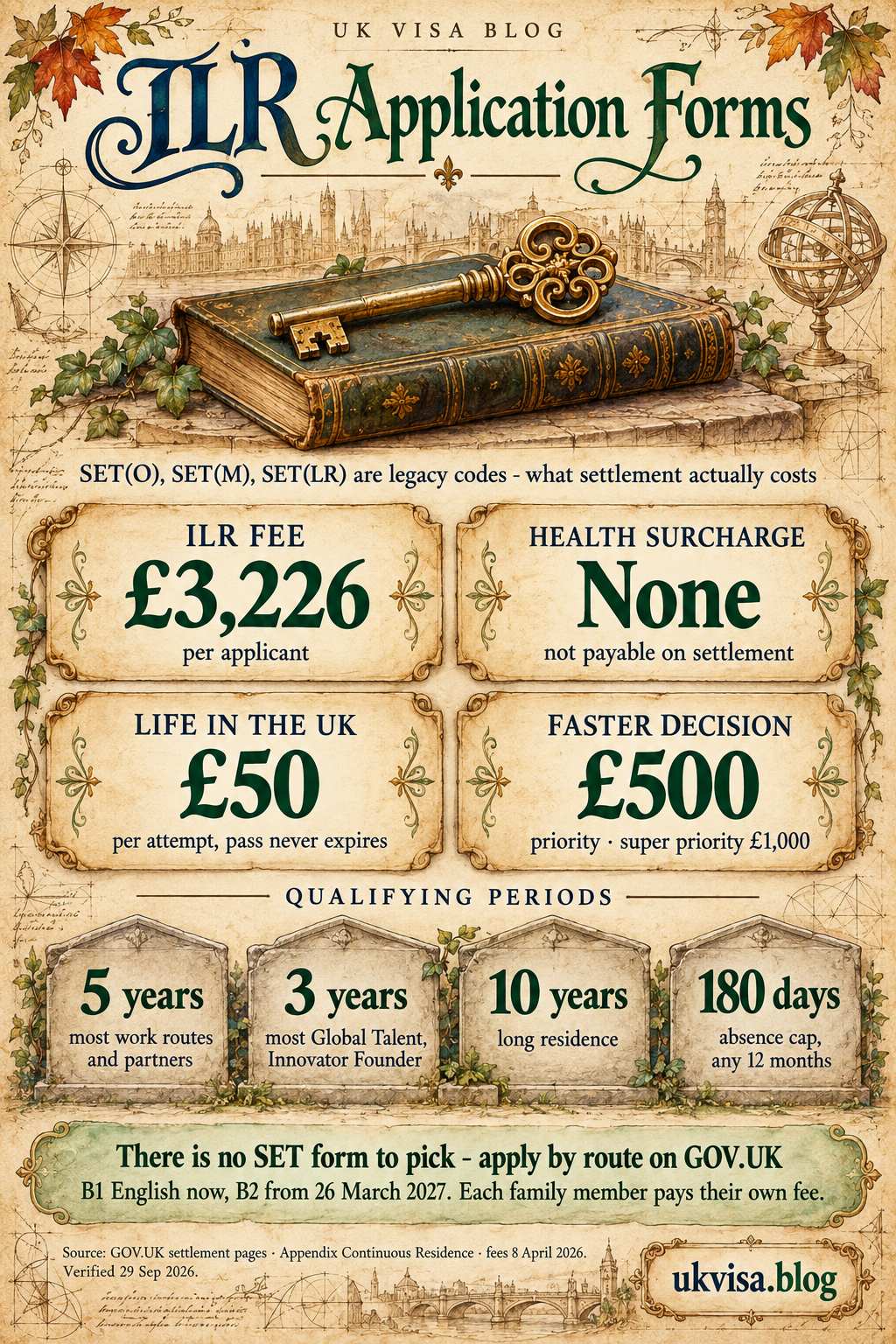
Settlement costs £3,226 per applicant from 8 April 2026, with no health surcharge. Qualifying periods are five years on most work routes and the partner route, three on Global Talent and Innovator Founder, ten on long residence, and five on UK Ancestry and BN(O). Most routes need B1 English and the Life in the UK test. Choose the application by route, not by form code.
Why the Codes Still Matter
SET(O), SET(M), SET(LR), SET(F), SET(DV) and SET(AF) are legacy names from the paper era. They still appear in Home Office guidance, in decision notices and in adviser conversation, so recognising them is useful — but searching GOV.UK for one and finding nothing is not a sign you have missed something.
Applying on a route you do not qualify on, or through a journey that does not cover your basis, can make the application invalid rather than merely misconceived. The £3,226 is not refunded, and for an in-country applicant an invalid application means section 3C never applied — so the protection you thought you had was never there.
Work and Talent Routes
This is the largest group: Skilled Worker and its predecessors, International Sportsperson, Scale-up Worker, Global Talent, Innovator Founder, and the legacy Tier 1 categories. Most qualify after five years; Global Talent and Innovator Founder can qualify after three, and legacy Tier 1 categories after two or three.
- The qualifying period completed: on a route that counts towards settlement.
- Continuous residence: no more than 180 days outside the UK in any rolling twelve months.
- The employment condition at the date of application: where the route requires it.
- The Life in the UK test: required.
- English: several of these routes are exempt at settlement, having proved it at entry.
That English exemption is worth knowing, because it removes a document and a potential delay. See our pages on the Skilled Worker route and on English requirements.
Partners and Family Members
The five-year partner route under Appendix FM. The application turns on the relationship continuing to be genuine and subsisting, the financial requirement, accommodation, English at B1 — rising to B2 from 26 March 2027 — and the Life in the UK test.
One point specific to this route: Appendix Continuous Residence does not list Appendix FM, so the 180-day cap does not govern the five-year partner or parent routes. It does apply to the ten-year family life route. See our pages on the spouse route, settlement as a partner and the continuous residence requirement.
Long Residence
Ten continuous years of lawful residence, governed by Appendix Long Residence and subject to Appendix Continuous Residence. It is the most document-heavy settlement route and the slowest, because a decade of permissions and absences has to be reconciled.
- A gap between permissions: often years earlier and forgotten.
- Absences over 180 days: in any rolling twelve-month window across ten years.
- Time on a route that does not count: including periods as a visitor.
- A break through imprisonment: which resets the clock in its own right.
- Records that cannot be reconstructed: where old passports have been lost.
Start the reconstruction months before applying. It is the single best preparation available on this route, and it is far cheaper than a refused £3,226 application.
Children
Children settle in their own right, usually alongside or after a parent. They are generally exempt from the English and Life in the UK requirements while under 18, but they pay the same £3,226 fee, and their qualifying position depends on their own immigration history rather than on the parent’s.
Check entitlement before applying. Some children are British already, or entitled to register as British at £1,000, which is both cheaper and better than settlement. See our pages on citizenship and dependants.
Victims of Domestic Abuse
There is a dedicated settlement route for people whose relationship broke down as a result of domestic abuse while they held permission as a partner. Indefinite leave in this category carries the same £3,226 fee as any other settlement application, and there is a separate concession dealing with status and support while an application is prepared.
Applicants in this position are also exempt from the health surcharge under the domestic violence concession, and the English and Life in the UK requirements have their own exemption for this category. Take advice: this is a route where the evidential approach matters and where support exists.
Armed Forces
Members of HM Armed Forces and their family members have their own settlement provisions. The fee table lists indefinite leave to enter as an Armed Forces service leaver, and as the dependant of one, at £3,226 — the same as other settlement applications.
Appendix Continuous Residence applies to Appendix HM Armed Forces for settlement as a partner or child, so the 180-day rule governs those family applications. Absences connected with service are among the categories that can be disregarded.
Routes That Do Not Lead to Settlement at All
Before choosing an application, check that the route you are on counts. Several do not: the Graduate route, Youth Mobility, most temporary work categories, short-term study, and time as a visitor. Years spent on them are years that do not accrue towards settlement, however lawfully they were spent.
Where a route does not count, the qualifying period runs from the point you moved onto one that does. That is why switching timing matters so much for anyone whose goal is settlement rather than simply staying — a year on a non-qualifying route is a year added to the wait.
Where the Qualifying Period Is Counted From
Generally from the date permission on the qualifying route was granted, not from when you first arrived in the UK. Someone who spent two years as a student and then five as a Skilled Worker reaches settlement at seven years in the country, not at five — unless the long residence route offers a shorter path, which after ten years it may.
Where both are theoretically available, they are different applications with different requirements and different absence rules. Work out which you actually qualify on before starting, rather than assuming the one you have heard of applies.
Documents
- Passport and all previous passports: covering the qualifying period.
- The absence record: every trip, with dates and reasons.
- The Life in the UK pass reference: which does not expire.
- English evidence: unless your route or circumstances exempt you.
- Route evidence: employment, relationship, accommodation or residence as applicable.
- Certified translations: for anything not in English or Welsh.
Applying
Apply online, pay the fee, then prove identity and provide documents at a service point appointment or through the UK Immigration ID Check app. Where you applied before your existing permission expired, section 3C continues it on the same conditions until the decision.
Each family member applies separately and pays separately. Linked applications are usually decided together, which means the household moves at the pace of whichever case needs the most checking — see our page on ILR processing times.
Keep the Evidence of Your Own Application
Settlement decisions take longer than most, and section 3C leave carries no expiry date to point at. Keep the submission confirmation, the payment receipt and a current share code together, because employers, landlords and banks will need to verify your position while the decision is outstanding.
Fees and Timing
Settlement Costs From 8 April 2026
| Item | Amount |
|---|---|
| Indefinite leave to remain, per applicant | £3,226 |
| Previous fee | £3,029 |
| Health surcharge on a settlement application | Not payable |
| Life in the UK test | £50 per attempt |
| Priority service | £500 per applicant |
| Super priority service | £1,000 per applicant |
Source: Home Office immigration and nationality fees, 8 April 2026, and GOV.UK faster decision guidance. Checked 22 August 2026.
Priority services are available across a broad list of settlement categories, though some carry channel restrictions — see our pages on priority services and our in-country fee page.
Common Mistakes
- Applying on the wrong route: which can make the application invalid.
- Applying too early: more than 28 days before the qualifying period completes.
- Miscounting absences: by calendar year rather than on a rolling basis.
- Assuming a route’s exemptions apply: the English exemption is route-specific.
- An unverifiable test certificate: from a provider not approved at the date taken.
- Not declaring a conviction or immigration breach: non-disclosure is worse than the matter itself.
None of these is refunded, and none of them is hard to check in advance. Our pages on settlement, the Life in the UK test and refusal grounds cover the detail.
Sources: the GOV UK settlement pages, Appendix Continuous Residence and the Home Office fee table effective 8 April 2026. Figures verified 22 August 2026.
Frequently Asked
Settlement Application Questions
Which SET form do I need?
You do not choose one. Start from your route on the GOV.UK settlement service and it directs you to the right application. The SET codes are legacy names from the paper era.
How much does settlement cost?
£3,226 per applicant from 8 April 2026, up from £3,029, with no health surcharge on a settlement application.
Does the 180-day rule apply to my route?
It applies to the routes Appendix Continuous Residence lists. Appendix FM is not among them, so it does not govern the five-year partner or parent routes.
Do I need to prove English again at settlement?
Not on several work routes, where it was proved at entry. Family and general settlement applicants do, at B1, rising to B2 from 26 March 2027.
Do children need the Life in the UK test?
No. Under-18s are exempt from both the test and the English requirement, but they still pay the full £3,226 fee.
How early can I apply?
Normally up to 28 days before the qualifying period completes. Applying earlier risks refusal for applying too soon, and the fee is not returned.
Why is long residence the hardest route?
Because ten years of permissions and absences have to reconcile. A forgotten gap between permissions, or an uncounted absence, is the usual cause of refusal.
Is there a settlement route for victims of domestic abuse?
Yes, with its own exemptions from the knowledge requirements and from the health surcharge under the domestic violence concession. Take advice, because support exists alongside the application.
Can I pay for a faster decision?
Priority at £500 and super priority at £1,000, per applicant, across a broad list of settlement categories. Some carry channel restrictions, so check your own route.
Does time on the Graduate route count towards settlement?
No. The Graduate route, Youth Mobility, most temporary work categories and time as a visitor do not count. The qualifying period runs from the point you moved onto a route that does.
Does the clock run from when I first arrived?
Generally from the grant of permission on the qualifying route, not from first arrival. Long residence is the exception, counting ten years of lawful residence however it was made up.
Does my family apply on one application?
No. Each person applies and pays separately at £3,226. Linked applications are usually decided together.