
The High Potential Individual visa lets graduates of eligible overseas universities work in the UK with no sponsor and no job offer. Two years, or three with a doctorate. It costs £880 plus the Ecctis check and the health surcharge. Three things decide whether it is open to you: which list your university was on in your award year, how recent the award is, and whether you have used a graduate route before.
UK Work Visas
High Potential Individual Visa UK 2026: Eligibility, Fees and the Annual Cap
What the HPI Visa Is
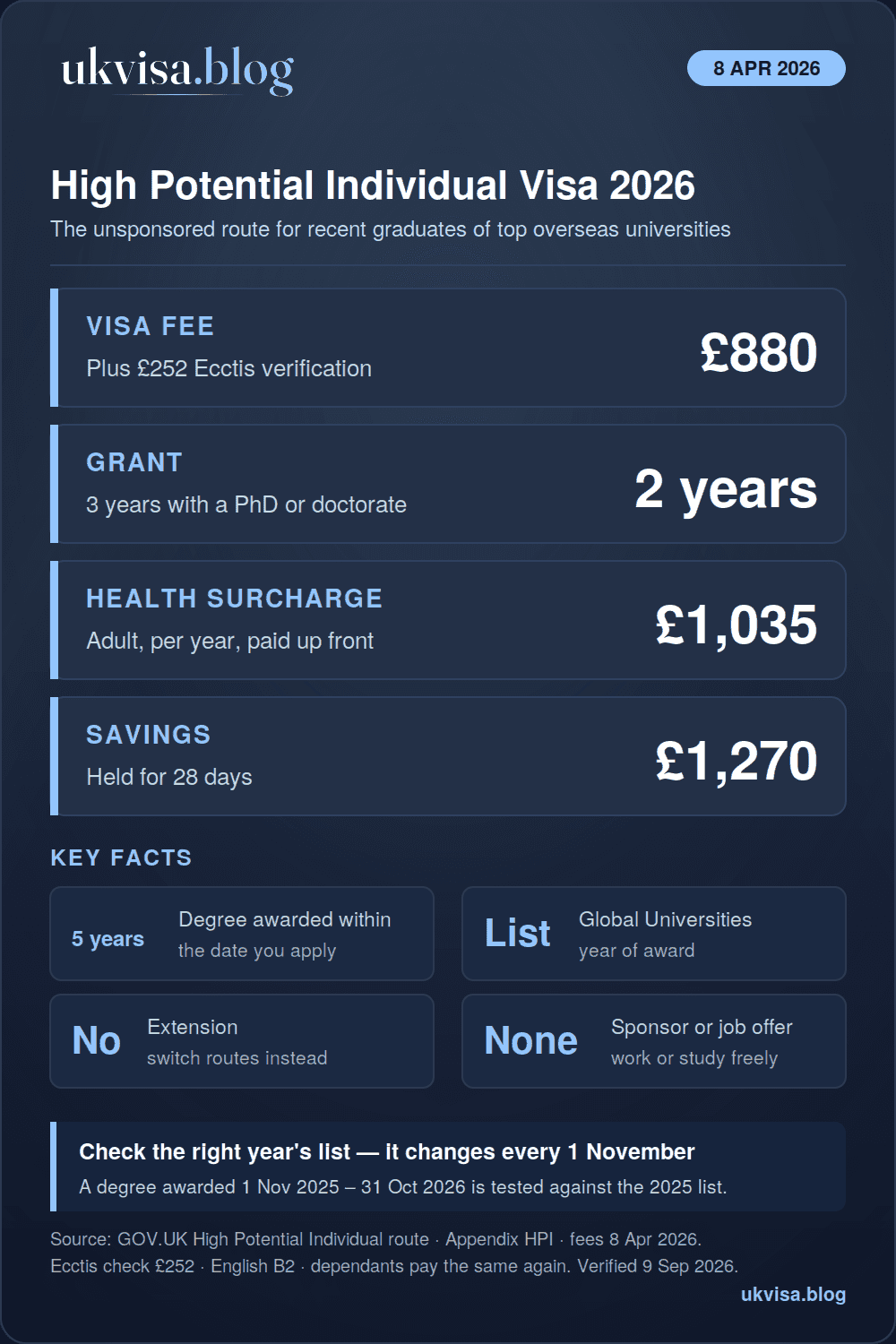
An unsponsored route for people awarded a degree by an eligible overseas university in the last five years. It runs for two years, or three with a PhD or other doctorate, and cannot be extended. You pay £880, £252 for the Ecctis check and £1,035 a year of health surcharge, and hold £1,270 in savings. No job offer is needed, and the route does not lead to settlement on its own.
The permission is deliberately open-ended in what it lets you do and deliberately closed at the end. You can work for any employer, be self-employed, take several jobs, do voluntary work and study alongside. You cannot work as a professional sportsperson or claim public funds, and when the grant runs out there is no extension — you switch to another route or you leave.
The Global Universities List
Eligibility turns on a published list of universities, not on a ranking you can look up yourself. The Home Office builds the list from world university rankings and republishes it each year, and the version that matters is the one covering the month and year your qualification was awarded — not the current one.
Which List Applies to You
| Qualification awarded between | List to check |
|---|---|
| 1 November 2025 and 31 October 2026 | Global Universities List 2025 |
| 1 November 2024 and 31 October 2025 | Global Universities List 2024 |
| 1 November 2023 and 31 October 2024 | Global Universities List 2023 |
| 1 November 2022 and 31 October 2023 | Global Universities List 2022 |
| 1 November 2021 and 31 October 2022 | Global Universities List 2021 |
| 1 November 2020 and 31 October 2021 | Global Universities List 2020 |
Source: GOV.UK, High Potential Individual visa — eligibility. Verified 22 August 2026.
HPI Visa University List 2025 — Qualifications Awarded 1 November 2025 to 31 October 2026 (80 universities)
| University | Country |
|---|---|
| Australian National University (ANU) | Australia |
| Boston University | United States |
| Brown University | United States |
| California Institute of Technology (Caltech) | United States |
| Carnegie Mellon University | United States |
| City University of Hong Kong (CityUHK) | Hong Kong |
| Columbia University | United States |
| Cornell University | United States |
| Delft University of Technology | Netherlands |
| Duke University | United States |
| EPFL – Ecole Polytechnique Fédérale de Lausanne | Switzerland |
| ETH Zurich | Switzerland |
| Fudan University | China |
| Harvard University | United States |
| Heidelberg University | Germany |
| Institut Polytechnique de Paris | France |
| Johns Hopkins University | United States |
| Karolinska Institute | Sweden |
| KTH Royal Institute of Technology | Sweden |
| KU Leuven | Belgium |
| Kyoto University | Japan |
| Lund University | Sweden |
| Massachusetts Institute of Technology (MIT) | United States |
| McGill University | Canada |
| Monash University | Australia |
| Nanjing University | China |
| Nanyang Technological University, Singapore (NTU Singapore) | Singapore |
| National University of Singapore (NUS) | Singapore |
| New York University (NYU) | United States |
| Northwestern University | United States |
| Peking University | China |
| Princeton University | United States |
| PSL University | France |
| Purdue University – West Lafayette | United States |
| Seoul National University | South Korea |
| Shanghai Jiao Tong University | China |
| Sorbonne University | France |
| Stanford University | United States |
| Technical University of Munich | Germany |
| The Chinese University of Hong Kong (CUHK) | Hong Kong |
| The Hong Kong Polytechnic University | Hong Kong |
| The Hong Kong University of Science and Technology | Hong Kong |
| The University of Hong Kong | Hong Kong |
| The University of Melbourne | Australia |
| The University of New South Wales (UNSW) | Australia |
| The University of Queensland | Australia |
| The University of Texas at Austin | United States |
| The University of Tokyo | Japan |
| Tsinghua University | China |
| Université Paris-Saclay | France |
| University of Amsterdam | Netherlands |
| University of Bonn | Germany |
| University of British Columbia | Canada |
| University of California, Berkeley (UCB) | United States |
| University of California, Irvine | United States |
| University of California, Los Angeles (UCLA) | United States |
| University of California, San Diego (UCSD) | United States |
| University of California, Santa Barbara | United States |
| University of Chicago | United States |
| University of Copenhagen | Denmark |
| University of Groningen | Netherlands |
| University of Illinois at Urbana-Champaign | United States |
| University of Michigan-Ann Arbor | United States |
| University of Minnesota, Twin Cities | United States |
| University of Munich (LMU Munich) | Germany |
| University of North Carolina at Chapel Hill | United States |
| University of Pennsylvania | United States |
| University of Science and Technology of China | China |
| University of Southern California | United States |
| University of Sydney | Australia |
| University of Toronto | Canada |
| University of Washington | United States |
| University of Wisconsin-Madison | United States |
| University of Zurich | Switzerland |
| Uppsala University | Sweden |
| Vanderbilt University | United States |
| Washington University in St Louis | United States |
| Yale University | United States |
| Yonsei University | South Korea |
| Zhejiang University | China |
Source: GOV.UK, High Potential Individual visa: global universities list 2025. Verified 31 August 2026.
Eighty institutions make the 2025 list, and the United States accounts for the largest share. If your degree was awarded before 1 November 2025, do not rely on this table — use the earlier list linked above for your award year, which may differ.
Because the lists change from year to year, an institution can be on one year's list and off the next. Check the list for your award year before you spend anything, and check it again against the exact awarding institution rather than a parent group or campus. UK universities are not on any of these lists by design — if you studied in the UK, the Graduate route is the equivalent permission.
HPI Visa Requirements
The route awards 70 points and none of them can be traded: 50 for a qualifying degree from a listed university, 10 for English at level B2, and 10 for the financial requirement. Miss any component and the application fails, however strong the rest of it looks.
- Qualification: equivalent to a UK bachelor's, postgraduate or doctoral degree, awarded by a university on the list for your award year.
- Recency: awarded in the last five years, measured to the date of application.
- Ecctis: an assessment confirming the qualification is valid and at the right level.
- English: level B2, proved by a UK school qualification, a UK degree, an English-taught overseas degree, or an approved test.
- Money: £1,270 in savings, unless you have been in the UK on a valid visa for at least 12 months.
- Scholarship consent: written approval where a government or international agency funded your fees and living costs in the last 12 months.
- Age: 18 or over, with no job offer required at any point.
You Cannot Have Used a Graduate Route Before
Caseworkers check your immigration history for previous permission as a High Potential Individual, on the Graduate route, or under the Doctorate Extension Scheme. Any of the three and the application is rejected as invalid — not refused after consideration, rejected before it starts. That makes the choice between finishing a UK degree and using the Graduate route, or applying as an HPI on an overseas degree, a one-off decision rather than a sequence.
HPI Visa Fees and Money
The application fee is £880 per person, and it does not change with the length of the grant or whether you apply from inside or outside the UK. The health surcharge is the larger cost: £1,035 a year for an adult and £776 a year for a child, all paid upfront.
What an HPI Application Costs
| Item | 2-year grant | 3-year grant, doctorate |
|---|---|---|
| Application fee | £880 | £880 |
| Ecctis assessment | £252 including VAT | £252 including VAT |
| Health surcharge, adult | £2,070 | £3,105 |
| Health surcharge, child under 18 | £1,552 | £2,328 |
| Savings you must hold | £1,270 | £1,270 |
Source: GOV.UK, High Potential Individual visa — how much it costs. Verified 22 August 2026.
A single applicant on a two-year grant therefore pays £3,202 before living costs, and £4,237 on a three-year doctoral grant. Dependants need their own money too: £285 for a partner, £315 for a first child and £200 for each additional child. The wider picture sits in the work-route fee table and the full fee schedule, with the levy itself explained in our health surcharge guide.
The Ecctis Check — and What It Does Not Do
Before you apply you must have Ecctis confirm that your qualification is genuine and sits at the right UK academic level. If you have been assessed by Ecctis before, you can reuse that certificate rather than paying again — a point worth checking if you used one for an earlier UK application.
The limit of that check is where applications go wrong. GOV.UK is explicit: Ecctis will not check whether your university is eligible. It looks at the qualification, not the institution's presence on the Global Universities List. Confirming the university yourself, against the list for your award year, is a separate step and entirely your responsibility.
How to Apply
You apply online, from inside or outside the UK, proving identity either through the UK Immigration: ID Check app or at an appointment. Decisions usually take three weeks from outside the UK and eight weeks inside it. Your document set follows the ordinary points-based pattern set out in our evidence checklist, and what happens after biometrics covers the wait.
Who Cannot Switch From Inside the UK
You cannot switch into this route if your current or last permission was as a Visitor, a Short-term Student, a Parent of a Child Student, a Seasonal Worker, a Domestic Worker in a Private Household, or outside the Immigration Rules. People in those categories must leave and apply from abroad. Students switching in must have completed the course their Confirmation of Acceptance for Studies was assigned for — or, on a PhD course, completed at least 24 months of it.
Proving English
B2 is the level, worth 10 of the 70 points under the caseworker guidance. A UK school qualification, a UK degree, an overseas degree taught in English with an Ecctis confirmation, or an approved test all satisfy it, and you may not need to prove it again if you did so in an earlier successful application. The cross-route detail is in our CEFR levels and exemptions guide.
The 8,000 Annual Cap
The route is capped at 8,000 applications in each year running from 1 November to 31 October. The caseworker guidance describes the cap as automated, so the system should stop applications once the ceiling is reached rather than taking fees for cases that cannot be granted.
Two clocks run at once. The cap year resets every 1 November, and your qualification stops being eligible five years to the day after it was awarded. If your award date falls late in a cap year, waiting for the next cycle can push you past the five-year limit entirely — there is no discretion for a qualification that has aged out. Anyone in the fourth or fifth year after graduation should apply early in a cycle rather than late.
Switching Before It Expires
The caseworker guidance states it plainly: High Potential Individual is not a route to settlement. Time on it does not build towards permanent settlement, and the permission cannot be extended. The two or three years are a window in which to qualify for something else, and the settlement clock starts only when you move.
Skilled Worker is the common exit and needs a licensed sponsor and a qualifying salary. The Scale-up route asks for six months of sponsored work and then releases you. Global Talent visa runs on endorsement rather than employment, and Innovator Founder on an endorsed business — both plausible if you spend the HPI period building the evidence rather than only working.
Sources: GOV.UK High Potential Individual route page on GOV.UK guidance; the Global Universities List; Appendix High Potential Individual; and the Home Office High Potential Individual caseworker guidance version 9.0, published 3 August 2026. Figures verified 22 August 2026.
Frequently Asked
Questions about the HPI Visa
Only those on the Home Office Global Universities List for the year your qualification was awarded. There are separate published lists covering each period from 1 November to 31 October, back to 2020, and they change from year to year. Check the list for your award year, not the current one, and check the exact awarding institution. No UK university appears on any of them.
£880 to apply, £252 including VAT for the Ecctis assessment, and the health surcharge at £1,035 a year for adults — £2,070 over two years or £3,105 over three. You also need £1,270 in savings, which is proved rather than paid. A two-year application therefore costs £3,202 in fees and charges before any dependants are added.
Two years for a bachelor's or master's-level qualification, three years for a PhD or other doctorate. It cannot be extended and cannot be granted twice. To stay beyond the grant you must switch into another route before it expires — Skilled Worker, Scale-up, Global Talent and Innovator Founder are the usual destinations.
No. Previous permission as a High Potential Individual, on the Graduate route, or under the Doctorate Extension Scheme means the application is rejected as invalid. The check is on your immigration history rather than on the qualification you are relying on now, so a second overseas degree does not reopen the route.
Level B2, worth 10 of the 70 mandatory points. You can prove it with a UK school qualification, a degree awarded by a UK institution, an overseas degree taught in English confirmed by Ecctis, or an approved English test. If you already proved English to that standard in an earlier successful UK application, you may not have to prove it again.
No, and this is the most common misunderstanding on the route. Ecctis confirms that your qualification is genuine and at the right UK academic level. It does not look at whether the awarding university is on the Global Universities List. That check is yours to make, against the list for your award year, before you commit to the application.
Yes — 8,000 applications in each year running from 1 November to 31 October. The caseworker guidance describes the cap as automated, so it should prevent applications being made once the ceiling is reached. If you are close to the five-year limit on your qualification, apply early in a cycle rather than risking a wait for the next one.
Usually, but not from every category. You cannot switch if your current or most recent permission was as a Visitor, Short-term Student, Parent of a Child Student, Seasonal Worker, Domestic Worker in a Private Household, or outside the Immigration Rules. Students must have completed the course their CAS was assigned for, or at least 24 months of a PhD course.