
A UK spouse visa interview is a credibility check, not an exam. Most applicants never face one. Those who do are asked about how they met, the wedding, the money and the plan — and are refused for contradicting their own paperwork far more often than for not knowing an answer.
UK Family Visas
Understanding UK Spouse Visa Interview Questions and Answers
What Is a UK Spouse Visa Interview?
A credibility assessment by UK Visas and Immigration to test whether the relationship is genuine and subsisting under Appendix FM. It usually runs 30 to 60 minutes in person, less by video or telephone, and covers relationship history, the marriage, the sponsor's finances and the couple's plans. It is requested case by case, not as a standard step.
The interview exists because documents can only show so much. Where a caseworker cannot resolve a doubt from the file, they can put questions directly instead of refusing on paper. It applies across the family routes — the UK Spouse visa, unmarried partner applications and the UK Fiancé visa.
What Is Actually Being Assessed
Six things: whether the relationship is real rather than arranged for immigration, whether the sponsor meets the financial requirement, whether the couple genuinely intend to live together here, whether the answers match the application, whether the immigration history holds up, and whether each partner knows the other's life in the ordinary way people do.
Interview Formats and When They Are Used
| Format | Typical length | When used |
|---|---|---|
| In person | 30 to 60 minutes | Complex cases and serious credibility concerns |
| Video call | 20 to 45 minutes | Overseas applicants and remote locations |
| Telephone | 15 to 30 minutes | Routine checks and single points of clarification |
Source: Appendix FM; relationship with a partner caseworker guidance version 7.0.
Who Gets Called for an Interview?
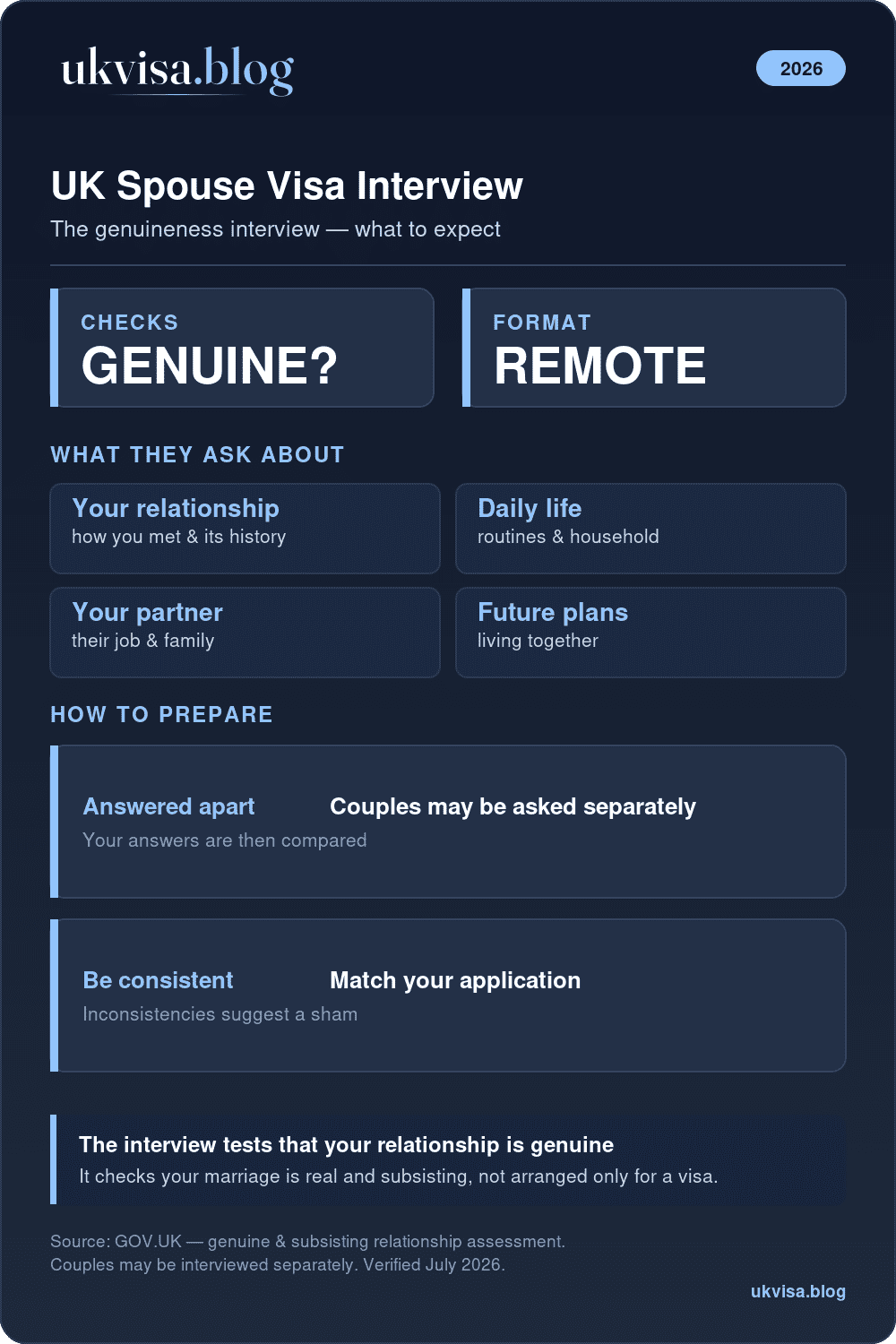
Most applicants do not. Straightforward files with strong documentary evidence are decided without any contact. Interviews are triggered by something specific in the case, and the triggers are predictable enough to prepare for.
- Short history: a relationship that formed recently, or a marriage soon after meeting.
- Little time in person: a relationship conducted mostly at a distance or online.
- Financial questions: unclear income documents or unexplained deposits.
- Previous sponsorship: the sponsor has sponsored another partner before.
- Immigration history: earlier refusals, overstaying or deception on record.
- Internal contradiction: the form, the statements and the documents disagree.
Note what is not on that list. Cultural difference, an age gap and a relationship that began online are not problems in themselves — the guidance tells caseworkers to allow for country conditions and customs. They attract questions only when combined with something else.
Relationship History Questions
These questions explore how the relationship began and how it has been sustained. Specificity is what carries them: dates, places, names and the small details of an ordinary shared life. Our guide to proving a genuine and subsisting relationship covers the documentary side.
How and When Did You Meet?
Give the month, the setting and the person or circumstance that brought you together, then how it progressed. "We met in March 2022 through a mutual friend at a university event in Manchester, exchanged numbers that evening, and had our first proper date two weeks later." That reads as memory. "We met through friends" reads as a summary of a story someone else wrote.
How Often Do You Communicate?
Describe the actual pattern rather than a frequency. Which app, roughly what time, who usually calls first, how you handle a time difference. The answer should sound like a habit, because that is what the officer is listening for and what your communication evidence will corroborate.
Have You Lived Together?
If you have, say where, for how long and how the household worked. If you have not, say so plainly and explain why — visa restrictions are a complete answer — then describe the extended visits instead. Never invent cohabitation that the documents will not support.
What Do You Know About Their Family?
Names, rough ages, what they do, where they live, and when you last saw or spoke to them. This question defeats people who have never been asked to say it aloud. Write the list out before the interview and read it back until it is comfortable.
Marriage and Wedding Questions
Wedding questions test presence and involvement rather than fact retention. Someone who was genuinely there remembers the room, the weather, who cried, what went wrong. Someone who was not remembers only the date on the certificate.
When and Where Did You Marry?
The date, the venue, the type of ceremony, roughly what time it started and how long it lasted. Then where you went afterwards. All of this is on documents you have already submitted, so an inconsistency here is expensive and entirely avoidable.
How Was the Proposal?
Month, place, circumstances, who else knew in advance. If there was no proposal in the conventional sense — many marriages are agreed rather than staged — say that. A plain description of how the decision was reached is more credible than a manufactured scene.
Who Came, and What Did They Wear?
Approximate guest numbers, which relatives on each side, who spoke, and what the two of you wore. Where a close relative could not attend, explain why and say how they took part — a video call during the ceremony, for instance — and submit the evidence for the absence.
The officer has your application form and your documents in front of them. Contradicting them is far more damaging than not remembering something. If you cannot recall a detail, say so — "I would have to check the certificate" is an ordinary human answer. A confident wrong date is not.
Financial and Employment Questions
These verify that the sponsor meets the spouse visa financial requirement of £29,000 — or £18,600 where the first application predates 11 April 2024 — and that the couple understand their own household finances.
What Does Your Sponsor Do, and What Do They Earn?
Employer, job title, how long they have been there, the gross annual salary, and the working pattern. Quote the gross figure, because that is what the rules use and what the payslips show. An applicant who quotes take-home pay creates a discrepancy out of nothing.
How Will You Support Yourselves?
Point to the income actually evidenced, add any savings, and say what you intend to do about work. The spouse visa carries full work rights, so an intention to find a job is a strength rather than an admission. Public funds are off limits and should be named as such.
Be Ready to Explain Anything Unusual in the Bank Statements
A large deposit, a gap in salary credits, a reimbursement that made one month look bigger. These are the questions that arrive without warning, because they come from a caseworker who has read the statements line by line and could not reconcile something. Prepare an explanation and, where possible, a document.
Living Arrangements and Future Plans
The intention to live together permanently is a requirement in its own right, and these questions test whether it has been thought about concretely rather than asserted.
Where Will You Live?
The address, the type of property, how many rooms, who else lives there and what the tenure is. This must match the evidence filed under the UK Spouse visa accommodation requirements, including the landlord's or owner's consent.
What Are Your Plans?
A realistic answer covers work, the immigration path and where you expect to be in a few years. Knowing the shape of the route helps: an extension at two and a half years, UK Spouse visa settlement at five, citizenship after that. Vagueness about your own plan invites doubt.
Daily Life
Questions about routine — who cooks, when each of you leaves for work, how weekends go — sound trivial and are among the most revealing. Answer from life rather than from a script, and accept that the two of you will not phrase things identically. Officers expect two accounts, not one rehearsed one.
Preparing for the Interview
Preparation means re-reading, not memorising. Go back through the application and the UK Spouse visa supporting documents you filed, so that every date and figure in the interview comes from the same place the officer is reading from.
- Re-read the form: the whole application, including the parts an adviser completed.
- Fix the dates: when you met, first visit, engagement, wedding, each trip.
- Know the money: employer, exact gross salary, role, and any unusual transaction.
- Compare notes: agree the shared facts with your partner, without scripting sentences.
- Organise papers: labelled copies you can find in seconds.
- Check the certificate: your UK Spouse visa English requirement details often come up.
- Practise aloud: written preparation alone does not transfer to speech.
On the Day
Answer the question asked and stop. Volunteering extra material opens lines of enquiry that were never going to be raised. Ask for clarification rather than guessing. If the officer corrects you, accept it calmly. Some nerves are ordinary and are read as such.
Interpreters
You may ask for a professional interpreter if you are not comfortable in English, arranged in advance through the visa application centre. A family member cannot interpret. Requesting one is not held against you, and it is far better than an answer mangled by a language gap.
After the Interview
No decision is given at the interview. The notes go back on the file and the application is decided on everything together. Overseas cases typically take eight to twelve weeks from that point and in-country cases around eight — see our guide to UK visa processing time.
If the Visa Is Granted
Overseas applicants receive a short-dated entry vignette in the passport and must travel within the dates printed on it. Status is then held digitally in the UKVI account as an eVisa; biometric residence permits are no longer issued. Entry clearance is granted for 33 months, after which the FLR(M) spouse visa extension can be made at any point before expiry.
If the Visa Is Refused
The refusal letter gives the reasons and often summarises the interview. Because a partner application under Appendix FM is a human rights claim, refusal carries a right of appeal to the First-tier Tribunal — 14 days from receipt of the decision inside the UK and 28 days outside, at £82 for a decision on the papers or £144 with a hearing.
There is no re-interview on the same application. Where credibility was the problem, a fresh application supported by better evidence usually beats an appeal; where the caseworker misread what you sent, the UK Spouse visa refusal appeal process is the route. Our reasons for spouse visa refusal guide sets out which is which, and absences count towards continuous residence for later applications.
Sources: Appendix FM of the Immigration Rules; Home Office guidance, relationship with a partner, version 7.0 of 8 October 2024; and the tribunal appeal pages on GOV.UK for deadlines and fees. Figures verified 22 August 2026.
Frequently Asked
Questions about the UK Spouse Visa Interview
No. Most straightforward applications with strong documentary evidence are decided without any interview. UKVI calls applicants where something specific needs testing — a short relationship history, little time spent in person, unclear finances, previous sponsorship or immigration problems, or contradictions inside the application. The decision to interview is a caseworker's, not a standard step.
Usually 30 to 60 minutes in person. Video interviews run 20 to 45 minutes and telephone checks 15 to 30. The length reflects how many questions the officer needs to settle their concern rather than the strength of the case, so a short interview is not a bad sign and a long one is not a verdict.
How and when you met, how the relationship developed, how you keep in contact, the wedding — date, venue, guests, what each of you wore — the sponsor's job and gross salary, where you will live, and what you plan to do in the UK. Questions about each other's families and daily routines are also standard, and are the ones people least expect.
Sometimes. UKVI may contact the UK-based partner separately about the relationship, the finances and the living arrangements. Agree the shared facts beforehand — dates, names, the wedding day — but do not rehearse sentences. Two honest accounts differ in wording and match in substance, which is exactly what an officer expects to hear.
£29,000 gross a year for applications made on or after 11 April 2024, or £18,600 where the first partner application predates that date and permission has been continuous. Quote the gross salary, not take-home pay, and be ready to explain any unusual movement in the bank statements — that is where the unscripted questions come from.
Yes, a professional one, arranged in advance through the visa application centre. A family member or friend cannot interpret. Asking for one is not treated as a weakness in the application; an answer distorted by a language gap is far more damaging than the request, and the officer may arrange an interpreter anyway if a barrier becomes obvious.
Say so. Not recalling a detail is ordinary and officers know it. What damages an application is a confident answer that contradicts the paperwork sitting in front of the officer, because that goes to credibility rather than memory. "I would need to check that" is a complete and perfectly acceptable answer.
Typically eight to twelve weeks for an overseas application after the interview, and around eight weeks in-country. Priority services, where offered, shorten the wait for an additional £500, or £1,000 for super priority. Times vary by post and season, and a case that needed an interview often sits at the longer end of the range.
Not on the same application — the assessment is made on the interview that took place. If the application is refused on credibility grounds you can appeal within 14 days from inside the UK or 28 days from outside, at £82 on the papers or £144 with a hearing, or make a fresh application. A fresh application with stronger evidence usually beats hoping for a second conversation.